Rio Grande Cichlid
Herichthys cyanoguttatus
The only cichlid native to the United States, holding the family's northern limit in the Rio Grande and Nueces drainages and now established well beyond it, wherever winter water stays warm enough.
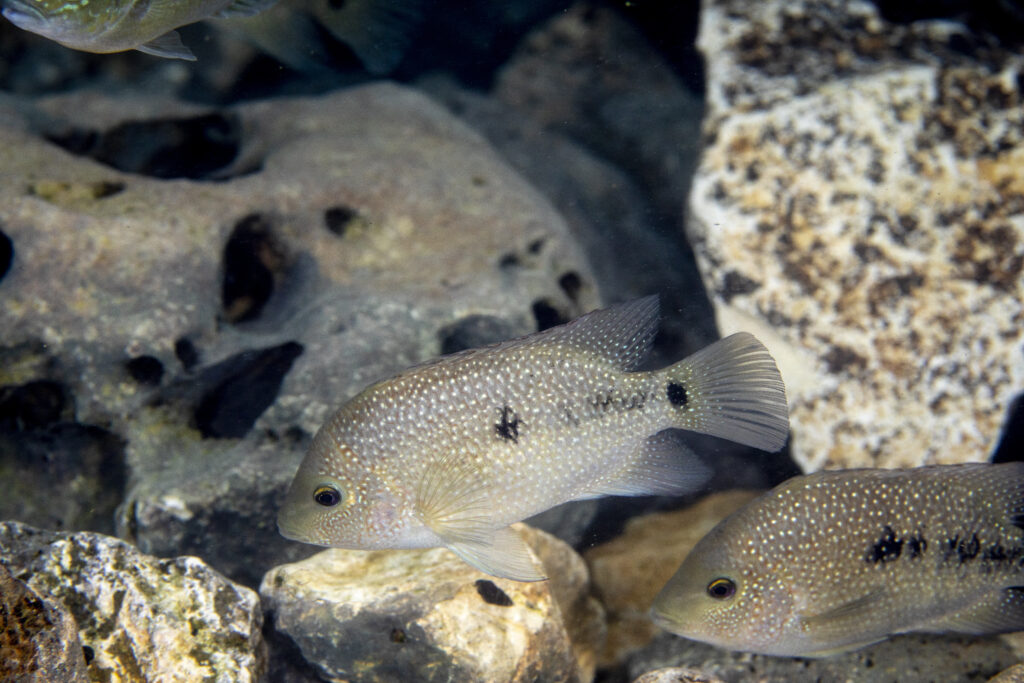
The only cichlid the United States has
Cichlidae is one of the largest and most studied families of vertebrates on earth — well over a thousand described species across Africa, South and Central America, and southern Asia. Exactly one of them is native to the United States, and it lives in Texas.
The Rio Grande cichlid reaches the northern edge of the family’s natural New World distribution in the Rio Grande and Nueces drainages. Everything else that swims in American water and looks like a cichlid — the tilapias of Florida canals, the peacock bass of south Florida, the jaguar guapote, the Midas cichlid — arrived by human agency. This fish did not. It is the single native representative of the family north of the Mexican border, and that alone makes it one of the more remarkable fish an angler can catch in North America.
It looks the part. The body is deep, laterally compressed, and heavily built through the shoulder, with the long spinous dorsal and the single nostril on each side that mark the family. The ground colour is dark olive to charcoal, and the flanks are scattered with iridescent blue-white to blue-green spots — the feature that gives the species its scientific name, cyanoguttatus, meaning blue-spotted. Breeding adults darken dramatically, developing a pale anterior half against a near-black posterior, and males develop a nuchal hump. A fish in spawning condition in clear Hill Country water is one of the more striking sights in American freshwater.
Native range
The U.S. Geological Survey describes the natural distribution as tropical and subtropical America — northeast Mexico and southern Texas, on the Atlantic Coast from the Río Conchos to the Río Grande basin, with the native United States range limited to the Nueces and Rio Grande drainages of Texas.
That is a small native footprint for a fish now found across much of central and eastern Texas, and the difference between the two is entirely the work of the twentieth century. It is worth being precise about the boundary: a Rio Grande cichlid in the Devils River or the lower Rio Grande is a native fish in its native water. The same species in the Guadalupe, the San Marcos, the Comal, or the Brazos is an introduced population, however long established and however welcome it may be locally.
How it got everywhere else
The expansion has a documented and partly official history. USGS records that the U.S. Fish and Wildlife Service’s San Marcos Fish Cultural Station released the species into the Guadalupe River drainage between 1928 and 1943. A federal hatchery, in other words, seeded the population that now supports much of the central Texas cichlid fishery.
Aquarium and aquaculture pathways did the rest. The species was cultured commercially as the “Texas bluespot” during the 1940s and 1950s, and some Florida populations resulted from flooding of resident fish farms; the Florida introduction is attributed to a private individual from Mulberry, Polk County, working from Texas stock around 1941.
The resulting distribution is broad. USGS records occurrences across 43 hydrologic units in Texas since 1929, 12 in Florida since 1942, six in Louisiana since 1977, and four in Arizona since 1969, with a Nevada population recorded from 1983 and now extirpated, plus scattered and largely historical records from Illinois, Nebraska, Ohio and Puerto Rico. The overall status is given as introduced and established or locally established in parts of Florida, Louisiana, and Texas.
Louisiana is the best-documented case of establishment outside the native range. The species has held on in the New Orleans area through severe disturbance, with research published in Southeastern Naturalist examining the establishment and post-hurricane survival of the non-native Rio Grande cichlid. The species has since reached considerably further: a 2026 report in Biological Invasions documents the first population of the Rio Grande cichlid reported in Taiwan.
Temperature is the limiting factor
The single variable that governs where this fish can live is winter minimum water temperature. It is a subtropical species at the extreme northern margin of a tropical family, and cold, not competition or food, sets its boundary.
This explains the geography of the introduced Texas range with unusual precision. The strongest and most persistent populations sit in spring-fed systems — the San Marcos, the Comal, the upper Guadalupe, the San Antonio — where large artesian springs discharge groundwater at a near-constant temperature year-round and buffer the river against winter cold. In surface-fed reaches subject to hard freezes, populations crash in severe winters and recolonise from thermal refuges afterwards. Where no refuge exists within reach, they simply disappear, which is the most likely explanation for the extirpated Nevada population.
The species’ thermal preferences and tolerances have been measured directly; a comparative study examined temperature preference and tolerance of the spotted tilapia and Rio Grande cichlid. Published lower lethal thresholds for the species vary with acclimation history, fish size, and exposure duration, and figures around 50°F are widely repeated for the point at which prolonged exposure becomes lethal — a value that should be treated as approximate rather than as a single established constant.
Salinity tolerance broadens the picture further: work in Marine and Freshwater Behaviour and Physiology has examined the effects of salinity on the survival and aggression of the invasive Rio Grande cichlid, which is relevant to its persistence in coastal Louisiana waters.
For anyone watching a live temperature reading on a Texas river, the practical translation is that Rio Grande cichlid activity tracks that number closely. The fish become sluggish and move to deeper or spring-influenced water as temperatures fall through the 50s, and they feed and spawn hardest through the 70s and low 80s.
Spawning and the reason it is aggressive
Rio Grande cichlids are substrate spawners with full biparental care, which is the behavioural key to everything an angler observes about them. A pair clears a nest site on rock, gravel, or a firm bottom, deposits adhesive eggs on the cleaned surface, and both parents then guard the eggs and the resulting fry — fanning, defending a territory, and driving off anything that approaches.
Spawning runs from spring into summer as water warms, generally from around the high 60s Fahrenheit upward, with multiple broods possible in a long warm season. Guarding pairs will attack objects considerably larger than themselves. USGS notes an incident of cichlids biting several swimmers in the Frio River, Texas, causing abrasions, most likely when the swimmers disturbed nests.
That aggression has measurable ecological consequences where the fish is introduced. A study in Journal of Ethology examined aggressive interactions between the invasive Rio Grande cichlid and native bluegill, and USGS summarises the competitive relationship as one in which cichlids compete with bluegill for food and spawning habitat while themselves showing reduced growth when bluegill are present — evidence of biotic resistance running in both directions rather than a one-way displacement.
Size, diet, and habitat
Rio Grande cichlids commonly run six to ten inches, with larger fish approaching a foot in productive spring-fed water. They are heavy for their length; a ten-inch cichlid is a thick, deep-bodied fish, not a slender one.
The diet is broad and benthic-leaning: aquatic insect larvae, snails, small crustaceans, worms, detritus, plant material, and small fish. The pharyngeal jaw apparatus characteristic of cichlids — a second set of jaws in the throat — allows them to process hard-shelled prey that many similarly sized sunfish handle poorly, and snails feature prominently where they are available.
Preferred habitat is warm, clear, moderately flowing water with abundant hard structure: limestone ledges, boulder gardens, undercut banks, submerged root wads, and the margins of spring runs. They are strongly associated with cover and rarely far from it. In the clear spring-fed rivers of central Texas they are often visible on the bottom, holding beside or over a nest site, which makes them one of the few American freshwater fish that can be reliably sight-fished in the same way as a bonefish on a flat.
On the water
Rio Grande cichlids are an established fly-rod quarry in Texas and have a devoted following on the Guadalupe, San Marcos, Colorado and Llano systems. They take small subsurface flies fished close to the bottom and near structure, and they strike hard for their size. Guarding fish will hit an intruding fly out of territorial aggression rather than hunger, which is why the fishing sharpens dramatically through the spawning months.
The fight is short, deep, and disproportionately strong. A deep-bodied fish turned sideways in current has considerable leverage, and cichlids use structure aggressively.
What gives the fish its real interest is the context. Within the Rio Grande and Nueces drainages, this is the northernmost naturally occurring cichlid on earth, a genuine native at the family’s continental limit. Elsewhere in Texas and beyond, it is a widely established introduction, largely seeded by a federal hatchery a century ago, whose distribution is drawn almost entirely by where groundwater keeps the winter water warm enough. Both facts are true, and knowing which one applies to a given river is the difference between catching a native fish and catching a naturalised one.
Where to catch it
12 waterways on GuidedFloats list rio grande cichlid. Each page carries live gauge readings, access notes, and the guides who fish it.
Texas 12
- Blanco River5 cfs
- Devils River
- Frio River62 cfs
- Greens Bayou
- Llano River449 cfs
- Medina River17 cfs
- Nueces River75 cfs
- Pecan Bayou13 cfs
- Pedernales River7 cfs
- San Marcos River89 cfs
- San Saba River91 cfs
- Whiteoak Bayou19 cfs
References
- Herichthys cyanoguttatus (Rio Grande cichlid) fact sheet - Nonindigenous Aquatic Species database — U.S. Geological Survey
- Establishment and Post-Hurricane Survival of the Non-Native Rio Grande Cichlid — Southeastern Naturalist
- From the neotropics to East Asia: first population of the Rio Grande cichlid reported in Taiwan — Biological Invasions
- Temperature preference and tolerance of the spotted tilapia and Rio Grande cichlid — Archiv fur Hydrobiologie
- Aggressive interactions between the invasive Rio Grande cichlid and native bluegill — Journal of Ethology
- Effects of salinity on the survival and aggression of the invasive Rio Grande cichlid — Marine and Freshwater Behaviour and Physiology
- Pathological Manifestations of Francisella orientalis in the Green Texas Cichlid — Animals (MDPI)
- Herichthys cyanoguttatus (Rio Grande cichlid) — CABI Compendium
- What Is Your Diagnosis? Rostral Lesions in a Rio Grande Cichlid — Veterinary Clinical Pathology
- Parachromis managuensis (jaguar guapote) fact sheet - introduced cichlids in the United States — U.S. Geological Survey
- IGFA World Records — International Game Fish Association