Claycut Bayou Fishing Guides
A quiet bottomland bayou on the northeast side of Baton Rouge, paddled and fished for bass, bream and catfish within minutes of the city.
Guides on the Claycut Bayou
Claimed profiles take booking requests. Unclaimed profiles are built from public records so the river is never empty; the guide can claim or remove one any time.
No guides listed yet
Guide or outfit this water? Create your profile. Listing is free, the commission is 10% or 7% with a premium profile, and premium profiles list first on this water.
About the Claycut Bayou
Claycut Bayou is a small, slow-moving bayou draining the wooded bottomland on the northeast side of Baton Rouge, running through a mix of residential neighborhoods, parkland and hardwood swamp before joining the larger drainage that feeds toward the Amite River. It is not a destination water in the sense that Toledo Bend or the Barataria marsh are, and no one travels across the state to fish it. What it offers instead is genuinely useful: a quiet, tree-shaded bayou with year-round fish in it, reachable in a few minutes from one of Louisiana’s largest cities, and small enough to fish thoroughly from a kayak or a canoe in an afternoon.
The fishing is classic Louisiana bottomland. Largemouth bass hold against cypress knees, laydowns and undercut clay banks, and they run smaller here than in the big reservoirs but are reliably present. Bluegill and redear sunfish are the mainstay through the warm months and are what most families come for, taken on crickets, worms and small popping bugs along the shaded margins. Channel catfish work the deeper bends, and the bayou holds its share of bowfin and spotted gar, which surprise anglers expecting nothing larger than a bass. Because the water is narrow and overhung, casting is close-quarters work and a short rod is worth more than a long one.
The gauge at Antioch Road reports stage and turbidity rather than discharge, and both readings matter more here than on a bigger water. A bayou this size responds to rainfall within hours: a heavy summer thunderstorm over Baton Rouge will lift the stage, push the turbidity up and put the fish off for a day or two, while a settled dry week drops it back to a clear, low, very fishable level. Check the stage trace before loading a boat, because access on a small bayou is as sensitive to water level as the fishing is, and the low end of the range can leave stretches too shallow to float.
This water needs a real photo
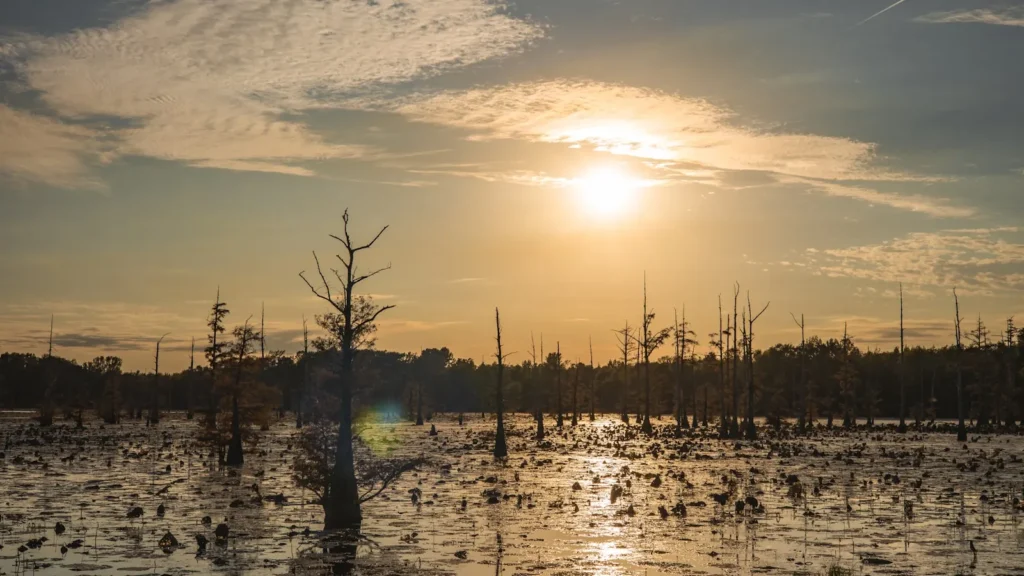
The photo at the top of this page is not Claycut Bayou.
It is a regional stand-in, honestly captioned but generic — we will not put a name to a river we cannot prove. Send us a photograph you took here and it replaces the stand-in, with your credit on it.
Add a photo of this water
Landscape, not fish — the water itself. Reviewed by hand before it appears. The first one published here earns the Pioneer badge.
Fished this water? Add a photo
Reviewed by hand before it appears. Pick the water, not the spot — we never publish exact locations.
Access
Baton Rouge - the city the bayou runs through, with the nearest services, lodging and tackle.
Antioch Road - the gauge crossing and the most convenient put-in on the middle bayou.
Greenwell Springs - a community upstream along the drainage with additional road access.
Central - the small city northeast of Baton Rouge that the bayou system drains.
Comite River - the larger river this drainage feeds, fished on the same trip by paddlers.
Amite River - the main stem downstream, with developed launches and bigger water.
Blackwater Conservation Area - protected bottomland nearby offering bank access and paddling.
Seasons
Spring: the strongest bass fishing of the year as water warms and fish move shallow, with bream beginning to bed by late spring.
Summer: bream and catfish dominate, fished in shade along the banks early and late while the middle of the day goes quiet.
Fall: cooling water brings bass back onto the wood, and clearer, lower flows make the bayou easy to paddle.
Winter: slow and low, with fish holding in the deepest bends and the best days coming during mild stretches between fronts.
From the water
No logged trips yet. Be the first to put this water on your map.
Log this water
Fished it or cleaned it? Log in or create a free account to log a trip with photos and earn the waterway badge.
Questions
What species can you catch on the Claycut Bayou?
Anglers target Black Crappie, Bluegill, Bowfin, Channel Catfish, Largemouth Bass, Redear Sunfish, Spotted Gar, Warmouth on the Claycut Bayou in Louisiana.
Where can you access the Claycut Bayou?
Baton Rouge - the city the bayou runs through, with the nearest services, lodging and tackle. Antioch Road - the gauge crossing and the most convenient put-in on the middle bayou. Greenwell Springs - a community upstream along the drainage with additional road access. Central - the small city northeast of Baton Rouge that the bayou system drains. Comite River - the larger river this drainage feeds, fished on the same trip by paddlers. Amite River - the main stem downstream, with developed launches and bigger water. Blackwater Conservation Area - protected bottomland nearby offering bank access...
When is the best time to fish the Claycut Bayou?
Spring: the strongest bass fishing of the year as water warms and fish move shallow, with bream beginning to bed by late spring. Summer: bream and catfish dominate, fished in shade along the banks early and late while the middle of the day goes quiet. Fall: cooling water brings bass back onto the wood, and clearer, lower flows make the bayou easy to paddle. Winter: slow and low, with fish holding in the deepest bends and the best days coming during mild stretches between fronts.
Where are the fishing regulations for the Claycut Bayou?
Regulations change by season and section. Read the current rules on the Louisiana agency site: https://www.wlf.louisiana.gov/page/fishing-regulations