Waterloo Creek Fishing Guides
Iowa's best known Driftless spring creek, a limestone valley at Dorchester with a strong wild brown trout population and long public stretches.
Guides on the Waterloo Creek
Claimed profiles take booking requests. Unclaimed profiles are built from public records so the river is never empty; the guide can claim or remove one any time.
No guides listed yet
Guide or outfit this water? Create your profile. Listing is free, the commission is 10% or 7% with a premium profile, and premium profiles list first on this water.
About the Waterloo Creek
Waterloo Creek runs south out of Minnesota into the far northeastern corner of Iowa and reaches the Upper Iowa River near Dorchester, and it is widely regarded as the finest trout stream in the state. It flows through the Driftless Area, the region the last glaciers missed, where the landscape is deeply cut valleys, limestone bluffs and hardwood hillsides rather than the flat till plain that covers the rest of Iowa.
The creek is spring-fed and limestone-influenced, and everything about the fishery follows from that. Groundwater emerging from the carbonate bedrock holds the water cold through an Iowa July and keeps it from freezing hard in January, and the dissolved minerals it carries support dense insect populations and rapid trout growth. The stream runs clear over gravel and rubble, with undercut banks, deep bends against the bluff bases and long riffles between.
Brown trout are the fish here and the population is wild and self-sustaining through the great majority of the stream, which is unusual and prized in a Midwestern context. The fish run better than the small-stream average and include genuinely large specimens in the deeper bend pools. Brook trout hold in some of the coldest spring-fed tributaries, and rainbows are stocked in the more heavily used public reaches.
Access is better here than the Driftless norm. Iowa’s Department of Natural Resources holds substantial public fishing easements along the valley, and the stretches are marked and walkable, which sidesteps the permission problem that limits so much of the region’s trout water. That said, the easements are interleaved with private ground and the boundaries matter, so it is worth carrying the state access map rather than assuming.
The fishing is technical. Clear spring water, wary wild browns and open meadow banks mean the trout usually see you before you see them. Fine tippet, an upstream approach, and staying low and off the skyline are more important than fly selection. Scud, sowbug and small mayfly imitations cover most of the year, and a late-season terrestrial fished tight to the grass edge is as reliable as anything on the creek.
This water needs a real photo
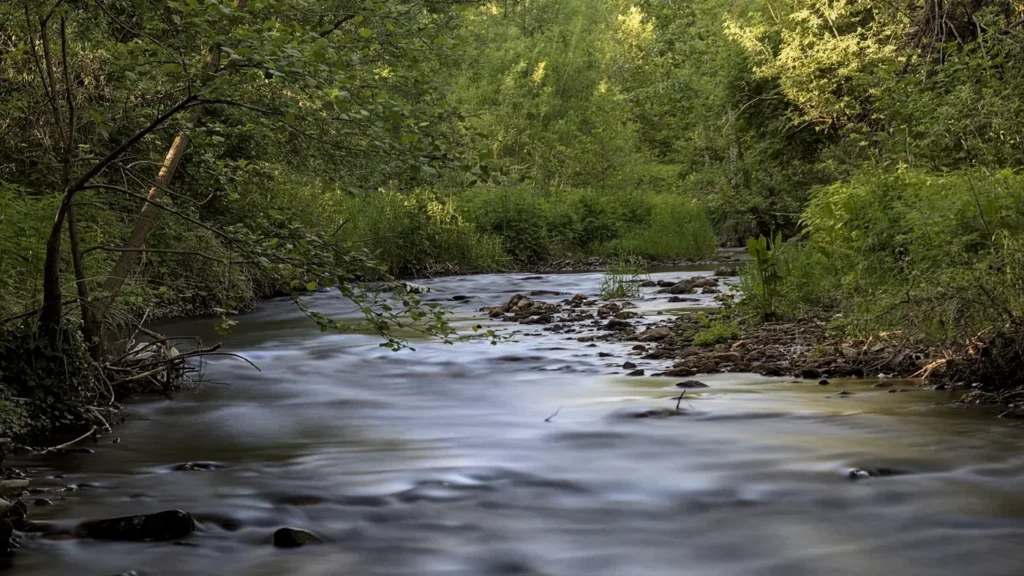
The photo at the top of this page is not Waterloo Creek.
It is a regional stand-in, honestly captioned but generic — we will not put a name to a river we cannot prove. Send us a photograph you took here and it replaces the stand-in, with your credit on it.
Add a photo of this water
Landscape, not fish — the water itself. Reviewed by hand before it appears. The first one published here earns the Pioneer badge.
Fished this water? Add a photo
Reviewed by hand before it appears. Pick the water, not the spot — we never publish exact locations.
Access
Dorchester - the village on the lower creek, the usual base and the gauge location.
Waterloo Creek public easements - the marked state fishing easements along the valley.
Upper Iowa River - the larger river receiving the creek, with its own smallmouth fishery.
Allamakee County roads - the gravel routes tracing the valley with repeated pullouts.
New Albin - the nearby community toward the Mississippi with services.
Bear Creek - the Minnesota continuation of the same drainage above the state line.
Yellow River State Forest - the large public tract south of the drainage.
Seasons
Spring: high cold water from snowmelt and rain, with the creek off color after storms.
Summer: stable spring-fed flows, heavy insect activity and the best dry fly fishing of the year.
Fall: cooling water, brown trout coloring for the spawn and quiet valleys after harvest.
Winter: the creek stays open at the springs, with a genuine catch-and-release winter season.
From the water
No logged trips yet. Be the first to put this water on your map.
Log this water
Fished it or cleaned it? Log in or create a free account to log a trip with photos and earn the waterway badge.
Questions
What species can you catch on the Waterloo Creek?
Anglers target Brook Trout, Brown Trout, Rainbow Trout on the Waterloo Creek in Iowa.
Where can you access the Waterloo Creek?
Dorchester - the village on the lower creek, the usual base and the gauge location. Waterloo Creek public easements - the marked state fishing easements along the valley. Upper Iowa River - the larger river receiving the creek, with its own smallmouth fishery. Allamakee County roads - the gravel routes tracing the valley with repeated pullouts. New Albin - the nearby community toward the Mississippi with services. Bear Creek - the Minnesota continuation of the same drainage above the state line. Yellow River State Forest - the large public tract south of the drainage.
When is the best time to fish the Waterloo Creek?
Spring: high cold water from snowmelt and rain, with the creek off color after storms. Summer: stable spring-fed flows, heavy insect activity and the best dry fly fishing of the year. Fall: cooling water, brown trout coloring for the spawn and quiet valleys after harvest. Winter: the creek stays open at the springs, with a genuine catch-and-release winter season.
Where are the fishing regulations for the Waterloo Creek?
Regulations change by season and section. Read the current rules on the Iowa agency site: https://www.iowadnr.gov/things-do/fishing/regulations-laws