Rainbow Trout
Oncorhynchus mykiss
Native to the Pacific slope and stocked almost everywhere else, the rainbow trout is globally secure while its wild steelhead runs are among the most imperilled fish in the country.
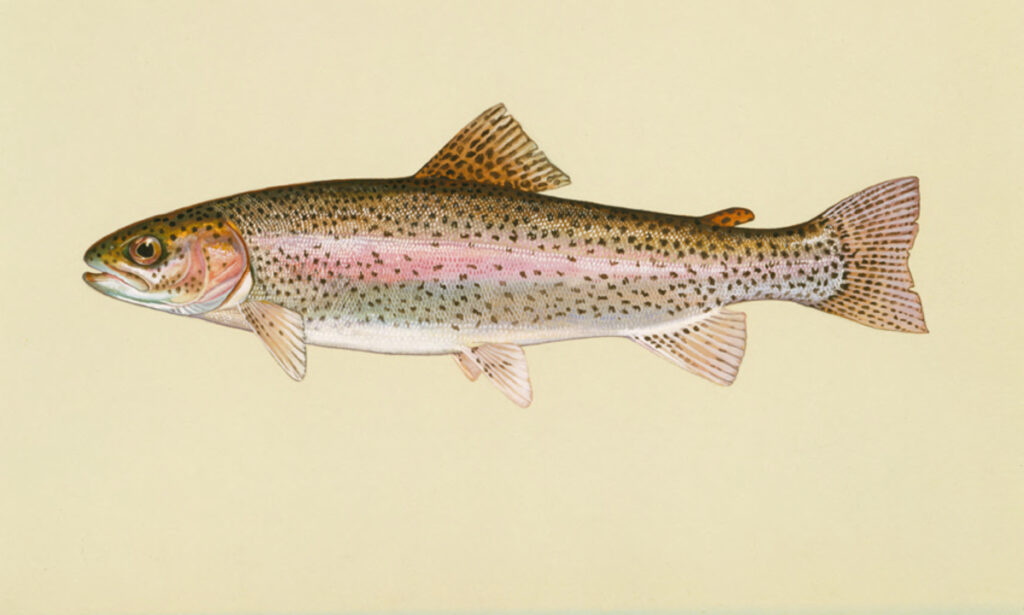
The rainbow trout is the most widely distributed trout on earth and, for a great many American anglers, the first fish they ever caught. It is native to the Pacific slope of North America, from the Kuskokwim River in Alaska south into Baja California, and inland through the Columbia and upper Mackenzie basins. Everywhere else it swims — which is to say nearly everywhere — it was put there, beginning in the 1870s, by hatchery crews, railroads, milk cans and volunteers with buckets.
That history produces a species with two faces. Globally, the rainbow trout is secure and abundant. Locally, its wild anadromous populations — the fish we call steelhead — include one run listed as endangered and ten listed as threatened under the Endangered Species Act. Both statements are true at once, and holding them together is the key to understanding this fish.
Identification
A rainbow trout is bluish-green to dark olive across the back, silver to white on the sides and belly, scattered with black spots over the body and fins, and marked along the flank with the reddish-pink stripe that gives the fish its name. The scales are small, the adipose fin is present, and the tail is distinctly forked with rows of small spots running along the rays. Idaho Fish and Game notes the white leading tips on the pelvic and anal fins, a character that holds up well in the hand.
Three confusions come up constantly on the water.
Against cutthroat trout, two characters are reliable. Cutthroat carry the red-orange slash beneath the lower jaw, though Washington’s identification guide warns it can be invisible on bright sea-run fish. The character that never fails is the tongue: cutthroat have basibranchial teeth on the tongue, and rainbow trout do not. Spotting helps too — cutthroat spots are larger and cluster toward the back and tail, while rainbow spots run more evenly from head to tail.
Against brown trout, look at the tail and the spots. Brown trout carry red or orange spots, often haloed in pale blue, on a square, largely unspotted tail. Rainbow spots are black, and the forked tail is spotted along the rays. Brown trout also lack the pink flank stripe entirely.
Against a cuttbow — a rainbow × cutthroat hybrid — field identification is genuinely unreliable, and it is worth saying so plainly. When Idaho Fish and Game researchers tested appearance against genetics in Palisades Creek, phenotype correctly identified 94% of Yellowstone cutthroat but only 79% of hybrids and 71% of rainbow trout. Hybrids usually show a muted, intermediate throat slash and mixed spotting, and siblings from one pairing can look markedly different from one another.
Range and distribution
The native range runs the Pacific slope from Alaska to northwestern Mexico, plus the upper Mackenzie drainage in Alberta and British Columbia, and Kamchatka in the Russian Far East. Introductions began in the late 1800s and have since reached, by the U.S. Geological Survey’s account, nearly every U.S. state, from Alabama to Hawaii and Puerto Rico. Michigan’s first fish came from California eggs imported in 1876 and released into the Au Sable River.
Two points of precision are worth keeping straight, because they are frequently garbled. Idaho lists rainbow trout as native — those are interior redband trout, a native inland form, not a contradiction of the continental range. And in much of the country the fish present are maintained entirely by stocking: Missouri’s Department of Conservation notes that most of its rainbow populations depend on continuous stocking, with only small self-sustaining pockets. In Texas, summer heat prevents reproduction almost everywhere, and the only self-sustaining population in the state lives in McKittrick Canyon in the Guadalupe Mountains.
Habitat and water temperature
Rainbow trout want cold, clear, well-oxygenated water over clean gravel. Beyond that generality, the thermal numbers are unusually well established, and they explain more about where fish will be on a given day than any other single variable.
Research by Bear, McMahon and Zale, published in the Transactions of the American Fisheries Society, put optimal growth at 13.1 °C (55.6 °F). Growth declines significantly by 20 °C (68 °F) and falls to almost nothing at 24 °C (75 °F). The ultimate upper incipient lethal temperature over a 60-day exposure is 24.3 °C (75.7 °F); in the same study, survival was essentially complete at 20 °C and 22 °C, fell to 73% at 24 °C, and reached 2% at 26 °C. A review by Richter and Kolmes adds the behavioural thresholds that matter to anglers: adult migration is blocked at 21–22 °C (70–72 °F), and fish actively avoid water above 22 °C (72 °F).
That last figure is the practical one. When a mainstem climbs past the low seventies, trout do not simply feed less — they leave. They stack into groundwater-fed tributaries, spring inflows and cold seeps, which is why late-summer fishing concentrates so sharply at tributary mouths. Oregon State University notes that Klamath Basin redband trout survive otherwise lethal summer conditions precisely this way.
One caution on applying these numbers: interior and desert redband trout tolerate considerably more heat and less oxygen than coastal rainbows. Do not carry coastal thermal figures into desert water.
Tailwaters invert the whole picture. Cold water drawn from the bottom of a reservoir creates rainbow habitat hundreds of miles outside anything the species could otherwise occupy — Lake Taneycomo below Table Rock, the tailraces below Canyon Reservoir in Texas, and dozens more.
Life history
Rainbow trout spawn in spring across most of their range, and this is the cleanest contrast with the fall-spawning brown and brook trout. The female digs a shallow redd in gravel riffles, eggs are deposited and fertilised, and the nest is covered over. Incubation runs about 21 days at 55 °F, though Michigan’s Department of Natural Resources gives a range of 20 to 100 days depending on temperature. Successful incubation requires gravel largely free of fine sediment, which is why sedimentation is such a direct lever on trout recruitment.
Regional variation is real. Missouri documents wild trout in Ozark spring branches spawning from late December into early February — constant-temperature spring systems and tailwaters shift timing away from the typical pattern entirely.
The species is polymorphic, and this is the single most useful fact about it. Resident rainbow trout and anadromous steelhead are the same species, not merely close relatives. Idaho Fish and Game puts it plainly: the two forms live in the same waters, interbreed, and their offspring can adopt either life history. A resident female can produce anadromous young; a steelhead can produce fish that never leave. Which path a given fish takes emerges from the interaction of its genetics, its growth and condition, and its environment.
Unlike most Pacific salmon, rainbow trout are iteroparous — they do not necessarily die after spawning. Steelhead may spawn one to five times, most often once or twice.
Steelhead: the anadromous form
Steelhead are born in fresh water, rear there for one to three years, then migrate to the ocean — or, in the Great Lakes, to open lake water — before returning to spawn. At sea they turn silver and grow far beyond what their stream-resident siblings ever will. Telling a returning steelhead from a large resident rainbow can require examining scales or the chemical signature of the otoliths.
The distinction anglers care most about is run timing, and it is not really about the calendar. It is about sexual maturity at the moment the fish enters the river.
Summer-run (stream-maturing) fish return between May and October while still sexually immature. They need months in fresh water to mature, overwintering in the river and spawning the following spring. Inland Columbia basin rivers are almost entirely summer-run. Because these fish hold for months, summer steelhead fishing is a holding-water fishery.
Winter-run (ocean-maturing) fish return from November through April with gonads already developed and spawn soon after arrival. They spawn nearer the ocean and travel shorter distances. Coastal streams are predominantly winter-run, and winter fishing tracks fresh arrivals rather than resident fish.
Run timing turns out to have a strong genetic basis. NOAA Fisheries’ 12-month finding on northern California summer-run steelhead identifies the Greb1L gene region as associated with the trait, yielding summer-run homozygotes, winter-run homozygotes and heterozygotes. NOAA concluded that summer-run fish do not constitute a separate distinct population segment, in part because siblings from a single mating can express different run types.
In the Snake and Columbia systems, managers overlay a further distinction on summer-run fish. A-run steelhead spend one year at sea and return at roughly 23 to 26 inches and 4 to 6 pounds, arriving June through August. B-run fish spend two years at sea and come back at 31 to 34 inches and 10 to 13 pounds, arriving from late August, with most bound for the Clearwater River.
Two other forms are worth knowing. Half-pounders return to fresh water after only a single summer at sea, overwinter, and go back out — a pattern documented in the Klamath basin. Kelts are post-spawn survivors, and their persistence is one measure of a healthy population.
Great Lakes steelhead are not anadromous in the strict sense but behave identically. They enter spawning streams from late October through early May, with fall-run fish spawning in March and spring-run fish in April, and feed in the open lakes chiefly on alewives and rainbow smelt.
Diet
Fry begin on zooplankton and water fleas. Stream juveniles move onto drifting aquatic insects — caddisflies, mayflies and midges — and larger stream fish add terrestrial insects, snails and small fish. In lakes and the Great Lakes the shift is decisive: adult steelhead feed primarily on baitfish, and Michigan’s DNR notes they work surface scumlines where thermal bars concentrate food. Ocean fish take fish, eggs, crustaceans and molluscs.
Angling
Almost everything about how rainbow trout are fished follows from temperature and forage. Optimal growth near 55 to 59 °F, measurable loss by 68 °F, and active avoidance above 72 °F mean that a live gauge reading maps directly onto where fish will be holding — and, in a hot August, onto the cold tributary mouths they have retreated into.
Stream fish keyed to drifting caddis, mayflies and midges are the reason drift presentations and matched imitations dominate river fishing. Lake and Great Lakes fish keyed to alewife and smelt are the reason presentation changes so completely on open water.
For steelhead, method follows water condition. Oregon’s Department of Fish and Wildlife describes plunking — a stationary presentation near the bottom — as productive specifically when water is high and fish hold in soft water near the bank. At normal flows fish spread into the main current, and presentations that drift at current speed near the bottom take over. Swung flies on single- or double-handed rods, bobber-and-jig, drift fishing and diving plugs all trace back to the same problem: putting something in front of a fish that has stopped feeding in earnest.
It is worth knowing where the giants actually come from. The IGFA record table for this species is dominated not by classic river habitat but by reservoirs and canals — Lake Diefenbaker in Saskatchewan, the Tekapo and Ohau canals in New Zealand, Argentina’s Lake Strobel.
Conservation
The rainbow trout’s conservation story runs in two directions, because the species is both protected and a threat.
Where it is native and anadromous, it is in trouble. NOAA Fisheries lists the Southern California steelhead DPS as endangered and ten further DPSs as threatened. Snake River steelhead must pass up to eight mainstem dams, against three or four for mid-Columbia fish, producing consistently lower life-cycle survival. The current five-year geometric mean abundance of natural-origin steelhead passing Lower Granite Dam is 12,605 fish; the Clearwater drainage alone may historically have produced 40,000 to 60,000 adults.
Where it has been introduced, it is frequently the problem. The USGS records that hybridization with rainbow trout has been a major factor in the decline of native cutthroat trout across the Lahontan drainage and the Rocky Mountain rivers, and links the virtual extinction of the Alvord cutthroat to rainbow introduction. The thermal asymmetry compounds it: rainbow trout tolerate 4.7 °C more heat than westslope cutthroat, so a warming stream steadily favours the invader over the native.
Hatchery propagation carries its own risks, which NOAA states directly: genetic effects, reduced fitness, altered life-history traits, competition, amplified predation and disease transfer. Mainstem dams can worsen straying of hatchery fish into wild spawning areas.
Rainbow trout are also the salmonid most susceptible to whirling disease, caused by the parasite Myxobolus cerebralis, which invades the head and spinal cartilage of young fish. First detected in the United States in 1958 and now reported in more than twenty states, it produced losses of up to 90% of wild rainbow trout in several Colorado and Montana streams during the 1993–94 outbreaks, including a 90% reduction in the Madison River population.
Where to catch it
518 waterways on GuidedFloats list rainbow trout, across 44 states. Each page carries live gauge readings, access notes, and the guides who fish it.
Alabama 1
- Sipsey Fork8 cfs
Alaska 13
- Bradley River below Bradley Lake Dam1 cfs
- Cooper Creek29 cfs
- Copper River51,400 cfs
- Gulkana River1,040 cfs
- Kenai River4,270 cfs
- Kvichak River28,000 cfs
- Lemon Creek
- Situk River611 cfs
- Sixmile Creek665 cfs
- Staney Creek1,290 cfs
- Stikine River81,500 cfs
- Taku River20,500 cfs
- Talkeetna River3,550 cfs
Arizona 17
- Black River167 cfs
- Blue Ridge Reservoir
- Bright Angel Creek19 cfs
- Chevelon Creek55 cfs
- Colorado River (Lees Ferry)7,900 cfs
- Del Rio Springs1 cfs
- East Verde River77 cfs
- Lake Mohave
- Oak Creek53 cfs
- Salt River511 cfs
- Salt River below Stewart Mountain Dam42 cfs
- Show Low Creek
- Tonto Creek73 cfs
- Verde River841 cfs
- West Clear Creek49 cfs
- West Fork Oak Creek3 cfs
- Wet Beaver Creek9 cfs
Arkansas 8
- Caddo River23 cfs
- Lake Catherine
- Little Red River231 cfs
- Mammoth Spring
- South Fork Spring River4 cfs
- Spring River299 cfs
- Spring River
- White River1,720 cfs
California 31
- American River1,500 cfs
- Carmel River
- Cosumnes River61 cfs
- Eel River82 cfs
- Hat Creek120 cfs
- Kern River
- Klamath River1,250 cfs
- Little Truckee River below Boca Dam207 cfs
- Lower Sacramento River5,970 cfs
- Merced River14 cfs
- Nacimiento River62 cfs
- Navarro River4 cfs
- Piru Creek401 cfs
- Pit River30 cfs
- Prosser Creek72 cfs
- Putah Creek141 cfs
- Russian River156 cfs
- Salinas River
- San Joaquin River392 cfs
- Santa Ynez River
- Scott River10 cfs
- Sespe Creek1 cfs
- Shasta River123 cfs
- Smith River188 cfs
- South Fork Eel River14 cfs
- Stanislaus River849 cfs
- Trinity River369 cfs
- Tuolumne River1,150 cfs
- Upper Sacramento River211 cfs
- Van Duzen River7 cfs
- Yuba River551 cfs
Colorado 22
- Animas River154 cfs
- Arkansas River
- Blue River below Green Mountain Reservoir186 cfs
- Boulder Creek12 cfs
- Cache la Poudre River26 cfs
- Clear Creek57 cfs
- Colorado River660 cfs
- Dolores River315 cfs
- Eagle River7 cfs
- East River64 cfs
- Fryingpan River76 cfs
- Gunnison River213 cfs
- Pueblo Reservoir
- Purgatoire River below Trinidad Lake
- Ridgway Reservoir
- Roaring Fork River506 cfs
- South Platte River105 cfs
- Taylor Park Reservoir
- Taylor River42 cfs
- Trinidad Lake
- Uncompahgre River65 cfs
- Yampa River117 cfs
Connecticut 9
- Farmington River594 cfs
- Housatonic River879 cfs
- Natchaug River123 cfs
- Naugatuck River264 cfs
- Quinebaug River912 cfs
- Salmon Creek22 cfs
- Salmon River (Connecticut)86 cfs
- Saugatuck River11 cfs
- West Branch Farmington River151 cfs
Delaware 3
- Brandywine Creek276 cfs
- Red Clay Creek38 cfs
- White Clay Creek55 cfs
Georgia 6
- Chattahoochee River613 cfs
- Chattooga River182 cfs
- Etowah River190 cfs
- Soque River67 cfs
- Tallulah River54 cfs
- Toccoa River163 cfs
Hawaii 1
- Kawaikoi Stream53 cfs
Idaho 29
- Anderson Ranch Reservoir
- Big Lost River102 cfs
- Big Wood River54 cfs
- Bruneau River44 cfs
- C.J. Strike Reservoir
- Clearwater River3,240 cfs
- Coeur d'Alene Lake
- Coeur d'Alene River273 cfs
- Henrys Fork94 cfs
- Henrys Lake
- Kootenai River4,410 cfs
- Lake Pend Oreille
- Lochsa River359 cfs
- Mackay Reservoir
- Medicine Lodge Creek26 cfs
- Payette Lake
- Payette River803 cfs
- Priest River1,340 cfs
- Salmon River1,100 cfs
- Selway River517 cfs
- Silver Creek90 cfs
- South Fork Boise River300 cfs
- South Fork Snake River3,050 cfs
- St. Joe River341 cfs
- Teton River406 cfs
- Thousand Springs Creek5 cfs
- Valley Creek91 cfs
- Warm Springs Creek29 cfs
- Warm Springs Creek40 cfs
Indiana 1
- Blue River14 cfs
Iowa 3
- Bloody Run Creek25 cfs
- Waterloo Creek
- Yellow River215 cfs
Kentucky 2
Maine 2
- Androscoggin River2,180 cfs
- Kennebec River1,700 cfs
Maryland 10
- Big Pipe Creek40 cfs
- Conococheague Creek237 cfs
- Deer Creek47 cfs
- Gunpowder Falls77 cfs
- Licking Creek67 cfs
- Patuxent River28 cfs
- Savage River74 cfs
- Town Creek21 cfs
- Wills Creek98 cfs
- Youghiogheny River (Maryland)383 cfs
Massachusetts 7
- Deerfield River932 cfs
- Millers River322 cfs
- Quinebaug River80 cfs
- Swift River126 cfs
- Upper Mystic Lake
- West River
- Westfield River574 cfs
Michigan 9
- Au Sable River1,280 cfs
- Boardman River117 cfs
- Higgins Lake
- Jordan River184 cfs
- Manistee River1,160 cfs
- Muskegon River1,370 cfs
- Pere Marquette River611 cfs
- Presque Isle River84 cfs
- Rifle River338 cfs
Minnesota 4
- Root River983 cfs
- Rush Creek
- South Fork Root River201 cfs
- Straight River35 cfs
Missouri 24
- Barren Fork Creek
- Bennett Spring101 cfs
- Big Spring272 cfs
- Blue Springs Creek
- Bryant Creek140 cfs
- Crane Creek
- Current River143 cfs
- Current River at Montauk61 cfs
- East Fork Black River below Taum Sauk Reservoir7 cfs
- Eleven Point River271 cfs
- Greer Spring197 cfs
- Huzzah Creek62 cfs
- Jacks Fork147 cfs
- Little North Fork River
- Little Piney Creek61 cfs
- Meramec River174 cfs
- Mill Creek
- Niangua River26 cfs
- North Fork of the White River304 cfs
- Pearson Creek6 cfs
- Roaring River15 cfs
- Roubidoux Creek
- Spring Creek
- Spring River78 cfs
Montana 21
- Beaverhead River200 cfs
- Big Hole River471 cfs
- Big Spring Creek152 cfs
- Bighorn River1,600 cfs
- Bitterroot River840 cfs
- Blackfoot River600 cfs
- Clark Fork1,470 cfs
- Gallatin River360 cfs
- Hebgen Lake
- Hungry Horse Reservoir
- Jefferson River1,070 cfs
- Lake Como
- Madison River779 cfs
- Madison River below Hebgen Lake707 cfs
- Missouri River2,980 cfs
- Rock Creek270 cfs
- Ruby River52 cfs
- Smith River191 cfs
- Stillwater River414 cfs
- Warm Springs Creek59 cfs
- Yellowstone River1,620 cfs
Nebraska 6
- Dismal River255 cfs
- Lodgepole Creek1 cfs
- Long Pine Creek146 cfs
- Niobrara River543 cfs
- North Loup River382 cfs
- Spring Creek
Nevada 16
- East Fork Carson River49 cfs
- East Walker River111 cfs
- Humboldt River21 cfs
- Lamoille Creek3 cfs
- Lehman Creek4 cfs
- Little Washoe Lake
- Marlette Lake
- Rye Patch Reservoir
- South Fork Reservoir
- Steptoe Creek2 cfs
- Topaz Lake
- Truckee River323 cfs
- Truckee River below Derby Dam264 cfs
- Walker River27 cfs
- Weber Reservoir
- Wild Horse Reservoir
New Hampshire 20
- Ammonoosuc River124 cfs
- Androscoggin River (New Hampshire)1,430 cfs
- Ashuelot River433 cfs
- Ashuelot River below Surry Mountain Dam129 cfs
- Baker River97 cfs
- Bearcamp River46 cfs
- Beaver Brook25 cfs
- Cold River31 cfs
- Connecticut River (New Hampshire)467 cfs
- Contoocook River98 cfs
- Contoocook River below Hopkinton Dam472 cfs
- Diamond River263 cfs
- East Branch Pemigewasset River169 cfs
- Nubanusit Brook below MacDowell Dam
- Peabody River74 cfs
- Pemigewasset River573 cfs
- Piscataquog River34 cfs
- Saco River411 cfs
- Upper Ammonoosuc River330 cfs
- Winnicut River41 cfs
New Jersey 4
- Musconetcong River154 cfs
- Raritan River359 cfs
- Rockaway River75 cfs
- South Branch Raritan River52 cfs
New Mexico 15
- Blue Springs6 cfs
- Bluewater Lake
- Cimarron River2 cfs
- Costilla Creek
- Eagle Nest Lake
- Gila River146 cfs
- Pecos River116 cfs
- Rio Chama208 cfs
- Rio Chama below Abiquiu Dam182 cfs
- Rio Chama below El Vado Dam153 cfs
- Rio Grande186 cfs
- Rio Nambe11 cfs
- Rio Pueblo de Taos41 cfs
- San Juan River272 cfs
- Santa Rosa Lake
New York 18
- Ausable River688 cfs
- Battenkill318 cfs
- Beaverkill314 cfs
- Black River4,670 cfs
- Cattaraugus Creek205 cfs
- Esopus Creek808 cfs
- Genesee River1,330 cfs
- Mohawk River140 cfs
- Mongaup River123 cfs
- Neversink River180 cfs
- Oatka Creek46 cfs
- Owasco Lake
- Pepacton Reservoir
- Salmon River236 cfs
- Saranac River1,350 cfs
- Schoharie Creek
- West Branch Delaware River331 cfs
- Willowemoc Creek82 cfs
North Carolina 14
- Cataloochee Creek42 cfs
- Catawba River2,930 cfs
- Cheoah River99 cfs
- Davidson River63 cfs
- French Broad River1,050 cfs
- Linville River63 cfs
- Little Tennessee River117 cfs
- Nantahala River87 cfs
- South Toe River114 cfs
- Tuckasegee River614 cfs
- Valley River66 cfs
- Watauga River106 cfs
- Wilson Creek
- Yadkin River below W. Kerr Scott Dam946 cfs
Ohio 4
- Chagrin River148 cfs
- Cuyahoga River372 cfs
- Mad River221 cfs
- Rocky River125 cfs
Oklahoma 4
- Blue River41 cfs
- Honey Creek33 cfs
- Illinois River394 cfs
- Lower Mountain Fork River158 cfs
Oregon 20
- Clackamas River607 cfs
- Deschutes River3,950 cfs
- Diamond Lake
- Grande Ronde River591 cfs
- John Day River190 cfs
- Lake Billy Chinook
- McKenzie River1,710 cfs
- Metolius River1,190 cfs
- Nehalem River93 cfs
- North Santiam River1,320 cfs
- North Umpqua River736 cfs
- Owyhee River31 cfs
- Rogue River1,150 cfs
- Sandy River278 cfs
- Siuslaw River Estuary
- South Santiam River1,150 cfs
- Umpqua River1,000 cfs
- Upper Klamath Lake
- Willamette River6,730 cfs
- Williamson River
Pennsylvania 31
- Allegheny River below Kinzua Dam2,310 cfs
- Aquashicola Creek57 cfs
- Aughwick Creek66 cfs
- Bald Eagle Creek298 cfs
- Big Spring Run1 cfs
- Brodhead Creek71 cfs
- Buck Run17 cfs
- Clarion River513 cfs
- Codorus Creek10 cfs
- Fishing Creek75 cfs
- Jordan Creek64 cfs
- Kettle Creek43 cfs
- Kishacoquillas Creek192 cfs
- Lackawaxen River199 cfs
- Lehigh River1,250 cfs
- Lehigh River below Francis E. Walter Dam700 cfs
- Little Juniata River190 cfs
- Little Lehigh Creek5 cfs
- Loyalsock Creek271 cfs
- Monocacy Creek26 cfs
- Penns Creek302 cfs
- Pine Creek145 cfs
- Pohopoco Creek97 cfs
- Shohola Creek44 cfs
- Spring Creek56 cfs
- Spring Creek4 cfs
- Spring Creek81 cfs
- Tobyhanna Creek180 cfs
- Tulpehocken Creek203 cfs
- Yellow Breeches Creek153 cfs
- Youghiogheny River2,260 cfs
Rhode Island 11
- Beaver River28 cfs
- Blackstone River498 cfs
- Branch River109 cfs
- Chipuxet River32 cfs
- Nipmuc River12 cfs
- Pawcatuck River602 cfs
- Pawtuxet River267 cfs
- Peeptoad Brook2 cfs
- Usquepaug River98 cfs
- Wood River142 cfs
- Woonasquatucket River42 cfs
South Carolina 2
- North Saluda River6 cfs
- Saluda River2,440 cfs
South Dakota 13
- Battle Creek
- Castle Creek
- Deerfield Reservoir
- Elk Creek
- Fall River25 cfs
- Grace Coolidge Creek1 cfs
- Little Spearfish Creek12 cfs
- Pactola Reservoir
- Rapid Creek25 cfs
- Rapid Creek below Pactola Dam17 cfs
- Spearfish Creek36 cfs
- Spring Creek
- Whitewood Creek5 cfs
Tennessee 4
- Big Limestone Creek28 cfs
- Little River67 cfs
- Nolichucky River below Nolichucky Dam959 cfs
- Watauga River413 cfs
Texas 1
- Guadalupe River103 cfs
Utah 16
- Ashley Creek168 cfs
- Big Brush Creek45 cfs
- Blacksmith Fork53 cfs
- Chalk Creek14 cfs
- Duchesne River108 cfs
- Green River2,300 cfs
- Lake Fork River7 cfs
- Logan River92 cfs
- North Fork Virgin River51 cfs
- Ogden River below Pineview Reservoir17 cfs
- Price River9 cfs
- Provo River164 cfs
- Santa Clara River below Winsor Dam1 cfs
- South Fork Ogden River8 cfs
- Strawberry River31 cfs
- Weber River64 cfs
Vermont 17
- Ayers Brook15 cfs
- Batten Kill
- Lamoille River255 cfs
- Lewis Creek36 cfs
- Missisquoi River1,070 cfs
- Moose River94 cfs
- Ompompanoosuc River63 cfs
- Ottauquechee River35 cfs
- Otter Creek712 cfs
- Passumpsic River402 cfs
- Ranch Brook8 cfs
- Waterbury Reservoir
- Wells River69 cfs
- West River311 cfs
- White River (Vermont)562 cfs
- Winooski River1,020 cfs
- Wrightsville Reservoir
Virginia 12
- Bullpasture River81 cfs
- Calfpasture River59 cfs
- Cedar Creek33 cfs
- Cowpasture River308 cfs
- Jackson River200 cfs
- Linville Creek27 cfs
- Maury River112 cfs
- North River192 cfs
- Passage Creek17 cfs
- Pedlar River6 cfs
- Pound River below Flannagan Dam
- Smith Creek39 cfs
Washington 20
- Baker Lake
- Bogachiel River171 cfs
- Chehalis River27 cfs
- Cowlitz River4,040 cfs
- Dungeness River62 cfs
- Hoh River555 cfs
- Humptulips River169 cfs
- Klickitat River603 cfs
- Lake Chelan
- Lake Quinault
- Lake Tapps
- Methow River317 cfs
- Queets River684 cfs
- Skagit River6,370 cfs
- Skykomish River537 cfs
- Snoqualmie River687 cfs
- Spokane River1,600 cfs
- Sultan River185 cfs
- Wenatchee River333 cfs
- Yakima River718 cfs
West Virginia 16
- Back Creek32 cfs
- Big Sandy Creek238 cfs
- Cheat River3,320 cfs
- Cranberry River329 cfs
- Gauley River1,940 cfs
- Gauley River below Summersville Dam
- Greenbrier River1,540 cfs
- Howard Creek
- Laurel Creek115 cfs
- Patterson Creek80 cfs
- Shavers Fork215 cfs
- South Branch Potomac River1,530 cfs
- Tygart Valley River613 cfs
- Warm Springs Run3 cfs
- West Fork River below Stonewall Jackson Dam375 cfs
- Williams River482 cfs
Wisconsin 12
- Black Earth Creek41 cfs
- Bois Brule River113 cfs
- Brule River526 cfs
- Chaffee Creek12 cfs
- Devils Lake
- Dorn Creek3 cfs
- Eau Galle River16 cfs
- Namekagon River43 cfs
- Peshtigo River243 cfs
- Tenmile Creek48 cfs
- White Creek2 cfs
- Whittlesey Creek18 cfs
Wyoming 19
- Bear River
- Big Sandy Reservoir
- Boulder Creek below Boulder Lake13 cfs
- Encampment River102 cfs
- Firehole River38 cfs
- Fish Creek146 cfs
- Gibbon River72 cfs
- Green River (Wyoming)605 cfs
- Lamar River149 cfs
- Middle Fork Powder River5 cfs
- North Brush Creek10 cfs
- North Fork Shoshone River213 cfs
- North Platte River306 cfs
- North Platte River below Whalen Diversion Dam14 cfs
- Pacific Creek52 cfs
- Salt River423 cfs
- Shoshone River680 cfs
- Snake River1,040 cfs
- Wind River440 cfs
References
- Rainbow Trout (Oncorhynchus mykiss) - Species Profile — USGS Nonindigenous Aquatic Species
- Steelhead — NOAA Fisheries
- Steelhead: Conservation and Management — NOAA Fisheries
- Comparative Thermal Requirements of Westslope Cutthroat Trout and Rainbow Trout (Bear, McMahon and Zale 2007) — Transactions of the American Fisheries Society, via Montana State University
- Maximum Temperature Limits for Chinook, Coho, and Chum Salmon, and Steelhead Trout in the Pacific Northwest (Richter and Kolmes 2005) — Reviews in Fisheries Science, hosted by NOAA
- Salmon and Trout: The Identification Guide — Washington Department of Fish and Wildlife
- Distinguishing Yellowstone Cutthroat Trout, Rainbow Trout, and Hybrids by Field-Based Phenotypic Characteristics (Meyer et al. 2017) — Idaho Department of Fish and Game
- Rainbow trout and steelhead - what is the difference? — Idaho Department of Fish and Game
- What is a Steelhead? — Idaho Department of Fish and Game
- 12-Month Finding on a Petition to List Summer-Run Steelhead in Northern California — NOAA Fisheries
- Snake River Basin Steelhead Species and Critical Habitat Summary Update — NOAA Fisheries
- Rainbow Trout - Field Guide — Missouri Department of Conservation
- Rainbow Trout (Oncorhynchus mykiss) — Texas Parks and Wildlife Department
- Rainbow trout — Michigan Department of Natural Resources
- Steelhead — Michigan Department of Natural Resources
- Rainbow trout (Oncorhynchus mykiss) — Washington Department of Fish and Wildlife
- Whirling Disease — USGS Fish Health Program
- Redband Rainbow Trout — Oregon State University, College of Agricultural Sciences
- How to fish for steelhead — Oregon Department of Fish and Wildlife
- Oncorhynchus mykiss - Rainbow Trout or Steelhead — NatureServe Explorer