Cutthroat Trout
Oncorhynchus clarkii
North America's most geographically fragmented trout, split across a dozen isolated basins, defined by a red jaw slash and by a narrow thermal ceiling that introduced rainbow trout do not share.
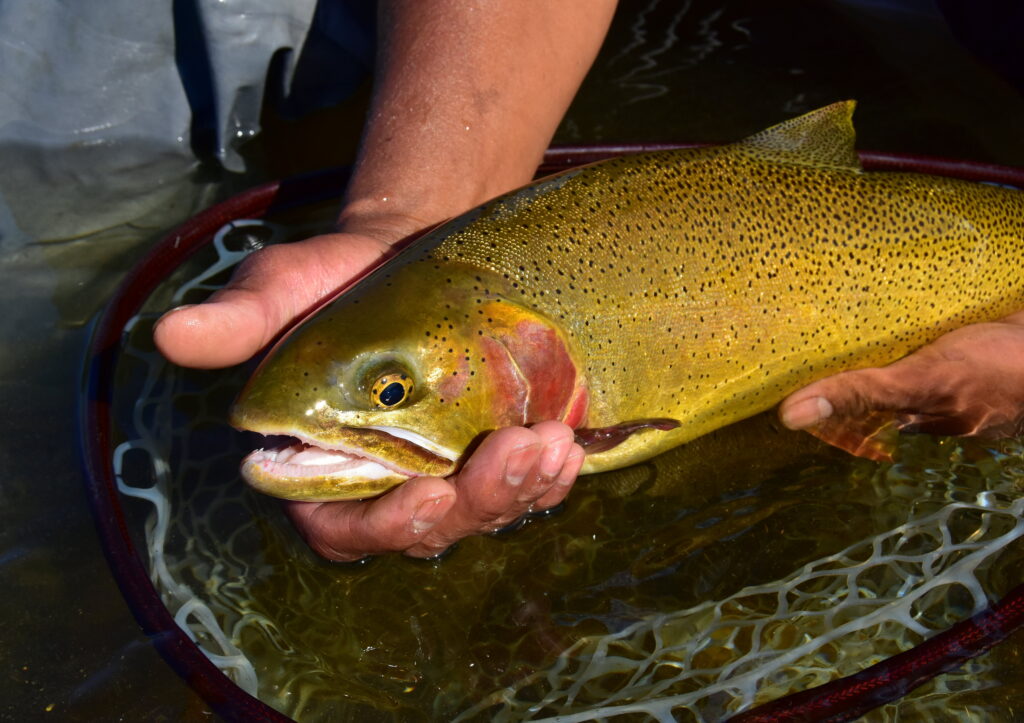
Cutthroat trout are the native trout of the interior West and the Pacific Northwest coast, and they are the most geographically fragmented salmonid in North America. The USGS Nonindigenous Aquatic Species database puts the native range along Pacific coastal drainages from Prince William Sound, Alaska, to the Eel River in northern California, plus interior populations scattered from southern Alberta to New Mexico that touch the Hudson Bay, Mississippi, Columbia, Colorado, Bonneville, Lahontan and Rio Grande basins. That distribution is not a continuous range. It is a set of isolated remnants left behind by Pleistocene lakes and river captures, and that isolation is the reason the group is so taxonomically messy and so hard to manage.
Recognizing a Cutthroat
The diagnostic feature is the pair of red to orange slashes under the lower jaw, in the fold between the jawbones. They are vivid on spawning fish and faint or absent on bright sea-run and lake fish, so the slash alone is not reliable. The second character is more dependable: cutthroat carry small basibranchial teeth at the back of the tongue, which Washington Department of Fish and Wildlife uses as the working separator from rainbow trout. Cutthroat also tend toward a longer maxillary that extends past the rear margin of the eye.
Spotting pattern separates the lineages more than it separates cutthroat from rainbow. Westslope cutthroat carry spots concentrated above the lateral line and toward the tail, with the forward flanks nearly clean. Lahontan fish show medium to large spots spread evenly, including onto the belly. The Snake River fine-spotted form is covered in small, uniform black speckling over almost the whole body. Hybrids blur all of this, which is exactly the problem described below.
A Contested Taxonomy
How many species of cutthroat exist is genuinely unsettled, and the disagreement runs between institutions rather than within any one of them.
The framework nearly every agency still runs on is Robert Behnke’s: one species, Oncorhynchus clarkii, containing a series of subspecies. The Integrated Taxonomic Information System currently treats O. clarkii as a valid species with eleven subspecies, including bouvieri (Yellowstone), clarkii (coastal), henshawi (Lahontan), lewisi (westslope), pleuriticus (Colorado River), stomias (greenback), utah (Bonneville), virginalis (Rio Grande), seleniris (Paiute), behnkei (Snake River fine-spotted) and the extinct macdonaldi (yellowfin). The U.S. Fish and Wildlife Service uses the same trinomials on its species profiles for westslope, Lahontan and greenback cutthroat. So does USGS, and so do the state agencies: Montana’s 2023-2026 statewide fisheries management plan names O. clarkii lewisi and O. clarkii bouvieri, and Idaho Department of Fish and Game catalogues westslope cutthroat as O. clarkii lewisi with a global rank of G5T4.
Against that, the American Fisheries Society’s 8th edition names list (2023) adopted a multi-species arrangement, following two decades of lineage work that found the major cutthroat groups to be older and more distinct than subspecies rank implies. Under that arrangement, names including Oncorhynchus lewisi for westslope cutthroat and Oncorhynchus virginalis for the interior Rio Grande lineage are used at species rank. A public copy of that list could not be retrieved for this article, so the full arrangement is reported here as unverified and should be checked against the printed publication. What is verifiable is the other half of the disagreement: ITIS searches return no species-rank entry for Oncorhynchus lewisi, only the valid subspecies O. clarkii lewisi, and the same is true for virginalis.
The practical consequence is that a fish may be called Oncorhynchus clarkii lewisi in a Montana management plan and Oncorhynchus lewisi in a 2024 journal paper, and both are current usage. This site follows agency usage, because agency usage is what regulations, recovery documents and state rank assessments are written against.
Water Temperature
Temperature is the single most useful number for reading a cutthroat river, and the group’s thermal ceiling is measurably lower than that of the rainbow trout that have been stocked over the top of it. The controlled comparison comes from Bear, McMahon and Zale (2007), Transactions of the American Fisheries Society 136(4):1113-1121. They measured an ultimate upper incipient lethal temperature of 19.6 C (67.3 F) for westslope cutthroat trout against 24.3 C (73.7 F) for rainbow trout, a difference of 4.7 C. Above 20 C, rainbow trout simply survived better.
Two details matter for interpreting a live gauge reading. First, the UUILT is a sustained-exposure threshold, not an instantaneous kill point, so a river sitting near 67 F for days is doing real damage even though fish are still visibly alive. Second, growth optima were similar between the two species, at roughly 13-14 C, and the authors concluded that holding maximum daily temperatures near the optimum of 13-15 C (55-59 F) would secure suitable thermal habitat for westslope cutthroat. A reading in the low to mid 50s F is a healthy cutthroat river. A reading in the mid 60s F is a river running out of margin. A reading approaching 70 F is a river where rainbow trout have a direct physiological advantage.
These figures were measured on westslope cutthroat. Comparable controlled numbers for the other lineages were not verified for this article, and applying the westslope values to Lahontan or coastal fish is an extrapolation rather than a measurement.
Hybridization Is the Central Conservation Problem
Across the whole group, the dominant threat is not overharvest or dams but genetic swamping by introduced rainbow trout. Cutthroat and rainbow interbreed freely and their hybrids are fertile, so introgression does not stop at a first generation; it spreads until a population is no longer genetically cutthroat. Washington Department of Fish and Wildlife states the case bluntly for the westslope form: “the primary source of decline for westslope cutthroat has been hybridization with rainbow trout.”
Warming water accelerates it. Muhlfeld and colleagues (2014), Nature Climate Change 4:620-624, tracked the Flathead River system in western Montana and found that despite decades of rainbow trout stocking, hybridization stayed confined to a single source population until a 30-year warming period, after which it spread rapidly upstream. The drivers were declining spring precipitation and rising summer stream temperature acting together. The mechanism links directly to the Bear results: as headwater reaches warm past the cutthroat optimum, rainbow trout can occupy and reproduce in refuges that previously excluded them.
Montana’s statewide plan treats hybridization between introduced rainbow trout and native cutthroat as a standing management problem addressed through suppression, migration barriers and selective stocking. Barriers are the recurring compromise across the range: a waterfall or engineered structure that keeps rainbow trout out also isolates the cutthroat population above it, leaving small, disconnected groups with no way to recolonize after a fire or a drought.
Other Pressures
Introduced predators matter where cutthroat share large lakes. Yellowstone Lake is the clearest case: invasive lake trout were discovered in 1994 and drove what Koel and colleagues (2020), Fishes 5(2):18, describe as a precipitous decline in Yellowstone cutthroat abundance. Brook trout displace cutthroat in small streams through competition. Brown trout prey on them. Beyond fish, the familiar habitat pressures apply: sediment from roads and logging, dewatering, loss of beaver-pond complexes, and barriers that sever migratory life histories.
Life History and Spawning
Cutthroat are spring spawners throughout the group. USFWS describes westslope spawning occurring in spring at around 50 F, with females cutting redds in gravel and eggs hatching within weeks to months depending on temperature. Wyoming Game and Fish reports roughly 2,000 eggs per female for the Bonneville form, which is a reasonable order of magnitude for the group.
Four life-history strategies recur. Resident fish complete their lives in a single small stream and stay small. Fluvial fish rear in tributaries and move to a mainstem river as adults. Adfluvial fish live in a lake and run up tributaries to spawn, and produce the largest freshwater fish. Anadromous fish, found only in the coastal lineage and in a few westslope populations, move to estuaries and nearshore salt water. Every one of these strategies except the resident form depends on unobstructed movement, which is why culverts and diversions do disproportionate damage to cutthroat.
Size and Records
Size tracks life history and productivity more than lineage. Headwater residents mature at 6 to 9 inches. USFWS gives 6 to 16 inches as the typical westslope range. Lake and desert-basin fish are a different animal: the Lahontan form reached roughly 4 feet and 40 pounds, and Nevada Department of Wildlife still publishes a 41-pound Pyramid Lake fish taken in 1925. Modern state marks are more modest — 16 pounds from Red Eagle Lake for Montana in 1955, and 15 pounds at 32 inches from Native Lake for Wyoming in 1959. Notably, Wyoming keeps a single undifferentiated cutthroat record rather than separate marks by subspecies, which reflects how hard the lineages are to tell apart in hand.
Angling Natural History
Cutthroat are opportunistic drift feeders, taking aquatic insects, terrestrial insects that fall in, crustaceans, and — in the larger lake and desert forms — other fish. Nevada’s Lahontan fish become substantially piscivorous with size, and Wyoming’s Bonneville fish add crayfish and small fish as they grow. The behavioral trait that shows up in every agency description is a willingness to rise and a slow, deliberate take, which is why cutthroat waters have historically been the first to show depletion under heavy angling pressure and are managed conservatively across most of the range.
Cutthroat are less aggressive competitors than the trout introduced alongside them and less tolerant of warm water, and those two facts together explain most of their modern distribution. Where they persist as genetically intact populations, it is usually because something — a waterfall, a long cold headwater, a desert basin nothing else could survive in — kept the newcomers out.
Where to catch it
141 waterways on GuidedFloats list cutthroat trout, across 13 states. Each page carries live gauge readings, access notes, and the guides who fish it.
Alaska 6
- Bradley River below Bradley Lake Dam1 cfs
- Lemon Creek
- Situk River611 cfs
- Staney Creek1,290 cfs
- Stikine River81,500 cfs
- Taku River20,500 cfs
Arkansas 2
- Little Red River231 cfs
- White River1,720 cfs
California 5
- Eel River82 cfs
- Prosser Creek72 cfs
- Scott River10 cfs
- Smith River188 cfs
- Van Duzen River7 cfs
Colorado 17
- Animas River154 cfs
- Arkansas River
- Blue River below Green Mountain Reservoir186 cfs
- Boulder Creek12 cfs
- Cache la Poudre River26 cfs
- Clear Creek57 cfs
- Dolores River315 cfs
- Eagle River7 cfs
- East River64 cfs
- Fryingpan River76 cfs
- Gunnison River213 cfs
- Roaring Fork River506 cfs
- South Platte River105 cfs
- Taylor Park Reservoir
- Taylor River42 cfs
- Uncompahgre River65 cfs
- Yampa River117 cfs
Idaho 19
- Clearwater River3,240 cfs
- Coeur d'Alene Lake
- Coeur d'Alene River273 cfs
- Henrys Fork94 cfs
- Henrys Lake
- Kootenai River4,410 cfs
- Lake Pend Oreille
- Lochsa River359 cfs
- Mackay Reservoir
- Medicine Lodge Creek26 cfs
- Priest Lake
- Priest River1,340 cfs
- Salmon River1,100 cfs
- Selway River517 cfs
- South Fork Snake River3,050 cfs
- St. Joe River341 cfs
- Teton River406 cfs
- Valley Creek91 cfs
- Warm Springs Creek29 cfs
Montana 17
- Big Spring Creek152 cfs
- Bitterroot River840 cfs
- Blackfoot River600 cfs
- Clark Fork1,470 cfs
- Flathead Lake
- Gallatin River360 cfs
- Hebgen Lake
- Hungry Horse Reservoir
- Jefferson River1,070 cfs
- Lake Como
- Madison River below Hebgen Lake707 cfs
- Rock Creek270 cfs
- Ruby River52 cfs
- Smith River191 cfs
- Stillwater River414 cfs
- Warm Springs Creek59 cfs
- Yellowstone River1,620 cfs
Nevada 12
- East Fork Carson River49 cfs
- East Walker River111 cfs
- Lamoille Creek3 cfs
- Marlette Lake
- Pyramid Lake
- South Fork Reservoir
- Topaz Lake
- Truckee River323 cfs
- Truckee River below Derby Dam264 cfs
- Walker Lake
- Walker River27 cfs
- Weber Reservoir
New Mexico 3
Oregon 9
- Clackamas River607 cfs
- Grande Ronde River591 cfs
- McKenzie River1,710 cfs
- Nehalem River93 cfs
- North Santiam River1,320 cfs
- Sandy River278 cfs
- Siuslaw River Estuary
- South Santiam River1,150 cfs
- Umpqua River1,000 cfs
South Dakota 2
- Rapid Creek below Pactola Dam17 cfs
- Spearfish Creek36 cfs
Utah 15
- Ashley Creek168 cfs
- Bear Lake
- Big Brush Creek45 cfs
- Blacksmith Fork53 cfs
- Chalk Creek14 cfs
- Duchesne River108 cfs
- Green River2,300 cfs
- Lake Fork River7 cfs
- Logan River92 cfs
- North Fork Virgin River51 cfs
- Ogden River below Pineview Reservoir17 cfs
- Price River9 cfs
- South Fork Ogden River8 cfs
- Strawberry River31 cfs
- Weber River64 cfs
Washington 17
- Baker Lake
- Bogachiel River171 cfs
- Chehalis River27 cfs
- Cowlitz River4,040 cfs
- Dungeness River62 cfs
- Hoh River555 cfs
- Humptulips River169 cfs
- Klickitat River603 cfs
- Lake Quinault
- Methow River317 cfs
- Queets River684 cfs
- Skagit River6,370 cfs
- Skykomish River537 cfs
- Snoqualmie River687 cfs
- Sultan River185 cfs
- Wenatchee River333 cfs
- Yakima River718 cfs
Wyoming 17
- Bear River
- Big Sandy Reservoir
- Boulder Creek below Boulder Lake13 cfs
- Encampment River102 cfs
- Fish Creek146 cfs
- Green River (Wyoming)605 cfs
- Jackson Lake
- Lamar River149 cfs
- Middle Fork Powder River5 cfs
- North Brush Creek10 cfs
- North Fork Shoshone River213 cfs
- North Platte River306 cfs
- Pacific Creek52 cfs
- Salt River423 cfs
- Shoshone River680 cfs
- Snake River1,040 cfs
- Wind River440 cfs
References
- Oncorhynchus clarkii (Cutthroat Trout) Species Profile — U.S. Geological Survey, Nonindigenous Aquatic Species Database
- Oncorhynchus clarkii (Richardson, 1836) — Taxonomic Serial No. 161983 — Integrated Taxonomic Information System (ITIS)
- ITIS search results for Oncorhynchus lewisi — Integrated Taxonomic Information System (ITIS)
- Comparative Thermal Requirements of Westslope Cutthroat Trout and Rainbow Trout: Implications for Species Interactions and Development of Thermal Protection Standards — Transactions of the American Fisheries Society 136(4):1113-1121 (Bear, McMahon & Zale 2007)
- Invasive hybridization in a threatened species is accelerated by climate change — Nature Climate Change 4:620-624 (Muhlfeld et al. 2014)
- Watershed boundaries and geographic isolation: patterns of diversification in cutthroat trout from western North America — BMC Evolutionary Biology 12:38 (Loxterman & Keeley 2012)
- Yellowstone Lake Ecosystem Restoration: A Case Study for Invasive Fish Management — Fishes 5(2):18 (Koel et al. 2020)
- Statewide Fisheries Management Plan 2023-2026, Part I — Montana Fish, Wildlife and Parks
- Cutthroat Trout (Oncorhynchus clarkii) Species Profile — U.S. Fish and Wildlife Service
- Westslope Cutthroat Trout (Oncorhynchus clarkii lewisi) — U.S. Fish and Wildlife Service
- Westslope Cutthroat Trout — Washington Department of Fish and Wildlife
- Coastal Cutthroat Trout (Resident) — Washington Department of Fish and Wildlife
- Lahontan Cutthroat Trout — Nevada Department of Wildlife
- Bonneville Cutthroat Trout Species Profile — Wyoming Game and Fish Department
- Wyoming's Record Fish — Wyoming Game and Fish Department
- Montana's Fish Records — Montana Fish, Wildlife and Parks
- Westslope Cutthroat Trout — Idaho Species Catalog — Idaho Department of Fish and Game
- IGFA World Records — International Game Fish Association
- Greenback Cutthroat Trout (Oncorhynchus clarkii stomias) — U.S. Fish and Wildlife Service