Kokanee Salmon
Oncorhynchus nerka
Kokanee are sockeye salmon that never leave fresh water. A zooplankton diet keeps them small, they turn crimson to spawn at about age four, then die — and most western fisheries are stocked.
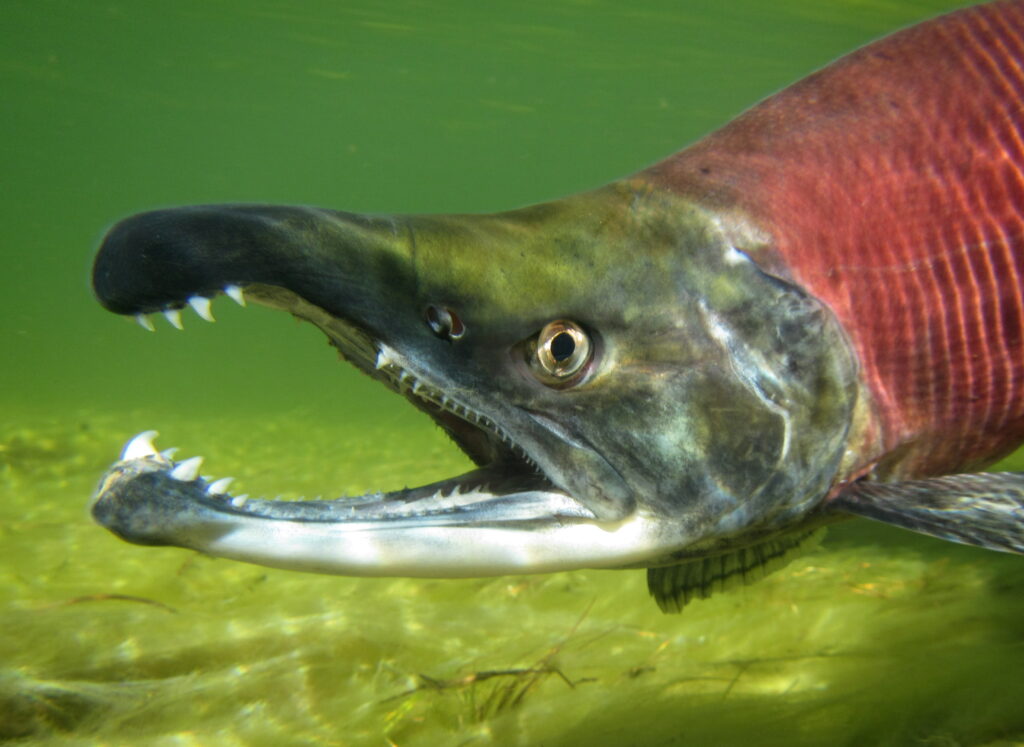
A sockeye that never sees salt water
Kokanee are sockeye salmon. Not a close relative, not a subspecies in any formal sense — the same species, Oncorhynchus nerka, living out its whole life in fresh water. NOAA Fisheries states it directly: in the Pacific Northwest, non-anadromous sockeye are known as “kokanee”. Oregon’s fish and wildlife agency puts it the same way — kokanee are landlocked sockeye salmon that never leave fresh water, and spawn in the tributaries of their home lake.
Washington’s agency lists kokanee, along with “silver trout,” as one of the common names for the landlocked form of O. nerka. That “silver trout” name is a clue to how the fish is usually encountered: a bright, small, trout-sized salmon that looks nothing like the crimson spawner it becomes.
The relationship runs deeper than shared taxonomy. Sockeye are the only Pacific salmon that require a lake in the system — juveniles rear in still water rather than in the river — which means the species was already, in effect, half a lake fish before any population lost access to the ocean. Kokanee are what happens when the marine half of that life history is removed and the lake half is all that remains.
Why they stay small
An ocean-run sockeye returns at 18 to 31 inches and 4 to 15 pounds. A kokanee in the same species rarely reaches 14 inches. The difference is not genetic potential but diet and the productivity of the water it lives in.
Kokanee are planktivores. The California Department of Fish and Wildlife describes them as feeding almost exclusively on zooplankton, an efficiency they owe to densely packed gill rakers that strain small crustaceans out of the water column. Alaska’s agency lists the sockeye diet as zooplankton, small crustaceans and small fish, with juveniles restricted to the plankton — a kokanee simply never graduates past that stage.
The composition matters at a finer grain than “plankton.” USGS work in Lake Pend Oreille, Idaho, found a clear ontogenetic split: juvenile kokanee primarily consumed copepods and adult kokanee preferentially consumed cladocerans — the larger water fleas such as Daphnia. Adult growth in that system tracked cladoceran availability closely enough that adult kokanee grew faster when a competing shrimp species declined.
So kokanee size is essentially a readout of a lake’s zooplankton production divided by the number of kokanee eating it. ODFW notes that size varies with population density and that, as filter feeders, kokanee populations fluctuate with zooplankton availability. CDFW gives California kokanee as 10 to 12 inches on average, with some reservoirs producing fish up to 20 inches. A crowded reservoir produces thousands of 9-inch fish; a thinner population in the same water produces far fewer 16-inch fish. This is the central management lever, and it is why kokanee waters are stocked to a target density rather than simply stocked heavily.
The stated ceiling is somewhat contested between agencies. NOAA says landlocked sockeye rarely exceed 1.2 feet; Alaska says rarely more than 14 inches; California documents 20-inch fish in its most productive reservoirs. All three are describing the same biology from different water.
The spawning transformation
For most of the year a kokanee is unremarkable to look at — slim, bright silver, small-scaled, faintly blue-green across the back. Then it matures, and the change is among the most dramatic in North American freshwater fish.
ODFW describes kokanee as silvery in colour until they are ready to spawn, at which time they become reddish. The fuller description, from the anadromous form of the same species, is that their heads turn green and their bodies turn bright red. Alaska’s agency adds the structural changes: males develop a humped back and hooked jaws filled with tiny, visible teeth. CDFW records the same in kokanee — males taking on a pronounced hook jaw (kype) and humped back, with both sexes turning bright red.
The colour comes from carotenoid pigments the fish has accumulated from its crustacean diet and mobilised out of the muscle into the skin — one reason a spawning kokanee’s flesh pales as its exterior brightens. The transformation runs on a fixed schedule and is irreversible.
Four years, then done
Kokanee are semelparous: they spawn once and die. USGS work describes the species plainly as a semelparous, landlocked salmon, and found in three Idaho lakes and reservoirs that reaching a size threshold of 18 to 19 cm in the fall was a good predictor of maturation the following year — maturity is triggered by size as much as by age.
The commonest pattern in the Northwest is a four-year life: fry emerge in spring, rear in the lake for roughly three growing seasons, mature in their fourth year, spawn in late summer or autumn, and die. NOAA gives sockeye maturity at around age five with a lifespan of about five years, but notes that age 4 is more common in the Pacific Northwest. Alaska gives a range of three to seven years for the species. California is the outlier at the short end: CDFW reports a typical life span of 2 to 3 years in California reservoirs, with older fish only occasionally seen. Warmer, more productive southern reservoirs push fish to the size threshold faster, and they mature and die younger as a result.
The practical consequence of semelparity plus a four-year clock is that kokanee populations are dominated by a single strong year class at a time. A bad spawning year, or a bad fry year, propagates forward as a hole in the fishery three or four seasons later. Agencies that track kokanee do so by year class for exactly this reason.
Spawning: streams, and shorelines
Mature kokanee move into tributaries in late summer and autumn — CDFW describes fish maturing in the lake and then migrating into tributaries in the fall to spawn. Where usable tributaries are absent or blocked, kokanee spawn instead along lake shorelines over gravel, and this shore-spawning behaviour supports major fisheries in its own right.
USGS studied shore-spawning kokanee in Lake Pend Oreille and found that substrate composition alone did not predict survival: fine sediment reduced fry emergence and condition, but groundwater flow emerged as a critical factor, potentially enhancing intragravel survival in habitats generally considered unsuitable for spawning. That is a direct link between reservoir water-level management and recruitment: dewatering a shoreline redd zone in winter kills a year class outright.
Stocked, almost everywhere
Most western kokanee fisheries exist because an agency put the fish there and keeps putting them there. Kokanee are native to a limited set of Pacific-drainage lakes; the great majority of the reservoirs where they are now caught are outside that native range.
California is a clear example. CDFW records kokanee as first introduced as fingerlings to California waters in 1941, chosen because they suited reservoirs with fluctuating water levels, and the state now plants approximately 750,000 fingerlings in 15 reservoirs annually, with seven further waters holding self-sustaining populations. That ratio — roughly two stocked waters for every self-sustaining one — is broadly representative of the interior West.
Even where wild spawning occurs, hatchery supplementation often runs alongside it. A USGS analysis of Lake Pend Oreille found that wild kokanee showed a compensatory stock-recruitment relationship — density-dependent, with growth slowing as stock size rose — while hatchery recruitment was positively and linearly related to stocking. Water-level management, contrary to expectation, had no detectable effect on wild recruitment in that system. Where kokanee were introduced above barriers or into isolated reservoirs, they are one of the few salmon that can be managed almost as a crop.
Mysis shrimp and the boom-bust problem
The most instructive failures in kokanee management involve a second introduction. Mysis diluviana, an opossum shrimp, was stocked into many western lakes in the mid-20th century on the theory that it would feed kokanee. It largely did the opposite: Mysis eat the same zooplankton kokanee eat, and they do it at depth and at night, where kokanee — visual feeders — cannot follow.
USGS work in Lake Chelan, Washington, separated two mechanisms operating at once. The first is straightforward resource competition for zooplankton. The second is apparent competition: Mysis feed lake trout, and more lake trout means more predation on kokanee. Comparing two basins of the same lake, researchers found the shallower basin warmed faster, thermally excluded Mysis from surface waters for 75 percent longer, and produced 2.5 to 18 times greater zooplankton production, with Mysis consuming 14 to 22 percent less zooplankton — but lake trout catch rates were seven times greater there, and kokanee predation risk four to five times higher. Which mechanism dominates depends on the lake’s temperature and depth structure.
This is why kokanee fisheries can appear to collapse for no visible reason. The forage base and the predator field are both moving, and neither is visible from the surface.
Water temperature and depth
Kokanee sit at the cold end even by salmonid standards. CDFW gives their preference as 10 to 13°C (50 to 55°F), tolerating up to 15°C (59°F). That is a narrow band, and it governs where the fish are in a stratified lake far more than anything else.
ODFW describes kokanee as found at all depths of cold, clear lakes and reservoirs, changing depth depending on water temperature. In practice they are near the surface shortly after ice-out and in late autumn, and progressively deeper through summer as the thermocline sets up, holding below it in midsummer. A surface temperature reading, in other words, tells you where kokanee are not. The temperature that matters is the one at depth.
Records
IGFA maintains an all-tackle world record for kokanee. GuidedFloats could not verify the current standing record directly against IGFA’s database at the time of writing; igfa.org/world-records is the authoritative source and should be checked there rather than in secondary listings. State records are published separately by each state agency. Record-class kokanee come overwhelmingly from a small number of unusually productive, lightly stocked western lakes — the same conditions that produce 20-inch fish rather than 10-inch fish.
Where they are found
Kokanee fisheries are spread across the interior and Pacific West: British Columbia and the Canadian interior, Alaska, Washington, Oregon, Idaho, Montana, Wyoming, Utah, Nevada, Colorado and California, plus scattered introductions further east. Washington’s native and established O. nerka waters include Lake Washington, Lake Sammamish, Baker Lake, Ozette Lake, Quinault Lake, Lake Wenatchee, Cle Elum Lake and Osoyoos Lake, among others. Idaho’s Lake Pend Oreille is among the most intensively studied kokanee waters anywhere, and much of what is known about kokanee recruitment, shore spawning and Mysis interaction comes from work done there.
Where to catch it
24 waterways on GuidedFloats list kokanee salmon, across 8 states. Each page carries live gauge readings, access notes, and the guides who fish it.
California 2
- Little Truckee River below Boca Dam200 cfs
- Prosser Creek72 cfs
Colorado 5
- Blue River below Green Mountain Reservoir179 cfs
- Gunnison River213 cfs
- Ridgway Reservoir
- Taylor Park Reservoir
- Taylor River41 cfs
Idaho 6
- Anderson Ranch Reservoir
- Coeur d'Alene Lake
- Lake Pend Oreille
- Mackay Reservoir
- Payette Lake
- Priest Lake
Montana 2
New Mexico 2
Oregon 2
- Lake Billy Chinook
- Metolius River1,190 cfs
Washington 3
Wyoming 2
- Boulder Creek below Boulder Lake13 cfs
- Green River (Wyoming)597 cfs
References
- Sockeye Salmon — NOAA Fisheries
- Kokanee — California Department of Fish and Wildlife
- Kokanee salmon — Oregon Department of Fish and Wildlife
- Sockeye Salmon (Oncorhynchus nerka) — Washington Department of Fish and Wildlife
- Sockeye Salmon Species Profile — Alaska Department of Fish and Game
- Sexual maturation in kokanee Oncorhynchus nerka — U.S. Geological Survey
- Influence of habitat characteristics on shore-spawning kokanee — U.S. Geological Survey
- Effects of water-level management and hatchery supplementation on kokanee recruitment in Lake Pend Oreille, Idaho — U.S. Geological Survey
- Ontogenetic diet shifts with potential ramifications for resource competition in a kokanee–Mysis diluviana system — U.S. Geological Survey
- Temperature and depth mediate resource competition and apparent competition between Mysis diluviana and kokanee — U.S. Geological Survey
- IGFA World Records — International Game Fish Association