Bull Trout
Salvelinus confluentus
Bull trout are the most cold-dependent salmonid in the lower 48, with an ultimate upper lethal limit of 20.9 C and field occupancy falling away above roughly 12 to 14 C.
Identification
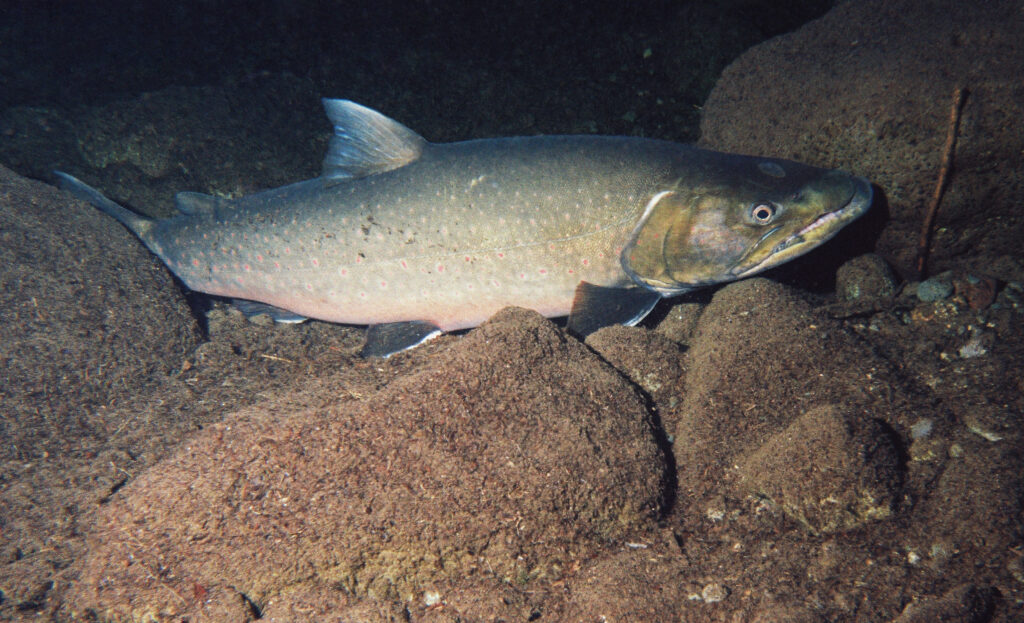
Bull trout are char, and they show the char pattern of pale spots on a dark ground. The back and sides are olive-green to bronze, and the flanks carry pale yellow, orange, or salmon-coloured spots. Washington’s Department of Fish and Wildlife gives the key marks as light spots on a dark background, an unusually large head and mouth, and white leading edges on the ventral fins.
The head is the most useful character in hand. Bull trout have a notably long, broad, flattened head and a large mouth, and the common name comes directly from that profile. Unlike brook trout they have no worm-like vermiculations on the back or dorsal fin, and no blue-haloed red spots. Unlike lake trout, the tail is only slightly forked rather than deeply so.
Separating bull trout from Dolly Varden is the genuinely hard problem, and it is not solved by field marks alone. The two were not recognised as separate species until Ted Cavender’s work in 1978, and where they co-occur in western Washington the difficulty is quantified: the U.S. Fish and Wildlife Service’s proposed similarity-of-appearance rule cited research in which bull trout were misidentified as Dolly Varden 48 percent of the time. That is the basis for the 2001 proposal at 66 FR 1628. Outside the coastal zone where the ranges overlap, geography usually resolves it: an interior char in the Columbia or upper Snake basin is a bull trout.
Range and distribution
The native range runs from Alaska and western Canada south through Washington, Oregon, Idaho, western Montana, and into Nevada, spanning Arctic, Pacific, and interior Columbia basin drainages. The U.S. Fish and Wildlife Service describes the range as extending from Alaska to northern California.
The southern end has already been lost. California’s Department of Fish and Wildlife records bull trout as extirpated from the state, with the last reported sighting in 1975. They occupied the McCloud River and its tributaries in Shasta and Siskiyou counties, from the mouth now inundated by Lake Shasta up to Lower Falls, and their disappearance is attributed to habitat loss from dams and competition with introduced brown trout.
In Montana, bull trout are restricted to waters west of the Continental Divide, primarily the Clark Fork and Flathead drainages. The Montana Field Guide assigns them a state rank of S2 and a declining trend.
For recovery planning the Service divides the listed population into six recovery units: Coastal, Klamath, Mid-Columbia, Columbia Headwaters, Upper Snake, and St. Mary, containing roughly 109 to 110 core areas. Critical habitat designated in 2010 covers 32 critical habitat units, 19,729 river miles, and 488,252 surface acres, per the Service’s recovery plan questions and answers.
Habitat and water temperature
Bull trout are the most cold-dependent salmonid in the lower 48, and unusually, the claim can be quantified precisely rather than asserted.
The controlled experiment is Selong and colleagues, published in Transactions of the American Fisheries Society in 2001 and available from Montana State University. Their findings:
- Optimum growth at 13.2 C (55.8 degrees F), with a 95 percent confidence interval of 10.9 to 15.4 C.
- Positive growth between 5.2 C and 20.7 C.
- Ultimate upper incipient lethal temperature of 20.9 C (69.6 degrees F) at 60 days, and about 23.5 C interpolated to a 7-day exposure.
- Survival of 98 percent or better from 8 to 18 C over 60 days, falling to 79 percent at 20 C, and to zero between 22 and 28 C. At 26 C, mortality was complete within 24 hours.
The comparative result is the important one. Selong found bull trout UUILT to be 1 to 5 C lower than brook, rainbow, brown, chinook, sockeye, coho, and Arctic grayling, with critical thermal maxima consistently 0.5 to 2 C below brook and rainbow trout. The only North American salmonid with comparable numbers is Arctic char, at 20.8 to 22.1 C. That is the entire basis for calling bull trout the coldest-water char in the lower 48, and it rests on measurement rather than reputation.
Field data give a colder picture still. A literature review compiled for EPA Region 10 temperature standards reports juvenile bull trout present between 4 and 16 C, with optimal growth at 12.3 C and growth declining sharply above 16 C; adult thermal selection averaging 11 to 15 C; and 97.9 percent of predicted August habitat below 14 C. The same review notes that bull trout cease to exist above about 16 C, and gives egg incubation optima below 16.5 C with survival collapsing to 1.7 percent at 17 C. Spawning observations in that review commenced at 7.9 to 8.3 C, peaked at 7.2 to 7.3 C, and ran across a 6.3 to 7.9 C window, with redd pit temperatures from 2.0 to 10.0 C and a mean of 6.26 C. The document is EPA Region 10’s salmonid temperature literature review.
These two bodies of evidence do not agree, and the discrepancy is real. The laboratory optimum near 13 C sits above the temperature at which field occupancy is already declining. The most common explanation is that laboratory fish are fed to satiation with no competitors and no predators, while wild bull trout face brook trout competition, limited food, and predation risk, all of which intensify with warming. For interpreting a live temperature reading on a bull trout river, the field numbers are the more relevant set.
Managers compress this into a habitat formula. The Service describes bull trout as needing cold, clean, complex, and connected habitat: cold water for every life stage, clean gravel with low fine sediment for incubation, complex cover in the form of deep pools, undercut banks, and large wood, and unbroken connectivity between spawning tributaries and downstream rearing water. Montana Fish, Wildlife and Parks describes adults tolerating water to about 65 degrees F but juveniles unable to survive above 60 degrees F and preferring 50 to 55 degrees F, which is the same picture in field units.
Climate projections follow directly. Forest Service modelling of cold-water refugia in the Northern Rockies predicted that under both moderate and extreme warming scenarios, only 33 to 68 bull trout refugia with occupancy probability above 0.9 would remain, against 917 to 1,425 for cutthroat trout, a stark difference in the size of the surviving network. That work is summarised at the Forest Service Treesearch record for Isaak et al. (2015).
Life history
Bull trout express four life history strategies, which the Service lists as resident, fluvial, adfluvial, and anadromous, the last being rare. Resident fish live their whole lives in small headwater streams and stay small, often under 12 inches. Fluvial fish rear in tributaries and grow in larger rivers. Adfluvial fish grow in lakes and reservoirs. All migratory forms return to natal tributaries to spawn.
The migrations are long. Montana’s field guide records migratory bull trout travelling up to 156 miles (250 km) among lakes, rivers, and tributaries, with some fish covering well over 100 miles in a few months to reach spawning water. Those movements are what make connectivity a first-order conservation issue rather than a secondary one.
Spawning runs late. Montana gives late August to early November in third and fourth order streams, and the Service gives August through November and sometimes December. Eggs are deposited deep, about 10 inches below the streambed surface in Montana’s account, and require 7 to 8 months before fry emerge. That very long incubation, spanning an entire winter beneath the gravel, is why fine sediment and substrate permeability matter so much: eggs need water flowing through the redd for most of a year.
Size depends on life history. Montana reports resident adults at 15 to 30 cm and migratory adults commonly over 60 cm, with Flathead Lake trophy fish reaching about 25 pounds. The Service gives a common length of 25 inches, a maximum of 40.5 inches, and a maximum weight of 31 pounds 15 ounces.
Diet
Juvenile bull trout eat aquatic invertebrates. Adults are among the most thoroughly piscivorous freshwater salmonids in North America. Montana’s field guide reports that in Flathead Lake, fish made up more than 99 percent of food biomass in bull trout stomachs.
That degree of specialisation binds bull trout tightly to their forage base. Where kokanee, whitefish, sculpins, or juvenile salmon decline, bull trout decline with them, and where an introduced predator takes the same forage, bull trout lose twice. The Flathead Lake sequence is the clearest case: introduced Mysis shrimp boosted lake trout, lake trout fed heavily on kokanee and on juvenile bull trout, and the bull trout population dropped sharply, as described by Montana Fish, Wildlife and Parks.
The large head and mouth are the anatomical expression of this diet. Bull trout routinely take prey items large relative to their own body, and a migratory adult in a river is functioning as an apex predator rather than a drift feeder.
Angling
Bull trout are federally threatened throughout the coterminous United States. Whether any angling opportunity exists for them in a given water, and under what conditions, is governed entirely by state, tribal, and federal rules that vary by basin and change over time. Those rules are the authoritative source and should be consulted directly for any specific water.
What is worth understanding as natural history is why bull trout behave the way they do. Their predatory habit and their willingness to follow and attack hooked fish is well known, and it is a direct consequence of a diet that is more than 99 percent fish by biomass in some systems. A bull trout that intercepts a struggling whitefish is doing exactly what it does for a living.
Their vulnerability follows from the same behaviour combined with their migration. Montana’s field guide lists bull trout as vulnerable to over-harvest and to poaching or accidental harvest, especially during migrations in tributaries, when large adults concentrate in small, shallow, visible water. A population that spawns in a handful of headwater tributaries can have most of its adults exposed in a few miles of stream for a few weeks each autumn.
Thermal biology compounds this. A fish whose 60-day lethal limit is 20.9 C, and whose growth is already declining at 16 C, has very little physiological margin for the additional oxygen demand of a long fight in warm water. Because bull trout occupy the coldest reaches available, water temperature at the point of encounter is the single most informative environmental number on any river where they occur.
Conservation
The Service determined threatened status for all bull trout populations within the coterminous United States on 1 November 1999 (64 FR 58910), effective 1 December 1999. A 2008 status review concluded that threatened status remained warranted rangewide. NatureServe carries a global rank of G3, vulnerable, reviewed in February 2025, citing a long-term decline of 30 to 50 percent.
Critical habitat was designated in 2010 across 32 units, 19,729 river miles, and 488,252 surface acres. The final recovery plan followed in September 2015, organised around the six recovery units.
The threats are consistent across the range and mutually reinforcing:
- Habitat degradation. Fine sediment smothers eggs and fry during an incubation period that lasts most of a year. Loss of riparian shade raises stream temperature directly.
- Fragmentation. Dams, weirs, and undersized culverts sever the connections that migratory life histories require, and a fish that cannot travel 100 miles to spawn cannot express the life history that produces the largest and most fecund adults.
- Non-native species. Brook trout compete with juvenile bull trout and hybridise with them, producing mostly sterile offspring. Lake trout prey on juveniles and compete for forage. Brown trout contributed to the California extirpation.
- Climate. The Service states plainly that bull trout depend more on cold water than any other freshwater salmon or trout species in the western United States, which makes warming a direct and species-specific threat rather than a general one.
Population status varies widely within the range. Montana Fish, Wildlife and Parks reports that bull trout still occur across 98 percent of their historical Montana range but at greatly reduced numbers, with Flathead Lake adults dropping below 5,000 before stabilising, and many tributaries now holding a few dozen fish where they once held hundreds or thousands. Occupancy of the map is not the same as abundance.
Where to catch it
36 waterways on GuidedFloats list bull trout, across 4 states. Each page carries live gauge readings, access notes, and the guides who fish it.
Idaho 16
- Anderson Ranch Reservoir
- Coeur d'Alene River273 cfs
- Kootenai River4,410 cfs
- Lake Pend Oreille
- Lochsa River359 cfs
- Payette Lake
- Payette River803 cfs
- Priest Lake
- Priest River1,340 cfs
- Salmon River1,100 cfs
- Selway River517 cfs
- South Fork Boise River300 cfs
- St. Joe River341 cfs
- Thousand Springs Creek5 cfs
- Valley Creek91 cfs
- Warm Springs Creek29 cfs
Montana 5
- Blackfoot River600 cfs
- Flathead Lake
- Hungry Horse Reservoir
- Lake Como
- Rock Creek270 cfs
Oregon 4
- Grande Ronde River591 cfs
- Lake Billy Chinook
- McKenzie River1,710 cfs
- Metolius River1,190 cfs
Washington 11
- Baker Lake
- Dungeness River62 cfs
- Hoh River555 cfs
- Methow River317 cfs
- Queets River684 cfs
- Skagit River6,370 cfs
- Skykomish River537 cfs
- Snoqualmie River687 cfs
- Sultan River185 cfs
- Wenatchee River333 cfs
- Yakima River718 cfs
References
- Determination of Threatened Status for Bull Trout in the Coterminous United States, 64 FR 58910 — U.S. Fish and Wildlife Service via Federal Register
- Bull Trout (Salvelinus confluentus) species profile — U.S. Fish and Wildlife Service
- Final Recovery Plan for the Coterminous U.S. Population of Bull Trout: Questions and Answers — U.S. Fish and Wildlife Service
- Effect of Temperature on Growth and Survival of Bull Trout, with Application of an Improved Method for Determining Thermal Tolerance in Fishes (Selong et al. 2001, Trans. Am. Fish. Soc. 130:1026-1037) — American Fisheries Society, copy hosted by Montana State University
- Freshwater Temperature and Dissolved Oxygen Tolerance of Salmonids: Literature Review (Attachment 7) — U.S. Environmental Protection Agency Region 10
- Bull Trout, Montana Field Guide — Montana Natural Heritage Program and Montana Fish, Wildlife and Parks
- An Upstream Battle: bull trout in Montana — Montana Fish, Wildlife and Parks, Montana Outdoors
- Bull trout (Salvelinus confluentus) species page — Washington Department of Fish and Wildlife
- Bull Trout, Inland Fisheries — California Department of Fish and Wildlife
- Salvelinus confluentus, Bull Trout, conservation status — NatureServe Explorer
- The cold-water climate shield: delineating refugia for preserving salmonid fishes through the 21st century (Isaak et al. 2015) — USDA Forest Service, Rocky Mountain Research Station
- Proposed Rule To List the Dolly Varden as Threatened in Washington Due to Similarity of Appearance to Bull Trout, 66 FR 1628 — U.S. Fish and Wildlife Service via Federal Register
- IGFA World Records — International Game Fish Association