Chum Salmon
Oncorhynchus keta
The most widely distributed Pacific salmon, spawning low in coastal rivers with fry that reach salt water within days, and two threatened populations in Washington and the Columbia.
Identification
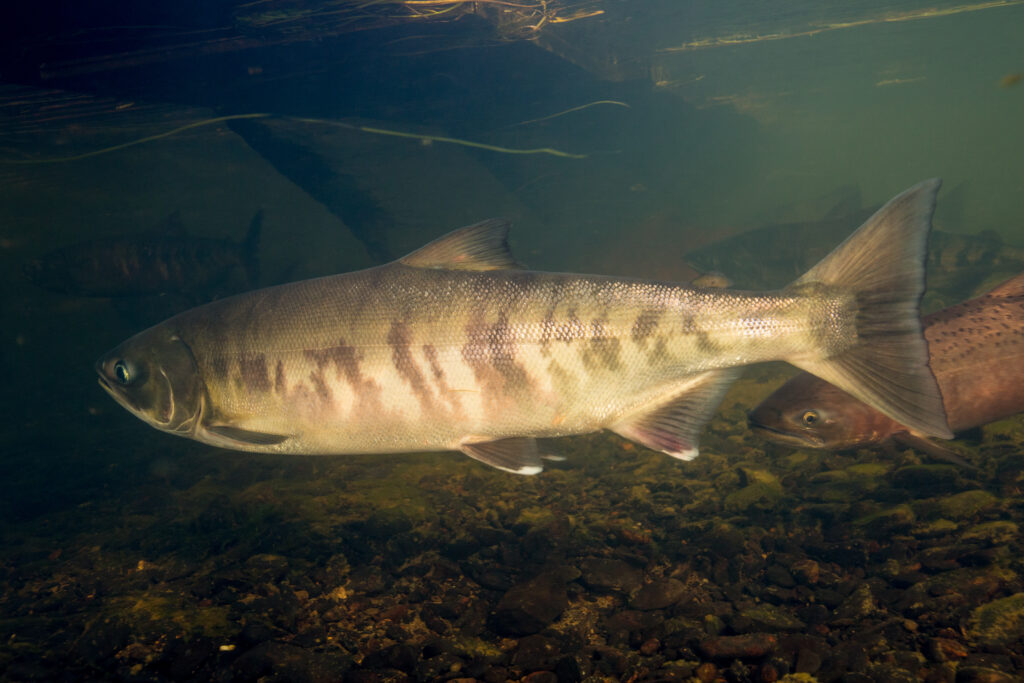
Chum salmon at sea are metallic bluish-green across the back with a paler belly and fine black speckling, and the single most useful identifying character is a negative one: the Alaska Department of Fish and Game states that “chum salmon have no dark spots on their back or tail.” Instead they show silver streaks along the rays of the tail fin, a deeply forked tail, and a comparatively small pupil in a large eye. NOAA describes the ocean fish as showing “dark metallic bluish-green coloring and black speckles on its upper half and lighter, paler belly.”
The spawning transformation is the most flamboyant among Pacific salmon and gives the fish its two common names. Males turn dark olive-brown overlaid with vertical red-purple bars — hence “calico salmon” — and develop a heavily hooked jaw armed with enlarged canine-like teeth. WDFW notes that males develop “large ‘teeth’ during spawning, which resemble canine teeth,” earning them the nickname “dog salmon.” ADF&G records females turning brown-grey with less pronounced barring.
Range and distribution
Chum are the most broadly distributed Pacific salmon. ADF&G states they have “the widest distribution of any of the Pacific salmon,” occurring throughout Alaska though scarce north of Kotzebue Sound, with most ocean-phase fish remaining in the eastern Chukchi and Bering seas and the Gulf of Alaska. NOAA adds that chum “may historically have been the most abundant of all Pacific salmonids.”
In Washington, WDFW reports chum in “virtually every small coastal stream” and closely associated with marine shoreline ecosystems — a distribution that reflects their spawning strategy rather than any tolerance for headwater conditions. They occur in the lower Columbia, throughout Hood Canal and Puget Sound, and along the outer coast. Southward they thin quickly, and Oregon populations are sparse.
Habitat and water temperature
Chum spawn lower in river systems than any Pacific salmon except pink, and WDFW explains why in mechanical terms: chum use small coastal streams and the lower reaches of larger rivers, generally spawning closer to salt water than coho, “likely due to their larger size requiring deeper water and their inferior jumping ability.” Chum are poor climbers. A falls or a culvert that a coho will pass stops a chum, which makes the species unusually sensitive to barriers in the lowest reaches of a drainage — precisely where roads and development concentrate.
Thermally, chum share the general salmonid band. The peer-reviewed synthesis by Richter and Kolmes (2005) gives an incubation optimum of 8–10°C (46–50°F) and a lethality threshold of 20–21°C (68–70°F) as a daily maximum. The EPA Region 10 criteria applying to chum, as summarised by the California Department of Fish and Game, are below 55°F (13°C) for spawning, egg incubation and fry emergence and below 64°F (18°C) for adult migration, relaxing to 68°F (20°C) in lower basins — all as seven-day averages of daily maxima rather than instantaneous limits.
The incubation window is narrow at both ends, and the Alaska Department of Fish and Game’s temperature literature review documents the shape of it: chum eggs held at 2°C did not survive; maximum alevin tissue weight was achieved at an 8°C incubation temperature; water below 4.4°C during the first month caused higher mortality and deformity rates; and exposure to warm water around 12°C during early development caused increased mortality at later stages. Tolerance improves markedly after the gastrula stage. Optimal incubation for the genus generally falls in the 5–8°C band, and the review’s overall recommendation is not to elevate water temperatures above 12–14°C for coldwater species during egg development.
Because chum fry leave fresh water within days, the summer rearing temperatures that dominate coho and Chinook survival are largely irrelevant to them. What matters is the temperature of the water adults migrate through in fall and the temperature of the gravel through winter incubation — a different exposure profile from any other Pacific salmon except pink.
Life history
Chum have the shortest freshwater residence of any Pacific salmon apart from pink. ADF&G records juveniles spending “days or weeks in freshwater before moving downstream to saltwater,” and WDFW states that fry “spend only a few days in freshwater,” moving downstream to the estuary and rearing there for several months before heading to open ocean. The estuary, not the stream, is the nursery — which makes estuarine habitat quality the controlling variable for chum production and explains why diking, filling and armouring of tidal marsh has hit the species so hard.
Adults typically mature at age three, four or five, per ADF&G, with NOAA giving a lifespan of up to six years and typically three to five. Two distinct races exist. ADF&G records “two distinct races: summer-running and fall-running chum salmon,” which enter fresh water at different times and are managed as separate stocks. Eggs hatch after three to four months depending on water temperature.
Chum are semelparous. ADF&G states they “spawn once in fall, then die,” and that adults cease feeding entirely upon returning to fresh water. The physiological collapse follows the pattern documented across the genus: research published by the U.S. Geological Survey on maturing Pacific salmon found both resting and stressed cortisol rising through the final three months before spawning, with elevated cortisol accompanied by energy depletion and reduced immune capacity that increases susceptibility to parasites and pathogens. In chum this is visible in the extreme: the enlarged breeding teeth and thickened, barred skin of a spawning male are grown by an animal simultaneously dismantling its own digestive tract and immune defences.
Diet
ADF&G records juvenile chum feeding on insect larvae in fresh water and, at sea, on “copepods, tunicates, mollusks and a variety of fishes.” The inclusion of gelatinous prey such as tunicates is distinctive — chum exploit a marine niche that the more strictly piscivorous Chinook and coho do not. Adults stop feeding entirely on entering fresh water. The commercial consequence of the diet is a paler, lower-oil flesh than sockeye or Chinook, which is why chum are traditionally marketed canned or smoked and why ADF&G notes they rank second only to pink salmon in Alaskan commercial fisheries by volume.
Angling
Chum behaviour in rivers is shaped by three things: they spawn low in the system, they are poor jumpers, and they are large and aggressive at spawning. Because most chum spawn within a short distance of tidewater, the fish are concentrated in the lower river, in estuaries and around stream mouths rather than distributed through a long migration corridor. WDFW’s note that chum are limited by their inferior jumping ability means that any modest barrier — a low falls, a beaver dam, a perched culvert — becomes an accumulation point where fish stack up.
Spawning-phase chum are conspicuously aggressive. The enlarged canine teeth and heavy kype are weapons used in intense competition on the redds, and the territorial responses that follow are directed at anything intruding into a defended area. This is not feeding behaviour — adults have stopped feeding — but it is unusually pronounced in this species compared with, say, sockeye.
The two-race structure matters for timing. Summer-run and fall-run chum enter at different points in the season and use different parts of the same systems, so a river with both will show two distinct pulses rather than one continuous run. In Hood Canal, the summer-run fish are the ESA-listed component and enter well ahead of the more numerous fall fish.
One further contrast is worth noting. Chum appear to be markedly less sensitive than coho to 6PPD-quinone, the tire-derived contaminant that causes acute pre-spawn mortality in urban streams; researchers at Washington State University noted that “other species of salmon, such as chum salmon, are so much less sensitive.” Chum can therefore persist in lowland streams where coho returns collapse.
Conservation
NOAA Fisheries lists two chum Evolutionarily Significant Units, both as threatened: Hood Canal summer-run and Columbia River. No chum population is listed as endangered, and no other chum ESU carries federal protection.
The Hood Canal summer-run ESU was listed threatened on March 25, 1999 (64 FR 14508), reaffirmed on June 28, 2005 (70 FR 37159) and updated April 14, 2014. The listing covers naturally spawned summer-run chum from Hood Canal, its tributaries and Olympic Peninsula rivers, plus two artificial propagation programs — the Lilliwaup Creek Fish Hatchery and the Tahuya River program. Critical habitat was designated September 2, 2005, and NOAA adopted the Hood Canal Coordinating Council’s recovery plan in 2005, supplemented in 2007.
The Columbia River ESU was listed threatened on the same date, March 25, 1999, with updates in 2005 and 2014. It covers naturally spawned chum from the Columbia River and its tributaries in Washington and Oregon, plus three hatchery programs: Grays River, Washougal River Hatchery/Duncan Creek, and Big Creek Hatchery. A recovery plan covering four lower Columbia species including chum was published in July 2013. Both listings were confirmed in the 2005 final listing determinations for 16 ESUs of West Coast salmon.
NOAA identifies the same threat set that applies across Pacific salmon — climate change, harvest, habitat degradation, dams and culverts blocking access, and habitat loss — but for chum the weighting is distinctive. Because they spawn in the lowest reaches of coastal streams and rear in estuaries, chum are disproportionately exposed to tidal wetland loss, shoreline armouring and low-elevation barriers, and comparatively less exposed to the upper-watershed problems that dominate Chinook and sockeye recovery. ADF&G reports Alaska’s chum stocks showing mixed trends, with some declining while others remain stable or increase, and notes hatchery program expansion since 1971 as a complicating factor in reading those trends.
Where to catch it
15 waterways on GuidedFloats list chum salmon, across 2 states. Each page carries live gauge readings, access notes, and the guides who fish it.
Alaska 8
- Bradley River below Bradley Lake Dam1 cfs
- Chena River below Moose Creek Dam1,870 cfs
- Lemon Creek
- Salcha River2,040 cfs
- Sixmile Creek633 cfs
- Staney Creek712 cfs
- Taku River18,700 cfs
- Talkeetna River3,420 cfs
Washington 7
- Bogachiel River161 cfs
- Chehalis River28 cfs
- Humptulips River166 cfs
- Queets River667 cfs
- Skagit River6,240 cfs
- Skykomish River520 cfs
- Sultan River183 cfs
References
- Chum Salmon (Protected) — NOAA Fisheries
- Chum Salmon (Protected): Overview — NOAA Fisheries
- Hood Canal Summer-run Chum Salmon — NOAA Fisheries West Coast Region
- Columbia River Chum Salmon — NOAA Fisheries West Coast Region
- Final Listing Determinations for 16 ESUs of West Coast Salmon — Federal Register / NMFS
- Chum Salmon Species Profile — Alaska Department of Fish and Game
- Chum Salmon Species Profile (printer-friendly) — Alaska Department of Fish and Game
- Influence of Temperature on Freshwater Fishes: A Literature Review with Emphasis on Species in Alaska (Technical Report 91-1) — Alaska Department of Fish and Game, Habitat Division
- Chum salmon (Oncorhynchus keta) — Washington Department of Fish and Wildlife
- Washington Sport Fish Records — Washington Department of Fish and Wildlife
- Maximum Temperature Limits for Chinook, Coho, and Chum Salmon, and Steelhead Trout in the Pacific Northwest (Richter & Kolmes 2005, Reviews in Fisheries Science 13:23-49) — NOAA
- Effects of Water Temperature on Anadromous Salmonids (DFG Exhibit 4) — California Department of Fish and Game / State Water Resources Control Board
- Global Warming of Salmon and Trout Rivers in the Northwestern U.S. (Isaak et al. 2018) — USDA Forest Service Rocky Mountain Research Station
- Scope of the cortisol stress response in Chinook salmon during maturation — U.S. Geological Survey
- Tire-related chemical largely responsible for adult coho salmon deaths in urban streams — Washington State University