Nisqually River Fishing Guides
Fed by a glacier on Mount Rainier and metered by two dams below it, the Nisqually runs milky through summer and carries salmon and steelhead to within an hour of Tacoma and Olympia.
Guides on the Nisqually River
Claimed profiles take booking requests. Unclaimed profiles are built from public records so the river is never empty; the guide can claim or remove one any time.
No guides listed yet
Guide or outfit this water? Create your profile. Listing is free, the commission is 10% or 7% with a premium profile, and premium profiles list first on this water.
About the Nisqually River
The Nisqually begins on the Nisqually Glacier, high on the southern flank of Mount Rainier, and that origin explains most of what the river looks like. Glacial meltwater carries rock flour – sediment ground fine enough to stay suspended – and through the warm months it turns the river an opaque pale grey-green that can startle anglers used to clear coastal water. The colour is not pollution and it is not runoff; it is the mountain dissolving slowly, and the fish are entirely accustomed to it. Visibility is simply one of the conditions you fish around here.
Below the headwaters the river is metered. Alder Dam and the smaller La Grande Dam, built for Tacoma hydropower, sit upstream of the gauge at McKenna, so the lower Nisqually runs on a release schedule layered over the glacier and the rain. The reach from the dams down past McKenna and Yelm to the delta is the fishing river: Chinook and coho, pink salmon in the odd-numbered years that bring them to Puget Sound, chum in late autumn, winter and summer steelhead, with coastal cutthroat through the lower river and bull trout present. The Nisqually Indian Tribe co-manages the fishery and has been a driving force in the delta restoration downstream.
The practical value of the McKenna gauge is that it reads the river below both dams, so it reflects what an angler will actually find. Flows move with generation as well as weather, and a reading taken the morning you leave is worth more than a forecast. Late summer brings the lowest and milkiest water; autumn rain clears the glacial tint and brings the salmon in. The Billy Frank Jr. Nisqually National Wildlife Refuge protects the estuary at the mouth, one of the most successful tidal marsh restorations on the Sound.
This water needs a real photo
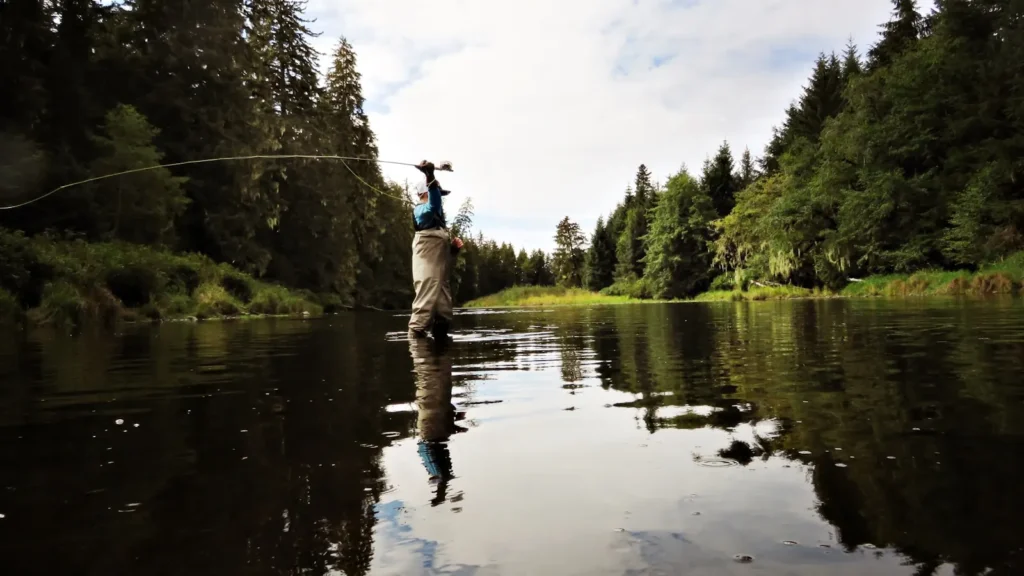
The photo at the top of this page is not Nisqually River.
It is a regional stand-in, honestly captioned but generic — we will not put a name to a river we cannot prove. Send us a photograph you took here and it replaces the stand-in, with your credit on it.
Add a photo of this water
Landscape, not fish — the water itself. Reviewed by hand before it appears. The first one published here earns the Pioneer badge.
Fished this water? Add a photo
Reviewed by hand before it appears. Pick the water, not the spot — we never publish exact locations.
Access
McKenna - the gauge community, with bridge and bank access on the lower river.
Yelm - the nearest town to the middle reach, the practical base for supplies and access information.
Wilcox Flats and the Nisqually State Park area - public frontage on the river above McKenna.
Alder Lake and La Grande Dam - the impoundments upstream that set the release schedule for the lower river.
Billy Frank Jr. Nisqually National Wildlife Refuge - the protected estuary at the river mouth on Puget Sound.
Mount Rainier National Park - the glacial headwaters and the upper river inside the park boundary.
Nisqually Indian Reservation - tribal land on the lower river, where access is by tribal permission only.
Seasons
Spring: high and cold with snowmelt layered on dam releases, and the tail of the winter steelhead season.
Summer: lowest flows but the heaviest glacial silt, with the river running opaque pale grey through the warm weeks.
Fall: the main event, with autumn rain clearing the glacial tint and Chinook, coho and chum moving up through the lower river.
Winter: high and pushy with coastal rain, with winter steelhead the target and flow the deciding factor on any given day.
From the water
No logged trips yet. Be the first to put this water on your map.
Log this water
Fished it or cleaned it? Log in or create a free account to log a trip with photos and earn the waterway badge.
Questions
What is the current flow on the Nisqually River?
As of Nov 2, 6:45 am, the USGS gauge NISQUALLY RIVER AT MCKENNA, WA reads 752 cfs. Conditions update every 15 minutes.
What species can you catch on the Nisqually River?
Anglers target Bull Trout, Chinook Salmon, Chum Salmon, Coastal Cutthroat Trout, Coho Salmon, Pink Salmon, Rainbow Trout, Steelhead on the Nisqually River in Washington.
Where can you access the Nisqually River?
McKenna - the gauge community, with bridge and bank access on the lower river. Yelm - the nearest town to the middle reach, the practical base for supplies and access information. Wilcox Flats and the Nisqually State Park area - public frontage on the river above McKenna. Alder Lake and La Grande Dam - the impoundments upstream that set the release schedule for the lower river. Billy Frank Jr. Nisqually National Wildlife Refuge - the protected estuary at the river mouth on Puget Sound. Mount Rainier National Park - the glacial headwaters and the upper river inside the park boundary. Nisqually...
When is the best time to fish the Nisqually River?
Spring: high and cold with snowmelt layered on dam releases, and the tail of the winter steelhead season. Summer: lowest flows but the heaviest glacial silt, with the river running opaque pale grey through the warm weeks. Fall: the main event, with autumn rain clearing the glacial tint and Chinook, coho and chum moving up through the lower river. Winter: high and pushy with coastal rain, with winter steelhead the target and flow the deciding factor on any given day.
Where are the fishing regulations for the Nisqually River?
Regulations change by season and section. Read the current rules on the Washington agency site: https://wdfw.wa.gov/fishing/regulations