Pink Salmon
Oncorhynchus gorbuscha
The smallest and most abundant Pacific salmon, locked into a rigid two-year life cycle that splits every river's population into genetically separate odd- and even-year lines.
Identification
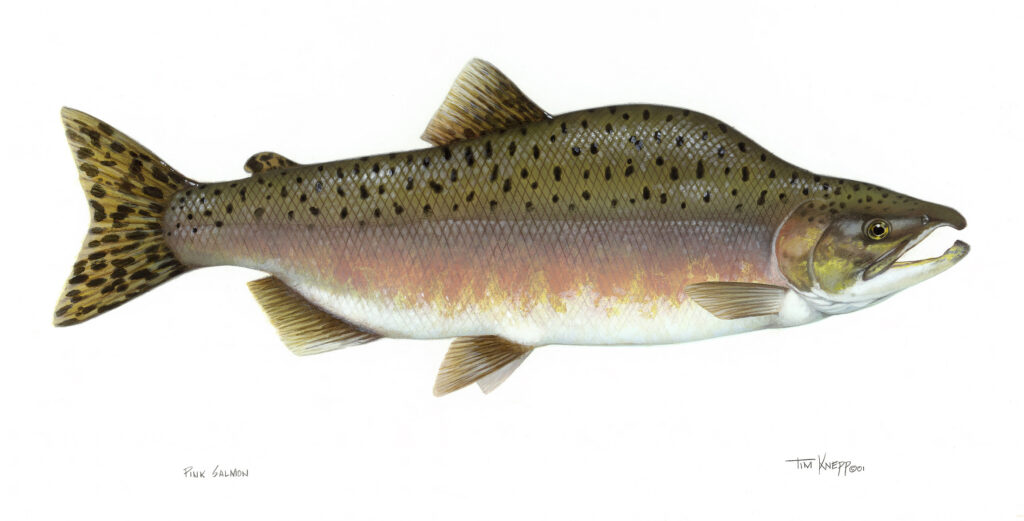
Pink salmon are the smallest Pacific salmon and among the easiest to identify. Ocean-phase fish are steel blue to blue-green across the back with bright silver sides and a white belly, marked with large oval black spots on the back and on both lobes of the tail — the spots are noticeably larger and more sharply oval than on any other Pacific salmon, and their presence across the entire tail is diagnostic. The NOAA Fisheries description leads with those large dark oval spots. Pinks also have very fine scales and no distinct spotting on the head.
The spawning male is the origin of every common name the species carries. He develops an enormous, laterally compressed dorsal hump, a hooked kype and heavy blotching, and the Alaska Department of Fish and Game notes the transformation is the reason for the nickname “humpback” or “humpy.” Females change less dramatically, darkening to olive with dusky blotching. WDFW records that pinks are the smallest fall-spawning Pacific salmon and that the male’s hump is the field mark.
Juveniles are distinctive in a way that reflects their life history: because pink fry go straight to salt water, they never develop the parr marks that stream-rearing salmonids carry. WDFW puts it directly — pink fry are “bright chrome for open water” rather than spotted for a streambed.
The two-year life cycle
Pink salmon have the shortest and most rigid life cycle of any Pacific salmon, and it is the single most important fact about the species. They mature in exactly two years. There is essentially no variation: no jacks returning early, no fish holding an extra year at sea, no age structure at all. ADF&G states that pinks “mature in exactly two years,” and NOAA describes the cycle as fry migrating to estuarine and marine waters shortly after hatching, feeding for roughly 18 months, then returning to spawn at age two, after which “all pink salmon die.”
The consequence is structural and profound. Because every fish returns at exactly two years, the fish spawning in odd-numbered years and the fish spawning in even-numbered years are reproductively isolated from each other, even where they use the same gravel in the same river. ADF&G is explicit: the two lines “do not interbreed with each other even when they return to the same spawning grounds.” A river with pink salmon does not have one population; it has two, running on parallel tracks that never touch.
These lines diverge genetically and demographically. NOAA notes that “independent populations spawn in even and odd years,” that in southern regions most systems are odd-year dominant though some Puget Sound rivers spawn in even years, and that Alaska’s northwestern populations run primarily in even years while most other Alaskan areas lack a dominant line. WDFW explains why Washington’s pattern is so clean: because pinks live exactly two years, productive runs occur only in odd-numbered years there, “since no younger or older cohorts exist to establish populations in alternate years.” A line that is extirpated cannot be rebuilt from the other line, because the other line is never in the river at the right time.
Range and distribution
Pinks occur throughout the North Pacific, from the Arctic coast of Alaska south to central California and from Russia to North Korea, though NOAA notes significant reproduction only from the Arctic coast to Puget Sound. They are the most abundant Pacific salmon by number, and ADF&G calls them “the ‘bread and butter’ fish in many Alaskan coastal fishing communities.”
They also make the shortest freshwater migrations. ADF&G records most fish travelling fewer than 40 miles upriver, with documented Alaskan exceptions to 250 miles in larger systems. WDFW notes pinks spawn near salt water in river mainstems and some tributaries. This is a direct consequence of the two-year budget: a fish with no ocean age variation and a fixed return date cannot afford a long, expensive migration.
Habitat and water temperature
Pink salmon are the thermal outliers of the genus, and the numbers are counterintuitive. Work published in the Journal of Experimental Biology tested Fraser River pinks across 8 to 28°C and found aerobic scope peaking at approximately 21°C — the temperature at which sockeye migration is considered blocked. The authors reported that pink salmon aerobic scope “was elevated across the entire temperature range in comparison with other Pacific salmonids,” with declining cardiac output above 17°C and impaired maximum swimming speed above about 23°C. The paper’s framing is that this exceptional cardiovascular performance may underlie resilience in a warming climate.
Freshwater habitat preference is colder. The U.S. Geological Survey’s nonindigenous species profile gives a preferred range of 5.6–14.6°C (42–58°F), and the Alaska Department of Fish and Game’s temperature literature review places optimal growth below 15°C with avoidance of water above that.
Eggs are where the vulnerability lies. The ADF&G review reports 100 percent mortality in pink eggs incubated at 2.0°C, and a requirement for temperatures above about 4.5°C through the gastrula stage — after which the embryo can tolerate 0°C. It also found that decreasing temperature regimes through incubation produced larger alevins and fry than increasing regimes, meaning the shape of the seasonal temperature curve matters and not only its average. Because pink eggs sit in gravel close to salt water through the winter, they are exposed to both flooding and freezing in a way that eggs in headwater tributaries are not.
Life history
The freshwater phase is the shortest of any Pacific salmon. ADF&G records fry migrating to the ocean immediately after emerging from the gravel, and WDFW states flatly that “pink fry do not rear in freshwater. Immediately after emerging they move downstream to the estuary.” Pinks therefore skip the freshwater rearing bottleneck that governs coho and stream-type Chinook abundance, which is a large part of why their numbers are so high and so volatile.
After roughly 18 months at sea, fish return to spawn between late June and mid-October. Pinks are semelparous, and in their case the terminology is almost redundant — the entire organism is built around a single reproductive event two years after fertilisation. Adults stop feeding on entering fresh water and complete spawning on stored energy. USGS research on maturing Pacific salmon documents the endocrine mechanism common to the genus: cortisol rises through the final months before spawning, accompanied by energy depletion and reduced immune capacity that increases susceptibility to parasites and pathogens. In pinks the collapse is compressed into a matter of weeks, and the male’s grotesque hump is itself part of it — a rapid, energetically expensive secondary sexual structure grown by a fish that will not live to use it twice.
Diet
ADF&G records ocean pinks feeding on “plankton, marine shrimp and krill, other smaller fish, squid, and the occasional aquatic insect,” and notes that the marine crustaceans they consume give the flesh its characteristic colour. Because fry leave fresh water immediately, there is essentially no freshwater feeding stage. Adults do not feed after entering the river.
Great Lakes populations
Pink salmon in the Great Lakes are the result of an accident, and they are the only Pacific salmon in the basin that established without sustained stocking. The USGS nonindigenous species profile records that pinks were introduced to the Canadian side of Lake Superior at Thunder Bay in 1956, when fish being handled at a Port Arthur hatchery — bred for a planned Hudson Bay stocking — entered the Current River, a Lake Superior tributary. Two accounts circulate and USGS reports both: that about 100 salmon escaped during transfer to a seaplane, and that roughly 21,000 surplus fingerlings were disposed of into the river.
They spread. USGS records second-generation fish captured in Lake Superior off Minnesota in 1959, first observation in northern Lake Huron tributaries in 1969, and dispersal throughout all the Great Lakes by 1979. The USGS-indexed account by Emery (1981) documents that expansion and — importantly — records pink salmon developing spawning populations in both even- and odd-numbered years in the Great Lakes, calling them the only self-sustaining salmon species in the basin at the time. The rigid single-line structure that characterises Pacific rivers did not survive the transplant intact.
The Michigan DNR describes pinks as unintentionally introduced in the mid-1950s and now occupying much of Lake Superior and the northern portions of Lakes Huron and Michigan, with lake-run fish showing the same large oval black spots on tail and back, spawning runs beginning in summer, and an odd-year/even-year abundance pattern alongside a slowly growing overall population. USGS notes Great Lakes pinks complete the entire life cycle in fresh water and flags competition with native chubs, lake herring and other salmonids for prey including rainbow smelt and alewife as the primary ecological concern. Pinks intentionally stocked on the Maine and Maryland coasts survived until about 1973 and then disappeared.
Angling
Everything distinctive about pink salmon behaviour follows from the two-year cycle. Runs are enormous and compressed — a river’s entire cohort arrives within weeks — and abundance alternates violently between years in systems with a single dominant line. A river that is thick with fish one August can hold almost none the next, and this is not a failure of the run but the structure of the species.
Pinks hold close to salt water. With most fish travelling fewer than 40 miles upstream, the fishery is concentrated in the lower river, the estuary and the beaches, and fish move through in dense schools rather than dispersing into individual holding lies. Their small size means they use softer water than Chinook, favouring current seams and slower margins.
Their unusual heat tolerance also matters. In a summer when mainstem temperatures climb toward 70°F and sockeye stop migrating, pink salmon are near their measured aerobic optimum and continue to move. On a river gauge showing water in the high 60s, pinks are often the only Pacific salmon still running.
Conservation
No pink salmon population is listed under the Endangered Species Act. NOAA states plainly that pink salmon “are not listed as threatened or endangered under the Endangered Species Act,” and the species does not appear among the West Coast salmon ESUs that carry protection. This reflects genuine abundance — pinks are the most numerous Pacific salmon — rather than an absence of pressure.
NOAA identifies habitat loss from dams and urban development, degraded water quality from agricultural and logging practice, and changing ocean and climate conditions as the main threats, and notes that population fluctuations correlate strongly with ocean conditions. Management includes hatchery programs, dam removal and modification, habitat restoration and water quality work supported by the Pacific Coastal Salmon Recovery Fund.
The odd/even structure creates a conservation risk that raw abundance figures conceal. Because the two lines never interbreed, a river’s total pink production can look healthy while one of its two independent populations is functionally gone — and because there is no age structure to buffer a bad year, a single catastrophic event in one line’s spawning season removes that line’s entire reproductive output. The high total numbers that keep pink salmon off the listing tables coexist with a life history that offers no redundancy at all.
Where to catch it
10 waterways on GuidedFloats list pink salmon, across 2 states. Each page carries live gauge readings, access notes, and the guides who fish it.
Alaska 6
- Bradley River below Bradley Lake Dam1 cfs
- Cooper Creek29 cfs
- Lemon Creek
- Sixmile Creek633 cfs
- Staney Creek757 cfs
- Taku River18,700 cfs
Washington 4
- Dungeness River62 cfs
- Skagit River6,220 cfs
- Skykomish River526 cfs
- Sultan River181 cfs
References
- Pink Salmon — NOAA Fisheries
- Pink Salmon: Overview — NOAA Fisheries
- Pink Salmon Species Profile — Alaska Department of Fish and Game
- Influence of Temperature on Freshwater Fishes: A Literature Review with Emphasis on Species in Alaska (Technical Report 91-1) — Alaska Department of Fish and Game, Habitat Division
- Pink salmon (Oncorhynchus gorbuscha) — Washington Department of Fish and Wildlife
- Pink Salmon (Oncorhynchus gorbuscha) - Species Profile — U.S. Geological Survey, Nonindigenous Aquatic Species
- Range extension of pink salmon (Oncorhynchus gorbuscha) into the lower Great Lakes (Emery 1981, Fisheries 6(7):7) — U.S. Geological Survey
- Pink salmon — Michigan Department of Natural Resources
- Exceptional aerobic scope and cardiovascular performance of pink salmon (Clark et al. 2011, Journal of Experimental Biology 214:3074-3081) — The Company of Biologists
- Scope of the cortisol stress response in Chinook salmon during maturation — U.S. Geological Survey
- Maximum Temperature Limits for Chinook, Coho, and Chum Salmon, and Steelhead Trout in the Pacific Northwest (Richter & Kolmes 2005) — NOAA
- Effects of Water Temperature on Anadromous Salmonids (DFG Exhibit 4) — California Department of Fish and Game / State Water Resources Control Board
- Global Warming of Salmon and Trout Rivers in the Northwestern U.S. (Isaak et al. 2018) — USDA Forest Service Rocky Mountain Research Station
- Pacific Salmon in the Great Lakes (eForum) — Great Lakes Fishery Commission
- Washington Sport Fish Records — Washington Department of Fish and Wildlife