Steelhead
Oncorhynchus mykiss
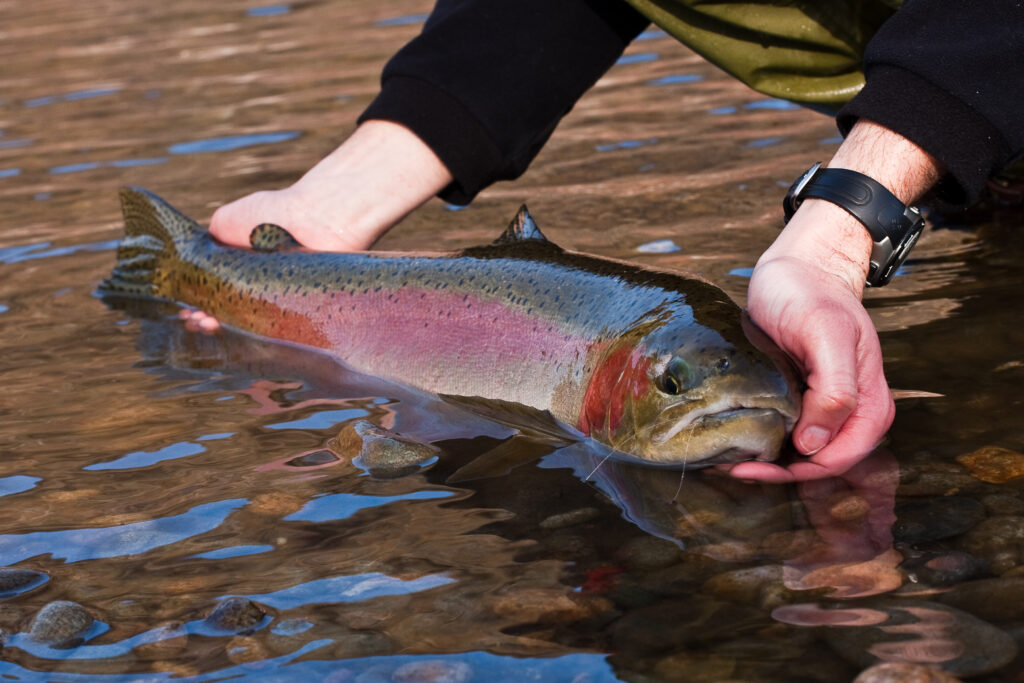
Steelhead are the ocean-going form of Oncorhynchus mykiss, rebuilt physiologically for salt water, capable of spawning more than once, and listed under the ESA across eleven population segments.
What Anadromy Actually Costs
Steelhead are the ocean-going expression of a species that does not have to go to the ocean. In the same gravel, in the same year, siblings may take entirely different paths: some mature in the stream at eight inches, others rebuild their bodies from the inside out and leave for the North Pacific. The NOAA Fisheries species account draws the line simply — fish that stay are called rainbow trout, fish that migrate are called steelhead — but the biology underneath the label is a physiological commitment, not a preference.
That commitment is smoltification. Over weeks, a stream-reared parr rebuilds its osmoregulatory machinery: gill chloride cells proliferate and switch to a seawater-secreting form, the fish deposits guanine and hypoxanthine in the skin until the parr marks disappear under silver, the body slims and the fins darken at the margins, and behaviour flips from territorial defence of a feeding station to schooling and downstream movement. Most wild steelhead go through this at age 1 to 3 in fresh water, with colder, less productive interior streams pushing smolt age later than coastal ones. The transformation is reversible if the fish does not reach salt water in time, and it is expensive — smolting fish lose condition and are more vulnerable to predation and disease during the window.
Whether a juvenile smolts at all is not a coin flip. Growth rate, lipid stores and size at a critical point in the first year push individuals across a threshold, which is why a warm, food-rich stream tends to produce residents and a cold, unproductive one tends to produce migrants. There is also a large heritable component. A chromosomal inversion on chromosome Omy5 is strongly associated with resident versus migratory tendency in coastal populations, and it behaves as a supergene — a block of genes held together by suppressed recombination so that whole life-history strategies are inherited more or less intact (Pearse et al. 2014). Below barriers, both arrangements persist; above dams that removed the ocean option, the resident-associated arrangement rises toward fixation within decades.
Run Timing Genetics, in More Detail
The summer-run and winter-run split is the most visible axis of steelhead diversity, and the discovery that so much of it tracks a single genomic region near GREB1L and ROCK1 reshaped how managers think about it. The key finding is that premature migration — entering fresh water months before spawning, sexually immature, and holding — is associated with the same region in independent lineages of both steelhead and Chinook, and that the early-migrating variant appears to have arisen once and been shared across populations rather than evolving repeatedly from scratch (Prince et al. 2017).
The management consequence is uncomfortable and worth stating plainly. If the early-migrating variant is effectively unique in origin, then a population that loses its summer-run component has not lost a behaviour that can be re-derived from the surviving winter-run fish on any useful timescale. Standing genetic variation of that kind is far easier to extinguish than to recreate. That argument has been used to press for treating run timing as a conservation unit in its own right, which cuts against the way Distinct Population Segments are currently drawn.
The picture is not settled, and the site should say so. Later work across the Columbia Basin has found the association between the region and adult migration timing to be real but lineage-dependent, with different genetic backgrounds and different environments producing different strengths of effect, and with substantial timing variation left unexplained (Narum et al. 2023). The honest summary is that a single region explains an unusually large share of a complex trait — far more than quantitative genetics led anyone to expect — but it is a strong predictor, not a switch, and it does not operate identically everywhere.
The A-run and B-run distinction in the Snake River sits partly on top of this. Those groups differ in the number of years spent at sea, and it is ocean age far more than freshwater genetics that produces the size gap between them. The larger, later-returning B-run fish are the ones most exposed to compounding mortality, because two ocean winters double the exposure to marine and migratory risk.
Life at Sea
Ocean ecology is the least visible part of the steelhead life cycle and the part that most determines how many fish come back. Unlike Chinook and coho, which often stay on the continental shelf, steelhead move offshore quickly after leaving the estuary and disperse widely across the North Pacific and the Gulf of Alaska, feeding in the upper water column on squid, amphipods, and small fishes. They are largely pelagic and largely solitary, which is why they are rarely a significant bycatch and why so little of their marine life is directly observed.
Growth at sea is fast and it is what produces the fish anglers recognise. NOAA Fisheries reports steelhead reaching roughly 40 inches and 30 pounds, against a typical adult range that WDFW puts at 8 to 11 pounds, with occasional fish of 40 pounds or more. A one-ocean-year fish and a two-ocean-year fish from the same stream can differ by a factor of three in weight. Longevity is correspondingly extended: NOAA Fisheries gives 5 to 8 years typically, up to 11.
Marine survival is the dominant term in most population models, and it is highly variable between years. Because it swamps a great deal of freshwater management effort, run forecasts built on freshwater metrics alone tend to fail in exactly the years that matter most.
Kelts and the Cost of Coming Back
Steelhead are iteroparous — they do not necessarily die after spawning, and many drop back to the ocean and return in a later year (NOAA Fisheries). This is the trait that most clearly separates them from the semelparous Pacific salmon, but the survival rates behind it are low and asymmetric.
A post-spawn steelhead, or kelt, is severely depleted: it has often gone months without meaningful feeding, has spent stored lipid on gonad development and migration, and must then run the same gauntlet downstream that it ran upstream. In interior basins with long migrations and multiple dams, the proportion that survives to spawn a second time is small — the repeat-spawner fraction is generally a few percent, against much higher rates in short coastal rivers. Females dominate the repeat-spawning population, because males expend more on prolonged competition on the spawning grounds and are in worse condition afterwards.
Because the marginal value of a returning adult is so high, several Columbia Basin programs have worked on kelt reconditioning — capturing outmigrating kelts, holding and feeding them until they regain condition, and releasing them to spawn again (Evans et al. 2001; Hatch et al. 2004). The rationale is that a reconditioned kelt is a proven spawner of known origin, which is a different thing from a hatchery smolt.
Half-pounders are the other well-known departure from the standard schedule. In the Rogue, Klamath, Eel and Mad river systems, a large share of juveniles return to fresh water after only two to four months at sea, at roughly 12 to 16 inches, overwinter without spawning, and go back to the ocean. The behaviour is regionally concentrated rather than universal, and it means that in those basins a substantial part of the visible “steelhead” population is sexually immature.
Listings and Population Structure
Steelhead are managed under the Endangered Species Act as Distinct Population Segments. NOAA Fisheries lists one DPS as endangered — Southern California — and ten as threatened: California Central Valley, Central California Coast, Lower Columbia River, Middle Columbia River, Northern California, Puget Sound, Snake River Basin, South-Central California Coast, Upper Columbia River, and Upper Willamette River, along with one non-essential experimental population in the Middle Columbia (NOAA Fisheries).
A genuine and long-running dispute sits inside those boundaries. The DPSs are drawn around the anadromous form, while resident rainbow trout in the same watersheds — often the same gene pool, capable of producing anadromous offspring — are generally outside the listed unit. Critics argue this is biologically incoherent given that the two forms interbreed and that residents can act as a reservoir for anadromy; the counterargument is that the anadromous life history is the thing at risk and the thing that ocean and mainstem conditions are destroying. The Omy5 evidence cuts both ways: it shows residents can carry migratory potential, and it shows that potential erodes quickly once the ocean route is closed.
Threats are consistent across the listed range: passage barriers and dams, degraded and simplified spawning and rearing habitat, water withdrawal, elevated stream temperature, and interactions with hatchery fish.
Range and the Shape of Diversity Across It
The native anadromous range runs from the Kamchatka Peninsula around the North Pacific rim to the Alaska coast and south along western North America. The USGS Nonindigenous Aquatic Species account gives the North American Pacific slope distribution of the species as extending from the Kuskokwim River in Alaska south to at least the Rio Santo Domingo in Baja California. Anadromy is not evenly expressed across that span: it dominates in coastal basins with short, cold, reliable connections to the sea, and thins inland until it disappears above natural barriers.
Diversity of run type follows a rough geographic logic. Winter-run fish, entering mature or near-mature, predominate in coastal rivers where the migration is short. Summer-run fish, entering immature and holding through low water, predominate where the migration is long and the spawning grounds are far inland — the interior Columbia and Snake being the extreme case, with fish travelling hundreds of miles and climbing thousands of feet. The southern end of the range, in the Southern California DPS, holds the most precarious populations, where anadromy persists in intermittent coastal streams that connect to the ocean only in wet years.
Water Temperature
Temperature governs steelhead distribution more tightly than any other measurable variable, and it acts on every life stage. Growth is most efficient near 55 °F; controlled work on O. mykiss places optimum growth temperature at 13.1 °C, or about 55.6 °F, with the ultimate upper incipient lethal temperature at 24.3 °C — roughly 76 °F (Bear et al. 2007). Those two numbers bracket the useful range.
In practice the important thresholds sit well below the lethal one. Migrating adults begin to stall and seek thermal refuge as mainstem temperatures push past the mid-60s °F, holding summer-run fish concentrate in cold tributary mouths and spring inflows through late summer, and sustained readings above about 70 °F impose a metabolic cost that a non-feeding, non-mature adult cannot pay indefinitely. Eggs and alevins are the most sensitive stage of all and require substantially colder water than adults tolerate.
The consequence for anyone reading a live gauge is that the daily maximum matters more than the daily mean, and the trajectory matters more than either. A river climbing through the mid-60s °F in July behaves very differently from one falling through the same range in September, because in the first case the fish are being pushed into refuge and in the second they are being released from it.
Steelhead as an Angling Fish
Steelhead have a reputation for difficulty that is mostly a function of density. A returning run is thinly distributed over a large river, the fish are not feeding to gain weight, and most of a day’s water holds none at all. Encounter rates per hour are low by the standards of resident trout fishing, which is why steelhead fishing is organised around covering water rather than working a rise.
Their behaviour on the line reflects the ocean phase: high-speed runs and repeated jumps, powered by white muscle and a body built for sustained marine swimming. Summer-run fish, which enter immature and hold for months, are generally more responsive to a swung or surface presentation than winter fish that arrive close to spawning; the difference is one of physiological state, not temperament. Water temperature again sets the terms — fish holding in cold winter water are far less willing to move a long distance to intercept anything, which is the underlying reason presentation depth matters more in February than in September.
Where to catch it
79 waterways on GuidedFloats list steelhead, across 10 states. Each page carries live gauge readings, access notes, and the guides who fish it.
Alaska 7
- Bradley River below Bradley Lake Dam1 cfs
- Cooper Creek29 cfs
- Lemon Creek
- Situk River611 cfs
- Staney Creek1,290 cfs
- Stikine River81,500 cfs
- Taku River20,500 cfs
California 18
- American River1,500 cfs
- Carmel River
- Cosumnes River61 cfs
- Eel River82 cfs
- Klamath River1,250 cfs
- Lower Sacramento River5,970 cfs
- Navarro River4 cfs
- Russian River156 cfs
- Salinas River
- Scott River10 cfs
- Shasta River123 cfs
- Smith River188 cfs
- South Fork Eel River14 cfs
- Stanislaus River849 cfs
- Trinity River369 cfs
- Tuolumne River1,150 cfs
- Van Duzen River7 cfs
- Yuba River551 cfs
Idaho 4
- Clearwater River3,240 cfs
- Lochsa River359 cfs
- Salmon River1,100 cfs
- Selway River517 cfs
Michigan 7
- Boardman River117 cfs
- Jordan River184 cfs
- Manistee River1,160 cfs
- Muskegon River1,370 cfs
- Pere Marquette River611 cfs
- Presque Isle River84 cfs
- Rifle River338 cfs
New York 5
- Black River4,670 cfs
- Cattaraugus Creek205 cfs
- Genesee River1,330 cfs
- Salmon River236 cfs
- Saranac River1,350 cfs
Ohio 3
- Chagrin River148 cfs
- Cuyahoga River372 cfs
- Rocky River125 cfs
Oregon 14
- Clackamas River607 cfs
- Deschutes River3,950 cfs
- Grande Ronde River591 cfs
- John Day River190 cfs
- McKenzie River1,710 cfs
- Nehalem River93 cfs
- North Santiam River1,320 cfs
- North Umpqua River736 cfs
- Rogue River1,150 cfs
- Sandy River278 cfs
- Siuslaw River Estuary
- South Santiam River1,150 cfs
- Umpqua River1,000 cfs
- Willamette River6,730 cfs
Vermont 4
- Lamoille River255 cfs
- Lewis Creek36 cfs
- Missisquoi River1,070 cfs
- Winooski River1,020 cfs
Washington 15
- Bogachiel River171 cfs
- Chehalis River27 cfs
- Cowlitz River4,040 cfs
- Dungeness River62 cfs
- Hoh River555 cfs
- Humptulips River169 cfs
- Klickitat River603 cfs
- Lake Quinault
- Methow River317 cfs
- Queets River684 cfs
- Skagit River6,370 cfs
- Skykomish River537 cfs
- Snoqualmie River687 cfs
- Sultan River185 cfs
- Wenatchee River333 cfs
Wisconsin 2
- Bois Brule River113 cfs
- Whittlesey Creek18 cfs
References
- Steelhead Trout (species profile, ESA listing status, size and life history) — NOAA Fisheries
- Steelhead Trout: Overview — NOAA Fisheries
- Oncorhynchus mykiss (rainbow trout and steelhead) species profile — Washington Department of Fish and Wildlife
- Oncorhynchus mykiss fact sheet (native range, stocking history, hybridization) — U.S. Geological Survey, Nonindigenous Aquatic Species Database
- The evolutionary basis of premature migration in Pacific salmon highlights the utility of genomics for informing conservation — Science Advances 3(8):e1603198 (Prince et al. 2017)
- Rapid parallel evolution of standing variation in a single, complex, genomic region is associated with life history in steelhead/rainbow trout — Proceedings of the Royal Society B (Pearse et al. 2014)
- Genetic variation associated with adult migration timing in lineages of steelhead and Chinook salmon in the Columbia River — Evolutionary Applications (Narum et al. 2023)
- Comparative thermal requirements of westslope cutthroat trout and rainbow trout: implications for species interactions and development of thermal protection standards — Transactions of the American Fisheries Society (Bear, McMahon and Zale 2007)
- Kelt reconditioning: a research project to enhance iteroparity in Columbia Basin steelhead (Oncorhynchus mykiss), annual report 2000 — U.S. Department of Energy / Bonneville Power Administration (Evans et al. 2001)
- Kelt reconditioning: a research project to enhance iteroparity in Columbia Basin steelhead (Oncorhynchus mykiss), 2004 annual report — U.S. Department of Energy / Bonneville Power Administration (Hatch et al. 2004)
- Smoltification in an impounded, adfluvial redband trout population upstream from an impassable dam — Transactions of the American Fisheries Society (Holecek et al. 2012)