Lake Trout
Salvelinus namaycush
The largest North American char and the deepest-living, lake trout hold below the thermocline near 50 degrees F and can live past 60 years.
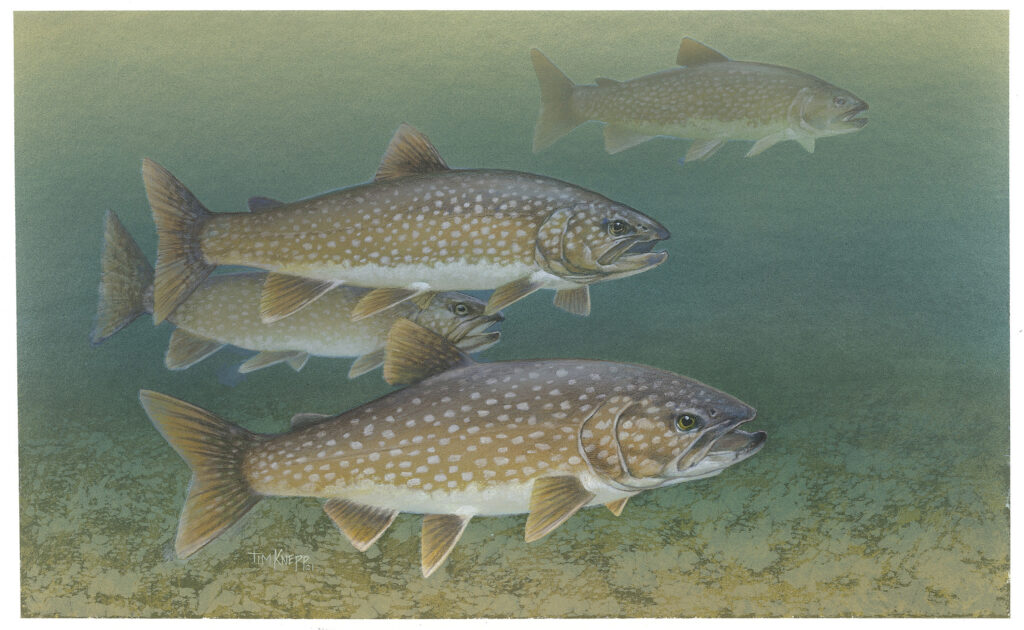
Identification
Lake trout are char, and they show the family pattern of pale marks on a dark ground. The body is gray to greenish or nearly black, covered in irregular cream to white spots that extend onto the dorsal and caudal fins. Two features separate them from every other North American char at a glance: the deeply forked tail, with lobes of equal length, and the absence of pink or red spots. The Alaska Department of Fish and Game gives exactly those two marks as the working diagnosis, along with a white leading edge on the pectoral, pelvic, and anal fins.
Michigan’s Department of Natural Resources describes light spots on a black to gray background, white bellies, and orange-red lower fins, with the deeply forked tail and an adipose fin. Breeding males develop a slightly longer and more pointed snout and a dark lateral stripe.
Lake Superior complicates the picture, because it holds three morphologically distinct forms that the Great Lakes Fishery Commission treats separately for management. Lean lake trout have a straight pointed snout, a slender body, and low fat content, and live inshore in water shallower than about 73 m. Siscowets have a convex snout, a robust body, and very high fat content, and live offshore between roughly 50 and 150 m. Humpers occupy isolated shoals about 50 m deep surrounded by water over 100 m, and are intermediate. Older federal accounts describe siscowet fat content reaching nearly 70 percent, which is why the form was historically considered too oily for ordinary market use.
Range and distribution
The native distribution runs from Alaska east to the Labrador Peninsula, south into northern New England and northern New York, and through the Great Lakes basin, as summarized in the NOAA Fisheries leaflet on the species. It is essentially a map of formerly glaciated ground with deep, cold, oxygenated lakes.
In Alaska, lake trout occupy deep lowland lakes on the central Arctic coastal plain, waters of the Brooks Range and Alaska Range, and both clear mountain lakes and turbid glacial systems on the north side of the Chugach Range and the Kenai Peninsula. They are absent from the Yukon-Kuskokwim lowlands and from Southeast Alaska coastal drainages.
The introduced range is the more consequential story for western rivers and reservoirs. Lake trout were stocked into deep lakes across the northern and western United States and have repeatedly restructured the systems they entered. NatureServe assigns the species a global rank of G5, secure, with an adult population exceeding one million and a very wide distribution.
Habitat and water temperature
Lake trout are the coldest-preferring of the widely distributed North American salmonids in still water. A synthesis of laboratory work compiled for water quality standards gives an optimum growth temperature of 10 to 12.5 C (50 to 54.5 degrees F) and a final thermal preferendum of 10.2 to 11.7 C (50 to 53 degrees F), with upper preference values reaching 14.5 C. The same review gives an upper incipient lethal temperature of 22.5 to 23.5 C (72.5 to 74.3 degrees F) for fish acclimated at 8 to 15 C, and a critical thermal maximum of 25.9 C at 17 C acclimation. Those numbers are drawn together in the Nevada Division of Environmental Protection thermal tolerance analysis, which cites Gibson and Fry, McCauley and Tait, Edsall and Cleland, and others.
Field agencies describe a slightly wider window. Michigan’s DNR gives a preferred range of 40 to 55 degrees F. The NOAA leaflet reports that adults prefer water of about 50 degrees F and seldom remain for extended periods above it, and that siscowets live colder still, in water probably seldom exceeding 40 degrees F. The disagreement is more apparent than real: the laboratory optimum measures growth under unlimited food, while the field preference measures where fish actually sit, and lake trout will choose colder than growth-optimal water when it is available.
The seasonal pattern follows directly. Alaska describes lake trout near the surface and along shorelines in spring, then progressively deeper as the season advances, finally residing beneath the thermocline. Michigan gives the same cycle in numbers: 10 to 30 feet in fall, winter, and spring, retreating to 100 to 200 feet and beyond in warm summers, and reports lake trout most abundant between 100 and 300 feet in the Great Lakes during the stratified season.
This is why a surface water temperature reading is nearly useless as a direct measure of lake trout habitat, and highly useful as an indirect one. What surface temperature tells you is where the thermocline is likely to sit and how compressed the usable band has become. The real constraint is oxythermal, meaning the fish need cold water and adequate dissolved oxygen in the same layer. In productive or enriched lakes, hypolimnetic oxygen is drawn down over the summer while the epilimnion warms, and lake trout get squeezed between water that is too warm above and too depleted below. That squeeze, rather than any single temperature, sets the southern edge of the species and makes lake trout an early casualty of nutrient loading and lake warming.
Life history
Lake trout are long-lived, slow-growing, and late to mature, and every part of their biology follows from that. Alaska reports that populations there commonly live around 20 years, some exceed 50, and the oldest lake trout aged was 62 years old. Michigan gives a lifespan exceeding 25 years for Great Lakes fish. Maturity comes at five to eight years in Alaska and six to seven in Michigan.
Growth is slow and slows further with size. Tagging work summarized by NOAA showed an average of about 3 inches of growth per year for fish between 12 and 26 inches, dropping to half an inch or less per year for fish over 36 inches. A 40-inch lake trout is therefore not a fast-grown fish, it is an old one.
Spawning is unusual among salmonids in that no redd is built. Fish broadcast eggs over clean rocky substrate and the eggs fall into the interstitial spaces, where they incubate through the winter. Alaska records spawning in September or October over clean rocky lake bottoms, and notes that it happens only at night, with peak activity after dusk. NOAA gives a range beginning in August in the north and extending into November in the Great Lakes and into December in certain New York lakes. A USGS review of Great Lakes spawning habitat found no direct evidence of egg deposition deeper than 18 m, and concluded that substrate size and shape, reef contour, and wave exposure govern site selection, while the role of water temperature in spawning remains unclear.
Reproductive output is low. Alaska reports that northern populations spawn every other year or less often, while southern Alaskan stocks may spawn annually. Michigan documents strong homing, with fish returning to the same reefs year after year.
Alaska’s managers draw the obvious conclusion plainly: slow growth, alternate-year spawning, and older ages at maturity combine to make lake trout populations susceptible to overharvest, and when large fish are removed it takes many years to restore the biomass.
Diet
Lake trout are generalists that become specialists on fish as they grow. Alaska’s list for the species is remarkably broad: zooplankton, insect larvae, small crustaceans, clams, snails, leeches, several kinds of fish, mice, shrews, and occasional young birds. Larger individuals feed heavily on whitefish, grayling, sticklebacks, and sculpins.
In the Great Lakes the transition point is well documented. NOAA reports young fish taking small crustaceans and opossum shrimp, with fish becoming the principal food by the time a lake trout reaches 15 to 18 inches. Michigan lists native ciscoes and sculpin as the historical staples, supplemented by alewives, smelt, and round gobies where those are present.
The dependence on a deep-water forage base is a recurring vulnerability. Where native ciscoes collapsed, lake trout growth and condition followed, and where introduced forage later filled the gap, it came with its own problems including thiamine deficiency in some Great Lakes stocks.
Angling
Nearly everything distinctive about lake trout as a quarry follows from the thermal biology. For a few weeks after ice-out the entire population is available in the top of the water column, because the whole lake is uniformly cold and there is no reason for the fish to be deep. As the surface warms and stratification sets up, lake trout withdraw below the thermocline, and the fishery becomes a depth-and-structure problem rather than a location problem. In autumn the process reverses and fish move onto shallow rock to spawn.
The forms matter where they occur. In Lake Superior, leans, siscowets, and humpers occupy different depth strata and are effectively different fisheries, which is why the Great Lakes Fishery Commission tracks them separately.
The life history has a direct consequence for how populations respond to fishing pressure. A 30-pound lake trout may be four or five decades old, from a population that spawns every second year and matures at six or more. Alaska’s own assessment is that lake trout production rates are inherently low and that removing large fish means several years before the biomass is replaced. On lakes where fish are handled and released, water temperature at depth and the physical stress of a rapid ascent from 100 feet or more are the relevant variables, not air temperature.
Conservation
The Great Lakes collapse is the defining conservation episode for the species. Lake Superior supported an annual commercial harvest of about 2 million kg (4 million pounds) from 1920 to 1950. Stocks then collapsed under the combined weight of excessive fishing mortality and sea lamprey predation, and harvest declined more than 90 percent between 1953 and 1962, when agencies closed the commercial lake trout fishery. Chemical sea lamprey control began in 1958 and reduced lamprey abundance 87 percent by 1961. Those figures come from the Lake Trout Restoration Plan for Lake Superior.
Lake Superior is the success story. The Great Lakes Fishery Commission’s State of the Lake assessment reports that the abundance of naturally reproduced lake trout is at or above the best estimates of pre-lamprey abundance, that the Lake Superior Committee considers the population restored, and that stocking was substantially reduced by 1996 as natural reproduction took over. Rehabilitation depended on sea lamprey control first, with harvest management and stocking effective only afterward.
Outside the native range, lake trout are the problem rather than the patient. In Yellowstone Lake, a lake trout was first documented in 1994, and the National Park Service has since removed more than 2.3 million of them to protect Yellowstone cutthroat trout. The predation rate is stark: the Park Service records a single overnight net set of 21 lake trout containing the remains of at least 47 cutthroat trout. Gillnet suppression effort rose to about 79,000 units by 2016, against a 2001 to 2011 average of 20,500, with crews working six days a week from late May into early October. Suppression concentrates in deeper water that cutthroat do not typically use, which is exactly the thermal separation described earlier. Details are in the National Park Service account of the program.
The same dynamic plays out in the Northern Rockies at the expense of bull trout. In Flathead Lake, lake trout populations boosted by introduced Mysis shrimp fed heavily on kokanee and juvenile bull trout, and Montana Fish, Wildlife and Parks records the bull trout population taking a nosedive as a result. Montana’s field guide lists lake trout predation on juveniles among the primary threats to native bull trout.
Climate is the emerging pressure on native populations. Because lake trout depend on the joint availability of cold water and dissolved oxygen, warmer surface temperatures and longer stratified seasons compress usable habitat from both directions, and the effect is felt first in the shallower, more productive lakes at the southern edge of the range.
Where to catch it
34 waterways on GuidedFloats list lake trout, across 14 states. Each page carries live gauge readings, access notes, and the guides who fish it.
Alaska 2
- Cooper Creek29 cfs
- Kvichak River29,500 cfs
Colorado 1
Idaho 3
Maine 5
- Allagash River566 cfs
- East Branch Penobscot River444 cfs
- Fish River128 cfs
- Sebago Lake
- West Grand Lake
Michigan 2
Montana 4
New York 4
Pennsylvania 1
South Dakota 2
Utah 1
Vermont 2
Washington 1
Wisconsin 2
Wyoming 4
- Boulder Creek below Boulder Lake13 cfs
- Jackson Lake
- Pacific Creek50 cfs
- Snake River1,000 cfs
References
- Lake Trout Species Profile — Alaska Department of Fish and Game
- Lake Trout in Michigan — Michigan Department of Natural Resources
- The Lake Trout (Salvelinus namaycush), Fishery Leaflet 555 — NOAA Fisheries / U.S. Fish and Wildlife Service
- Lake Trout (Salvelinus namaycush) Thermal Tolerance Analysis — Nevada Division of Environmental Protection
- Lake trout spawning habitat in the Great Lakes: a review of current knowledge — U.S. Geological Survey
- A Lake Trout Restoration Plan for Lake Superior — Great Lakes Fishery Commission
- State of the Lake: Lake Superior — Great Lakes Fishery Commission
- Suppressing Non-native Lake Trout to Restore Native Cutthroat Trout in Yellowstone Lake — U.S. National Park Service
- Salvelinus namaycush, Lake Trout, conservation status — NatureServe Explorer
- Salvelinus namaycush siscowet — NatureServe Explorer
- An Upstream Battle (lake trout impacts on bull trout, Flathead Lake) — Montana Fish, Wildlife and Parks, Montana Outdoors
- Bull Trout, Montana Field Guide (lake trout listed as a threat) — Montana Natural Heritage Program and Montana Fish, Wildlife and Parks
- IGFA World Records — International Game Fish Association