Arctic Grayling
Thymallus arcticus
The only salmonid with a sail for a dorsal fin, and the subject of one of the more consequential conservation fights in American fisheries — the collapse of Montana's native river grayling in the Big Hole.
Identification
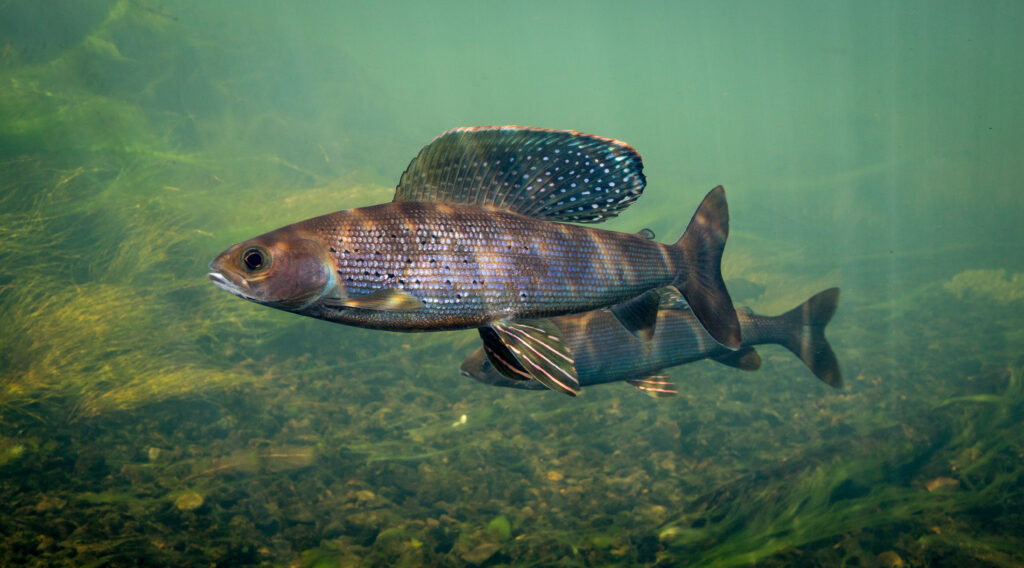
No other North American freshwater fish looks like this. The dorsal fin is enormous and sail-like, and ADF&G describes it as “typically fringed in red and dotted with large iridescent red, aqua, or purple spots.” The fin is not ornamental in the sense of being incidental — it is the diagnostic feature of the genus Thymallus and it is proportionally largest in mature males, which use it in display and in spawning.
The rest of the fish is quieter but distinctive. The back is dark, the sides run silver to blue or grey with scattered black spots, and the belly is white; body colour varies noticeably between streams. The pelvic fins are striated with iridescent orange, red or pink. The tail and pectoral fins are duller, and the tail carries a scalloped edge that ADF&G calls unique. There is an adipose fin — this is a salmonid — and the mouth is small, matched to a diet of drifting insects rather than fish.
Grayling reach 610 mm (24 inches) and 2.3 kg (5 pounds 1 ounce) at the extreme in Alaska (ADF&G). In Montana, exceptional individuals reach 20 inches and 3 pounds (Montana Field Guide). Most fish an angler encounters are considerably smaller.
Range and distribution
Arctic grayling are circumpolar, occurring from the Ural Mountains of Russia across Siberia, Alaska and Canada to the western shores of Hudson Bay. In Alaska they are found throughout most of the state, excluding Kodiak Island, the Aleutians and Southeast Alaska other than stocked lakes — they survived the last glaciation in the unglaciated Yukon River valley and North Slope refugia and spread from there (ADF&G Wildlife Notebook Series).
In the contiguous United States the picture is entirely different, and it is a story of loss. Two disjunct native populations existed south of Canada: one in Michigan’s Lower Peninsula, and one in the upper Missouri River basin above Great Falls, Montana. The Michigan population is extinct (USFWS).
The Montana population is where the conservation argument sits. Grayling in the upper Missouri basin occur in two forms: adfluvial fish that live in lakes and run to tributaries to spawn, and fluvial fish that complete their entire life cycle in rivers. Montana still holds adfluvial grayling in 30 or more lakes across the western half of the state. The fluvial form is the one that nearly disappeared.
Habitat and water temperature
Grayling are cold-water specialists, and unusually the numbers for this are published by a federal agency in a regulatory document. In its 12-month finding on the Upper Missouri River population, USFWS states that “Arctic grayling optimal thermal habitat is between 7 to 17°C (45 to 63°F), but becomes unsuitable above 20°C (68°F),” citing Hubert et al. (1985) (79 FR, 20 August 2014).
Two caveats belong with those figures. First, life stages differ: USFWS notes that fry may be more tolerant of high water temperature than adults. Second, populations may differ. Lohr and colleagues studied upper thermal tolerance in Big Hole River grayling in 1996, but USFWS points out that the study design “did not include other populations from different thermal regimes, so it was not possible to make between-population contrasts under a common set of conditions.” There is, in other words, no verified single lethal temperature that applies rangewide, and printing one would misrepresent the state of the evidence.
For Alaskan waters, the state’s water quality criteria for fresh waters supporting fish growth and propagation set the outer bounds: such waters may not exceed 20°C (68°F) at any time, with 15°C (59°F) for migration routes and rearing areas and 13°C (55°F) for spawning areas and egg and fry incubation (18 AAC 70).
Habitat preference follows from the thermal band. Montana grayling occupy small, cold, clear lakes with tributaries suitable for spawning, and in rivers they need connected cold water across the whole annual cycle. In warmer regions grayling are often associated with spring-fed habitats, which hold temperature where surface-fed reaches do not. Alaskan grayling additionally tolerate low dissolved oxygen well enough to overwinter in deep pools and lakes that other salmonids cannot use.
Life history
Grayling spawn in spring, shortly after ice-out. They do not build redds: eggs are broadcast over gravel in moving streams and sink to lodge between pebbles. Females produce between 1,500 and 30,000 eggs, and fry hatch about three weeks after spawning. In Alaska, first spawning occurs between ages 4 and 7 at a length of roughly 255 to 305 mm (10 to 12 inches), and fish may spawn many times over a life that ADF&G’s species profile puts at up to 32 years — the Wildlife Notebook says 30. Either figure makes grayling one of the longest-lived salmonids in North America.
Movement is the other defining trait. Alaskan grayling employ strikingly varied strategies, some migrating extensively between separate spawning, rearing, summer feeding and overwintering areas within a single year and others staying in one section of stream. Juveniles often occupy warmer water in the lower river to accelerate growth. In Montana, grayling in the Big Hole River have been recorded moving up to 60 miles between habitats. That mobility is exactly why fragmentation hurts this species so badly: a fish that must reach four different places in a year cannot tolerate a barrier at any of them.
Diet
Arctic grayling are drift feeders. The primary foods are drifting aquatic insects — blackflies, mayflies, stoneflies and caddisflies. They take terrestrial insects that fall to the surface, and opportunistically salmon eggs, smaller fish and salmon smolts. ADF&G notes that they will occasionally take small mammals, which is less a dietary category than an indication of how unselective a hungry grayling can be. Lake populations shift toward zooplankton, and river populations remain mostly insectivorous (Montana Field Guide).
Angling
The drift-feeding habit makes grayling the most reliably surface-oriented salmonid in much of the north. They hold in the current, watch upward, and rise freely to small dry flies — behaviour that in a warmer river would be considered a hatch-dependent event and in a grayling river is closer to a default. The small mouth means small hooks; the soft take means the rise is often more visible than felt.
In Alaska the fishery is broad and unglamorous by the standards of the state’s salmon runs. The Chena River grayling fishery near Fairbanks “has been popular since before statehood and has increased in popularity as Fairbanks and the surrounding area have been developed and access has improved,” and ADF&G describes it as offering high-quality opportunity because of ease of access and a high proportion of large fish (ADF&G Fishery Management Report 25-33). ADF&G has assessed grayling stocks in the headwaters of both the Chena and Chatanika rivers (Fishery Data Series 04-22). Trophy grayling in lightly fished Alaskan water exceed 3 pounds.
In Montana the same fish carries entirely different weight. Fishing for fluvial grayling in the Big Hole is fishing for a population that has been the subject of a two-decade recovery effort, and the fish are encountered against that background rather than as a routine catch.
Conservation
Globally the species is ranked G5, secure. Montana ranks it S1 — the state’s highest level of concern — noting it is declining and faces numerous threats.
The decline of Montana’s fluvial grayling is one of the more important conservation cases in American fisheries because of what it demonstrates: a fish can lose almost everything without ever being listed. USFWS documents that fluvial Arctic grayling occupied up to 2,000 km (1,250 miles) of stream habitat in the upper Missouri system until the early twentieth century, in the mainstem Missouri and in the Smith, Sun, Jefferson, Madison, Gallatin, Big Hole, Beaverhead and Red Rock rivers. The fluvial form “currently occupies less than 10 percent of its historical range in the Missouri River system.” In its 2014 finding USFWS stated that “the only remaining native fluvial population is found in the Big Hole River and some of its tributaries,” while the Service’s species page describes two remaining fluvial populations — the Big Hole upstream from Divide and the upper Ruby near Alder. Those statements are not identical, and readers should be aware that accounts differ on whether the Ruby population counts as native fluvial or as restored.
Abundance is low by any measure. USFWS reports that estimated abundance of reproductively mature individuals in the fluvial populations “varies from about one hundred to several thousand Arctic grayling.”
The response was a Candidate Conservation Agreement with Assurances on the Big Hole — an arrangement under which private landowners undertake habitat work in exchange for regulatory certainty. The mechanism is unglamorous: reducing irrigation dewatering, restoring riparian vegetation, removing barriers, and opening access to cold-water refugia. In July 2020 USFWS again found that listing the Upper Missouri River Distinct Population Segment “as an endangered species or threatened species under the Act is not warranted,” citing 13 years of CCAA implementation that “addressed many past threats, and resulted in both improvements in habitat conditions and increases in the number of effective breeders,” and reporting that effective breeders in the Big Hole increased by 111 percent on average since 2006 (85 FR, 23 July 2020).
The named threats are consistent across sources: dewatering from irrigation and the water temperature increases that follow, competition and predation from introduced species, habitat degradation and fragmentation, drought and climate change. The temperature threat is the one that connects directly to the biology described above. A fish whose habitat becomes unsuitable above 68°F, in a river drawn down for irrigation in August, in a warming climate, in the last 10 percent of its historical range, has very little margin. That the Big Hole population has grown rather than vanished is a real result, and it took a coordinated agreement with private landowners over more than a decade to produce it.
Where to catch it
14 waterways on GuidedFloats list arctic grayling, across 3 states. Each page carries live gauge readings, access notes, and the guides who fish it.
Alaska 9
- Chena River2,470 cfs
- Chena River below Moose Creek Dam1,890 cfs
- Cooper Creek29 cfs
- Gulkana River1,040 cfs
- Kvichak River28,000 cfs
- Salcha River2,080 cfs
- Sixmile Creek665 cfs
- Taku River20,500 cfs
- Talkeetna River3,550 cfs
Montana 3
- Big Hole River471 cfs
- Hebgen Lake
- Madison River below Hebgen Lake707 cfs
Wyoming 2
- Gibbon River72 cfs
- North Brush Creek10 cfs
References
- Arctic Grayling Species Profile — Alaska Department of Fish and Game
- Arctic Grayling — Wildlife Notebook Series — Alaska Department of Fish and Game
- Endangered and Threatened Wildlife and Plants; Revised 12-Month Finding on a Petition To List the Upper Missouri River Distinct Population Segment of Arctic Grayling — U.S. Fish and Wildlife Service, 79 FR, 20 August 2014, via GovInfo
- Endangered and Threatened Wildlife and Plants; Four Species Not Warranted for Listing — U.S. Fish and Wildlife Service, 85 FR, 23 July 2020, via GovInfo
- Arctic Grayling species account — Montana Field Guide, Montana Natural Heritage Program and Montana Fish, Wildlife and Parks
- Arctic Grayling (Thymallus arcticus) — U.S. Fish and Wildlife Service
- Fishery Management Report for Recreational Fisheries in the Tanana River Management Area (FMR 25-33) — Alaska Department of Fish and Game
- Stock Assessment of Arctic Grayling in the Headwaters of the Chatanika and Chena Rivers During 2002 (Fishery Data Series 04-22) — Wuttig, K.G., Alaska Department of Fish and Game
- Alaska Water Quality Standards, 18 AAC 70 — Alaska Department of Environmental Conservation
- Fishery Management Report for Sport Fisheries in the Tanana River Drainage from 1995 to 1997 (FMR 00-6) — Parker, J.F. and T. Viavant, Alaska Department of Fish and Game
- IGFA World Records — International Game Fish Association