Sockeye Salmon
Oncorhynchus nerka
The lake-dependent Pacific salmon, turning scarlet at spawning, with the Snake River population endangered and unusually well-documented thermal limits.
Identification
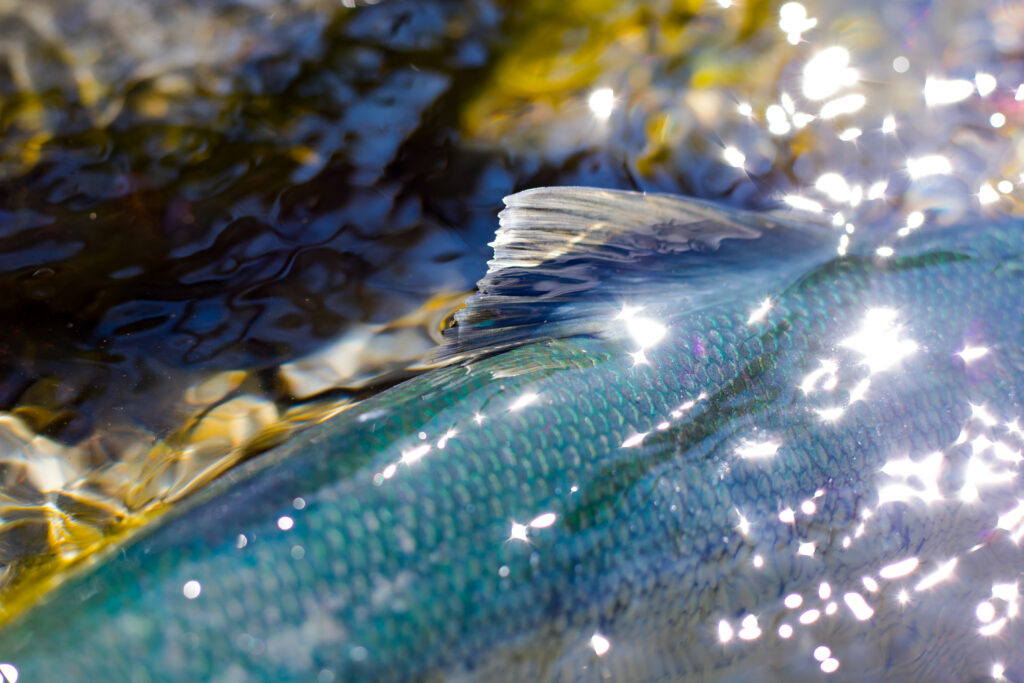
At sea, sockeye are the sleekest and most streamlined of the Pacific salmon: metallic green-blue across the back, iridescent silver on the flanks, white below, and — critically — without the distinct black spots found on Chinook, coho and pink salmon. The Alaska Department of Fish and Game describes ocean fish as showing “iridescent silver flanks, a white belly, and a metallic green-blue top.” Fine speckling may be present but discrete oval spots are not. Sockeye also have notably fine, numerous gill rakers, an adaptation to a diet of zooplankton.
The spawning transformation is the most dramatic in the genus. Bodies turn brilliant scarlet while the head stays olive-green; males develop a pronounced dorsal hump and a hooked kype, and the change is fast enough to be visible over days. ADF&G records returning fish developing “brilliant red bodies with greenish heads.” Washington Department of Fish and Wildlife notes the species is called blueback in the Columbia and Quinault rivers, and kokanee when landlocked.
Range and distribution
Sockeye range from the Klamath River north to Point Hope, Alaska, but their distribution within that span is far patchier than any other Pacific salmon’s, for one reason: they need a lake. WDFW states the requirement plainly — sockeye “require a lake to rear in as fry,” so a spawning river must contain a lake system. That single constraint determines where sockeye occur and why they are absent from many rivers that support four other salmon species.
The largest runs are Alaskan and Canadian. ADF&G identifies Bristol Bay’s rivers and the Fraser system as holding the biggest populations. Bristol Bay’s scale is difficult to overstate: the department’s season summary for 2022 recorded an inshore run of 79.0 million sockeye, the largest on record and 81 percent above the preceding twenty-year average, with a commercial harvest of 60.1 million fish. The 2024 run of 51.6 million was the tenth consecutive year above 50 million.
In Washington, WDFW lists Lake Washington, Baker Lake, Ozette Lake, Lake Quinault and Lake Wenatchee among the systems used. The most extreme population is Idaho’s. Snake River sockeye return to the Sawtooth Valley lakes, and the Idaho Department of Fish and Game describes the journey as “more than 900 miles and climbing more than 6,500 feet in elevation” — the longest and highest sockeye migration in the world.
Where sockeye are cut off from the sea, or where populations simply forgo migration, they persist as kokanee, a permanently freshwater form of the same species covered separately.
Habitat and water temperature
Sockeye spawn on lake beaches, at lake outlets and in tributary streams, then rear as fry in the lake itself for one to two years. WDFW notes that because sockeye “use freshwater year-round,” lake water quality is unusually consequential for the species, and that they can “move below the thermocline if surface waters become thermally unsuitable” — a real but limited buffer against warming.
Adult thermal biology is the best-quantified of any Pacific salmon, and it is also where sources most visibly disagree. Laboratory work on eight Fraser River populations published in Science found population-specific optimal temperatures for aerobic scope ranging from 14.5°C for the coastal Weaver population to 16.4–17.2°C for upriver populations, with the differences tracking the temperatures each population historically encountered on migration. The same study noted that Fraser temperatures near Hells Gate have peaked at 21.5°C since the 1940s, that historic mean migration temperatures never exceeded 19°C, and that no population has historically begun migration above 21°C.
Field survival tells a more conservative story. Modelling of Snake River sockeye published in PLOS ONE found survival declining significantly above 15°C (59°F), and projected 2040s migrants encountering above 19°C at Bonneville, 21°C at Ice Harbor and 23°C in the lower Salmon River, with cumulative survival falling 78–81 percent from baseline. The two findings are not contradictory but they are not interchangeable: a temperature at which aerobic scope is maximal in a swim tunnel is not a temperature at which a fish reliably completes a 900-mile migration.
The 21°C (70°F) figure recurs as the practical blocking threshold. Isaak et al. (2018) identify 21°C as the critical threshold for sockeye migration and record that in 2015 Columbia temperatures crossed it four weeks earlier than normal. The consequence was catastrophic. The Northwest Power and Conservation Council reports that more than 250,000 sockeye died in summer 2015 — about half the anticipated 500,000-fish run — with water above Bonneville Dam averaging 73°F, nine degrees above the five-year average, and biologists projecting losses reaching 80 percent before fish reached spawning grounds. NOAA Fisheries records that “unusually warm river conditions killed most adult sockeye salmon migrating up the Columbia and Snake River system in 2015.”
Egg incubation is the cold end. The Alaska Department of Fish and Game’s temperature literature review reports optimal incubation at 5–8°C and notes that sockeye eggs incubated above 14°C did not survive.
Life history
Sockeye spend one to four years in fresh water and one to three at sea, per ADF&G, with a typical total lifespan of three to five years and a maximum around six. Females deposit 2,000–5,000 eggs in gravel redds. The lake-rearing phase distinguishes them entirely from the other Pacific salmon: fry emerge from stream or beach gravel and move into the lake, where they feed on zooplankton in open water for one or two years before smolting.
Sockeye are semelparous, and ADF&G states the outcome directly: after spawning, “both parents die shortly after.” The collapse is physiological rather than merely exhaustive. Adults stop feeding on entering fresh water and complete the migration, the scarlet transformation, gonad maturation and spawning entirely on stored fat and muscle protein. USGS research on maturing Pacific salmon documents rising resting and stressed cortisol through the final three months, accompanied by energy depletion and suppressed immune function that increases susceptibility to parasites and pathogens. For a Snake River fish climbing 6,500 feet over 900 miles, the energy budget is the binding constraint, and every degree of extra water temperature raises the metabolic cost of the trip.
Diet
Sockeye are the plankton specialists of the genus, and their fine gill rakers reflect it. ADF&G records juveniles feeding on zooplankton and small crustaceans in fresh water, with ocean adults taking the same prey plus small fish. The dependence on zooplankton is what ties sockeye productivity to lake conditions so tightly — a lake’s plankton production effectively sets the carrying capacity for a year class. The crustacean-heavy diet also produces the deep red flesh the species is named for in commerce.
Angling
Sockeye behaviour in rivers follows directly from their biology. As plankton feeders they have no history of chasing baitfish, and adults have stopped feeding altogether, so their reactions in fresh water are territorial and reflexive rather than predatory. Sockeye also travel in dense, tightly schooled groups and move along predictable travel lanes — often close to the bank in the softer water at the edge of the main current — rather than dispersing into holding lies the way Chinook or coho do.
Run timing is driven by lake access and temperature. Fish stage at river mouths and below thermal barriers, and when mainstem temperature crosses roughly 70°F migration stops: fish hold rather than continue, and mortality accumulates. On systems with live temperature monitoring, that threshold is the single most informative number on the gauge during a summer run.
The rapid colour change is a useful index of physiological state. A chrome-bright sockeye in the lower river is days or weeks from spawning with its energy reserves largely intact; a scarlet fish at a lake outlet is close to the end of a process that ends in death regardless of what happens to it.
Conservation
NOAA Fisheries lists two sockeye Evolutionarily Significant Units: Snake River (endangered) and Ozette Lake (threatened). No other sockeye population is listed.
Snake River sockeye were listed as endangered on November 20, 1991, with critical habitat designated in December 1993 and the listing reaffirmed in 2005; a recovery plan was adopted in June 2015. The listing covers all naturally spawned anadromous and residual sockeye originating in the Snake River basin plus the Redfish Lake Captive Broodstock and Snake River Sockeye Hatchery programs. IDFG records that in the 1880s an estimated 25,000 to 35,000 sockeye returned annually to the Sawtooth Valley and Payette Basin, and that by 1992 a single fish — the one that became known as Lonesome Larry — returned to Redfish Lake. The captive breeding program was founded on just 16 adults captured between 1991 and 1998, eleven males and five females, and IDFG reports it has retained about 95 percent of the remaining genetic variability. Hatchery-origin adults that complete the ocean migration now spawn naturally in Redfish Lake.
Ozette Lake sockeye were listed as threatened on March 25, 1999, with critical habitat designated September 2, 2005 and a recovery plan in 2009. The ESU covers naturally spawned sockeye from the Ozette River, Ozette Lake and its tributaries, plus the Umbrella Creek/Big River hatchery program run by the Makah Tribe. The population’s beach-spawning component is the principal concern; hatchery work has aimed at re-establishing tributary spawning to broaden distribution. NOAA identifies predation by non-native fish and river otters, invasive plants degrading stream habitat, and habitat and water-quality loss as the main threats.
Climate is the dominant long-term pressure across the range. The PLOS ONE projection for Snake River sockeye is stark: under 2040s scenarios, cumulative survival falls 78–81 percent from baseline, and in 41–55 percent of simulated years cumulative survival drops below 5 percent. NOAA’s own summary anticipates survival declining by roughly 80 percent from already depressed levels, with many more years as warm as 2015 and heat persisting through the summer rather than abating as it did that year.
Where to catch it
14 waterways on GuidedFloats list sockeye salmon, across 2 states. Each page carries live gauge readings, access notes, and the guides who fish it.
Alaska 11
- Bradley River below Bradley Lake Dam1 cfs
- Cooper Creek29 cfs
- Copper River51,400 cfs
- Gulkana River1,040 cfs
- Kenai River4,270 cfs
- Kvichak River28,000 cfs
- Lemon Creek
- Situk River611 cfs
- Staney Creek1,290 cfs
- Stikine River81,500 cfs
- Taku River20,500 cfs
Washington 3
References
- Sockeye Salmon (Protected) — NOAA Fisheries
- Sockeye Salmon (Protected): Overview — NOAA Fisheries
- Sockeye Salmon (Protected): Resources — NOAA Fisheries
- Snake River Sockeye Salmon — NOAA Fisheries West Coast Region
- Lake Ozette Sockeye Salmon — NOAA Fisheries West Coast Region
- Warming Poses "Catastrophic" Threat to Snake River Sockeye — NOAA Fisheries
- Sockeye Salmon Species Profile — Alaska Department of Fish and Game
- 2022 Bristol Bay Salmon Season Summary — Alaska Department of Fish and Game, Division of Commercial Fisheries
- 2024 Bristol Bay Salmon Season Summary — Alaska Department of Fish and Game, Division of Commercial Fisheries
- Influence of Temperature on Freshwater Fishes: A Literature Review with Emphasis on Species in Alaska (Technical Report 91-1) — Alaska Department of Fish and Game, Habitat Division
- Sockeye Salmon (Oncorhynchus nerka) — Washington Department of Fish and Wildlife
- Sockeye salmon (Ozette Lake ESU) — Washington Department of Fish and Wildlife
- Sockeye Salmon — Idaho Department of Fish and Game
- Differences in Thermal Tolerance Among Sockeye Salmon Populations (Eliason et al. 2011, Science 332:109-112) — University of British Columbia
- Snake River sockeye and Chinook salmon in a changing climate (Crozier et al. 2020, PLOS ONE 15(9):e0238886) — PLOS ONE
- Global Warming of Salmon and Trout Rivers in the Northwestern U.S. (Isaak et al. 2018) — USDA Forest Service Rocky Mountain Research Station
- Warm Water Blamed for Huge Columbia River Sockeye Die-off — Northwest Power and Conservation Council
- Scope of the cortisol stress response in Chinook salmon during maturation — U.S. Geological Survey
- Final Listing Determinations for 16 ESUs of West Coast Salmon — Federal Register / NMFS