Lahontan Cutthroat Trout
Oncorhynchus clarkii henshawi
The largest cutthroat trout that ever lived, native to the desert terminal lakes of the Lahontan Basin, now ESA-threatened and holding about a tenth of its historical stream habitat.
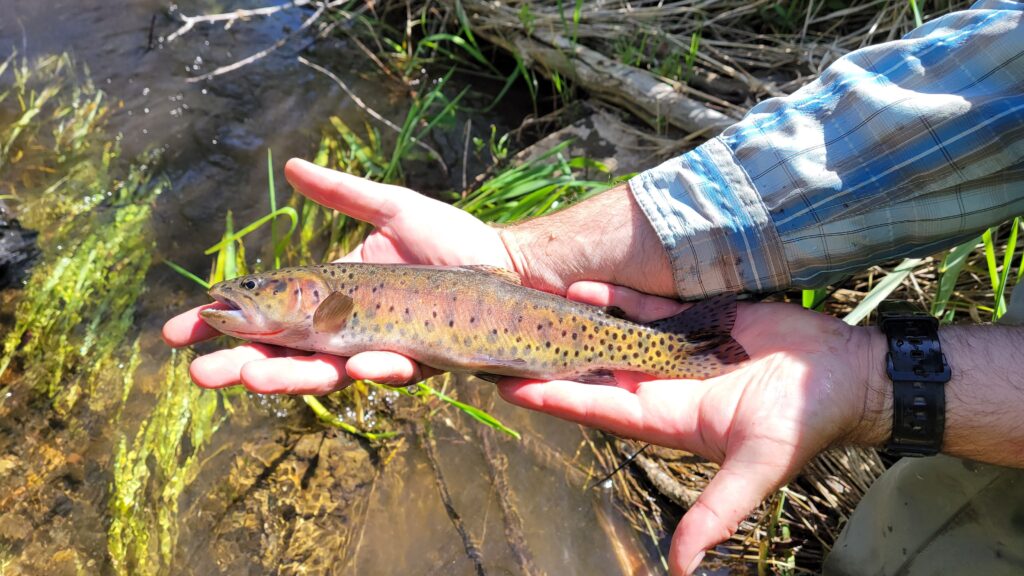
Lahontan cutthroat trout are the desert-basin cutthroat and the largest members of the group. They evolved in the terminal lakes of Pleistocene Lake Lahontan — waters with no outlet, high alkalinity and extreme seasonal variability — and they grew to sizes no other cutthroat lineage approached. They are also the most heavily reduced: the subspecies is listed as Threatened under the Endangered Species Act and occupies a small fraction of the habitat it once held.
Range
The Nevada Department of Wildlife describes the subspecies as endemic to the Lahontan Basin of northern Nevada, northeastern California and southeastern Oregon, with Nevada populations concentrated in Elko, Humboldt and Nye counties. WDFW ties the name directly to its origin: the fish are named for ancient Lake Lahontan, the ice-age lake that covered much of the western Great Basin. The historic system included the Truckee, Carson, Walker, Humboldt and Quinn drainages and terminated in Pyramid Lake, Walker Lake and a set of smaller sinks and lakes.
The U.S. Fish and Wildlife Service describes the migratory scale that system once supported: fish moved 120 miles between Pyramid Lake and Lake Tahoe along the Truckee River. Three life-history forms are recognized — stream-dwelling, lake-dwelling and migratory — and it was the migratory lake fish, feeding in a productive terminal lake and running a long river to spawn, that produced the giants.
Lahontan cutthroat have also been widely stocked outside the basin. USGS records nonindigenous occurrences in California (9 hydrologic units, 1962-1994), Idaho (14 units, 1988-2011), Nevada outside the native basin (11 units, 1873-1999), Oregon (1 unit, 1975), Washington (5 units, 1968-2003) and Wyoming (2 units, 1961). The Washington introductions produced the alkaline-lake fisheries at Omak and Lenore lakes, where the subspecies’ tolerance for hard water is the whole point.
Conservation Status
NDOW lists the Lahontan cutthroat as Threatened and as a Priority Species. The scale of loss is stark: self-sustaining populations persist in only 10.7 percent of historic stream habitat and 0.4 percent of historic lake habitat. Current occupancy is 123 to 129 streams within the Lahontan Basin and 32 to 34 outside it, totalling roughly 482 miles of habitat. NDOW identifies the primary threats as habitat fragmentation, local extinction risk and decreased migration rates — a coherent set, since all three describe the same failure: a fish adapted to long migrations between a productive lake and distant spawning tributaries, confined to short isolated stream segments.
The lake habitat figure is the one that carries the history. Pyramid Lake’s native migratory population was lost after Derby Dam severed the Truckee River connection early in the twentieth century, and Walker Lake’s decline followed water diversion and rising salinity. The 0.4 percent figure is the arithmetic of losing terminal lakes.
Size
WDFW states the case plainly: Lahontan cutthroat are “the largest of the cutthroat subspecies.” NDOW gives a working range of 7 to 33 inches and 1 to 25 pounds with a lifespan of 5 to 14 years, which spans everything from a small Elko County headwater fish to a lake-run adult. USFWS puts the historic maximum at roughly 4 feet and 40 pounds. The 41-pound Pyramid Lake fish of 1925 that NDOW still cites is the largest cutthroat trout on record from anywhere.
In Washington’s introduced fisheries, WDFW gives a typical 16 to 18 inches with fish of 5 to 10 pounds in quality populations, and a state record of 18.04 pounds from Omak Lake in 1993 — evidence that the growth potential travels with the fish when it is put in a productive alkaline lake.
Identification
Stream-dwelling Lahontan cutthroat show, in NDOW’s description, a faint rosy-pink band along the lateral line, distinct cutthroat slashes and darker coloration dominated by copper to green hues. Lake fish go silvery and lose most of that color. WDFW adds the useful structural characters: a mouth extending past the eye, dark olive backs, and medium to large dark spots. The spotting is more evenly distributed over the body than in westslope cutthroat, extending below the lateral line and onto the belly — the opposite of the westslope pattern.
Water Temperature and Water Chemistry
Lahontan cutthroat carry a long-standing reputation for tolerating warmer, more alkaline and more variable water than any other cutthroat, and the waters they evolved in support that reputation circumstantially: Pyramid Lake and Walker Lake are highly alkaline terminal lakes, and the Humboldt system runs warm and low in late summer. However, no controlled thermal tolerance study establishing a higher upper lethal temperature for this subspecies was verified for this article, and neither NDOW nor WDFW publishes specific temperature or alkalinity tolerance figures. The reputation is reported here as unquantified.
The best available benchmark remains the westslope measurements of Bear, McMahon and Zale (2007): an ultimate upper incipient lethal temperature of 19.6 C (67.3 F) for westslope cutthroat versus 24.3 C (73.7 F) for rainbow trout, with growth optima near 13-14 C and a recommendation to hold maximum daily temperatures near 13-15 C (55-59 F). Applied to Lahontan waters those numbers are conservative and extrapolated. On a desert stream running through the upper 60s F in August, the honest position is that this subspecies probably has more margin than a westslope cutthroat and that nobody has published the number.
Life History and Diet
Lahontan cutthroat spawn in spring, with lake populations moving into inlet tributaries. WDFW describes the seasonal pattern in lake fisheries: spawning near inlet streams in spring, a move offshore in summer to depths near the thermocline, and increased feeding activity as water cools in fall. That thermocline behavior is the clearest practical evidence of thermal limitation in this subspecies — the fish leave warm surface water when it exceeds what they will tolerate.
Diet shifts strongly with size. WDFW describes them as opportunistic feeders taking aquatic and terrestrial insects when young and becoming piscivorous as they mature. USFWS lists aquatic insects, crustaceans, small fish and plant material. Piscivory is the mechanism behind the historic sizes: a cutthroat eating tui chub in a productive terminal lake grows on a different trajectory from one picking mayflies out of a headwater drift.
The Pyramid Lake Recovery
The Lahontan cutthroat’s best-known story is the one the conservation-status arithmetic hides. The lake form that produced the 41-pound fish was gone from its home water by the 1940s: Derby Dam cut the spawning run off from the Truckee early in the twentieth century, and diversion, overharvest and introduced species finished the job. The University of Nevada, Reno puts the outcome flatly — by the 1940s the fish was extirpated from its native habitat throughout the Truckee River watershed — and the U.S. Fish and Wildlife Service describes the same loss: gone from their home waters, driven out by habitat loss, water diversion and introduced species.
What came next is unusual in fisheries history. In 1977 a population of cutthroat was found in a small stream in the Pilot Peak Mountains on the Nevada–Utah border, in the Bonneville basin and well outside the Lahontan Basin, and was tentatively identified as the extirpated Pyramid Lake lake form, presumably carried there by an early transplant. Peacock and colleagues (2017) tested that identification against DNA from 62 museum specimens collected between 1872 and 1913 from Lake Tahoe, the lower Truckee at Derby Dam, and Pyramid and Winnemucca lakes, and confirmed that the Pilot Peak fish carry the lineage of the original Pyramid Lake lacustrine population. Eggs from the Pilot Peak population reached the Lahontan National Fish Hatchery at Gardnerville, Nevada, in 1995, and the hatchery now maintains the Pilot Peak strain as its broodstock, with a target of roughly 500,000 Pilot Peak fish a year.
The Lahontan National Fish Hatchery Complex began stocking Pilot Peak fish into Pyramid Lake in 2006 in collaboration with the Pyramid Lake Paiute Tribe, according to the Marble Bluff Fish Passage and Research Facility, which sits inside the Tribe’s reservation and is operated from February to July to aid the spawning migrations of cui-ui and Lahontan cutthroat from the lake into the Truckee. In 2014, as the first stocked generations reached spawning age, adult fish left the lake and ran up the lower river. A 2019 paper in Fisheries catalogued by the USGS Publications Warehouse records that for the first time in over 80 years, and each year since 2014, adfluvial Lahontan cutthroat have spawned in the lower Truckee River and produced tens of thousands of young-of-year. The size potential returned with the lineage: UNR reports anglers at Pyramid Lake catching trout up to 30 pounds, and the hatchery describes the Pilot Peak strain as the largest inland cutthroat trout in the world.
The recovery is real but narrow. Pyramid Lake’s fishery still rests on hatchery production, wild reproduction in the Truckee is measured in young-of-year rather than in a self-sustaining adult run, and the river’s flow remains a negotiated quantity. Walker Lake, the basin’s other great terminal lake, went the other way. The Nevada Department of Wildlife reports that its Lahontan cutthroat fishery was maintained only by stocking from the early 1950s, that total dissolved solids in the lake now exceed 21,000 mg/L, and that no Lahontan cutthroat has been reported by anglers or in sampling surveys since the winter of 2010. NDOW’s judgement is that a rise in lake level is the key to any rebound.
Where the Wild Populations Are
Two lakes still hold self-sustaining lake-dwelling populations inside the native range. Summit Lake in remote northwestern Nevada supports the largest self-sustaining lake population within the native range; the fish spawn in a single tributary, Mahogany Creek, and the Summit Lake Paiute Tribe manages the watershed, which the University of Nevada, Reno describes as home to the only robust self-sustaining lake population of the subspecies. Independence Lake in the Sierra Nevada is, in the California Department of Fish and Wildlife’s words, the only lake in California and one of just two in the world with a self-sustaining lake population, and CDFW biologists working with USGS, the Forest Service, USFWS, The Nature Conservancy and Trout Unlimited have identified hybridization as a new threat there.
Stream populations are scattered across the Humboldt, Quinn, Walker and Carson headwaters, and their management runs through the federal recovery program. The Service’s 2019 Updated Goals and Objectives record the listing history — federally listed as endangered on 13 October 1970 under the Endangered Species Conservation Act, then reclassified as threatened on 16 July 1975 under the Endangered Species Act with a special rule that allows regulated sport fishing — cite the 1995 Recovery Plan and the 2009 five-year review, and list the California, Nevada and Oregon wildlife agencies among the signatory management agencies. The Service’s 2023 Status Review replaced the recovery plan’s three geographic management units with ten management units.
Waters and Angling Notes
On this site the subspecies is tied to Pyramid Lake, the Truckee River and the Truckee below Derby Dam, the Humboldt River, the Walker River, the East Fork Carson River and Lahontan Reservoir in Nevada, and the Little Truckee below Boca Dam in California. Pyramid Lake is a tribal fishery: the Pyramid Lake Paiute Tribe issues its own fishing and boating permits, and a Nevada state licence is not the instrument that governs the lake. Seasons, limits and gear rules on every water here are set by the Tribe, NDOW or CDFW and change from year to year; they are linked from each water page rather than restated in this article.
The lake form is caught from the shore and from boats in the cold months, when the big fish work the shallows ahead of the spring run, and the recovery has made a 20-pound cutthroat a realistic ambition rather than a museum specimen. In the streams a Lahontan cutthroat behaves like any other cutthroat — surface-oriented, opportunistic and vulnerable to warm late-summer water — so the thermal caution above applies, and on desert rivers like the Humboldt the fishable window is set by temperature as much as by flow. On the stocked alkaline lakes outside the basin, Omak and Lenore in Washington above all, the lineage’s growth potential in hard water is the whole attraction.
Taxonomy
ITIS lists Oncorhynchus clarkii henshawi as a valid subspecies (TSN 201902), alongside the Paiute cutthroat O. c. seleniris, a closely allied form endemic to about 15 km of Silver King Creek in Alpine County, California. USFWS, USGS, NDOW and WDFW all use the trinomial.
The American Fisheries Society’s 8th edition names list (2023) treats the Lahontan lineage at species rank as Oncorhynchus henshawi. That could not be verified against a publicly accessible copy of the list for this article and is reported as unverified. The underlying genetic case for lineage distinctness is stronger here than for most cutthroat groups: Loxterman and Keeley (2012) recovered eight major mitochondrial lineages across the species, six of which corresponded to recognized subspecific taxonomy, and also identified a previously undocumented Great Basin lineage more closely related to the Colorado River group than to the geographically adjacent upper Snake — a result that argues the Great Basin cutthroat story is still incompletely described.
Where to catch it
11 waterways on GuidedFloats list lahontan cutthroat trout, across 2 states. Each page carries live gauge readings, access notes, and the guides who fish it.
California 1
- Prosser Creek74 cfs
Nevada 10
References
- Lahontan Cutthroat Trout — Nevada Department of Wildlife
- Lahontan Cutthroat Trout (Oncorhynchus clarkii henshawi) — U.S. Fish and Wildlife Service
- Lahontan Cutthroat Trout — Washington Department of Fish and Wildlife
- Oncorhynchus clarkii henshawi Species Profile — U.S. Geological Survey, Nonindigenous Aquatic Species Database
- Oncorhynchus clarkii seleniris (Paiute Cutthroat Trout) Species Profile — U.S. Geological Survey, Nonindigenous Aquatic Species Database
- Comparative Thermal Requirements of Westslope Cutthroat Trout and Rainbow Trout — Transactions of the American Fisheries Society 136(4):1113-1121 (Bear, McMahon & Zale 2007)
- Watershed boundaries and geographic isolation: patterns of diversification in cutthroat trout from western North America — BMC Evolutionary Biology 12:38 (Loxterman & Keeley 2012)
- Oncorhynchus clarkii — Taxonomic Serial No. 161983 — Integrated Taxonomic Information System (ITIS)
- Cutthroat Trout in Oregon — Oregon Department of Fish and Wildlife (MyODFW)
- IGFA World Records — International Game Fish Association
- From Peak to Pyramid — U.S. Fish and Wildlife Service
- Lahontan cutthroat trout species thought to be extinct rediscovered in Utah creek — University of Nevada, Reno
- Return of a giant: DNA from archival museum samples helps to identify a unique cutthroat trout lineage formerly thought to be extinct (Peacock et al. 2017, Royal Society Open Science) — PubMed Central
- Lahontan National Fish Hatchery — U.S. Fish and Wildlife Service
- Marble Bluff Fish Passage and Research Facility — U.S. Fish and Wildlife Service
- Return of a giant: Coordinated conservation leads to the first wild reproduction of Lahontan Cutthroat Trout in the Truckee River in nearly a century (Fisheries, 2019) — U.S. Geological Survey Publications Warehouse
- Summit Lake Paiute Tribe clears spawning path for threatened Lahontan cutthroat trout — U.S. Fish and Wildlife Service
- Lahontan Cutthroat Trout thrive at Paiute's Summit Lake — University of Nevada, Reno
- New Threat Facing Lahontan Cutthroat Trout at Independence Lake: Hybridization — California Department of Fish and Wildlife
- Walker Lake — Nevada Department of Wildlife
- Updated Goals and Objectives for the Conservation of Lahontan Cutthroat Trout (2019) — U.S. Fish and Wildlife Service
- Status Review: Lahontan Cutthroat Trout (2023) — U.S. Fish and Wildlife Service, ECOS
- Fishing — Pyramid Lake Paiute Tribe