Conodoguinet Creek Fishing Guides
A long, slow, limestone-fed Cumberland Valley creek with a genuine smallmouth and musky fishery, fished from a canoe far more often than from the bank.
Guides on the Conodoguinet Creek
Claimed profiles take booking requests. Unclaimed profiles are built from public records so the river is never empty; the guide can claim or remove one any time.
No guides listed yet
Guide or outfit this water? Create your profile. Listing is free, the commission is 10% or 7% with a premium profile, and premium profiles list first on this water.
About the Conodoguinet Creek
The Conodoguinet drains the Cumberland Valley from west of Shippensburg east to the Susquehanna, and for most of its length it behaves like nothing else in the region. It is a limestone creek, fed by the same aquifer that produces the famous Cumberland County spring runs a few miles south, but it is far larger than any of them and it moves slowly, winding through farmland in enormous meandering loops with undercut banks and long flat pools. Anglers who come looking for a classic clear limestoner are usually surprised: the Conodoguinet is a warmwater creek with limestone bones, and what the geology gives it is not cold water but remarkable fertility and a baseflow that keeps the creek alive through dry summers.
That fertility is why the fishing is as good as it is. Smallmouth are the main quarry and they grow well here, holding along the undercut banks, the fallen sycamores and the rock ledges at the few places where the creek drops. Rock bass and redbreast sunfish are everywhere and make the creek a fine place to take a beginner. Musky are stocked and present in real numbers, which gives the lower creek a following among anglers who do nothing but chase them, and walleye and channel catfish use the deeper pools. A handful of the coldest tributary mouths hold brown trout. The creek is canoe water above all else, with the low gradient and the long loops making for easy paddling and awkward wading.
The gauge at Hogestown reports discharge and stage without temperature, which matters on a creek that warms as much as this one does in July. The flow record is still the most useful number: a Conodoguinet running near the middle of its range is clear enough to fish and deep enough to float, while a high muddy spike after valley thunderstorms puts it out of play for a day or two and a severe late-summer recession concentrates everything into the deep bends. Spring and autumn carry the best of it.
This water needs a real photo
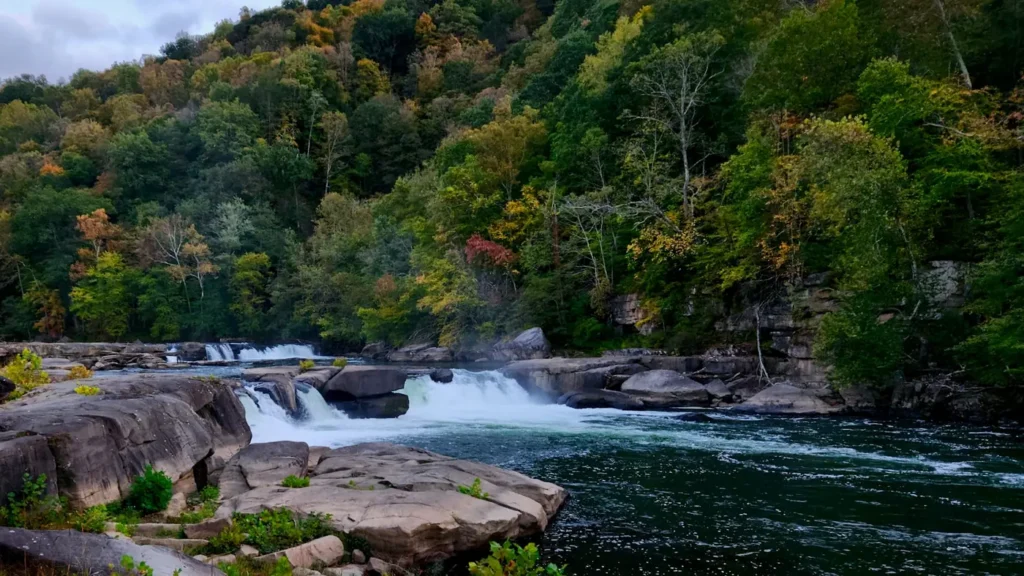
The photo at the top of this page is not Conodoguinet Creek.
It is a regional stand-in, honestly captioned but generic — we will not put a name to a river we cannot prove. Send us a photograph you took here and it replaces the stand-in, with your credit on it.
Add a photo of this water
Landscape, not fish — the water itself. Reviewed by hand before it appears. The first one published here earns the Pioneer badge.
Fished this water? Add a photo
Reviewed by hand before it appears. Pick the water, not the spot — we never publish exact locations.
Access
Hogestown - the gauge crossing and a common reference point for judging whether the creek is floatable.
Mechanicsburg - the nearest larger town to the middle creek, with tackle and services.
Carlisle - the Cumberland County seat upstream, and the base for fishing the middle and upper creek.
Camp Hill - the access point for the lower creek closest to the Susquehanna mouth.
Shippensburg - the upstream town where the creek is small enough to wade.
Harrisburg - the city across the river, with guides and the Susquehanna smallmouth fishery nearby.
Susquehanna confluence - the downstream end of the creek and the best of the musky water.
Seasons
Spring: high and often coloured, but the smallmouth fishing turns on quickly as the water settles and the musky fishing is at its best.
Summer: warm and low, with the creek concentrating into its deep bends and the early and late hours carrying the fishing.
Fall: the clearest and most pleasant float of the year, with hard-feeding smallmouth and good musky activity through the cooling water.
Winter: cold, slow and largely left alone, though the deepest pools hold fish for anglers prepared to work very slowly.
From the water
No logged trips yet. Be the first to put this water on your map.
Log this water
Fished it or cleaned it? Log in or create a free account to log a trip with photos and earn the waterway badge.
Questions
What is the current flow on the Conodoguinet Creek?
As of Nov 2, 7:30 am, the USGS gauge Conodoguinet Creek near Hogestown, PA reads 195 cfs. Conditions update every 15 minutes.
What species can you catch on the Conodoguinet Creek?
Anglers target Brown Trout, Carp, Channel Catfish, Muskellunge, Redbreast Sunfish, Rock Bass, Smallmouth Bass, Walleye on the Conodoguinet Creek in Pennsylvania.
Where can you access the Conodoguinet Creek?
Hogestown - the gauge crossing and a common reference point for judging whether the creek is floatable. Mechanicsburg - the nearest larger town to the middle creek, with tackle and services. Carlisle - the Cumberland County seat upstream, and the base for fishing the middle and upper creek. Camp Hill - the access point for the lower creek closest to the Susquehanna mouth. Shippensburg - the upstream town where the creek is small enough to wade. Harrisburg - the city across the river, with guides and the Susquehanna smallmouth fishery nearby. Susquehanna confluence - the downstream end of the c...
When is the best time to fish the Conodoguinet Creek?
Spring: high and often coloured, but the smallmouth fishing turns on quickly as the water settles and the musky fishing is at its best. Summer: warm and low, with the creek concentrating into its deep bends and the early and late hours carrying the fishing. Fall: the clearest and most pleasant float of the year, with hard-feeding smallmouth and good musky activity through the cooling water. Winter: cold, slow and largely left alone, though the deepest pools hold fish for anglers prepared to work very slowly.
Where are the fishing regulations for the Conodoguinet Creek?
Regulations change by season and section. Read the current rules on the Pennsylvania agency site: https://www.pa.gov/agencies/fishandboat/fishing/regulations