Rock Bass
Ambloplites rupestris
The northern goggle-eye of Missouri's Meramec, Gasconade and Missouri River streams — a heavy-bodied, red-eyed centrarchid that lives in rootwads and rock ledges in running water.
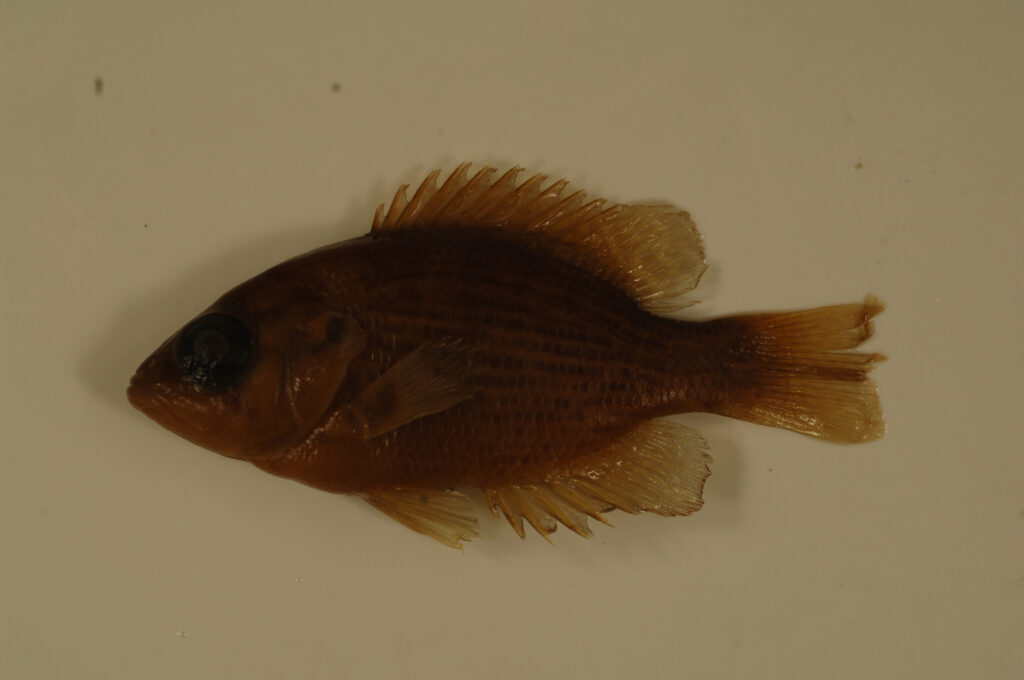
Identification
Rock bass are built unlike the flat, plate-shaped sunfishes anglers usually picture. The Missouri Department of Conservation describes them as thicker-bodied than most other sunfish, with a large mouth and very large eyes — the source of the name goggle-eye. Colour runs dark brown to bronze above and is often blotched along the sides. The single most useful field mark is the pattern of dark spots arranged in parallel rows running the length of the flank, following the scale rows.
Fin counts settle the harder identifications. Rock bass carry 12 spines in the dorsal fin and 6 spines in the anal fin. That anal-fin count is the practical way to separate a rock bass from a warmouth, which has only 3, and MDC uses exactly that character on its goggle-eye and warmouth page and again in its warmouth field guide entry. The eye itself is usually a hard red, which is why the fish is called redeye through much of the Midwest; Purdue University’s Fishes of Indiana lists redeye, black perch, rock sunfish and goggle-eye all as names for the same species.
The goggle-eye problem
In Missouri, “goggle-eye” is not a species. It is a bucket. Three Ambloplites species are lumped under the name, and MDC’s own drainage rule, laid out in the 2002 Missouri Conservationist feature “Rock Bass: Panfish Supreme”, assigns them geographically: northern rock bass in the Meramec and Missouri river drainages plus the Spring and Elk river systems of southwest Missouri; Ozark bass (A. constellatus) in the rivers and tributaries feeding Table Rock, Bull Shoals and Lake Taneycomo — the upper White River system; and shadow bass (A. ariommus) through the rest of Missouri’s southeastern Ozark streams. An earlier Conservationist piece, “Goggle-eye Bonanza”, puts it plainly: three species have been identified, but anglers generally refer to all three as goggle-eye.
To complicate matters further, the colloquial goggle-eye net catches a fish that is not an Ambloplites at all. Warmouth (Lepomis gulosus) is a true Lepomis sunfish, but it is thick-bodied, big-mouthed and red-eyed enough that MDC groups it with the rock basses in its own angler-facing material, and warmouth were stocked alongside rock bass in Missouri streams during the 1930s and 1940s.
Range and distribution
Northern rock bass occupy the widest range of any Ambloplites, spanning eastern and central North America in both streams and lakes. NatureServe’s assessment is blunt about the consequences: large range, common, no major threats, hence a G5 global rank.
Within Missouri the distribution is a stream distribution. MDC places the species in the northern Ozark streams, the middle Mississippi tributaries and part of the southwestern Ozarks, and notes they are rarely found in Ozark reservoirs. The rivers most associated with the fish are the Gasconade and its tributaries — Osage Fork, Roubidoux Creek, the Big Piney — along with the Meramec system. The Gasconade, MDC notes, runs 300 river miles to cover 100 map miles, making it the most crooked stream in the state, and that endless alternation of ledge, chute and pool is close to ideal rock bass water.
One complication for anyone reading old survey data: rock bass were stocked well outside their native drainages before the taxonomy was sorted out. MDC’s Black River Watershed Inventory and Assessment records that 24,000 rock bass were stocked into basin streams between 1944 and 1948 — in a watershed where MDC’s modern species accounts list shadow bass, not rock bass, as the resident Ambloplites.
Habitat and water temperature
Rock bass are structure fish in moving water. MDC’s account has larger individuals holding around boulders, logs and vegetation in deep pools. The Conservationist is more specific still: through daylight hours they sit in the nooks and crannies of rootwads and undercut rock in running water between 3 and 12 feet deep, moving out at dawn, dusk and after dark. That nocturnal shift is consistent across MDC’s material — the species is described as most active at night, when fish will take surface lures.
Thermally, rock bass sit at the cool end of the centrarchid spectrum. Compiled published preference records in the Ontario Freshwater Fishes Life History Database give a preferred range of 21–26°C (70–79°F) and classify the species as coolwater, with spawning at 16–23°C (61–73°F). This is worth saying honestly: unlike bluegill and smallmouth bass, rock bass has never been the subject of a federal habitat suitability model, and there is no state or federal thermal criterion for the species. The nearest well-documented comparison is smallmouth bass, which shares Ozark ledge-and-pool habitat and for which USFWS habitat suitability information gives optimal adult growth at 26–29°C (79–84°F) and an upper lethal limit above 32.3°C (90°F). Rock bass sit a few degrees cooler than that across the board.
The practical reading for a river gauge: water in the high 60s to high 70s Fahrenheit is rock bass water. Spring-fed Ozark streams that hold steady through August summer heat tend to hold rock bass better than sluggish, sun-exposed reaches.
Life history
Spawning runs from April into early June by MDC’s field guide, and mid-April into early July by the Conservationist, which describes a four-to-six week concentration beginning around the middle of April. Males build circular, saucer-shaped nests and guard them. Compiled records put fecundity at roughly 2,000 to 11,000 eggs and maturity at ages 3 to 5.
Growth is unhurried. MDC gives a lifespan of 7 to 9 years, and compiled riverine records suggest 5 to 6 years is more typical in streams than in lakes. Most fish an angler encounters run 6 to 10 inches and under half a pound; the Conservationist‘s 2001 piece observes that goggle-eye almost never weigh more than three-quarters of a pound, and that a fish at that weight is a really big one. Against that background the state record — 2 pounds 12 ounces and 17 inches from the Big Piney River in 1968 — is genuinely exceptional and has stood for more than half a century.
A 2019 study of Ambloplites population characteristics summarised on the USGS publications warehouse found that of the three species, rock bass showed the fastest growth trajectories after age 3 — a useful reminder that the three goggle-eyes are not ecologically interchangeable even where they look alike.
Diet
Rock bass are generalist carnivores with a mouth large enough to act on the ambition. MDC lists crayfish, aquatic insects, occasional terrestrial insects and small fish. The Conservationist summarises the species’ appetite as taking just about any live bait it can fit in its mouth — minnows, worms, crayfish, hellgrammites, crickets and grasshoppers. Compiled records classify the species as an invertivore-carnivore of intermediate pollution tolerance.
The crayfish component matters for where the fish live. Ozark and Great Lakes rock bass concentrate on the rock, ledge and woody structure that produces crayfish, and their nocturnal activity peak tracks crayfish activity closely.
Angling
Rock bass have a long history as an incidental catch in smallmouth water that turned out to be a fishery in its own right. Missouri float streams — the Gasconade, Big Piney, Osage Fork, Meramec and Roubidoux — produce them alongside smallmouth from the same rootwads and ledges, and MDC’s own magazine has treated them as a target species rather than bycatch for at least a quarter century.
The fish’s habits shape when it is caught. Daylight fish are deep and tight to cover; evening and after-dark fish move out and up, and will hit noisy surface presentations. During the four-to-six week spawning concentration beginning in mid-April, fish gather in predictable nest areas — the period MDC’s writers describe as producing consistent numbers on every visit.
Rock bass are also a fish of decent table quality relative to their size, which is why the 2002 Conservationist article ran under the title “Panfish Supreme.” At 6 to 10 inches they are a modest fillet, but the flesh is firm and clean, particularly from cold, spring-fed Ozark water.
Conservation
Rock bass are not a conservation concern. NatureServe ranks the species G5 globally and N5 in the United States, citing a large range in eastern and central North American streams and lakes, common occurrence and no major threats. It is classified as a game fish in Missouri.
The genuine uncertainty around rock bass is taxonomic, not demographic — and it is worth stating plainly rather than glossing. Roe, Mayden and Harris (2008, Copeia 2008(4):858–867) examined Ambloplites systematics using morphology, mitochondrial DNA and allozymes, and found that A. ariommus and A. rupestris could not be reliably separated in the Interior Highlands. In practice this means that some Missouri and Arkansas fish assigned to one species or the other on the basis of drainage cannot be confirmed as such by any character currently available. MDC’s drainage rule is the best working guide anyone has; it is not a diagnosis. Where rock bass were stocked outside their native drainages — as in the Black River basin in the 1940s — the historical record adds a further layer of doubt.
The practical conservation issues for rock bass are the ordinary ones for Ozark and Midwestern stream fish: gravel aggradation, loss of the deep pools and rootwad complexes the species depends on, and warming of low-flow summer reaches. Because rock bass sit cooler than most warmwater centrarchids, spring-influenced reaches are disproportionately valuable to them.
Where to catch it
202 waterways on GuidedFloats list rock bass, across 25 states. Each page carries live gauge readings, access notes, and the guides who fish it.
Alabama 1
- Locust Fork53 cfs
Arkansas 4
- Frog Bayou
- Illinois Bayou4 cfs
- Osage Creek27 cfs
- Ouachita River10 cfs
Connecticut 2
- Natchaug River121 cfs
- Salmon Creek22 cfs
Delaware 1
- Red Clay Creek38 cfs
Illinois 9
- Apple River94 cfs
- Channel Lake
- Iroquois River123 cfs
- Kankakee River1,610 cfs
- Kishwaukee River811 cfs
- Mackinaw River100 cfs
- Macoupin Creek14 cfs
- Spring Brook2 cfs
- Vermilion River152 cfs
Indiana 12
- Big Raccoon Creek104 cfs
- Blue River13 cfs
- Eagle Creek13 cfs
- Flatrock River47 cfs
- Hamilton Lake
- Lake Maxinkuckee
- Mississinewa River19 cfs
- Pike Lake
- Sugar Creek45 cfs
- Sylvan Lake
- Tippecanoe River514 cfs
- Wildcat Creek137 cfs
Iowa 8
- Beaver Creek834 cfs
- Big Bear Creek214 cfs
- Black Hawk Creek792 cfs
- Turkey River2,670 cfs
- Upper Iowa River745 cfs
- Wapsipinicon River3,330 cfs
- West Okoboji Lake
- Wolf Creek594 cfs
Kentucky 10
- Big South Fork69 cfs
- Dix River29 cfs
- Elkhorn Creek128 cfs
- Green River (Kentucky)414 cfs
- Levisa Fork below Fishtrap Dam
- Red River7 cfs
- Rockcastle River63 cfs
- Royal Springs1 cfs
- South Elkhorn Creek4 cfs
- Tygarts Creek30 cfs
Maryland 9
- Antietam Creek113 cfs
- Big Pipe Creek38 cfs
- Conococheague Creek223 cfs
- Deer Creek45 cfs
- Licking Creek66 cfs
- Monocacy River279 cfs
- Tonoloway Creek23 cfs
- Town Creek21 cfs
- Wills Creek94 cfs
Michigan 5
- Grand River88 cfs
- Higgins Lake
- Otsego Lake
- Thornapple River208 cfs
- Van Etten Lake
Minnesota 3
- Cannon River541 cfs
- Kettle River88 cfs
- South Fork Root River198 cfs
Missouri 12
- Big Piney River122 cfs
- Big River133 cfs
- Bryant Creek143 cfs
- East Fork Black River below Taum Sauk Reservoir6 cfs
- Gasconade River467 cfs
- Huzzah Creek61 cfs
- Little North Fork River
- Meramec River177 cfs
- Niangua River25 cfs
- North Fork Spring River7 cfs
- Roubidoux Creek
- Spring River74 cfs
Nebraska 3
- Cedar River259 cfs
- Frenchman Creek14 cfs
- North Loup River391 cfs
New Hampshire 4
- Ashuelot River below Surry Mountain Dam122 cfs
- Baker River88 cfs
- Contoocook River below Hopkinton Dam523 cfs
- Nubanusit Brook below MacDowell Dam
New York 11
- Battenkill291 cfs
- Black River4,500 cfs
- Mohawk River140 cfs
- Mongaup River112 cfs
- Neversink River176 cfs
- Oatka Creek46 cfs
- Oswegatchie River892 cfs
- Owasco Lake
- Saranac River1,310 cfs
- Schoharie Creek
- Willowemoc Creek76 cfs
North Carolina 11
- Cataloochee Creek42 cfs
- Cheoah River99 cfs
- Deep River56 cfs
- Linville River63 cfs
- Little Tennessee River117 cfs
- South Toe River111 cfs
- Tuckasegee River677 cfs
- Valley River64 cfs
- Watauga River101 cfs
- Wilson Creek
- Yadkin River below W. Kerr Scott Dam933 cfs
Ohio 11
- Chagrin River119 cfs
- Cuyahoga River361 cfs
- Hocking River572 cfs
- Kokosing River47 cfs
- Little Miami River72 cfs
- Little Muskingum River146 cfs
- Mad River218 cfs
- Mahoning River465 cfs
- Rocky River102 cfs
- Scioto River2,200 cfs
- Walhonding River
Oklahoma 6
- Flint Creek4 cfs
- Glover River
- Honey Creek30 cfs
- Illinois River353 cfs
- Mountain Fork8 cfs
- Sager Creek8 cfs
Pennsylvania 17
- Allegheny River below Kinzua Dam2,310 cfs
- Aquashicola Creek56 cfs
- Aughwick Creek63 cfs
- Bald Eagle Creek292 cfs
- Clarion River475 cfs
- Codorus Creek16 cfs
- Jordan Creek59 cfs
- Kishacoquillas Creek184 cfs
- Lehigh River below Francis E. Walter Dam686 cfs
- Little Juniata River186 cfs
- Loyalsock Creek252 cfs
- Penns Creek290 cfs
- Pine Creek138 cfs
- Pohopoco Creek97 cfs
- Shohola Creek43 cfs
- Tulpehocken Creek199 cfs
- Youghiogheny River2,220 cfs
South Carolina 2
Tennessee 15
- Big Limestone Creek28 cfs
- Buffalo River (Tennessee)302 cfs
- Clear Creek7 cfs
- Clinch River683 cfs
- Daddys Creek15 cfs
- Duck River372 cfs
- Elk River6 cfs
- French Broad River1,290 cfs
- Harpeth River
- Little River63 cfs
- Nolichucky River1,000 cfs
- Nolichucky River below Nolichucky Dam901 cfs
- Obed River15 cfs
- South Chickamauga Creek115 cfs
- Spring Creek
Vermont 2
Virginia 19
- Bullpasture River76 cfs
- Calfpasture River55 cfs
- Cedar Creek31 cfs
- Clinch River453 cfs
- Cowpasture River281 cfs
- Dan River708 cfs
- Hazel River154 cfs
- James River994 cfs
- Linville Creek26 cfs
- Maury River104 cfs
- North Fork Shenandoah River301 cfs
- North River183 cfs
- Opequon Creek13 cfs
- Passage Creek16 cfs
- Pedlar River6 cfs
- Pound River below Flannagan Dam
- Rapidan River78 cfs
- Smith Creek37 cfs
- South Fork Shenandoah River353 cfs
West Virginia 20
- Back Creek29 cfs
- Big Sandy Creek221 cfs
- Cacapon River270 cfs
- Cheat River2,910 cfs
- Cranberry River294 cfs
- Elk River (West Virginia)3,360 cfs
- Gauley River1,740 cfs
- Gauley River below Summersville Dam
- Greenbrier River1,410 cfs
- Howard Creek
- Laurel Creek107 cfs
- Opequon Creek105 cfs
- Patterson Creek72 cfs
- Shavers Fork190 cfs
- South Branch Potomac River1,410 cfs
- Tygart Lake
- Tygart Valley River539 cfs
- Warm Springs Run4 cfs
- West Fork River below Stonewall Jackson Dam371 cfs
- Williams River425 cfs
Wisconsin 5
- Brule River526 cfs
- Eau Galle River15 cfs
- Geneva Lake
- Namekagon River46 cfs
- Peshtigo River237 cfs
References
- Northern Rock Bass (Ambloplites rupestris) field guide — Missouri Department of Conservation
- Goggle-eye (Rock Bass) and Warmouth — Missouri Department of Conservation
- Rock Bass: Panfish Supreme (Missouri Conservationist, May 2002) — Missouri Department of Conservation
- Goggle-eye Bonanza (Missouri Conservationist, September 2001) — Missouri Department of Conservation
- Warmouth field guide — Missouri Department of Conservation
- Black River Watershed Inventory and Assessment — Missouri Department of Conservation
- Ambloplites rupestris — NatureServe Explorer — NatureServe
- Systematics and Zoogeography of the Rock Basses (Centrarchidae: Ambloplites), Copeia 2008(4):858-867 — Roe, Mayden & Harris / American Society of Ichthyologists and Herpetologists
- Population characteristics of Ozark Bass in the Upper White River Basin — U.S. Geological Survey publications warehouse
- Habitat Suitability Information: Smallmouth Bass (FWS/OBS-82/10.36) — U.S. Fish and Wildlife Service
- Rock Bass — Fishes of Indiana — Purdue University
- Ambloplites rupestris life history record — Ontario Freshwater Fishes Life History Database
- IGFA World Records search — International Game Fish Association