Cedar Run Fishing Guides
A northern Virginia Piedmont creek with enough limestone in its headwaters to hold a steady baseflow through summer, fished from Warrenton down to Catlett for smallmouth, rock bass and redbreast sunfish.
Guides on the Cedar Run
Claimed profiles take booking requests. Unclaimed profiles are built from public records so the river is never empty; the guide can claim or remove one any time.
No guides listed yet
Guide or outfit this water? Create your profile. Listing is free, the commission is 10% or 7% with a premium profile, and premium profiles list first on this water.
About the Cedar Run
Cedar Run is one of those northern Virginia creeks that most anglers drive over without noticing, and that rewards anyone who stops. It rises in the rolling country south of Warrenton, picks up a string of small limestone-fed tributaries on its way east, and runs through Fauquier County farmland to the gauge near Catlett before joining Broad Run above the Occoquan. The limestone contribution is what separates it from the flashier freestone creeks nearby: where those drop to a trickle by late July, Cedar Run holds a usable baseflow, and that steadier water is the reason it is classed here as a spring creek rather than simply another Piedmont run.
The fishing is wading and short-cast work, and the creek fishes much larger than its width suggests. Smallmouth bass are the main quarry, holding on the ledge drops and the undercut outside bends, rarely large but numerous and willing. Rock bass stack in the shaded pockets under sycamore roots, redbreast sunfish and bluegill fill the gravel shallows, and the deeper holes below the road bridges hold channel catfish and the occasional heavy common carp that will take a fly if you are patient. Fallfish round out the catch and are often mistaken for something more exciting. A light spinning rod or a four-weight is the right tool; nothing here calls for distance.
The gauge reports discharge and stage but no temperature, so the flow trace is the number to read before a trip. A low, steady line means clear water and easy wading across the whole reach. A sharp spike after a Piedmont thunderstorm means a day or two of stain, which is not fatal to the fishing but does push it toward larger, darker patterns. Spring and autumn are the strongest months, and the creek stays fishable well into the cold half of the year.
This water needs a real photo
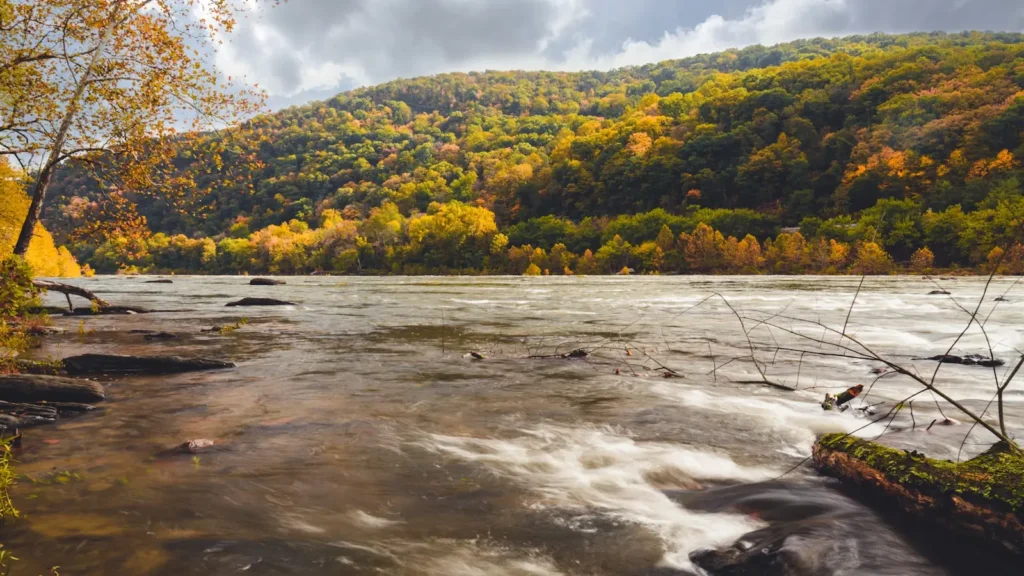
The photo at the top of this page is not Cedar Run.
It is a regional stand-in, honestly captioned but generic — we will not put a name to a river we cannot prove. Send us a photograph you took here and it replaces the stand-in, with your credit on it.
Add a photo of this water
Landscape, not fish — the water itself. Reviewed by hand before it appears. The first one published here earns the Pioneer badge.
Fished this water? Add a photo
Reviewed by hand before it appears. Pick the water, not the spot — we never publish exact locations.
Access
Catlett - the gauge village and the simplest reference point for checking the creek before driving further.
Warrenton - the nearest town for lodging, tackle and food, twenty minutes upstream of the main fishing water.
Route 28 crossing - the mid-reach bridge access and the usual place to judge water clarity.
Route 806 crossing - an upstream access that opens the smaller, more intimate headwater pools.
Broad Run confluence - the downstream limit of the practical wading water, where the creek slows and deepens.
Occoquan Reservoir - the nearby still-water alternative when the creek is high and stained.
Rappahannock River - the larger regional smallmouth float an hour south, useful as a second option.
Seasons
Spring: the strongest season, with good flow, cool water and smallmouth and rock bass feeding hard on the bends.
Summer: the limestone baseflow keeps the creek fishable when neighbouring freestone water has dropped out, but fish early and late.
Fall: flows recover, the crowds are nonexistent and the smallmouth put on weight before winter.
Winter: slow but genuinely workable on the deeper holes, with the steadier spring-fed reaches the place to start.
From the water
No logged trips yet. Be the first to put this water on your map.
Log this water
Fished it or cleaned it? Log in or create a free account to log a trip with photos and earn the waterway badge.
Questions
What is the current flow on the Cedar Run?
As of Nov 2, 5:45 am, the USGS gauge CEDAR RUN NEAR CATLETT, VA reads 4 cfs. Conditions update every 15 minutes.
What species can you catch on the Cedar Run?
Anglers target Bluegill, Channel Catfish, Common Carp, Fallfish, Largemouth Bass, Redbreast Sunfish, Rock Bass, Smallmouth Bass on the Cedar Run in Virginia.
Where can you access the Cedar Run?
Catlett - the gauge village and the simplest reference point for checking the creek before driving further. Warrenton - the nearest town for lodging, tackle and food, twenty minutes upstream of the main fishing water. Route 28 crossing - the mid-reach bridge access and the usual place to judge water clarity. Route 806 crossing - an upstream access that opens the smaller, more intimate headwater pools. Broad Run confluence - the downstream limit of the practical wading water, where the creek slows and deepens. Occoquan Reservoir - the nearby still-water alternative when the creek is high and st...
When is the best time to fish the Cedar Run?
Spring: the strongest season, with good flow, cool water and smallmouth and rock bass feeding hard on the bends. Summer: the limestone baseflow keeps the creek fishable when neighbouring freestone water has dropped out, but fish early and late. Fall: flows recover, the crowds are nonexistent and the smallmouth put on weight before winter. Winter: slow but genuinely workable on the deeper holes, with the steadier spring-fed reaches the place to start.
Where are the fishing regulations for the Cedar Run?
Regulations change by season and section. Read the current rules on the Virginia agency site: https://dwr.virginia.gov/fishing/regulations/