White Crappie
Pomoxis annularis
The turbid-water crappie: 5 or 6 dorsal spines, regular vertical barring, and enough tolerance for muddy water to dominate rivers where black crappie cannot hold.
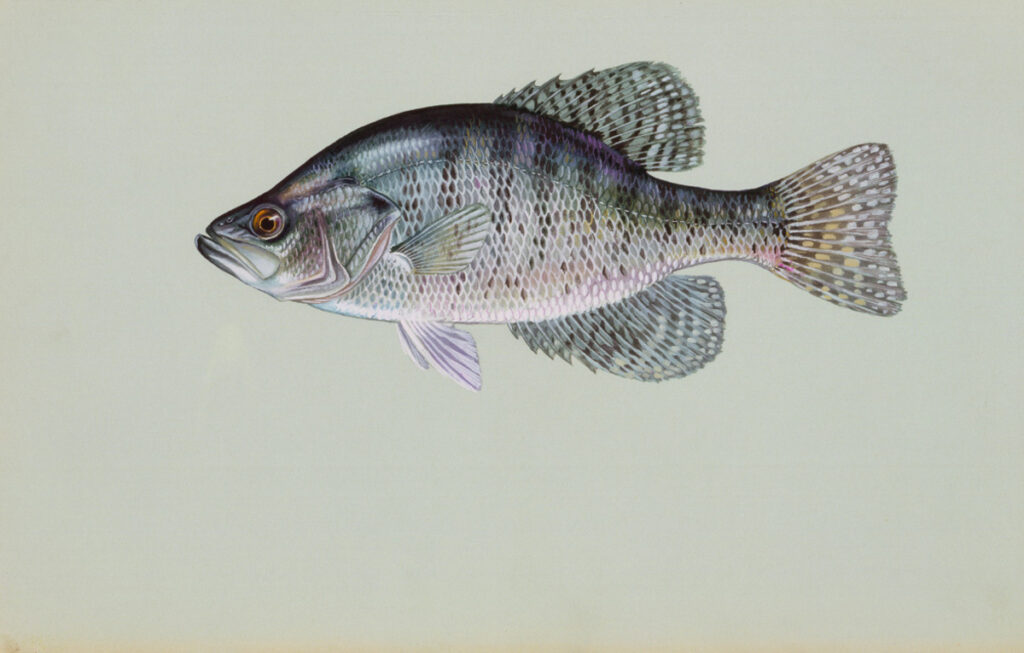
The white crappie is the crappie of coloured water. It is built almost exactly like its relative — deep, thin, big-mouthed, a schooling open-water sunfish — but it holds and reproduces in silty, low-visibility rivers and reservoirs that the black crappie cannot occupy in numbers. That single physiological difference determines which of the two dominates in most American river systems, and it is why the white crappie is the crappie of the lower Mississippi, the Missouri and the big southern impoundment tailwaters.
Identification
Two characters separate the crappies reliably, and neither is overall colour.
- Dorsal spine count. The white crappie’s dorsal fin usually has 6 spines, sometimes 5. The black crappie has 7 or 8. Ohio states the contrast directly — “seven or eight dorsal spines” in black crappie “instead of the five or six spines found on the white”.
- Pattern. The white crappie carries 5 to 10 often faint, dark, regularly arranged vertical bars down the flank. Ohio describes the same feature as “5-10 vertical bars rather than randomly scattered spots like the black crappie”. The bars can be very faint on a pale fish from muddy water; the pattern’s regularity, not its intensity, is the diagnostic.
Supporting characters: the white crappie’s dorsal fin begins further back on the body, its body is a little more elongate for its depth, and its upper jaw is long, extending past the mid-point of the eye. Spawning males darken heavily around the head and throat and are frequently mistaken for black crappie on colour alone — count the spines instead.
Turbidity: the real difference
This is where the two species part company, and the primary literature is unusually direct about it. The U.S. Fish and Wildlife Service’s 1982 habitat model for the species states that “white crappie generally predominate in southern, more turbid waters, where black crappie do not fare as well”, and that “black crappie are usually predominate in clear waters where they occur with white crappie.” Ohio’s Division of Wildlife reaches the same conclusion from the field: white crappie “are more tolerant of turbid (murky) waters than black crappie” and often dominate where aquatic vegetation is sparse. Montana’s guide notes that the species “is supposed to tolerate muddier waters than the black crappie”.
The point worth stating plainly is that tolerance is not preference. The same habitat model records that although the white crappie “appears to prefer moderately turbid waters,” its best growth occurs in clearer water below 50 JTU, and that it “can tolerate severe turbidity levels but appear to avoid them.” Both crappies grow fastest in clean water. The white crappie simply survives and recruits in water the black crappie cannot, so on a muddy river it wins by attrition rather than by liking mud. Where a system has both clear tributary arms and a silty main stem, expect the species mix to flip along the length of it.
River habitat
White crappie are slack-water fish. The habitat model records that they “prefer low velocity areas, including pools and backwater sections of rivers,” that “slow to zero velocity sections of Oklahoma streams were preferred,” and that they are “most numerous in base-level, low gradient rivers.” That is a precise description of the lower reaches of most large American rivers: navigation pools, wing-dam eddies, oxbow cutoffs, revetment pockets, flooded timber in side channels, and the slack water above and below in-river structures.
Cover use is broad. Missouri describes the fish in open water near submerged timber or cover in ponds, lakes, reservoirs and slow-flowing river backwaters, most active in the evening and at night but present through the day. Montana lists weedy areas, logs and other protective cover. Because white crappie do not depend on aquatic vegetation the way black crappie do, they persist in reservoirs and channelised rivers where vegetation has been lost — one more reason they end up as the dominant crappie in heavily engineered systems.
Temperature
The white crappie’s thermal envelope is measurably wider on the warm end than the black crappie’s, which is the second half of the story of why it dominates in the south. The Fish and Wildlife Service model summarises the published work as follows.
- Midsummer occupancy: 63–86°F is the adequate range for adults and juveniles, with a mean of about 74°F.
- Growth optimum: about 77°F for juveniles in the laboratory.
- Preference and avoidance: 80–81°F selected near a thermal effluent; no fish found above about 88°F in a heated discharge.
- Upper lethal: about 91°F for juveniles acclimated to 84°F.
- Embryos: best survival at 66–67°F, with reduced survival at both 58°F and 73°F.
For a river page carrying a live temperature reading, the useful thresholds are these: below about 55°F the fish concentrate and slow; 60–68°F is the spawning window; 70–80°F is the summer working range; above 86°F the fish are near the edge of what they will occupy and will be found deeper, in shade, or in the cooler water of tributary mouths and spring seeps.
Spawning
Missouri gives a spawning period of mid-April to early June, once water temperatures exceed about 56°F. Montana records a broader window, “late spring — early summer at water temperatures of 57–73°F,” most active at 60–68°F. The habitat model records spawning induced at 55–57°F and peaking at 61–68°F. Ohio describes males building small depressions in one to five feet of water near brush, rocks and logs through May and June.
The wide temperature range is itself meaningful. White crappie will spawn across a 16-degree band, which spreads their reproductive effort over several weeks and buffers a year class against a single cold snap or flood pulse. It also means that on a long river the spawn moves upstream as a wave over the course of a month rather than happening everywhere at once.
Feeding and growth
White crappie are piscivorous earlier and more completely than most sunfishes. Montana describes young fish taking microcrustaceans through the first year and then feeding “largely fish,” and calls adults opportunistic. Ohio identifies the staples as minnows and young gizzard shad; Missouri lists small fish such as minnows and young shad, plus aquatic insects and small crustaceans.
That diet ties white crappie growth tightly to clupeid forage. In a reservoir or lower main stem with a strong gizzard shad year class, white crappie put on length quickly; in a year when shad recruitment fails, the same population produces thin, slow-growing fish. Typical adults run 9 to 12 inches at around a pound, with exceptional fish reaching 18 inches and over 3 pounds. Missouri notes that they usually live no more than three or four years, but occasionally eight or more — so the largest fish in a river population are outliers in age as well as size.
Status
NatureServe ranks the white crappie G5, globally secure. Its range has expanded substantially through introduction — Montana dates its arrival there to the early 1900s — and the species has benefited from the twentieth-century impoundment of American rivers in a way the black crappie largely has not. Reservoirs, channelisation and increased sediment loads all favour the more turbidity-tolerant species, and in several systems the historical record shows white crappie replacing black crappie as the dominant crappie over decades.
The angling picture
Everything anglers notice about white crappie follows from the biology. They school tightly and suspend, so they are found as a depth as much as a place. They feed upward, so presentations that sit above the school work and presentations dragged below it do not. Their mouth is large, thin-walled and built for suction — the “papermouth” name is literal, and the tissue tears under sustained pressure, which is why hooks pull on hard-set fish.
On rivers, the two features that concentrate them are current break and cover. A wing dam eddy, the downstream face of a revetment, a flooded willow line in a side channel, or a bridge piling in a backwater will hold fish at a particular depth that shifts with light and temperature through the day — Missouri notes they are most active during evening and nighttime. Because they tolerate stain, white crappie remain catchable in river conditions that shut down clear-water species entirely, and a rising, colouring river frequently produces a shift in the catch from black crappie to white without any change in where anyone is fishing.
Where to catch it
184 waterways on GuidedFloats list white crappie, across 25 states. Each page carries live gauge readings, access notes, and the guides who fish it.
Alabama 8
- Alabama River below Millers Ferry
- Bayou Sara
- Black Warrior River below Bankhead Lock and Dam
- Black Warrior River below Selden Dam
- Lake Tuscaloosa
- Mobile River-68 cfs
- Tensaw River796 cfs
- Tombigbee River below Coffeeville Lock and Dam2,070 cfs
Arizona 1
Arkansas 12
- Bayou Bartholomew1 cfs
- Bayou Deview
- Bayou Macon14 cfs
- Bayou Meto
- Bear Bayou
- Beaver Lake
- Bull Shoals Lake
- Deep Bayou
- Frog Bayou
- Illinois Bayou4 cfs
- Lake Hamilton
- Saline River12 cfs
Florida 1
Georgia 4
- Altamaha River3,090 cfs
- Lake Eufaula
- Spring Creek196 cfs
- West Point Lake
Illinois 8
- Big Muddy River46 cfs
- Cache River4 cfs
- Channel Lake
- Embarras River52 cfs
- Fox Lake
- Kaskaskia River139 cfs
- Little Wabash River40 cfs
- Vermilion River124 cfs
Indiana 6
Iowa 2
Kansas 17
- Cedar Bluff Reservoir
- Cheney Reservoir
- Clinton Lake
- Cottonwood River94 cfs
- Fall River3 cfs
- Hillsdale Lake
- Horsethief Reservoir
- Kanopolis Lake
- Marais des Cygnes River31 cfs
- Melvern Lake
- Milford Lake
- Neosho River4,580 cfs
- Perry Lake
- Pomona Lake
- Stranger Creek33 cfs
- Tuttle Creek Lake
- Wilson Lake
Kentucky 3
Louisiana 60
- Alligator Bayou
- Atchafalaya River75,500 cfs
- Bayou Anacoco14 cfs
- Bayou Bartholomew4 cfs
- Bayou Bonne Idee
- Bayou Cocodrie61 cfs
- Bayou Conway
- Bayou Courtableau48 cfs
- Bayou D'Arbonne
- Bayou D'Arbonne
- Bayou Darby
- Bayou de Loutre
- Bayou Des Cannes1 cfs
- Bayou Des Glaises8 cfs
- Bayou DeSiard
- Bayou Dorcheat
- Bayou Fountain
- Bayou Francois
- Bayou Fusilier
- Bayou Grand Cane
- Bayou Grosse Tete
- Bayou Lafourche290 cfs
- Bayou Macon
- Bayou Mallet
- Bayou Milhomme
- Bayou Nezpique6 cfs
- Bayou Pierre166 cfs
- Bayou Plaquemine Brule
- Bayou Queue de Tortue
- Bayou Rapides
- Bayou San Patricio
- Bayou Teche
- Bayou Toro1 cfs
- Big Colewa Bayou
- Black Bayou
- Bodcau Bayou31 cfs
- Bogue Chitto River610 cfs
- Bushley Bayou
- Chauvin Bayou
- Chemin-A-Haut Bayou
- Choctaw Bayou
- Cross Bayou
- Cypress Bayou4 cfs
- Gilmer Bayou
- Henderson Bayou
- Lake Bistineau
- Lake D'Arbonne
- Little Corney Bayou
- Loggy Bayou
- Paw Paw Bayou
- Red Chute Bayou237 cfs
- Saline Bayou4 cfs
- Shettleworth Bayou
- Tangipahoa River353 cfs
- Tchefuncte River58 cfs
- Toledo Bend Reservoir
- Twelvemile Bayou
- White Bayou
- Willow Chute Bayou
- Youngs Bayou
Minnesota 1
Mississippi 9
- Big Black River109 cfs
- Harris Bayou
- Pearl River897 cfs
- Porter Bayou12 cfs
- Richies Bayou
- Ross Barnett Reservoir
- Steele Bayou
- Strong River44 cfs
- Tombigbee River221 cfs
Missouri 3
- Big River122 cfs
- Spring River63 cfs
- Table Rock Lake
Nevada 2
New Mexico 3
North Dakota 1
Ohio 6
- Caesar Creek Lake
- Hocking River417 cfs
- Indian Lake
- Licking River
- Mosquito Creek below Mosquito Creek Dam11 cfs
- Mosquito Creek Lake
Oklahoma 11
- Blue River41 cfs
- Canton Lake
- Fort Cobb Reservoir
- Grand Lake o' the Cherokees
- Kiamichi River2 cfs
- Lake Eucha
- Lake Hefner
- Lake Hudson
- Lake Thunderbird
- McGee Creek Reservoir
- North Fork Red River below Altus Dam
Pennsylvania 1
South Carolina 4
South Dakota 2
Tennessee 3
Texas 15
- Adams Bayou
- Attoyac Bayou
- Bayou Lanana2 cfs
- Big Cypress Bayou18 cfs
- Black Cypress Bayou
- Housen Bayou
- Lake Charlotte
- Lake Fork Reservoir
- Little Cypress Bayou
- Luce Bayou3 cfs
- O.H. Ivie Reservoir
- Palo Gaucho Bayou2 cfs
- Pine Island Bayou3 cfs
- Sam Rayburn Reservoir
- Turtle Bayou
West Virginia 1
References
- White Crappie — Field Guide — Missouri Department of Conservation
- Black Crappie — Field Guide — Missouri Department of Conservation
- White Crappie — Ohio Department of Natural Resources, Division of Wildlife
- Black Crappie — Ohio Department of Natural Resources, Division of Wildlife
- White Crappie (Pomoxis annularis) — Montana Field Guide — Montana Natural Heritage Program and Montana Fish, Wildlife & Parks
- Black Crappie (Pomoxis nigromaculatus) — Montana Field Guide — Montana Natural Heritage Program and Montana Fish, Wildlife & Parks
- Habitat suitability index models: White crappie (FWS/OBS-82/10.7) — U.S. Geological Survey Publications Warehouse (originally U.S. Fish and Wildlife Service)
- Habitat Suitability Index Models: White Crappie — full text — U.S. Fish and Wildlife Service, Biological Services Program (1982)
- Habitat suitability index models: Black crappie (FWS/OBS-82/10.6) — U.S. Geological Survey Publications Warehouse (originally U.S. Fish and Wildlife Service)
- Habitat Suitability Index Models: Black Crappie — full text — U.S. Fish and Wildlife Service, Biological Services Program (1982)
- IGFA World Records — International Game Fish Association