Driftwood River Fishing Guides
A short, gravel-bottomed central Indiana river formed by the meeting of the Big Blue and Sugar Creek, carrying more smallmouth and flathead water than its length suggests.
Guides on the Driftwood River
Claimed profiles take booking requests. Unclaimed profiles are built from public records so the river is never empty; the guide can claim or remove one any time.
No guides listed yet
Guide or outfit this water? Create your profile. Listing is free, the commission is 10% or 7% with a premium profile, and premium profiles list first on this water.
About the Driftwood River
The Driftwood is one of the shortest named rivers in Indiana and one of the most productive for its size. It begins where the Big Blue River and Sugar Creek come together above Edinburgh, carries that combined flow south through Johnson and Bartholomew counties, and ends at Columbus where it joins the Flatrock to form the East Fork of the White River. That is barely twenty miles of river, but it drains better than a thousand square miles of central Indiana farmland, so it runs with the volume of something considerably longer.
What makes it worth a day is the bottom. Where most central Indiana streams run on silt and clay, the Driftwood carries long gravel and cobble riffles separated by deep, slow bends, and that alternation is close to ideal for smallmouth bass. The riffles hold smallmouth and rock bass through the summer, while the deep outside bends below them hold channel catfish and some genuinely large flathead catfish. Longear sunfish and bluegill fill the shallower margins, and drum, carp and white sucker are present throughout the length of the river.
The gauge near Edinburgh reports discharge and stage, and because the river is formed by two tributaries rather than released from a dam, it answers to rainfall quickly and directly. A settled summer flow leaves the riffles ankle-deep and perfectly wadeable, and the same reach after a heavy storm is a fast brown float with the gravel bars submerged. Access is a mix of town parks, bridge crossings and informal gravel pullouts rather than developed ramps, which keeps pressure light on a river this close to Indianapolis. Local guides tend to work it in short sections rather than long floats, because the takeouts are widely spaced and the river is small enough that a mile of good gravel can occupy most of a morning.
This water needs a real photo
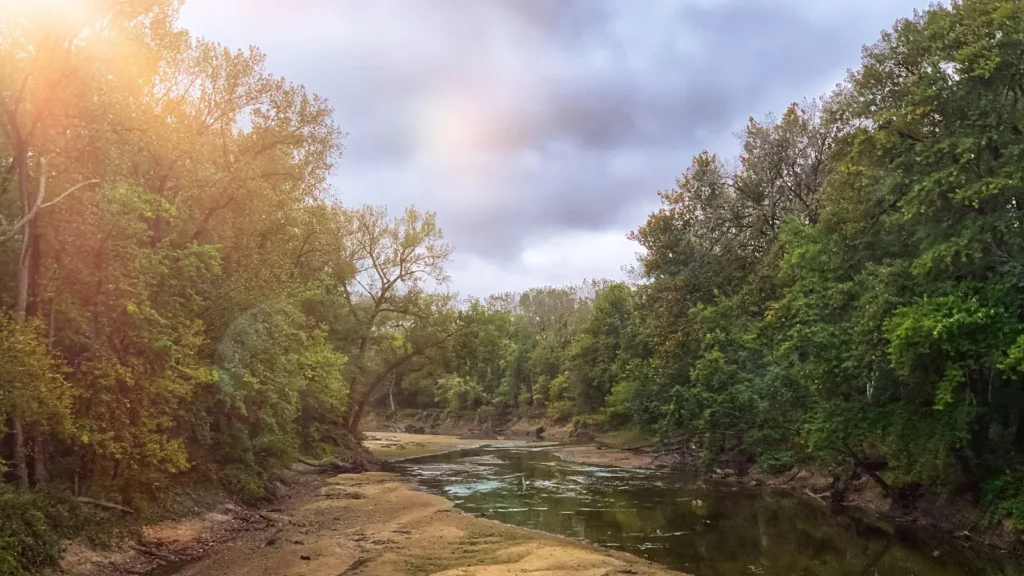
The photo at the top of this page is not Driftwood River.
It is a regional stand-in, honestly captioned but generic — we will not put a name to a river we cannot prove. Send us a photograph you took here and it replaces the stand-in, with your credit on it.
Add a photo of this water
Landscape, not fish — the water itself. Reviewed by hand before it appears. The first one published here earns the Pioneer badge.
Fished this water? Add a photo
Reviewed by hand before it appears. Pick the water, not the spot — we never publish exact locations.
Access
Edinburgh - the gauge town at the head of the river, where the Big Blue and Sugar Creek join.
Taylorsville - the usual midpoint for a float, with bridge access to the gravel reaches.
Columbus - the downstream end, where the Driftwood meets the Flatrock to form the East Fork White River.
Mill Race Park, Columbus - city parkland at the confluence with parking and walk-in bank access.
Lowell Bridge - a long-standing crossing giving access to the lower gravel riffles.
Big Blue River - the larger of the two forming tributaries, worth knowing when reading the gauge.
Sugar Creek - the second forming tributary, which carries the clearer of the two flows after rain.
Seasons
Spring: high and often coloured, with the best flathead and channel catfish fishing of the year as the water warms through April and May.
Summer: the prime smallmouth window, with low clear water, wadeable riffles and long evenings on the gravel.
Fall: steady flows and the lightest pressure of the season, with smallmouth concentrated in the deeper riffle tails.
Winter: low, cold and mostly a catfish proposition in the deep bends, with the riffles too thin to hold fish.
From the water
No logged trips yet. Be the first to put this water on your map.
Log this water
Fished it or cleaned it? Log in or create a free account to log a trip with photos and earn the waterway badge.
Questions
What is the current flow on the Driftwood River?
As of Nov 2, 6:30 am, the USGS gauge DRIFTWOOD RIVER NEAR EDINBURGH, IN reads 234 cfs. Conditions update every 15 minutes.
What species can you catch on the Driftwood River?
Anglers target Bluegill, Channel Catfish, Common Carp, Flathead Catfish, Freshwater Drum, Largemouth Bass, Longear Sunfish, Rock Bass, Smallmouth Bass, White Sucker on the Driftwood River in Indiana.
Where can you access the Driftwood River?
Edinburgh - the gauge town at the head of the river, where the Big Blue and Sugar Creek join. Taylorsville - the usual midpoint for a float, with bridge access to the gravel reaches. Columbus - the downstream end, where the Driftwood meets the Flatrock to form the East Fork White River. Mill Race Park, Columbus - city parkland at the confluence with parking and walk-in bank access. Lowell Bridge - a long-standing crossing giving access to the lower gravel riffles. Big Blue River - the larger of the two forming tributaries, worth knowing when reading the gauge. Sugar Creek - the second forming...
When is the best time to fish the Driftwood River?
Spring: high and often coloured, with the best flathead and channel catfish fishing of the year as the water warms through April and May. Summer: the prime smallmouth window, with low clear water, wadeable riffles and long evenings on the gravel. Fall: steady flows and the lightest pressure of the season, with smallmouth concentrated in the deeper riffle tails. Winter: low, cold and mostly a catfish proposition in the deep bends, with the riffles too thin to hold fish.
Where are the fishing regulations for the Driftwood River?
Regulations change by season and section. Read the current rules on the Indiana agency site: https://www.in.gov/dnr/fish-and-wildlife/fishing/