Flathead Catfish
Pylodictis olivaris
A nocturnal ambush predator that takes live fish and ignores carrion, now the top predator in Atlantic slope rivers where it was never native.
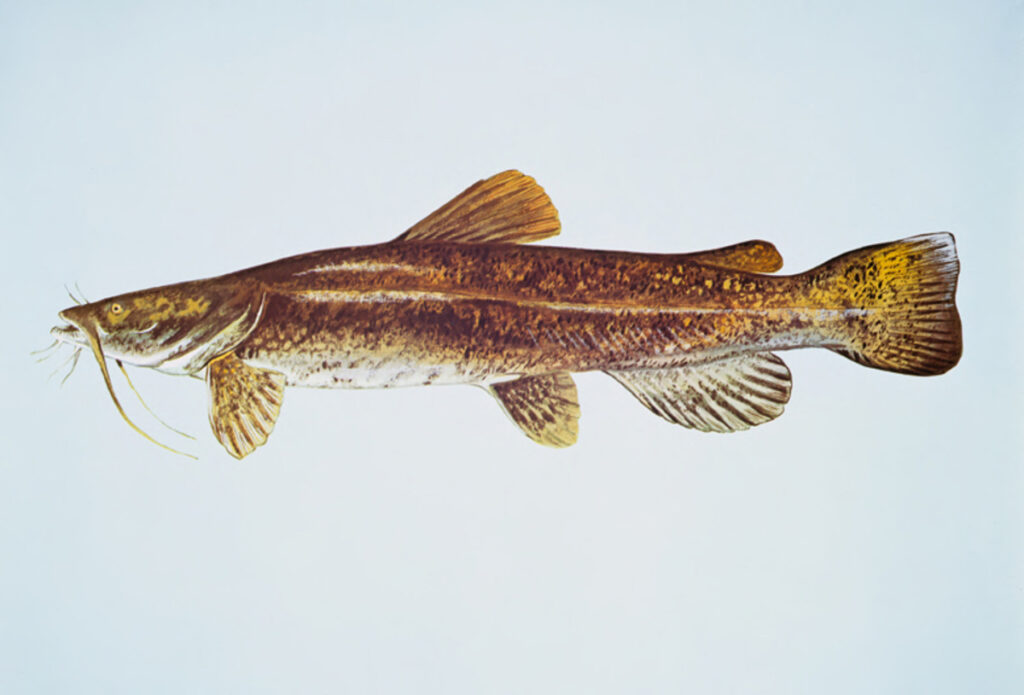
Identification
The flathead is the odd one out among North America’s big river catfishes, and almost nothing about it invites confusion once the fish is in hand. The head is broad and flattened with small eyes set high on top, and the lower jaw projects beyond the upper — the reverse of the arrangement in blue and channel catfish. The tail is squared off with only a slight notch, never deeply forked, and the upper lobe usually carries a pale or whitish tip that is visible at distance in clear water. Coloration runs pale yellow through light brown to olive, heavily mottled with dark brown or black, which is where the regional name “yellow cat” comes from. Young fish are darker and more boldly marbled than adults (Missouri Department of Conservation).
The anal fin settles the matter for anyone counting rays. A flathead carries roughly 14 to 17 anal rays on a short, rounded fin. Blue catfish carry 30 to 36 rays on a fin with a straight outer margin, and channel catfish carry 24 to 29 rays on a fin with a rounded margin (Texas Parks and Wildlife Department). Missouri’s field guide gives the blue catfish count as 30 to 35 rather than 30 to 36; the small discrepancy does not matter in practice, because the gap between a flathead’s fourteen-odd rays and a blue’s thirty-odd is enormous. Two further flathead characters are diagnostic: the adipose fin is free at its rear edge rather than fused to the back, and the tooth pad in the upper jaw has a backward-projecting extension at each end, a structure no other North American ictalurid shares.
The routine misidentification on Atlantic slope rivers is not flathead-versus-blue. It is blue-versus-channel, and the culprit is spotting. Channel catfish are spotted as juveniles and young adults, but the spots “may be absent in large adults”. A big, unspotted, slate-coloured channel catfish is regularly reported as a blue. Blue catfish are never spotted at any age. Because both species now occur alongside introduced flatheads in rivers from Georgia to Pennsylvania, counting anal rays rather than looking at colour is the only reliable field method. Flathead catfish share the family’s sensory equipment — dense external taste buds, four barbel pairs, and the Weberian ossicles linking swim bladder to inner ear — with channel catfish, and that biology is covered in depth elsewhere on this site. What separates the flathead is not how it senses prey but what it does with it.
Range and distribution
The native range covers the lower Great Lakes and Mississippi River basins from western Pennsylvania west to the White and Little Missouri river systems of North Dakota and south to Louisiana, plus the Gulf Slope from the Mobile Bay drainage in Georgia and Alabama south into Mexico (USFWS Ecological Risk Screening Summary). Within Georgia this produces an unusual split: the flathead is native to Gulf drainages including the Coosa River watershed in the northwest corner of the state while being an introduced predator in the Atlantic-flowing rivers to the east.
Outside that native range the flathead has been moved, mostly deliberately and mostly illegally, into river systems across the continent. The USGS Nonindigenous Aquatic Species database tracks the records; introductions span from Michigan in the 1920s through Texas and Florida in the 1950s to the Atlantic slope programme of introductions that began in the 1960s. The Smithsonian Environmental Research Center’s invasions database dates the first Chesapeake-drainage release to the James River in 1965, with western introductions running earlier still — the Colorado River basin near Phoenix in 1940 and the Snake River in Idaho in 1943.
The northeastern expansion is recent and well documented. USGS surveys record the first Delaware-basin detection in the Schuylkill River at Fairmount Dam in 1999 and the first Susquehanna detection at Safe Harbor Dam in 2002, with abundance since declining with distance from those two points of entry — a clean signature of two founding events followed by upstream spread (USGS). Sources disagree on the Susquehanna date: a separate USGS Chesapeake Bay programme page gives 1991 as the first detection, roughly a decade earlier than the survey-based figure. New Jersey logged its first confirmed flathead in the Delaware and Raritan Canal at Lambertville in July 1999, a second from the Delaware River in 2008 and a third in 2009, and attributed all of them to the reproducing Schuylkill population.
Habitat and water temperature
Flatheads are big-river fish. They hold in deep, slow water against structure — submerged logs, root wads, brush piles, rip-rap and undercut banks — and they are essentially absent from headwater creeks (North Carolina Wildlife Resources Commission). The pattern that matters for river anglers is that this is daytime cover, not feeding habitat. Flatheads occupy heavy wood through the day and move out onto shallower flats, bars and current seams after dark.
Thermally the species is warm-adapted but not extreme. Field surveys compiled by the USFWS find adults across 21.7 to 30 °C (71 to 86 °F), with abundance peaking at 27.2 °C (81 °F). Juveniles of 100 to 200 mm select warmer water still in laboratory trials, preferring 31.5 to 33.5 °C (89 to 92 °F). The upper field limit reported by the Smithsonian’s invasions database is 33 °C (91 °F). A defensible upper lethal figure for wild flatheads is not published in the primary sources reviewed here, and any number quoted without one should be treated with suspicion.
Salinity sets the practical downstream boundary. A 96-hour LC50 of 10.0 parts per thousand (confidence interval 9.0 to 11.1) is reported by USFWS, and the Smithsonian database gives a maximum tolerated salinity of 14 ppt. That is enough to let flatheads use tidal fresh and low-brackish reaches of Atlantic slope rivers, but not enough to make open estuary a corridor for them the way it has become for blue catfish.
Life history
Flatheads are cavity nesters. Spawning occurs in late spring through midsummer — Missouri places it in late June and July, notably later than channel catfish in the same rivers — with the male excavating and then guarding a nest in a hollow log, undercut bank, rock crevice or similar enclosed space (Missouri Department of Conservation). Reported temperature triggers vary by source. The Smithsonian database gives a reproductive range of 22 to 29 °C (72 to 84 °F); the USFWS screening summary cites two published figures that do not agree, 20 to 25 °C (68 to 77 °F) and 24 to 29 °C (75 to 84 °F). The overlap around 75 to 84 °F is the range all three support.
Sexual maturity arrives at roughly four to five years or about 18 inches. Maximum reported age is 20 years, maximum length 155 cm (about 61 inches) and maximum weight 55.8 kg (123 lb). Ordinary adults in a healthy river population run 15 to 45 inches and 1 to 45 pounds. Growth is fast where forage is abundant, and the Susquehanna population has produced fish exceeding four feet and nearly 70 pounds within roughly two decades of establishment (Penn State).
Diet
The flathead is a predator rather than a scavenger, and this is the single most important fact about the species. Missouri’s field guide is blunt about the distinction: unlike channel catfish, flatheads do not take carrion or prepared baits with any regularity, and adults feed almost entirely on live fish, crayfish and crustaceans. Only fish under about four inches rely on insect larvae.
The most detailed diet work available comes from the invaded Susquehanna. Researchers examined 576 flathead catfish over two years, recovered stomach contents from 241 of them, and used DNA barcoding to identify prey that morphology alone would have missed. They found 47 prey species. Rusty crayfish — itself an invader — appeared in nearly half the sampled fish. Margined madtom, a small native catfish of conservation concern, was among the most frequent fish prey, along with shiners. Blueback herring, gizzard shad, smallmouth bass, rock bass, channel catfish, walleye, bluegill and white perch all appeared, with 34 further species each below two percent occurrence. The switch to a fish-dominated diet occurred at about 24 inches: below that length flatheads mixed invertebrates and fish, above it they were largely piscivorous.
A companion stable-isotope study found flatheads occupying the highest trophic position in the river, above both smallmouth bass and channel catfish, and found that channel catfish fed measurably lower on the food web where flatheads were present, consistent with competitive displacement or predator avoidance. In the tidal James River, work on spring alosine runs found alosines in 16.67 percent of flathead stomachs against 4.46 percent of blue catfish stomachs, leading the authors to conclude that flatheads exert the greater per-capita impact on depleted American shad and river herring.
Angling
Flathead behaviour explains why they are caught the way they are. Because adults take live prey and largely ignore carrion, the fish that dominate blue and channel catfish catches — cut bait, stinkbait, chicken liver — rarely produce flatheads. Live sunfish, shad and bullheads are what North Carolina’s agency lists as preferred baits, and that preference is a direct read-out of the species’ feeding ecology rather than a matter of angler convention.
Timing follows from the same biology. Flatheads spend daylight in heavy wood and move to shallower feeding water after dark, which is why river catches concentrate at night and why the productive water is often the flat or bar adjacent to a snag rather than the snag itself. Their thermal profile — peak abundance at 81 °F, adults across 71 to 86 °F — means river temperature is a good proxy for activity through the warm months, which is why a live gauge reading is worth checking before a float. The Kansas record fish, a 123-pound flathead from Elk City Reservoir in 1998 that the state describes as also being the world record, came from still water rather than current; the very largest flatheads generally come from reservoirs and deep river pools where a fish can grow slowly for two decades without being displaced (Kansas Department of Wildlife and Parks).
Conservation and invasive status
NatureServe ranks Pylodictis olivaris G5, globally secure, reviewed February 2016. Nothing about the species is at risk within its native range. The conservation problem it presents is entirely one of introduction, and USFWS classifies it as high risk in its ecological risk screening.
The Atlantic slope record is the clearest case. In the Cape Fear River, North Carolina, flatheads reached 10.52 percent of total fish numbers and 64.7 percent of total fish weight, with severe decline in native bullhead catfish inside fifteen years. In the Altamaha River, Georgia, catch per unit effort hit 90 fish per hour by 1990 and redbreast sunfish catch rates fell precipitously. In the Ocmulgee, abundances of silver redhorse, robust redhorse, snail bullhead, flat bullhead and redbreast sunfish were all negatively correlated with flathead occurrence. In the Choctawhatchee River, Florida, flatheads expanded more than 91 river kilometres in two years and spotted bullhead catch rates declined significantly at three of four sites (USFWS). The consistent pattern across all of these systems is that native ictalurids and sunfishes take the heaviest losses.
The Satilla River in Georgia is the longest-running control effort and the best source of hard numbers. Flatheads were confirmed there in 1996, probably originating from an illegal release into the Altamaha in 1995, and declines in redbreast sunfish, channel catfish and bullheads followed within a few years. Georgia’s legislature funded a full-time removal project in 2006; intensive work began in April 2007. Over 4,000 flatheads came out in the first year, more than 64,000 between 2007 and 2016, and more than 100,000 by 2023. The population responded measurably: mean size fell from 5.8 pounds in 2007 to 0.8 pounds in 2018, and biomass per hour of effort fell from 57.1 kg/hr to 11.4 kg/hr. Tagging put exploitation at 50 to 53 percent in 2007 and 2008. More than 1,500 introduced blue catfish were removed from the same river in the 2022 season (Georgia DNR). Sustained removal suppresses a flathead population; it has not eliminated one.
As management context rather than instruction: several state agencies now discourage the release of flatheads caught outside their native range and ask anglers to report captures in newly invaded waters. New Jersey’s Division of Fish and Wildlife has asked anglers not to release flatheads back into the Delaware and to report captures to its Lebanon field office for verification; Georgia DNR runs active removal on the Satilla. A single Atlantic sturgeon has been recovered from a Satilla flathead stomach, which is the kind of finding that keeps the species on federal and state priority lists.
Where to catch it
280 waterways on GuidedFloats list flathead catfish, across 28 states. Each page carries live gauge readings, access notes, and the guides who fish it.
Alabama 14
- Alabama River below Millers Ferry
- Bayou Sara
- Black Warrior River below Bankhead Lock and Dam
- Black Warrior River below Selden Dam
- Choccolocco Creek156 cfs
- Choctawhatchee River308 cfs
- Conecuh River1,560 cfs
- Conecuh River below Point A Dam564 cfs
- Coosa River-364 cfs
- Lake Tuscaloosa
- Mobile River-3,610 cfs
- Tallapoosa River1,750 cfs
- Tensaw River-987 cfs
- Tombigbee River below Coffeeville Lock and Dam1,870 cfs
Arizona 5
- Bartlett Reservoir
- Bill Williams River below Alamo Dam13 cfs
- Salt River478 cfs
- Salt River below Stewart Mountain Dam
- Verde River1,020 cfs
Arkansas 13
- Bayou Bartholomew1 cfs
- Bayou Deview
- Bayou Macon13 cfs
- Bayou Meto
- Bear Bayou
- Beaver Lake
- Bull Shoals Lake
- Deep Bayou
- Frog Bayou
- Illinois Bayou4 cfs
- Lake Catherine
- Lake Hamilton
- Saline River13 cfs
Florida 2
- Lake Seminole
- Suwannee River6,170 cfs
Georgia 9
- Altamaha River3,770 cfs
- Broad River189 cfs
- Flint River1,490 cfs
- Kinchafoonee Creek137 cfs
- Middle Oconee River105 cfs
- Ocmulgee River1,380 cfs
- Ogeechee River25 cfs
- Satilla River2,430 cfs
- Spring Creek278 cfs
Illinois 18
- Big Muddy River47 cfs
- Cache River1 cfs
- Channel Lake
- Embarras River55 cfs
- Fox Lake
- Fox River1,480 cfs
- Illinois River (Illinois)14,000 cfs
- Iroquois River122 cfs
- Kankakee River1,610 cfs
- Kaskaskia River167 cfs
- Kishwaukee River804 cfs
- Little Wabash River77 cfs
- Mackinaw River100 cfs
- Macoupin Creek14 cfs
- Pecatonica River1,180 cfs
- Rock River4,900 cfs
- Vermilion River152 cfs
- Wabash River9,390 cfs
Indiana 9
- Big Raccoon Creek104 cfs
- Cecil M. Harden Lake
- Eagle Creek15 cfs
- East Fork White River
- Mississinewa Lake
- Salamonie Lake
- Tippecanoe River514 cfs
- White River (Indiana)1,010 cfs
- Wildcat Creek137 cfs
Iowa 9
- Beaver Creek834 cfs
- Big Bear Creek212 cfs
- Black Hawk Creek787 cfs
- Cedar River9,720 cfs
- Iowa River4,550 cfs
- Maquoketa River2,450 cfs
- Rathbun Lake
- Turkey River2,670 cfs
- Wapsipinicon River3,330 cfs
Kansas 14
- Cedar Bluff Reservoir
- Clinton Lake
- Cottonwood River104 cfs
- Fall River20 cfs
- Kanopolis Lake
- Kansas River15,000 cfs
- Marais des Cygnes River44 cfs
- Neosho River3,530 cfs
- Perry Lake
- Pomona Lake
- Stranger Creek39 cfs
- Tuttle Creek Lake
- Verdigris River68 cfs
- Walnut River174 cfs
Kentucky 7
- Bayou de Chien19 cfs
- Green River (Kentucky)414 cfs
- Kentucky River877 cfs
- Levisa Fork below Fishtrap Dam
- Rough River Lake
- Taylorsville Lake
- Tygarts Creek30 cfs
Louisiana 52
- Alligator Bayou
- Amite River321 cfs
- Atchafalaya River27,800 cfs
- Bayou Anacoco32 cfs
- Bayou Bartholomew5 cfs
- Bayou Bonne Idee
- Bayou Cocodrie62 cfs
- Bayou Conway
- Bayou Courtableau3 cfs
- Bayou D'Arbonne
- Bayou D'Arbonne
- Bayou Darby
- Bayou de Loutre
- Bayou Des Glaises11 cfs
- Bayou Dorcheat
- Bayou Fountain
- Bayou Fusilier
- Bayou Grand Cane
- Bayou Grosse Tete
- Bayou Macon
- Bayou Mallet
- Bayou Milhomme
- Bayou Nezpique9 cfs
- Bayou Pierre152 cfs
- Bayou Queue de Tortue
- Bayou Rapides
- Bayou San Patricio
- Bayou Teche
- Bayou Toro1 cfs
- Big Colewa Bayou
- Black Bayou
- Bodcau Bayou314 cfs
- Bushley Bayou
- Chauvin Bayou
- Chemin-A-Haut Bayou
- Choctaw Bayou
- Cross Bayou
- Cypress Bayou4 cfs
- Flagon Bayou
- Gilmer Bayou
- Henderson Bayou
- Lake D'Arbonne
- Little Corney Bayou
- Loggy Bayou
- Paw Paw Bayou
- Red Chute Bayou243 cfs
- Saline Bayou18 cfs
- Shettleworth Bayou
- Tangipahoa River359 cfs
- Twelvemile Bayou
- Willow Chute Bayou
- Youngs Bayou
Maryland 2
- Monocacy River276 cfs
- Potomac River5,030 cfs
Minnesota 2
- Cannon River541 cfs
- Mississippi River7,520 cfs
Mississippi 13
- Bayou Pierre
- Big Black River229 cfs
- Harris Bayou
- Luxapallila Creek87 cfs
- Pascagoula River
- Pearl River909 cfs
- Porter Bayou12 cfs
- Richies Bayou
- Ross Barnett Reservoir
- Steele Bayou
- Strong River43 cfs
- Tombigbee River230 cfs
- Wolf River (Mississippi)44 cfs
Missouri 4
- Big River133 cfs
- North Fork Spring River8 cfs
- Spring River74 cfs
- Table Rock Lake
Nebraska 14
- Bazile Creek44 cfs
- Big Blue River978 cfs
- Bow Creek37 cfs
- Cedar River259 cfs
- Elkhorn River1,240 cfs
- Frenchman Creek14 cfs
- Logan Creek215 cfs
- Loup River266 cfs
- Middle Loup River1,220 cfs
- Niobrara River543 cfs
- Platte River5,150 cfs
- Ponca Creek9 cfs
- Sappa Creek
- Wahoo Creek140 cfs
New Mexico 4
North Carolina 9
- Catawba River3,000 cfs
- Deep River56 cfs
- Haw River104 cfs
- Lumber River104 cfs
- Neuse River-82 cfs
- Pee Dee River592 cfs
- Roanoke River1,530 cfs
- Tar River3 cfs
- Yadkin River1,940 cfs
Ohio 10
- Great Miami River1,810 cfs
- Hocking River516 cfs
- Kokosing River47 cfs
- Licking River
- Maumee River989 cfs
- Muskingum River2,520 cfs
- Sandusky River66 cfs
- Scioto River2,190 cfs
- Tuscarawas River
- Walhonding River
Oklahoma 11
- Big Cabin Creek2 cfs
- Fort Cobb Reservoir
- Glover River
- Illinois River353 cfs
- Kiamichi River2 cfs
- Lake Eucha
- Lake Lawtonka
- Lake Thunderbird
- McGee Creek Reservoir
- Mountain Fork8 cfs
- North Fork Red River below Altus Dam1 cfs
Pennsylvania 1
- Susquehanna River16,300 cfs
South Carolina 13
- Broad River1,120 cfs
- Catawba River1,190 cfs
- Congaree River3,530 cfs
- Lake Marion
- Lake William C. Bowen
- Middle Tyger River21 cfs
- Monticello Reservoir
- Neal Shoals Reservoir
- Ninetynine Islands Reservoir
- Pacolet River177 cfs
- Parr Shoals Reservoir
- Saluda River2,380 cfs
- Wateree River Tailrace2,750 cfs
South Dakota 3
- Cheyenne River87 cfs
- Missouri River (South Dakota)
- White River93 cfs
Tennessee 5
- French Broad River1,270 cfs
- Hatchie River224 cfs
- Nolichucky River1,000 cfs
- Reelfoot Lake
- Running Reelfoot Bayou
Texas 27
- Attoyac Bayou
- Austin Bayou
- Bayou Lanana1 cfs
- Big Cypress Bayou20 cfs
- Black Cypress Bayou
- Brazos River465 cfs
- Buffalo Bayou149 cfs
- Greens Bayou
- Housen Bayou
- Hurricane Bayou
- Lake Charlotte
- Linnville Bayou
- Little Cypress Bayou
- Luce Bayou4 cfs
- Medina River17 cfs
- Mustang Bayou
- Neches River172 cfs
- Palo Gaucho Bayou2 cfs
- Pecan Bayou13 cfs
- Pine Island Bayou2 cfs
- Sabine River415 cfs
- San Marcos River89 cfs
- San Saba River91 cfs
- Village Creek97 cfs
- West Fork San Jacinto River
- Whiteoak Bayou19 cfs
- Winters Bayou
Virginia 5
- Clinch River453 cfs
- Dan River715 cfs
- James River986 cfs
- Pamunkey River218 cfs
- Pound River below Flannagan Dam
West Virginia 2
Wisconsin 3
- Chippewa River1,500 cfs
- Lake Koshkonong
- Wisconsin River5,300 cfs
References
- Flathead Catfish (Pylodictis olivaris) Ecological Risk Screening Summary — High Risk — U.S. Fish and Wildlife Service
- Flathead Catfish (Pylodictis olivaris) — Species Profile — USGS Nonindigenous Aquatic Species Database
- Invasive flathead catfish now top predators in Susquehanna River in Pennsylvania — U.S. Geological Survey, Chesapeake Bay Activities
- Range expansion and factors affecting abundance of invasive Flathead Catfish in the Delaware and Susquehanna Rivers, Pennsylvania, USA — U.S. Geological Survey
- Invasive flathead catfish impacting Susquehanna's food chain, researchers find — Penn State University
- Satilla River Flathead Catfish Removal Project — Georgia Department of Natural Resources, Wildlife Resources Division
- Flathead Catfish — Georgia Department of Natural Resources, Wildlife Resources Division
- Flathead Catfish — Field Guide — Missouri Department of Conservation
- Flathead Catfish — North Carolina Wildlife Resources Commission
- Catfish Comparison and Identification — Texas Parks and Wildlife Department
- Flathead Catfish — Kansas Department of Wildlife and Parks
- Pylodictis olivaris — species summary (tolerances, invasion history, impacts) — Smithsonian Environmental Research Center, NEMESIS
- Pylodictis olivaris — Flathead Catfish, global conservation status — NatureServe Explorer
- Flathead Catfish Confirmed in the Delaware River — New Jersey Division of Fish and Wildlife
- Predation and Prey Selectivity by Nonnative Catfish on Migrating Alosines in an Atlantic Slope Estuary — Marine and Coastal Fisheries (Oxford Academic)
- Virginia State Record Fish — Virginia Department of Wildlife Resources
- Invasive Blue and Flathead Catfish a Threat to Bay Ecosystems — Chesapeake Bay Program
- IGFA World Records — International Game Fish Association