Smoky Hill River Fishing Guides
The larger of the two rivers that form the Kansas River, carrying serious flathead and blue catfish water through central Kansas, with a gauge that reports water temperature alongside flow.
Guides on the Smoky Hill River
Claimed profiles take booking requests. Unclaimed profiles are built from public records so the river is never empty; the guide can claim or remove one any time.
No guides listed yet
Guide or outfit this water? Create your profile. Listing is free, the commission is 10% or 7% with a premium profile, and premium profiles list first on this water.
About the Smoky Hill River
The Smoky Hill is one of the two rivers that make the Kansas River, and it is the longer and larger of the pair. It rises on the high plains near the Colorado line and crosses almost the entire width of the state before meeting the Republican at Junction City. By the time it reaches the gauge at Enterprise it is draining better than nineteen thousand square miles, which makes this the biggest river in this batch by a wide margin and gives the lower reach the depth and volume that large catfish require.
Catfish are what the river is known for and what it delivers. Channel catfish are everywhere, flathead catfish reach genuine size in the deep holes and around submerged timber, and blue catfish are present in the lower river and growing more common as the population has expanded upstream from the Kansas River. White bass run up out of the bigger water in spring and can be found in numbers below the riffles. Largemouth and smallmouth bass hold on the rock and rip-rap, and drum, carp, bluegill and green sunfish are widespread through the whole reach.
The gauge at Enterprise is better equipped than most, reporting water temperature alongside discharge and stage. For a catfish river that temperature reading is the single most useful number available, because flathead feeding turns on and off with it far more sharply than with anything else: the difference between water in the low sixties and water in the mid seventies is the difference between a slow night and a good one. Access is from town parkland, bridge crossings and county roads. The riffles between the deeper holes are worth stopping at as well, because they concentrate white bass in spring and hold smallmouth through the summer in water most catfish anglers drive straight past.
This water needs a real photo
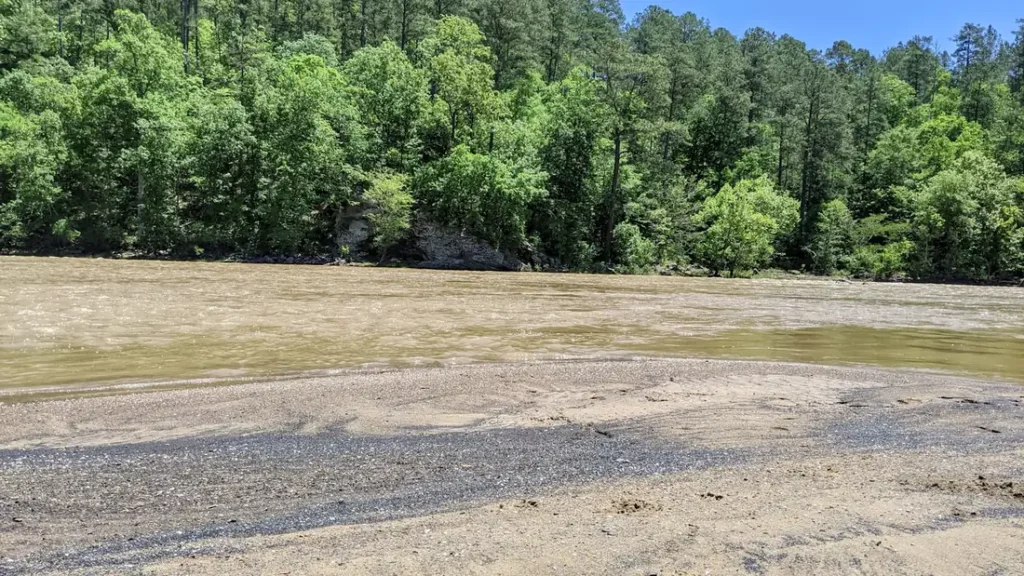
The photo at the top of this page is not Smoky Hill River.
It is a regional stand-in, honestly captioned but generic — we will not put a name to a river we cannot prove. Send us a photograph you took here and it replaces the stand-in, with your credit on it.
Add a photo of this water
Landscape, not fish — the water itself. Reviewed by hand before it appears. The first one published here earns the Pioneer badge.
Fished this water? Add a photo
Reviewed by hand before it appears. Pick the water, not the spot — we never publish exact locations.
Access
Enterprise - the gauge town, with the best road access to the deep holes of the lower river.
Abilene - the larger town upstream, with parkland and bridge access to the middle reaches.
Junction City - the downstream confluence with the Republican River, where the Kansas River begins.
Solomon - a village at the mouth of the Solomon River, a major tributary worth knowing.
Detroit - a small crossing between Abilene and Enterprise giving access to quieter water.
Milford Lake - the large reservoir on the Republican just above the confluence, a useful alternative in high water.
Chapman Creek - a tributary entering near Enterprise, often clearer than the main river after rain.
Seasons
Spring: high and coloured, with the white bass run up from the lower river and channel catfish feeding aggressively as temperatures climb.
Summer: the main flathead season, fished mostly at night in the deep holes, with the gauge temperature the best guide to timing.
Fall: flows settle and the water clears, bringing the best bass fishing of the year on the rock and rip-rap.
Winter: cold and low, with blue catfish the most reliable target and fish stacked in the deepest holes.
From the water
No logged trips yet. Be the first to put this water on your map.
Log this water
Fished it or cleaned it? Log in or create a free account to log a trip with photos and earn the waterway badge.
Questions
What is the current flow on the Smoky Hill River?
As of Nov 2, 6:45 am, the USGS gauge SMOKY HILL R AT ENTERPRISE, KS reads 372 cfs, with water temperature 63.7 F. Conditions update every 15 minutes.
What species can you catch on the Smoky Hill River?
Anglers target Blue Catfish, Bluegill, Channel Catfish, Common Carp, Flathead Catfish, Freshwater Drum, Green Sunfish, Largemouth Bass, Smallmouth Bass, White Bass on the Smoky Hill River in Kansas.
Where can you access the Smoky Hill River?
Enterprise - the gauge town, with the best road access to the deep holes of the lower river. Abilene - the larger town upstream, with parkland and bridge access to the middle reaches. Junction City - the downstream confluence with the Republican River, where the Kansas River begins. Solomon - a village at the mouth of the Solomon River, a major tributary worth knowing. Detroit - a small crossing between Abilene and Enterprise giving access to quieter water. Milford Lake - the large reservoir on the Republican just above the confluence, a useful alternative in high water. Chapman Creek - a trib...
When is the best time to fish the Smoky Hill River?
Spring: high and coloured, with the white bass run up from the lower river and channel catfish feeding aggressively as temperatures climb. Summer: the main flathead season, fished mostly at night in the deep holes, with the gauge temperature the best guide to timing. Fall: flows settle and the water clears, bringing the best bass fishing of the year on the rock and rip-rap. Winter: cold and low, with blue catfish the most reliable target and fish stacked in the deepest holes.
Where are the fishing regulations for the Smoky Hill River?
Regulations change by season and section. Read the current rules on the Kansas agency site: https://ksoutdoors.com/Fishing/Fishing-Regulations