Blue Catfish
Ictalurus furcatus
North America's largest catfish, and in the Chesapeake tributaries where it was stocked in the 1970s it now makes up as much as 75 percent of total fish biomass.
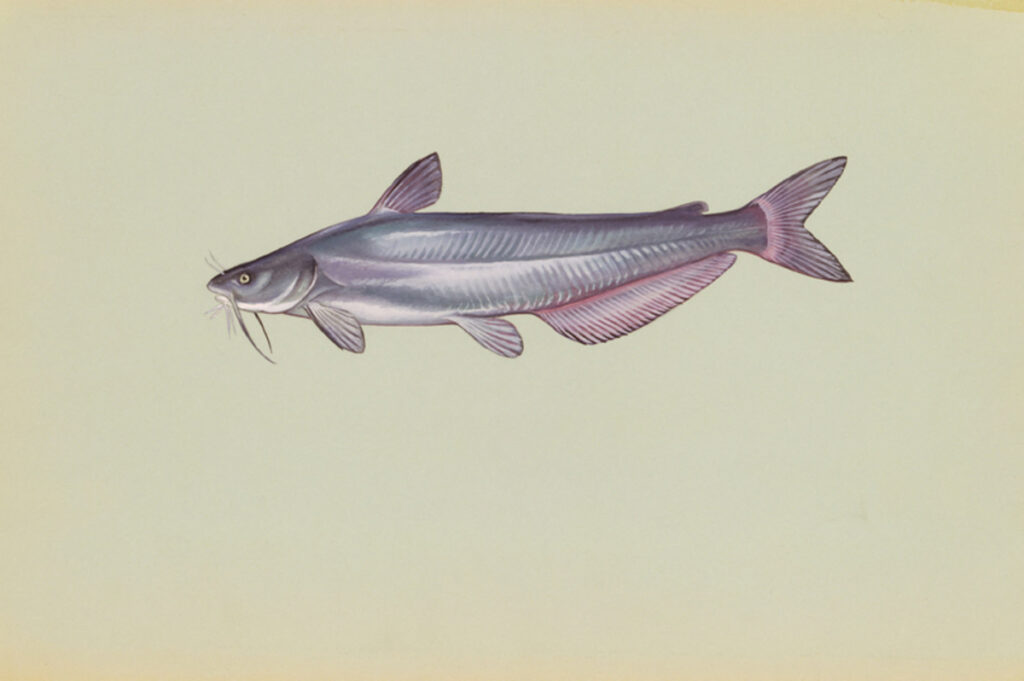
Identification
Blue catfish are separated from channel catfish by one reliable character and several unreliable ones. The reliable character is the anal fin. A blue catfish carries 30 to 36 anal rays on a fin whose outer margin is straight — Missouri’s field guide describes it tapering rearward “in a flat line, like a barber’s comb.” A channel catfish carries 24 to 29 rays on a fin with a rounded margin (Texas Parks and Wildlife Department). Missouri gives the blue catfish range as 30 to 35 rather than 30 to 36; the disagreement is one ray and does not affect any real identification.
The unreliable characters are colour and spotting, and they are the source of nearly every misidentification. Blue catfish are pale bluish-silver above, grading to silvery white on the lower sides and belly, with clear or whitish fins, and they never carry dark spots at any age (Missouri Department of Conservation). Channel catfish do carry scattered dark spots — but those spots “may be absent in large adults”. A large, unspotted, slate-grey channel catfish looks exactly like the mental image most anglers hold of a blue, and it is routinely reported as one. Counting rays takes ten seconds and resolves it every time. Two supporting characters help: blue catfish show a pronounced hump at the nape ahead of the dorsal fin and a straight-sided, wedge-shaped head profile that channel catfish lack (South Carolina DNR).
Neither species can be confused with the flathead catfish, which has a broad flattened head, a projecting lower jaw, a squared rather than forked tail, mottled yellow-brown coloration and only 14 to 17 anal rays. Blue and channel catfish both have deeply forked tails and an upper jaw that overhangs the lower. Blue catfish share the ictalurid sensory apparatus — external taste buds distributed over the body, four barbel pairs, and the Weberian ossicles that couple the swim bladder to the inner ear — with channel catfish, and that material is treated at length elsewhere on this site. What distinguishes the blue catfish is size, salinity tolerance and dietary breadth.
Range and distribution
The native range covers the Mississippi, Missouri and Ohio River basins from western Pennsylvania and southern South Dakota south to the Gulf of Mexico, plus Gulf Coast streams from Alabama south into Mexico. The species is rarely found above the Missouri River confluence (USGS Nonindigenous Aquatic Species database).
Introductions have carried it to more than thirty states. Early stockings include Oklahoma in 1947, California in 1966 and North Carolina in 1975; South Carolina’s introduction into Lake Marion dates to 1964. Some spread was accidental — flooding at an Alabama catfish farm in March 1990 released blue catfish into the Chattahoochee system, where they are now established alongside the Apalachicola and Escambia populations. Recent records from Delaware, Maryland and Pennsylvania date from after 2010 (USGS NAS).
The Chesapeake introductions are the consequential ones, and the sources disagree on their detail. Virginia DWR states that the agency introduced blue catfish to the James and Rappahannock rivers in 1974 and the York in 1985, to build a trophy fishery while striped bass stocks were declining. The Smithsonian Environmental Research Center’s Chesapeake records give first stocking of the Rappahannock in 1974 with 97,800 fish released across 1974, 1975 and 1977, and the James beginning in 1975 with 64,100 fish. Maryland DNR summarises the whole programme as more than 300,000 juveniles released between 1974 and 1985. The year the James was first stocked is genuinely contested.
What followed is not contested. Blue catfish reached the Potomac by the late 1980s, the Patuxent and Nanticoke in the 2000s, and the Susquehanna and Sassafras by 2008 to 2010. Wet years in 2018 and 2019 pushed them through the upper Bay. As of 2023 Virginia DWR records them in every Virginia tributary of the Chesapeake and lists the species as invasive.
Habitat and water temperature
Blue catfish favour large rivers with moderate to swift current over rock, gravel or clean sand, and unlike most catfish they hold in faster water — swift chutes, pools with visible current, silt-free bottoms (Missouri DOC; North Carolina WRC). They also do well in large impoundments. In the Chesapeake tributaries the concentrations sit in low-salinity tidal reaches averaging roughly three metres deep.
The USFWS ecological risk screening gives a preferred temperature of 28 to 30 °C (82 to 86 °F) and reports that 95 percent survive winter at temperatures as low as 5.1 °C (41 °F). The Smithsonian’s Chesapeake records place the reproductive minimum at 21 °C (70 °F). Taken together the warm-season band that matters on a river runs from about 70 °F, where spawning becomes possible, to about 86 °F at the top of the preferred range. A published upper lethal temperature for wild blue catfish was not located in the primary sources reviewed here; the species is warm-tolerant, but no specific number should be asserted without one.
Salinity is the more interesting axis, and the one that made the Chesapeake invasion possible. Blue catfish were expected to stay in fresh water. They did not. Maryland DNR and University of Maryland Extension report tolerance to about 15 parts per thousand; the Smithsonian records give survival across 0 to 12 ppt but reproduction only at 0 to 2 ppt; and a 2021 synthesis in the North American Journal of Fisheries Management documents expansion into salinities as high as 21.8 psu. Research summarised by NOAA found tolerance increasing with body size. The practical consequence is that adult blue catfish can cross open brackish water between tributaries even though they can only breed in the fresh upper reaches — the estuary is a corridor, not a barrier.
Life history
Spawning occurs in late spring and early summer at 70 to 75 °F, with eggs deposited in a cavity and guarded by the male; South Carolina DNR reports both parents attending eggs and young. Females produce roughly 2,000 to 4,000 eggs per pound of body weight (Virginia DWR).
Longevity estimates vary widely. Virginia DWR gives an average of 9 to 10 years with a maximum of 25; the USFWS screening summary reports a maximum published age of 21 years; South Carolina DNR cites roughly 34 years. Maximum published length is 165 cm (about 65 inches) and maximum published weight 68 kg, though the largest verified fish are well below that. Ordinary adults run 20 to 44 inches and 3 to 40 pounds. This is the largest catfish native to North America, and it is the size structure — a long-lived fish that keeps growing and keeps switching to larger prey — that drives its ecological effect.
Diet
Blue catfish diet is the most thoroughly studied aspect of the species, and it is also where the science is least settled. The largest study examined 16,110 stomachs from the James, Pamunkey, Mattaponi and Rappahannock between 2013 and 2016. It found “some of the highest diet breadths ever observed in an estuarine fish species”: aquatic vegetation occurred in 33 to 51 percent of stomachs depending on river, Asian clam in 6 to 16 percent, blue crab in 0.8 to 6.2 percent. Gizzard shad dominated by weight in the James at 52.2 percent. The threshold at which fish became the dominant prey varied enormously between rivers — 500 mm in the James, 700 mm in the Rappahannock, 800 mm in the Mattaponi, 900 mm in the Pamunkey. The authors concluded that blue catfish function as generalist omnivores at lower trophic levels than previously claimed, feeding heavily on other invasive species rather than on imperilled natives.
Targeted studies reach harder conclusions. A James River investigation examined 6,330 stomachs from 402 gill-net sets between August 2018 and June 2020. Blue crab appeared in 527 of them, at up to 72.4 percent occurrence in November 2019. Consumed crabs ran 6.2 to 128 mm carapace width, averaging 45.6 mm, indicating that predation falls almost entirely on juveniles while larger crabs occupy a size refuge. Catfish of 501 mm and above were 1.68 times more likely to eat a crab than fish of 301 to 500 mm, but the intermediate size class removed the most crabs in total because there are more of them. The estimated annual removal from the lower James alone was 564,365 juvenile blue crabs (95% CI 58,065 to 948,372).
On anadromous prey the picture is more nuanced than the headlines suggest. Spring sampling on the James found alosines — American shad, blueback herring and alewife — in 4.46 percent of 2,164 blue catfish stomachs, against 16.67 percent of 331 flathead catfish stomachs. Blue catfish ate gizzard shad instead. The authors concluded that flatheads have the greater per-capita impact on depleted alosines, even though blue catfish are far more numerous. Maryland DNR reports James River annual consumption estimates of 441 tons of blue crab, 108 tons of menhaden and 68 tons of American eel. The honest summary: per fish, the blue catfish is a moderate generalist; in aggregate, at Chesapeake densities, it removes a great deal.
Angling
Blue catfish behaviour on rivers follows from their preference for current and their omnivory. They hold in faster water than channel or flathead catfish and feed across the whole prey spectrum, which is why cut bait, live fish, crayfish, clams and shrimp all produce them — a diet study finding aquatic vegetation in half of all stomachs describes a fish that investigates almost anything. They are strongly mobile: telemetry summarised by NOAA shows blue catfish moving seasonally over substantial distances, with the heaviest movement in early summer.
Their cold tolerance explains the Chesapeake winter fishery. A fish with 95 percent overwinter survival at 41 °F does not shut down, and the November peak in blue crab consumption from the James River study shows active feeding well into late autumn. Temperature therefore predicts where blue catfish are more than whether they are feeding: as tidal rivers cool, fish concentrate in deeper channel water, and as they warm past 70 °F the population spreads onto flats and into the spawning reaches.
The largest documented fish are extraordinary. The Virginia state record — recognised by the state and by the Chesapeake Bay Program as a world record — is a 143-pound blue catfish taken from Buggs Island Lake (Kerr Reservoir) on 18 June 2011 (Virginia DWR). South Carolina’s record stands at 109 pounds 4 ounces from 1991.
Conservation and invasive status
NatureServe ranks Ictalurus furcatus G5, globally secure (review date February 2012). The species is not at risk within its native range. USFWS classifies it as high risk for introduction.
The Chesapeake numbers are what have driven policy attention. Electrofishing surveys show blue catfish making up up to 75 percent of total fish biomass in portions of the tidal James and Rappahannock. A mark-recapture study of a single 12-kilometre reach of the James estimated 1.6 million blue catfish between 21.4 and 46.6 cm fork length (95% CI 0.9 to 2.9 million), a density of 544 fish per hectare — higher than most non-native fish densities recorded anywhere. Upper Patuxent surveys in Maryland exceed 500 fish per hectare. Popular estimates of more than 100 million fish Bay-wide circulate in agency and extension material but are explicitly flagged there as unconfirmed.
Commercial landings track the population. Chesapeake blue catfish landings rose from just under 203,000 pounds in 2007 to over 4.1 million pounds in 2016, and Maryland and Potomac landings from 609,525 pounds in 2013 to 4.2 million pounds in 2023. Since 2015, blue catfish harvest by weight from the Chesapeake region has exceeded that of striped bass. A 2024 federal agriculture bill directed $500,000 toward monitoring and study.
Management is genuinely contested, because three objectives conflict: maintaining a valuable trophy and commercial fishery, reducing the population, and preventing further range expansion. Virginia Institute of Marine Science researchers modelling control options concluded that eradication is “not possible” and that blue catfish can survive and reproduce even when food is scarce. Documented consequences already include declines in native white catfish and white perch following blue catfish establishment. As management context rather than instruction: several Bay-state agencies and the Chesapeake Bay Program now actively encourage harvest and consumption of blue catfish as a control measure, and market development has become an explicit policy tool.
Where to catch it
199 waterways on GuidedFloats list blue catfish, across 22 states. Each page carries live gauge readings, access notes, and the guides who fish it.
Alabama 12
- Alabama River below Millers Ferry
- Bayou Sara
- Black Warrior River below Bankhead Lock and Dam
- Black Warrior River below Selden Dam
- Choctawhatchee River321 cfs
- Conecuh River2,200 cfs
- Conecuh River below Point A Dam1,240 cfs
- Coosa River3,540 cfs
- Lake Tuscaloosa
- Mobile River12,400 cfs
- Tensaw River8,260 cfs
- Tombigbee River below Coffeeville Lock and Dam1,680 cfs
Arkansas 10
- Bayou Bartholomew1 cfs
- Bayou Deview
- Bayou Macon13 cfs
- Bayou Meto
- Bear Bayou
- Beaver Lake
- Deep Bayou
- Lake Catherine
- Lake Hamilton
- Saline River13 cfs
Delaware 1
- Marshyhope Creek13 cfs
Florida 1
Georgia 4
- Altamaha River3,740 cfs
- Lake Eufaula
- Ocmulgee River1,500 cfs
- West Point Lake
Illinois 6
- Big Muddy River45 cfs
- Embarras River55 cfs
- Kaskaskia River170 cfs
- Little Wabash River76 cfs
- Macoupin Creek15 cfs
- Wabash River9,570 cfs
Indiana 1
Kansas 16
- Cedar Bluff Reservoir
- Cheney Reservoir
- Clinton Lake
- Hillsdale Lake
- Kanopolis Lake
- Kansas River15,100 cfs
- Marais des Cygnes River48 cfs
- Melvern Lake
- Milford Lake
- Neosho River3,040 cfs
- Perry Lake
- Pomona Lake
- Stranger Creek41 cfs
- Tuttle Creek Lake
- Verdigris River70 cfs
- Walnut River199 cfs
Kentucky 3
Louisiana 47
- Alligator Bayou
- Atchafalaya River76,000 cfs
- Bayou Bartholomew5 cfs
- Bayou Bonne Idee
- Bayou Cocodrie62 cfs
- Bayou Conway
- Bayou Courtableau30 cfs
- Bayou D'Arbonne
- Bayou D'Arbonne
- Bayou Darby
- Bayou de Loutre
- Bayou Des Cannes1 cfs
- Bayou Des Glaises11 cfs
- Bayou Dupre
- Bayou Fountain
- Bayou Francois
- Bayou Fusilier
- Bayou Grosse Tete
- Bayou Lafourche371 cfs
- Bayou Liberty
- Bayou Mallet
- Bayou Manchac
- Bayou Milhomme
- Bayou Perot
- Bayou Pierre156 cfs
- Bayou Plaquemine Brule
- Bayou Queue de Tortue
- Bayou Rapides
- Bayou Teche
- Big Colewa Bayou
- Bushley Bayou
- Chauvin Bayou
- Chemin-A-Haut Bayou
- Choctaw Bayou
- Cross Bayou
- Gilmer Bayou
- Henderson Bayou
- Little Corney Bayou
- Loggy Bayou
- Red Chute Bayou237 cfs
- Shettleworth Bayou
- Tchefuncte River58 cfs
- Toledo Bend Reservoir
- Twelvemile Bayou
- White Bayou
- Willow Chute Bayou
- Youngs Bayou
Maryland 2
Mississippi 12
- Bayou Pierre
- Big Black River229 cfs
- Harris Bayou
- Jourdan River
- Luxapallila Creek88 cfs
- Old Fort Bayou
- Pearl River879 cfs
- Porter Bayou12 cfs
- Richies Bayou
- Ross Barnett Reservoir
- Steele Bayou
- Tombigbee River236 cfs
Nebraska 1
- Big Blue River1,020 cfs
New Mexico 4
North Carolina 5
- Neuse River226 cfs
- Pamlico River
- Pee Dee River8,530 cfs
- Roanoke River1,510 cfs
- Yadkin River2,230 cfs
Ohio 2
- Muskingum River2,580 cfs
- Scioto River2,360 cfs
Oklahoma 12
- Big Cabin Creek3 cfs
- Canton Lake
- Fort Cobb Reservoir
- Grand Lake o' the Cherokees
- Kiamichi River2 cfs
- Lake Eucha
- Lake Hefner
- Lake Hudson
- Lake Lawtonka
- Lake Thunderbird
- McGee Creek Reservoir
- North Fork Red River below Altus Dam1 cfs
South Carolina 14
- Ashley River
- Broad River1,890 cfs
- Catawba River4,450 cfs
- Congaree River4,130 cfs
- Lake Marion
- Lake Moultrie
- Lake William C. Bowen
- Little Back River
- Monticello Reservoir
- Neal Shoals Reservoir
- Ninetynine Islands Reservoir
- Parr Shoals Reservoir
- South Santee River
- Wateree River Tailrace5,290 cfs
South Dakota 1
Tennessee 4
Texas 37
- Adams Bayou
- Attoyac Bayou
- Austin Bayou
- Bairds Bayou
- Bastrop Bayou
- Bayou Lanana1 cfs
- Big Cypress Bayou20 cfs
- Black Cypress Bayou
- Brazos River469 cfs
- Buffalo Bayou182 cfs
- Cedar Bayou2 cfs
- Chocolate Bayou14 cfs
- Cow Bayou
- Greens Bayou
- Highland Bayou
- Housen Bayou
- Hurricane Bayou
- Lake Charlotte
- Lake Conroe
- Lake Livingston
- Linnville Bayou
- Little Cypress Bayou
- Luce Bayou3 cfs
- Mustang Bayou
- Neches River177 cfs
- O.H. Ivie Reservoir
- Palo Gaucho Bayou2 cfs
- Pecan Bayou18 cfs
- Pine Island Bayou2 cfs
- Sabine River405 cfs
- Sam Rayburn Reservoir
- Trinity River1,460 cfs
- Turtle Bayou
- West Fork Double Bayou184 cfs
- West Fork San Jacinto River
- Whiteoak Bayou15 cfs
- Winters Bayou
Virginia 4
- Dan River695 cfs
- Mattaponi River230 cfs
- Pamunkey River232 cfs
- Rappahannock River806 cfs
References
- Blue Catfish (Ictalurus furcatus) — Species Profile — USGS Nonindigenous Aquatic Species Database
- Blue Catfish (Ictalurus furcatus) Ecological Risk Screening Summary — High Risk — U.S. Fish and Wildlife Service
- Blue Catfish — Virginia Department of Wildlife Resources
- Virginia State Record Fish — Virginia Department of Wildlife Resources
- Invasive Blue and Flathead Catfish a Threat to Bay Ecosystems — Chesapeake Bay Program
- Understanding the Chesapeake's catfish problem — Chesapeake Bay Program
- Bay Invaders: The Blue Catfish Fishery — NOAA Fisheries
- Blue Catfish Are Spreading Rapidly in Maryland Waters — Maryland Department of Natural Resources
- Chesapeake Bay Blue Catfish: Invasive, but Delicious and Nutritious! (FS-1142) — University of Maryland Extension
- Chesapeake Bay Blue Catfish fact sheet (FS-1142) — Maryland Department of Natural Resources
- Can Virginia stop the blue catfish? New research shows the Chesapeake Bay's top invader is hard to control — Virginia Institute of Marine Science
- Tidal Habitats Support Large Numbers of Invasive Blue Catfish in a Chesapeake Bay Subestuary — Estuaries and Coasts (Fabrizio et al.)
- Feeding ecology of generalist consumers: a case study of invasive blue catfish Ictalurus furcatus in Chesapeake Bay, Virginia, USA — Environmental Biology of Fishes (Schmitt et al. 2019)
- Predation impacts of invasive Blue Catfish on blue crabs in estuarine environments — Marine and Coastal Fisheries (Oxford Academic)
- Predation and Prey Selectivity by Nonnative Catfish on Migrating Alosines in an Atlantic Slope Estuary — Marine and Coastal Fisheries (Oxford Academic)
- Invasive Blue Catfish in the Chesapeake Bay Region: A Case Study of Competing Management Objectives — North American Journal of Fisheries Management (Oxford Academic)
- Ictalurus furcatus — Chesapeake Bay species summary (tolerances, stocking history, impacts) — Smithsonian Environmental Research Center, NEMESIS
- Blue Catfish — Field Guide — Missouri Department of Conservation
- Blue Catfish — North Carolina Wildlife Resources Commission
- Blue Catfish — South Carolina Department of Natural Resources
- Catfish Comparison and Identification — Texas Parks and Wildlife Department
- Ictalurus furcatus — Blue Catfish, global conservation status — NatureServe Explorer
- IGFA World Records — International Game Fish Association