White Bass
Morone chrysops
A short-lived, fast-breeding river fish whose adhesive sinking eggs let it reproduce in short tributaries where striped bass cannot recruit at all.
Range and native waters
White bass are the interior temperate bass. Their native range covers the St. Lawrence–Great Lakes, Hudson Bay and Mississippi River basins, from Quebec west to Manitoba and south to Louisiana, which puts them natively through the Ohio, the Mississippi, the Missouri and the lower Great Lakes. Nebraska calls the white bass its most common and only native temperate bass, most abundant in the Platte and Republican river systems and their reservoirs. Georgia lists it as naturally occurring in Georgia river systems. Oklahoma made it the state fish.
Unlike striped bass, white bass never had to be taught to live in fresh water. They evolved in big rivers, and reservoir construction across the twentieth century handed them enormous amounts of new habitat: open water with shad in it, connected to tributaries they could run up in spring. That combination is why white bass are among the most numerous large predators in most Plains and Ozark reservoirs, and why the fisheries that matter are usually river fisheries feeding a reservoir rather than reservoir fisheries proper.
The spring run
The defining event of the white bass year is the upstream spawning migration. Fish that spend most of the year in open reservoir water gather into schools, sort themselves roughly by sex, and push into tributaries — often miles upstream from the reservoir into rivers and creeks. Where tributary access is poor they will instead use rocky main-lake shoals, but the river run is the ancestral behaviour and remains the dominant one in most systems.
Run timing tracks latitude and water temperature rather than the calendar. The U.S. Fish and Wildlife Service gives a spawning window of February through May depending on latitude, with spawning around 57°F. Missouri puts its spawn at early spring, March through mid-to-late April. Oklahoma triggers it lower, at 50–55°F. The agencies do not fully agree on the threshold, and the spread is real rather than sloppy: fish stage and move upstream well before they release eggs, so a source describing the start of the migration will quote a colder number than one describing the act of spawning. Taken together the sources bracket the run at roughly 50–65°F, with actual egg release concentrated in the upper half of that band.
Rising flow matters as much as temperature. A spring rise gives the fish a cue and a route, and in regulated rivers the run frequently keys to the first sustained increase in discharge after the water warms past the low fifties. The run is not one push but several: schools move, spawn, drop back and are replaced by later groups, so a given river reach can hold fish for several weeks rather than a single weekend.
Spawning, and an egg that behaves nothing like a striped bass egg
White bass are broadcast spawners with no parental care. Missouri describes spawning taking place in midwater or near the surface over a gravelly or rocky bottom, often in a current, with a single female capable of nearly a million eggs in a season; Oklahoma likewise reports up to a million eggs, deposited over weeds, debris and rock.
The critical difference from their larger relative is what happens next. Striped bass eggs are semi-buoyant and must stay suspended in moving water for roughly two days or they suffocate in silt. White bass eggs do the opposite: they sink and stick. Missouri is explicit that fertilised eggs settle to the bottom, where they become attached to rocks and hatch in about two days; the Fish and Wildlife Service also gives hatching within two days.
That single trait explains most of the ecological difference between the two species. An adhesive, demersal egg does not need fifty or a hundred miles of continuously flowing river to survive; it needs a few hundred yards of clean gravel or rubble with enough current to keep silt off it. White bass therefore reproduce successfully in short tributaries, in creeks above reservoirs, and on windswept rock shoals, in systems where striped bass cannot recruit at all. It is the reason white bass populations are self-sustaining almost everywhere they occur while striped bass reservoir fisheries generally are not, and it is why the two species end up in such different management categories despite being close relatives that will interbreed on demand in a hatchery.
Size, age and the boom-and-bust year class
White bass are small, fast and short-lived. USFWS gives a typical length of about 12.5 inches, a maximum around 17.7 inches, and a typical weight near one pound. Missouri’s figures are 9–15 inches and a quarter-pound to a pound and a quarter, with a maximum around five pounds and a life span of roughly four years. Georgia gives the same ceiling, up to five pounds, typically half a pound to two. In the warmer parts of the range fish are mature within two years.
A four-to-six year life span with mass spawning produces violently uneven year classes. One strong hatch, driven by favourable spring flow and temperature and a well-timed zooplankton bloom, can dominate a reservoir’s white bass population for years and then vanish more or less at once as that cohort dies of old age. Populations that looked inexhaustible can thin dramatically within two seasons without anything having gone wrong beyond ordinary demographics. Oklahoma alone reports roughly 1.5 million pounds harvested annually by sport anglers, which is a measure of how much biomass these fish can turn over.
Water temperature
White bass are warm-water fish by temperate-bass standards, and considerably more heat-tolerant than striped bass. A thermal tolerance review compiled for Nevada’s water-quality criteria pulls the numbers together: a final temperature preference of 27.8°C (82°F), average laboratory preferences spanning 18–30°C (64–86°F), upper preferences reaching 34°C (93°F), and field observations of occupied water at 26–31.4°C (79–88°F).
At the top end, the same review gives an upper incipient lethal temperature of 33.5°C (92°F) for fish acclimated to 28°C and a critical thermal maximum of 35.3°C (95°F). Nevada’s derived criteria are a chronic weekly average of 30°C (86°F) and an acute daily maximum of 31°C (88°F). For comparison, a companion review of striped bass places their avoidance threshold around 26.4°C (79.5°F) — roughly where white bass are still at their preferred temperature. In a stratified reservoir in August, that gap decides which species is holding in the surface layer and which is pinned against the thermocline.
At the cold end white bass remain active well down into the forties, and the spring run happens in water that is still cold. They also feed through winter in open reservoir water, though far less predictably. The species does not disperse or shut down as sharply with temperature as striped bass do, which is part of why the two species overlap in space but rarely at the same depth.
Feeding, schooling and the shad connection
Young white bass eat small crustaceans, midge larvae and insects; adults are fish eaters. USFWS lists shad, silversides and occasionally young sunfish; Missouri notes that in large Ozark reservoirs gizzard shad is the staple. The pairing is close enough that white bass abundance in most reservoirs tracks shad production directly.
Their hunting method follows from that diet. White bass are obligate schoolers that drive baitfish into a compressed ball and attack it from below, frequently pushing it to the surface. Nebraska describes the resulting feeding frenzies, and these surface events are the species’ most visible behaviour. Missouri notes white bass are most active at dawn and dusk, prefer firm sand or rock bottoms and generally avoid persistently turbid water; Oklahoma adds that they hold in open water over sand by day and move shallow at night. In rivers, the same behaviour concentrates them at current seams, wing dams, bridge piers and tailwater discharges — anywhere flow does the work of pinning bait against a boundary.
Beyond the native range
White bass have been moved widely for sport, and the USGS Nonindigenous Aquatic Species programme now records them from 43 states and Puerto Rico, with Texas, Alabama and Kansas holding the largest numbers of documented occurrence areas. Most of that was intentional stocking. Not all of it: white bass appeared in California’s Lake Kaweah after legal stocking elsewhere in the state, spread during the 1982–83 floods, and prompted an eradication project the USGS puts at roughly $7.5 million.
Where they are introduced, the documented problems are competition and hybridisation. USGS records white bass severely depleting the forage base in Utah Lake, and notes that they interbreed with yellow bass where the two overlap. In the Great Lakes the traffic runs the other way as well: white perch, itself introduced, preys on white bass eggs and hybridises with white bass. Genus Morone hybridises readily, which is exactly the trait that hatchery programmes later exploited on purpose.
The hatchery parent
White bass are also a broodstock species, and much of what state hatcheries do with Morone depends on them. Crossed with striped bass they produce the hybrids stocked across most of the country: a female striped bass fertilised with white bass milt gives the palmetto bass, first produced in South Carolina in 1965, and the reciprocal — a female white bass fertilised with striped bass milt — gives the sunshine bass, first produced in Florida at the Richloam hatchery in 1973. North Carolina State’s account of the industry notes that the reciprocal cross became dominant precisely because white bass females are easier to work with: obtaining and handling large striped bass females is the hard part, and more than 80 percent of U.S. hybrids are now the sunshine cross.
That practical detail has a consequence for wild white bass populations. Hatcheries need ripe white bass females in numbers every spring, and they take them from the same tributary runs anglers watch for. Where a state runs a domestic broodstock programme instead — Kansas built one at its Milford hatchery starting in 1993, partly to stop depending on fish traded in from other states and to reduce the risk of importing unwanted species along with them — the wild runs are left alone and the biosecurity picture improves.
Rivers, flow and turbidity
White bass tolerate more turbidity than most sight-feeding predators but are not indifferent to it; Missouri notes they avoid continuously turbid water while still occupying the deeper pools of streams. In practice this makes them a species of moderately clear, moderately productive rivers with firm substrate — the middle ground between the silt-loaded lower reaches where they thin out and the cold, clear headwaters where there is no shad forage to support them.
Flow shapes their distribution the rest of the year too. Because they hunt by compressing bait rather than ambushing it, white bass need water that does the herding for them: eddy lines, tailrace boils, the downstream edge of a gravel bar. In a free-flowing river they shift with stage, moving into the main channel on a rise and back into pools and slack margins as it drops. Reading a white bass river is largely a matter of reading where the current is currently doing that work.
Identification
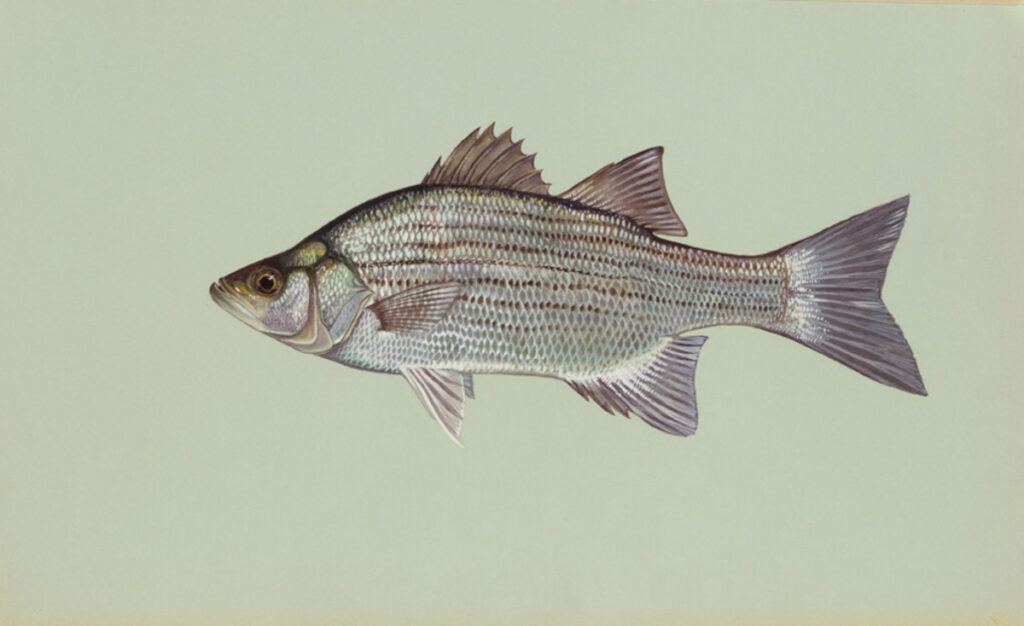
White bass are deep-bodied for a temperate bass, with a distinctly arched back just behind the head and silvery sides carrying several faint, often broken horizontal stripes. Nebraska adds a useful fin character: three stair-stepped anal fin spines.
The definitive check is the tongue. White bass have a single tooth patch on the tongue; striped bass have two distinct parallel patches and no arched back; the hatchery hybrids have two patches, usually crowded together, on a slightly arched body with broken stripes. Any of the three can be misidentified on the water, and in reservoirs stocked with hybrids, undersized hybrids and large white bass are routinely confused for one another.
Where to catch it
153 waterways on GuidedFloats list white bass, across 27 states. Each page carries live gauge readings, access notes, and the guides who fish it.
Alabama 7
- Alabama River below Millers Ferry
- Black Warrior River below Bankhead Lock and Dam
- Black Warrior River below Selden Dam
- Coosa River3,540 cfs
- Lake Tuscaloosa
- Tensaw River8,260 cfs
- Tombigbee River below Coffeeville Lock and Dam1,680 cfs
Arkansas 6
Florida 1
Georgia 2
- Broad River193 cfs
- Lake Allatoona
Illinois 11
- Big Muddy River45 cfs
- Fox Lake
- Fox River1,500 cfs
- Illinois River (Illinois)15,200 cfs
- Kaskaskia River170 cfs
- Little Wabash River76 cfs
- Mackinaw River104 cfs
- Macoupin Creek15 cfs
- Pecatonica River1,180 cfs
- Rock River4,980 cfs
- Wabash River9,570 cfs
Indiana 2
Iowa 5
Kansas 17
- Cedar Bluff Reservoir
- Cheney Reservoir
- Clinton Lake
- Cottonwood River96 cfs
- Fall River18 cfs
- Hillsdale Lake
- Kanopolis Lake
- Kansas River15,100 cfs
- Melvern Lake
- Milford Lake
- Neosho River3,040 cfs
- Perry Lake
- Pomona Lake
- Tuttle Creek Lake
- Verdigris River70 cfs
- Walnut River199 cfs
- Wilson Lake
Kentucky 7
- Barren River Lake
- Cave Run Lake
- Kentucky River972 cfs
- Levisa Fork below Fishtrap Dam
- Nolin River Lake
- Rough River Lake
- Taylorsville Lake
Louisiana 7
- Atchafalaya River76,000 cfs
- Cross Bayou
- Gilmer Bayou
- Lake Claiborne
- Toledo Bend Reservoir
- Willow Chute Bayou
- Youngs Bayou
Minnesota 2
- Lake Traverse
- Mississippi River8,040 cfs
Mississippi 3
Missouri 1
Nebraska 8
- Bazile Creek43 cfs
- Big Blue River1,020 cfs
- Bow Creek37 cfs
- Frenchman Creek13 cfs
- Harlan County Lake
- Loup River282 cfs
- Platte River5,750 cfs
- Ponca Creek8 cfs
Nevada 1
New Mexico 6
- Brantley Lake
- Conchas Lake
- Lake Sumner
- Rio Grande below Elephant Butte Dam
- Santa Rosa Lake
- Ute Reservoir
North Carolina 4
- Catawba River2,930 cfs
- Pee Dee River8,530 cfs
- Yadkin River2,230 cfs
- Yadkin River below W. Kerr Scott Dam946 cfs
North Dakota 14
- Apple Creek
- Devils Lake
- Dry Lake
- Eastern Stump Lake
- James River275 cfs
- Lake Ashtabula
- Lake Darling
- Morrison Lake
- Pipestem Creek9 cfs
- Sheyenne River254 cfs
- Sheyenne River below Baldhill Dam161 cfs
- Sheyenne River below Devils Lake Outlet5 cfs
- Tobacco Garden Creek3 cfs
- White Earth Lake
Ohio 8
- Great Miami River1,840 cfs
- Licking River
- Maumee River1,110 cfs
- Muskingum River2,580 cfs
- Sandusky River66 cfs
- Scioto River2,360 cfs
- Tuscarawas River
- Walhonding River
Oklahoma 11
- Big Cabin Creek3 cfs
- Canton Lake
- Fort Cobb Reservoir
- Grand Lake o' the Cherokees
- Lake Eucha
- Lake Hefner
- Lake Hudson
- Lake Lawtonka
- Lake Thunderbird
- McGee Creek Reservoir
- North Fork Red River below Altus Dam1 cfs
South Carolina 5
- Broad River1,890 cfs
- Catawba River4,450 cfs
- Neal Shoals Reservoir
- Ninetynine Islands Reservoir
- Parr Shoals Reservoir
South Dakota 2
Tennessee 2
Texas 13
- Big Cypress Bayou20 cfs
- Brazos River469 cfs
- Lake Fork Reservoir
- Lake Livingston
- Lake Travis
- Luce Bayou3 cfs
- Neches River177 cfs
- O.H. Ivie Reservoir
- Pecan Bayou18 cfs
- Sabine River405 cfs
- Sam Rayburn Reservoir
- Trinity River1,460 cfs
- West Fork San Jacinto River
Virginia 1
- Dan River695 cfs
West Virginia 1
Wisconsin 6
- Chippewa River1,500 cfs
- Fox River (Wisconsin)1,150 cfs
- Lake Kegonsa
- Lake Koshkonong
- Lake Winnebago
- Wolf River1,570 cfs
References
- White Bass (Morone chrysops) species profile — U.S. Fish and Wildlife Service
- White Bass (Morone chrysops) Species Profile — U.S. Geological Survey, Nonindigenous Aquatic Species
- White Perch (Morone americana) Species Profile — U.S. Geological Survey, Nonindigenous Aquatic Species
- White Bass — Missouri Department of Conservation
- Bass, White — Oklahoma Department of Wildlife Conservation
- White Bass Thermal Tolerance Analysis — Nevada Division of Environmental Protection
- Striped Bass Thermal Tolerance Analysis — Nevada Division of Environmental Protection
- Temperate Bass — Nebraska Game and Parks Commission
- White Bass — Kansas Department of Wildlife and Parks
- Fish Identification — Georgia Department of Natural Resources
- Hybrid Striped Bass (FA155) — University of Florida IFAS Extension
- History of the hybrid striped bass industry — North Carolina State University
- Striped Bass Hybrids: The Frankenfish — Kansas Department of Wildlife and Parks
- Bass, Striped — Oklahoma Department of Wildlife Conservation
- IGFA World Records — International Game Fish Association