Striped Bass
Morone saxatilis
An anadromous predator whose semi-buoyant eggs must stay suspended in flowing water for roughly two days, which is why specific river reaches decide whether striped bass reproduce at all.
Range and origins
Striped bass are native to the western Atlantic, occurring naturally from the St. Lawrence River in Canada south to the St. Johns River in northern Florida, and along the northern Gulf coast west into Louisiana. The Gulf populations are genetically and behaviourally distinct from the Atlantic fish and are managed separately; in Florida they persist mainly in the St. Johns River and a few panhandle rivers, and depend on hatchery stocking because natural reproduction is limited by habitat.
Everything inland is human work. Striped bass were moved into freshwater reservoirs across the South, the Plains and the West beginning in the 1950s and 1960s, once biologists established that the species could complete its life cycle without ever seeing salt water. Missouri’s fish in Lake of the Ozarks, Norfork and Bull Shoals are introduced, and the state notes that very few reservoir populations sustain themselves, so the fisheries run on stocking. Oklahoma is one of the exceptions: it holds naturally reproducing populations in Lake Texoma, Keystone Lake and the Arkansas River navigation system. South Carolina’s Santee-Cooper reservoirs produced the first well-documented landlocked reproducing population and became the template for hatchery work everywhere else, at the Dennis Wildlife Center in Moncks Corner.
Anadromy and the spring runs
Striped bass are anadromous. Adults live in coastal and estuarine water and move into fresh or brackish water each spring to spawn, then drop back downriver. Larvae drift toward river deltas and estuarine nurseries, and juveniles typically hold in those nurseries for two to four years before joining the coastal migration. Males mature at roughly ages two to four, females at four to eight, which is why the age structure of the spawning population matters far more than raw fish numbers.
The runs are cued by light, warming water and rising flow together. Virginia’s fisheries agency describes the trigger as increasing daylight, rising water temperature and increased stream flow acting in combination, with active spawning beginning as water approaches about 55°F. In the Chesapeake system spawning runs up the tidal tributaries generally run April into early June. Oklahoma’s inland fish spawn across a similar band, 55–70°F with a peak near 65°F, and South Carolina puts the Santee-Cooper spawn at 60–70°F. Sources differ by a few degrees at the bottom end because they are describing different things: the temperature at which fish stage and begin moving, and the temperature at which eggs are actually released.
A peer-reviewed analysis of Maryland spawning reaches puts firmer numbers on it: 14°C (57°F) marks the practical start of spawning, and 20°C (68°F) marks the point beyond which egg survival falls off, with best larval survival between 16 and 21°C (61–70°F). That study found the 20°C endpoint arriving earlier in the season since the 2000s while the 14°C start has not moved much, which means the usable spawning window in those rivers is getting shorter.
The semi-buoyant egg, and why particular river reaches matter
This is the single fact that explains why striped bass care about rivers and not just water. A female broadcasts eggs into open water — up to three million per season, spread over multiple spawning events — and those eggs are semi-buoyant. They are very slightly denser than fresh water and will sink unless moving water holds them up.
A USGS study of striped bass egg transport in the Congaree, Wateree and Santee rivers measured the difference directly: fertilised eggs had a specific gravity of 1.00101 to 1.00115, essentially neutral. Flume trials at Clemson for that study found eggs stayed suspended at roughly 0.2 feet per second of current. That is a lower bar than the fisheries literature had used previously — earlier work commonly cited about 1.0 ft/s — and the sources genuinely disagree on the number. What they do not disagree about is the mechanism: below the threshold, eggs settle into the bed, silt over and suffocate. Oklahoma states it plainly, that successful development requires a moving, unobstructed river during incubation, and eggs that settle into silt in still water die.
Incubation is short but not short enough to be forgiving. South Carolina gives about 50 hours; Virginia describes eggs drifting two-plus days before hatching; the USGS work found development time falling from about 63 hours at 15°C to 23 hours at 26°C. Two days of continuous drift at river velocity is a long distance, and it has to happen in flowing water the whole way. That is the arithmetic behind every dispute over spring flow releases from a dam above a spawning reach, and the reason a specific stretch of river — not a lake, not an estuary — is the limiting habitat for the species.
It also explains the landlocked pattern. Reservoirs that hold striped bass rarely recruit any, because the free-flowing tributary above the pool is too short, too slow, or drowned by the reservoir’s own backwater. Virginia notes that reservoir spawning is almost entirely unsuccessful, with the Staunton River reach of the Roanoke a rare exception where landlocked fish do reproduce.
The 1980s collapse, the moratorium, and where the stock stands
The Atlantic stock collapsed in the late 1970s and early 1980s. ASMFC attributes it to increased fishing pressure in the 1970s combined with habitat degradation and loss, with recruitment failing year after year. States responded with harvest moratoria — Maryland’s five-year closure being the best known — explicitly to protect the 1982 year class, the first decent cohort in nearly a decade. Congress passed the Atlantic Striped Bass Conservation Act in 1984, giving federal teeth to the interstate plan. NOAA Fisheries records the stock as declared recovered in 1995. It is the standard example of an interstate rebuilding effort that worked.
The current picture is less comfortable. The 2024 stock assessment update found the stock overfished but not experiencing overfishing. Female spawning stock biomass for 2023 was estimated at 86,536 metric tons (191 million pounds), against a threshold of 89,513 t (197 million lb) and a target of 111,892 t (247 million lb). Fishing mortality was 0.18, above the target of 0.17 but below the 0.21 threshold. The rebuilding deadline under Amendment 7 is 2029.
Recruitment is the live problem. The assessment found six of the seven year classes from 2015 onward below average. Maryland’s juvenile survey, running since 1954 at 22 fixed stations in the Potomac, Head of Bay, Nanticoke and Choptank, produced a 2025 index of 4.0 against a long-term average of 11 — the seventh consecutive below-average year. Maryland attributes the run of failures to warm, dry winters and reduced spring flow, and notes that white perch, blueback herring and American shad in the same rivers have failed alongside the bass, which points at shared river conditions rather than anything specific to striped bass. In October 2025 the interstate board approved Addendum III without the roughly 12% reduction in removals its own projections indicated was needed for even a 50% chance of rebuilding by 2029, and stood up a work group on the seven-year Chesapeake recruitment failure.
Chesapeake and Hudson: who produces the coastal fish
Most of the migratory fish on the Atlantic coast are born in a handful of river systems. The Chesapeake Bay Program’s long-standing figure is that 70 to 90 percent of the Atlantic striped bass population uses the Bay to spawn. The Hudson is the second major producer, with its own young-of-year seine survey running since 1979; the Delaware and the Roanoke/Albemarle system contribute the remainder.
The proportions are contested, and they depend on where and when you sample. A genetic mixed-stock analysis of fish taken at Montauk Point in 2019 assigned 77–88% of the catch to the Chesapeake, 8–14% to the Hudson and 3–9% to the Roanoke, depending on which of two assignment methods was used. Earlier tagging and otolith work has at times credited the Hudson with a much larger share of the fish in the northern part of the range. Both can be true: the Chesapeake dominates coastwide production while the Hudson’s contribution is concentrated near its own mouth. Anyone quoting a single percentage for “the Hudson’s share” without saying where and when the fish were sampled is overstating what the data support.
Water temperature
Striped bass are a cool-water fish carrying a warm-water reputation, and the laboratory and field literature disagree in an instructive way.
Laboratory work compiled by Nevada’s water-quality programme puts optimum growth at 25–26°C (77–79°F) in one study and 27–28.5°C (81–83°F) in another, with an average preferred range of 22.1–26.7°C (72–80°F), avoidance beginning around 26.4°C (79.5°F), upper incipient lethal temperatures of 31.8–33.9°C (89–93°F) and critical thermal maxima of 36.2–38.8°C (97–102°F). Those growth optima assume unlimited food and oxygen.
Free-ranging fish sit much cooler. A USGS telemetry study of adult landlocked striped bass in Melton Hill Reservoir found a mean occupied temperature of 17.5°C (63.5°F) through the summer growing season and 13°C (55°F) in winter, and argued that habitat-suitability models treating 18–24°C (64–75°F) as optimal should be revised downward to include cooler water. Florida’s agency, working at the warm edge of the native range, states simply that striped bass do not tolerate water above 75°F for long.
The complication is oxygen. In summer the fish are squeezed between surface water that is too warm and deep water that is too low in dissolved oxygen. A USGS acoustic-tracking study in the Patuxent found sub-adults avoiding water at or below 2 mg/L dissolved oxygen but tolerating temperatures above 25°C when nothing cooler was available, and concluded that the classic squeeze hypothesis needs revision for this species. Practically, that means summer river fish concentrate wherever cool oxygenated water enters — spring runs, tributary mouths, tailwater discharges — and the useful reading is not the reservoir surface but the temperature where the fish actually are.
Growth, age and size
Striped bass are long-lived. NOAA Fisheries gives a maximum of about 30 years, five feet and 77 pounds; the Chesapeake Bay Program cites an oldest recorded fish of 31 years and a maximum of about six feet and 125 pounds, with most adults two to three feet and 10–30 pounds. Inland fish grow quickly on shad — Missouri reports 24 inches by age four — but rarely reach the sizes coastal fish do, with South Carolina putting freshwater fish at a typical three to ten pounds.
Diet drives all of it. Larvae take zooplankton, juveniles take small crustaceans and larval fish, and adults are almost entirely piscivorous: menhaden and anchovies on the coast, gizzard and threadfin shad inland. The mismatch between spawning timing and the zooplankton bloom is one of the leading explanations for the Chesapeake recruitment failures, since large year classes have historically followed cold, wet winters when copepod production lines up with the hatch.
Identification and behaviour
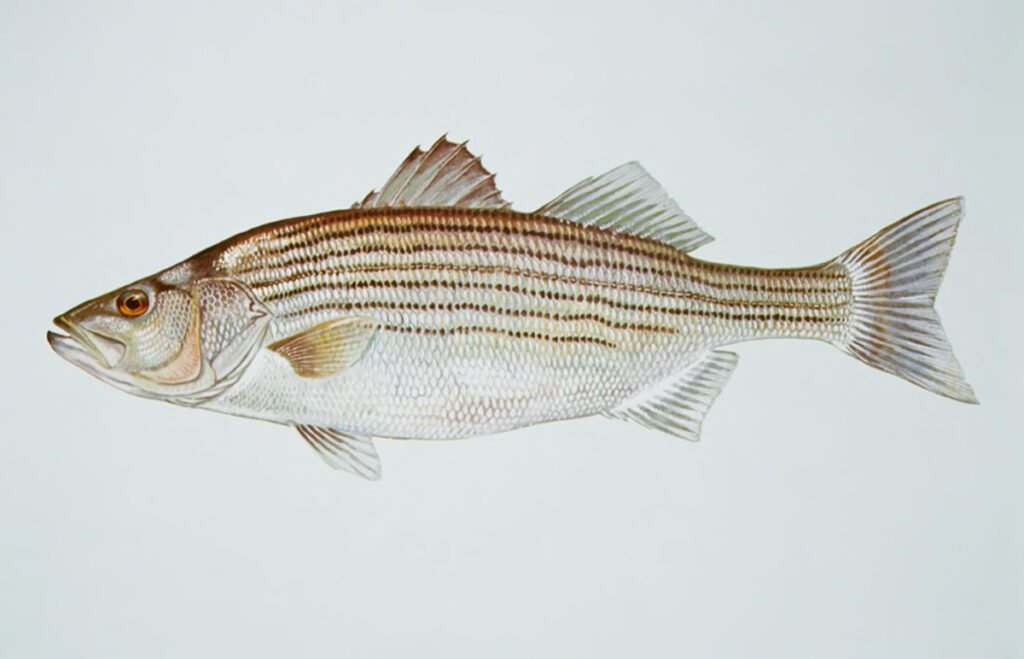
Striped bass have a slender, unarched body with seven or eight heavy, distinct, generally unbroken lateral stripes. The reliable internal character is the tongue: striped bass carry two parallel tooth patches, white bass one, and hybrids two that are usually joined or crowded.
In rivers they behave like current-oriented open-water predators: they hold in schools off structure and in seams rather than on the bank, and they use flow to concentrate forage rather than hunting cover. That preference for moving, oxygenated water is the same trait that made the species a candidate for tailwater and reservoir introductions in the first place, and it is why so much of the fishery is organised around dams, confluences and river mouths.
Where to catch it
164 waterways on GuidedFloats list striped bass, across 27 states. Each page carries live gauge readings, access notes, and the guides who fish it.
Alabama 10
- Alabama River below Millers Ferry
- Bayou Sara
- Black Warrior River below Bankhead Lock and Dam
- Black Warrior River below Selden Dam
- Choctawhatchee River321 cfs
- Conecuh River below Point A Dam1,240 cfs
- Coosa River3,540 cfs
- Mobile River12,400 cfs
- Tensaw River8,260 cfs
- Tombigbee River below Coffeeville Lock and Dam1,680 cfs
Arizona 1
Arkansas 4
California 10
- American River1,500 cfs
- Carquinez Strait
- Cosumnes River61 cfs
- Lower Sacramento River5,970 cfs
- Navarro River4 cfs
- San Joaquin River392 cfs
- Stanislaus River849 cfs
- Suisun Bay
- Tuolumne River1,150 cfs
- Yuba River551 cfs
Connecticut 9
- Connecticut River
- Connecticut River Estuary
- Greenwich Harbor
- Mystic River
- Norwalk Harbor
- Norwalk River
- Poquonnock River
- Quinnipiac River
- Thames River
Delaware 13
- Appoquinimink River
- Broadkill River
- Christina River-4,440 cfs
- Indian River
- Indian River Bay
- Jefferson Creek
- Little Assawoman Bay
- Marshyhope Creek13 cfs
- Massey Ditch
- Murderkill River
- Rehoboth Bay
- St Jones River46 cfs
- Vines Creek
Florida 7
- Aucilla River
- Chipola River910 cfs
- Hunter Spring Run63 cfs
- Lake Seminole
- St. Johns River3,590 cfs
- Suwannee River6,090 cfs
- Wakulla River719 cfs
Georgia 10
- Altamaha River3,740 cfs
- Chattahoochee River613 cfs
- Etowah River190 cfs
- Flint River487 cfs
- Lake Allatoona
- Lake Eufaula
- Lake Lanier
- Ocmulgee River1,500 cfs
- Satilla River2,570 cfs
- West Point Lake
Indiana 3
Kansas 1
Louisiana 4
- Amite River314 cfs
- Bayou Lafourche371 cfs
- Lake Claiborne
- Toledo Bend Reservoir
Maine 2
- Kennebec River1,700 cfs
- Saco River
Maryland 7
- Eastern Bay
- Isle of Wight Bay
- Little Annemessex River
- Nanticoke River
- Potomac River5,250 cfs
- St. George Creek
- Tuckahoe Creek45 cfs
Massachusetts 11
- Connecticut River7,210 cfs
- Danvers River
- Indian Head River37 cfs
- Jones River27 cfs
- Mattapoisett Harbor
- Monatiquot River16 cfs
- Mount Hope Bay
- Neponset River191 cfs
- Popponesset Bay
- Saugus River7 cfs
- Sippican Harbor
New Hampshire 1
- Winnicut River41 cfs
New Jersey 22
- Absecon Channel
- Absecon Creek
- Arthur Kill
- Barnegat Bay
- Beach Thorofare
- Cape May Harbor
- Cohansey River
- Delaware River5,490 cfs
- East Thorofare
- Great Channel
- Great Egg Harbor Bay
- Hackensack River
- Ingram Thorofare
- Inside Thorofare
- Little Egg Inlet
- Ludlum Thorofare
- Maurice River
- Newark Bay
- Raritan Bay
- Shark River
- Shrewsbury River
- Waackaack Creek
New Mexico 1
New York 7
- Great South Bay
- Jamaica Bay
- Moriches Bay
- Orient Harbor
- Oyster Bay
- Shelter Island Sound
- Shinnecock Bay
North Carolina 6
- Catawba River2,930 cfs
- Currituck Sound
- Neuse River226 cfs
- Pamlico River
- Pee Dee River8,530 cfs
- Roanoke River1,510 cfs
Oklahoma 1
Oregon 1
Pennsylvania 2
- Raystown Lake
- Susquehanna River16,600 cfs
Rhode Island 1
- Pawcatuck River602 cfs
South Carolina 20
- Ashley River
- Broad River1,890 cfs
- Catawba River4,450 cfs
- Congaree River4,130 cfs
- Lake Hartwell
- Lake Marion
- Lake Moultrie
- Lake Murray
- Lake Thurmond
- Lake William C. Bowen
- Little Back River
- Monticello Reservoir
- Neal Shoals Reservoir
- Ninetynine Islands Reservoir
- North Santee River
- Parr Shoals Reservoir
- Saluda River2,440 cfs
- South Santee River
- Wando River
- Wateree River Tailrace5,290 cfs
Tennessee 2
Texas 5
- Guadalupe River103 cfs
- Lake Livingston
- Lake Travis
- Trinity River1,460 cfs
- West Fork San Jacinto River
Virginia 3
- Mattaponi River230 cfs
- Pamunkey River232 cfs
- Rappahannock River806 cfs
References
- Atlantic Striped Bass — NOAA Fisheries
- Atlantic Striped Bass species page — Atlantic States Marine Fisheries Commission
- 2024 Atlantic Striped Bass Stock Assessment Update Report — Atlantic States Marine Fisheries Commission
- Atlantic Striped Bass Draft Addendum III: 2026 Measures to Support Rebuilding — Atlantic States Marine Fisheries Commission
- Chesapeake Bay 2025 Young-of-Year Striped Bass Survey Results — Maryland Department of Natural Resources
- Juvenile Striped Bass Survey — Maryland Department of Natural Resources
- Striped Bass field guide entry — Chesapeake Bay Program
- Striped Bass — Virginia Department of Wildlife Resources
- Striped Bass — South Carolina Department of Natural Resources
- Bass, Striped — Oklahoma Department of Wildlife Conservation
- Striped Bass — Missouri Department of Conservation
- Water-Resources Investigations Report 91-4088: striped bass egg transport in the Congaree, Wateree and Santee Rivers, South Carolina — U.S. Geological Survey
- The fundamental thermal niche of adult landlocked striped bass — U.S. Geological Survey
- Testing the thermal-niche oxygen-squeeze hypothesis for estuarine striped bass — U.S. Geological Survey
- Striped Bass Thermal Tolerance Analysis — Nevada Division of Environmental Protection
- Striped Bass (Hudson and Delaware marine fisheries) — New York State Department of Environmental Conservation
- Contribution of the Hudson River to the Atlantic coastal striped bass stock (Hasegawa and Polgar, 2020) — Hudson River Foundation
- Climate effects on the timing of Maryland Striped Bass spawning runs — Marine and Coastal Fisheries (American Fisheries Society)
- Striped Bass (Morone saxatilis) species profile — U.S. Fish and Wildlife Service
- Striped Bass Bonanza (all-tackle world record) — International Game Fish Association
- IGFA World Records — International Game Fish Association
- Checking in on Chesapeake Bay Striped Bass — NOAA Fisheries
- Striped Bass — Florida Fish and Wildlife Conservation Commission
- Fish Identification — Georgia Department of Natural Resources