Elkhart River Fishing Guides
A northern Indiana river running through Goshen to its confluence with the Saint Joseph at Elkhart, holding smallmouth, pike and the occasional fish that has run up from the bigger river.
Guides on the Elkhart River
Claimed profiles take booking requests. Unclaimed profiles are built from public records so the river is never empty; the guide can claim or remove one any time.
No guides listed yet
Guide or outfit this water? Create your profile. Listing is free, the commission is 10% or 7% with a premium profile, and premium profiles list first on this water.
About the Elkhart River
The Elkhart River drains the lake country of northeastern Indiana and runs north through Goshen to meet the Saint Joseph River in the middle of the city of Elkhart. That confluence is the most important fact about it. The Saint Joseph is one of the major Lake Michigan tributaries, and the fish that move up it do not always stop at the junction, so the lower Elkhart occasionally produces something considerably larger than its own modest size would suggest. For most of the year, though, it fishes as what it is: a mid-sized northern Indiana river with good structure and steady flows.
Above Goshen the river threads through a chain of natural lakes and wetlands, and that storage is what gives it more consistent summer flow than the farmland streams further south. Smallmouth bass hold on the gravel and around the old mill structures, northern pike sit in the slower weedy margins, and largemouth, rock bass, bluegill, black crappie and yellow perch spread through the impounded reaches. Channel catfish work the deeper holes. The Goshen dam and millrace, built to power the town, still shape the river through the middle of the city and concentrate fish above and below the drop.
The gauge at Goshen reports discharge and stage. The lake storage upstream damps the river response to rain, so the Elkhart rises more slowly and falls more gently than most Indiana rivers, which makes it a reliable choice in an unsettled week when other water is unfishable. Access is good for an urban river, with town parkland and a long riverside trail through Goshen giving legal bank access over several miles. For anglers based in South Bend or Fort Wayne it is close enough for an evening trip, and the stretch through town fishes surprisingly well for water with houses along it.
This water needs a real photo
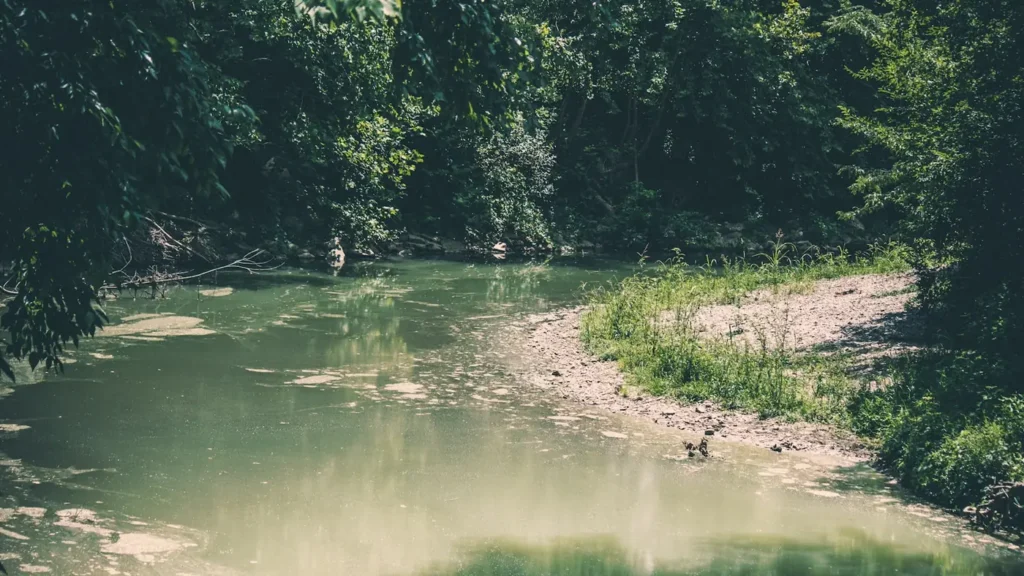
The photo at the top of this page is not Elkhart River.
It is a regional stand-in, honestly captioned but generic — we will not put a name to a river we cannot prove. Send us a photograph you took here and it replaces the stand-in, with your credit on it.
Add a photo of this water
Landscape, not fish — the water itself. Reviewed by hand before it appears. The first one published here earns the Pioneer badge.
Fished this water? Add a photo
Reviewed by hand before it appears. Pick the water, not the spot — we never publish exact locations.
Access
Goshen - the gauge city, with riverside parkland and the millrace giving the most accessible water on the river.
Goshen Dam Pond - the impoundment above town, holding pike, crappie and largemouth in the weedy margins.
Elkhart - the downstream city at the confluence with the Saint Joseph River.
Benton - an upstream village with bridge access to the quieter middle reaches.
Baintertown - a small crossing giving walk-in access between Benton and Goshen.
Millrace Trail, Goshen - a riverside path providing several miles of legal bank access through the city.
Saint Joseph River confluence - the junction at Elkhart, and the reason the lower river sometimes fishes bigger than it looks.
Seasons
Spring: the highest and most productive water of the year, with pike spawning in the backwaters and anything running up from the Saint Joseph most likely to be present.
Summer: steady lake-fed flows and the best smallmouth fishing, concentrated on the gravel and around the mill structures.
Fall: cooling water and active pike, with smallmouth holding deeper and pressure dropping away after Labor Day.
Winter: low and often iced in the impounded reaches, with the fast water below the Goshen dam staying open longest.
From the water
No logged trips yet. Be the first to put this water on your map.
Log this water
Fished it or cleaned it? Log in or create a free account to log a trip with photos and earn the waterway badge.
Questions
What species can you catch on the Elkhart River?
Anglers target Black Crappie, Bluegill, Channel Catfish, Common Carp, Largemouth Bass, Northern Pike, Rock Bass, Smallmouth Bass, White Sucker, Yellow Perch on the Elkhart River in Indiana.
Where can you access the Elkhart River?
Goshen - the gauge city, with riverside parkland and the millrace giving the most accessible water on the river. Goshen Dam Pond - the impoundment above town, holding pike, crappie and largemouth in the weedy margins. Elkhart - the downstream city at the confluence with the Saint Joseph River. Benton - an upstream village with bridge access to the quieter middle reaches. Baintertown - a small crossing giving walk-in access between Benton and Goshen. Millrace Trail, Goshen - a riverside path providing several miles of legal bank access through the city. Saint Joseph River confluence - the junct...
When is the best time to fish the Elkhart River?
Spring: the highest and most productive water of the year, with pike spawning in the backwaters and anything running up from the Saint Joseph most likely to be present. Summer: steady lake-fed flows and the best smallmouth fishing, concentrated on the gravel and around the mill structures. Fall: cooling water and active pike, with smallmouth holding deeper and pressure dropping away after Labor Day. Winter: low and often iced in the impounded reaches, with the fast water below the Goshen dam staying open longest.
Where are the fishing regulations for the Elkhart River?
Regulations change by season and section. Read the current rules on the Indiana agency site: https://www.in.gov/dnr/fish-and-wildlife/fishing/