Humpback Chub
Gila cypha
A Colorado River endemic reclassified from endangered to threatened in 2021, whose recovery in Grand Canyon has been driven almost entirely by water temperature below Glen Canyon Dam.
A fish shaped by whitewater
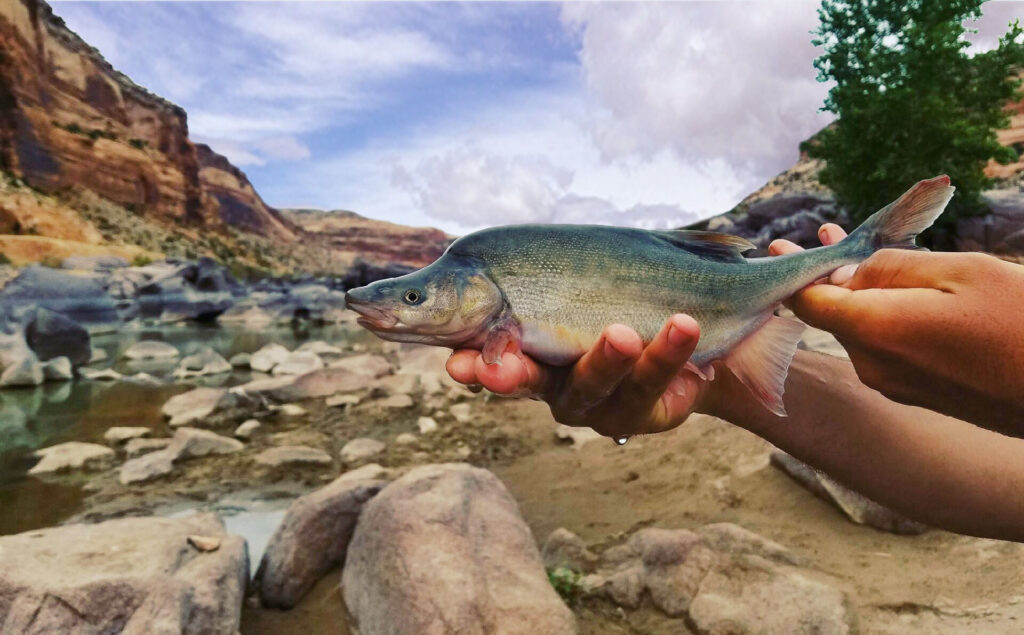
The humpback chub is a minnow that stopped looking like a minnow. Behind the head it carries a fleshy nuchal hump; the body behind it is laterally compressed and tapers into a thin, flexible caudal peduncle and a deeply forked tail. The eyes are small, the scales are reduced almost to nothing over much of the body, and the snout overhangs a subterminal mouth. Every part of that design points the same direction: holding station in fast, turbid, boulder-strewn canyon water without being swept downstream.
The U.S. Fish and Wildlife Service describes adults reaching roughly a foot and a half in length and weighing up to about 2.6 pounds, living 20 to 40 years and maturing at three to five. That combination — long life, late maturity, low fecundity relative to its lifespan — is the classic profile of a fish adapted to a variable environment, where good recruitment years are rare and adults must survive long enough to catch one.
Most of the fish is unremarkable in colour: grey-green above, silvery on the flanks, white below. It is the architecture that gives it away, and the architecture is the product of a river that no longer exists in the form that built it.
Range: a Colorado River endemic in five pieces
The humpback chub occurs nowhere on earth outside the Colorado River basin. The Service recognises five extant populations, split by Lake Powell: Desolation and Gray canyons, Black Rocks, Westwater Canyon, Cataract Canyon, and Grand Canyon. The first four sit upstream of the reservoir in Utah and Colorado. The fifth, in Arizona, is downstream, and it is by a wide margin the largest.
These are not arbitrary units. Each corresponds to a specific canyon-bound reach of deep, swift, rock-walled river — Black Rocks in the Ruby-Horsethief reach of the Colorado, Westwater immediately downstream, Desolation and Gray on the Green. The National Park Service notes that the species is specifically adapted to the deep swift reaches of the Colorado River, and the distribution reflects exactly that. Where the river slows, spreads, or is impounded, the chub is absent.
A sixth population, in Dinosaur National Monument on the Yampa and Green, is gone. Adults there fell below detectability and the population is treated as extirpated. That loss matters for reading the rest of the story: the species has already demonstrated that a population can be lost outright.
Individual chub are also strikingly sedentary. Fish typically spend their lives within a ten- to twenty-mile stretch of river. A population is therefore not easily rescued by immigration from elsewhere; each aggregation largely stands or falls on its own.
What Glen Canyon Dam did to the temperature
This is the centre of the humpback chub story, and it is a temperature story before it is anything else.
Glen Canyon Dam draws its generating water from deep in Lake Powell rather than off the surface. The Bureau of Reclamation states plainly that the water deep below the reservoir surface is about 44 degrees Fahrenheit year-round. That is what comes out of the penstocks and into the Colorado River at Lees Ferry.
Before the dam, the Colorado through Marble and Grand canyons swung hard with the seasons — near-freezing in winter, warm enough in late summer for a warmwater fish to spawn and for larvae to grow. After the dam began operating in the mid-1960s, that annual cycle was replaced by a narrow, cold, near-constant regime. The U.S. Geological Survey puts it directly: after the dam began operating, the river below it cooled sharply, making reproduction impossible for a fish that needs warm water.
The Service reports humpback chub spawning at water temperatures between 59 and 68 degrees Fahrenheit. A river held at 44°F is not a little too cold. It is roughly fifteen to twenty-five degrees below the window in which the species reproduces, held there permanently, in the reach that once held the most fish.
Flow was altered alongside temperature. Hydropower operations replaced the spring flood and the low late-summer baseflow with daily and weekly load-following fluctuations. Sediment was captured behind the dam. The USGS Grand Canyon Monitoring and Research Center, the science provider for the Glen Canyon Dam Adaptive Management Program, exists to study exactly these downstream consequences — including invasion and expansion of nonnative species, and losses of native fish.
The Little Colorado refuge
For roughly four decades, the Grand Canyon population survived the cold mainstem by not spawning in it. The Little Colorado River, which joins the Colorado in eastern Grand Canyon well downstream of Lees Ferry, is spring-fed, warm, and turbid with travertine. The USGS records that the species persisted largely by relying on a warmwater tributary, the Little Colorado River, for spawning.
That reliance was the population’s single greatest vulnerability. In the 2021 reclassification the Service put the Little Colorado core population at roughly 11,500 to 12,000 adults for 2008–2014 — a substantial number, but concentrated in one tributary. A chemical spill, a debris flow, or a barrier at the confluence could have taken most of the species’ reproductive output at once.
Managers responded by spreading the risk. The Park Service has translocated juvenile humpback chub from the Little Colorado into other perennial tributaries, including Shinumo, Havasu, and Bright Angel creeks. USGS monitoring of mainstem aggregations between 2002 and 2014 subsequently found that relative abundance of adults generally increased from the 1990s to 2014, with evidence of reproduction at several sites and translocations contributing to increases at specific locations.
Nonnative trout and the removal programmes
Cold, clear tailwater is poor habitat for a humpback chub and excellent habitat for a rainbow trout. The reach below Glen Canyon Dam became a productive trout fishery precisely because the dam made it cold, and trout and brown trout subsequently spread downstream into the reaches chub occupy.
Predation on juvenile chub is the mechanism of concern. Bright Angel Creek, which enters the Colorado near Phantom Ranch, held a self-sustaining brown trout population that produced fish moving out into the mainstem. The Park Service describes biologists removing invasive trout and other invasive fishes in an effort to minimize threats of predation and restore native fishes and habitat in larger perennial tributaries — the same tributaries used for chub translocation. Bright Angel is both a removal site and a receiving site, and the sequence matters: the creek was not suitable for chub until the trout in it were suppressed.
The predator list has since changed. Warmer releases, driven by low reservoir elevations, have made the mainstem more suitable for warmwater predators as well as for chub. The Service identified smallmouth bass, walleye, and northern pike as principal nonnative threats, and USGS notes that smallmouth bass are associated with steep declines in humpback chub abundances elsewhere in the basin, with evidence of possible downstream colonisation emerging in 2022. Warming the river helps the chub and helps the fish that eat the chub. That trade-off is unresolved.
A population that turned around
The recent trajectory is genuinely remarkable, and it is temperature-driven. USGS research estimates that adult humpback chub in western Grand Canyon increased roughly 160-fold between 2010 and 2024, reaching a median of about 70,000 adults in 2024. The centre of the population also moved: more chub are now found in western Grand Canyon, downstream of Havasu Creek, than in the Little Colorado, with the highest densities estimated roughly 210 to 250 river miles downstream of Lees Ferry.
The attributed cause is blunt. USGS attributes the surge primarily to warmer water temperatures, a consequence of low reservoir levels in Lake Powell. As Powell dropped, the water drawn through the penstocks came from progressively shallower and warmer strata, and the river below the dam warmed enough — the reclassification rule references operational modifications raising summer and autumn temperatures toward 16°C, about 61°F — for mainstem reproduction and growth to work again.
The uncomfortable implication is that the largest recovery in the species’ recorded history is a side effect of a drought-driven reservoir decline, not of a deliberate restoration of the river’s thermal regime. Whether the gains hold if Powell refills is an open question.
Federal status, stated accurately
The humpback chub is currently listed as threatened under the Endangered Species Act, not endangered. The Service published a final rule on 18 October 2021 reclassifying the species from endangered to threatened with a section 4(d) rule, at 86 FR 57588, effective 17 November 2021. The stated basis was substantial improvement in the species’ overall status since its original listing.
That status still stands. In a notice published 15 September 2025, the Service initiated five-year status reviews for twenty species in the Mountain-Prairie Region and lists the humpback chub with a listing status of threatened, at 90 FR 44390.
One minor discrepancy is worth flagging rather than smoothing over: the 2021 final rule refers to the original listing as endangered in 1974, while the Service’s own species profile dates protection to 1973. Some agency pages, including Reclamation’s, also still describe the chub as endangered. The Federal Register is the controlling record, and it says threatened.
Temperature in practice
For anyone watching a live gauge on the Colorado, the numbers translate directly. Water near 44–50°F is dam water: physiologically survivable for adult chub but far below the spawning window, and effectively sterile for recruitment. Water in the high 50s to high 60s is the band in which the Service records spawning. Water above that, in the Little Colorado during summer, is where larvae have historically been produced. The difference between a Grand Canyon that grows humpback chub and one that merely holds a few is a matter of ten to twenty degrees at the penstock intake.
Encountering one
Humpback chub are occasionally caught by anglers fishing the Colorado, particularly as the population expands downstream of Lees Ferry. A chub in hand should be kept in the water, handled minimally, and released immediately. That is not a procedural point; it follows from the biology. This is a fish that takes three to five years to mature, may live four decades, exists in five populations totalling a small fraction of what a major river basin once held, and is found nowhere else on the planet. An individual adult represents a large share of a small reproductive pool, and the species has already lost one population entirely.
Identification is straightforward once the hump is seen, but juveniles and hybrids are harder, and the Colorado basin holds closely related Gila species and intergrades. When in doubt, the fish goes back. The chub is also the reason the Lees Ferry reach is studied as intensively as it is: the tailwater fishery and the endemic fish downstream are two outcomes of the same dam, and the temperature that makes one possible is the temperature that constrains the other.
Where to catch it
1 waterway on GuidedFloats list humpback chub. Each page carries live gauge readings, access notes, and the guides who fish it.
Arizona 1
- Colorado River (Lees Ferry)5,390 cfs
References
- Reclassification of the Humpback Chub From Endangered to Threatened With a Section 4(d) Rule (final rule, 86 FR 57588) — U.S. Fish and Wildlife Service / Federal Register
- Initiation of 5-Year Status Reviews of 20 Listed Species in the Mountain-Prairie Region (90 FR 44390) — U.S. Fish and Wildlife Service / Federal Register
- Humpback Chub (Gila cypha) species profile — U.S. Fish and Wildlife Service
- Humpback chub rebound: USGS science uncovers population increase and range expansion for threatened fish — U.S. Geological Survey, Southwest Biological Science Center
- Grand Canyon Monitoring and Research Center — U.S. Geological Survey
- Glen Canyon Dam Adaptive Management Program — U.S. Geological Survey, Southwest Biological Science Center
- Fish of Grand Canyon National Park — National Park Service
- Glen Canyon Dam and Powerplant — U.S. Bureau of Reclamation, Upper Colorado Region
- Colorado River fish monitoring in Grand Canyon, Arizona; 2002-14 humpback chub aggregations (Open-File Report 2016-1177) — U.S. Geological Survey
- Grand Canyon Humpback Chub Population Improving (Fact Sheet 2007-3113) — U.S. Geological Survey
- Grand Canyon Humpback Chub Population Stabilizing (Fact Sheet 2006-3109) — U.S. Geological Survey