Suwannee Bass
Micropterus notius
The most range-restricted black bass in the United States, a crayfish specialist confined to the limestone and spring-fed rivers of north Florida and south Georgia.
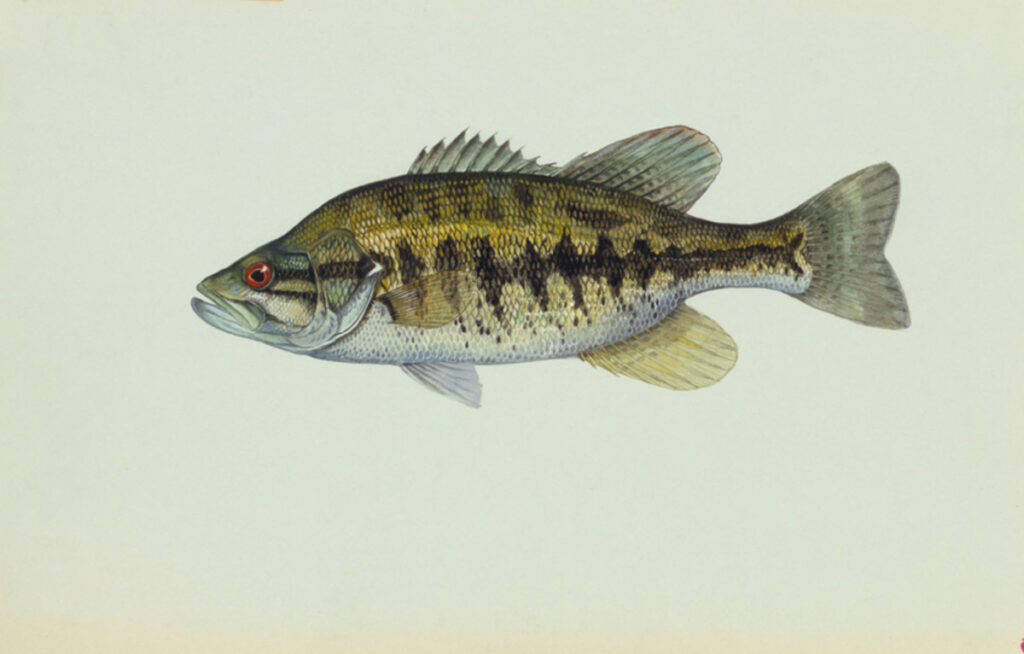
A bass with almost nowhere to be
Most black basses are defined by how widely they have spread. The Suwannee bass is defined by how little ground it holds. Florida’s Fish and Wildlife Conservation Commission gives its range as the Ichetucknee, Santa Fe, St. Marks, Suwannee, Wacissa and Wakulla rivers, plus the Alapaha, Ochlockonee and Withlacoochee rivers of Florida and Georgia. That is the entire world distribution of the species — a cluster of rivers spanning perhaps two hundred miles of the Florida panhandle border and the north Florida peninsula.
Structurally, the range breaks into two pieces: the Suwannee drainage and its tributaries, and the Ochlockonee drainage to the west, with the short spring-fed coastal rivers of the Big Bend — St. Marks, Wacissa, Wakulla — filling the gap between. Nothing about this range overlaps with redeye bass in the Mobile Basin or shoal bass in the Apalachicola. Three narrow-range southeastern endemics, three separate drainage systems, essentially no contact.
The oldest branch of the genus
The Suwannee bass turns out to occupy an unusual position in black bass evolution. The 2022 phylogenomic revision by Kim, Taylor and Near in Scientific Reports, which recovered nineteen species of Micropterus using ddRAD genomic data, used M. notius to root the genus: “trees were rooted with the Suwannee Bass (M. notius), following its placement in the centrarchid species tree.” It is the sister lineage to all other black basses, and it carries the largest genetic distances from the rest of the genus — the highest pairwise value the authors report, 0.96, is between Altamaha bass and Suwannee bass.
This is a strange combination: the deepest lineage in an economically enormous genus, sitting in one of its smallest ranges. Whatever produced Micropterus, the Suwannee bass split off from it early and has been confined to these rivers ever since.
Unlike the redeye bass complex, the Suwannee bass has not been fractured by recent taxonomy. It was described by Bailey and Hubbs in 1949 and remains a single, uncontested species — a rare piece of stability in a genus where the 2013 Zootaxa revision and the 2022 phylogenomic work have unsettled almost everything else. Georgia DNR lists it as one of the state’s ten recognized black bass species, and it is one of the species eligible for the Georgia Bass Slam.
Identification
As with the other narrow-range endemics, geography is the first filter and it is a strong one. Within its range, the Suwannee bass shares water mainly with largemouth bass, and the two are not difficult to separate. Redeye bass, shoal bass and smallmouth bass do not naturally occur here at all.
- Turquoise on the underside. The most distinctive live character in the genus. FWC describes mature fish as showing “bright turquoise coloring on the cheeks, breast, and belly.” No other black bass does this. It fades after death, so it is a character for fish in the water or in hand, not for photographs of fish on ice.
- Jaw against eye. The upper jaw does not extend past the eye. In largemouth bass it extends beyond the rear edge of the eye — the single quickest separation in the shared range.
- Shallow dorsal notch. A shallow notch between the dorsal fins, against the “obvious deep dip” FWC describes in largemouth bass.
- Caudal blotch. A distinct dark blotch where the lateral line meets the caudal fin.
- Scaled fin bases. Scaled bases on the dorsal, anal and caudal fins.
- Body form. Heavy-bodied and short — FWC notes the species “seldom exceeds 12 inches long,” which for a fish of that build gives a thick, stocky profile quite unlike a largemouth of similar length.
- Lateral-line scale counts. The standard confirming character across Micropterus, and the basis for much of the genus-level work. For comparison, spotted bass run 68 to 77 lateral-line scales in the upper Mobile Basin and 58 to 71 in the Tennessee River form, while smallmouth bass run 68 to 80.
One name confusion is worth flagging because it travels with all of these fish. “Redeye” is a widespread vernacular name for the rock bass, Ambloplites rupestris — Ohio DNR lists rock bass as also known as “goggle-eye” and “red-eye”. Rock bass are not native to the Suwannee system, but the habit of calling any red-eyed stream sunfish a “redeye” means regional reports need reading carefully.
Habitat: limestone, current and springs
FWC calls the Suwannee bass “a riverine fish” found “in moderate to swift currents near limestone or woody structure.” That description has been confirmed quantitatively. Yeager, Bonvechio and Hamel, writing in Hydrobiologia in 2023, tracked movement and habitat selection in the species and found positive selection for limestone and boulder substrates and negative selection for sandy substrate. In rivers that are largely sand-bottomed for long stretches, that means the fish are concentrated on a small fraction of the available river.
The same study found movement patterns that were far more variable than expected. Home ranges spanned 0.15 to 142.97 hectares, averaging 30.61 hectares. Roughly a third of tagged fish made substantial movements over short periods, with a maximum recorded distance of 28.53 km, while the remaining two thirds barely moved. Movement was, in the authors’ words, “erratic and unrelated to sex, length, weight, or time of year.” The species does not behave as a uniformly sedentary resident, and a population can be redistributed by the movements of a minority of individuals.
The thermal picture is genuinely split. Several rivers in the range — the Ichetucknee, Wacissa and Wakulla in particular, and the spring runs feeding the Santa Fe and Suwannee — are fed by artesian springs. USGS explains why that matters thermally: spring water emerges at roughly the mean annual temperature of the rock it has passed through, insulated from surface swings, which is why springs run “cold and clear” and hold near-constant temperature year-round. In north Florida that puts spring discharge close to 70°F regardless of season.
The blackwater reaches behave in the opposite way. The Alapaha, the Withlacoochee and the tannic middle Suwannee are surface-driven, and their temperature tracks air temperature and flow closely, running cold in winter and well into the eighties in late summer. A Suwannee bass river can therefore be thermally stable or thermally volatile depending on which reach is being read, and a live gauge number needs interpreting against which of the two it sits in.
Spawning and feeding
FWC gives a spawning season of February to June. That is an unusually long window for a black bass, and it fits the thermal setting: in rivers that reach spawning temperature early and hold it, the season is not compressed the way it is in a northern or upland stream. In the spring-fed reaches, the water is at or near suitable temperature for much of the year.
The diet is narrower than most black basses. FWC states that Suwannee bass feed primarily on crayfish. Schramm and Maceina examined distribution and diet of Suwannee bass and largemouth bass in the lower Santa Fe River in Environmental Biology of Fishes, comparing the two species where they occur together. The crayfish specialization and the limestone-substrate preference are the same fact seen from two directions: crayfish live in rock, and so the bass do too.
Conservation
The IUCN lists Micropterus notius as Near Threatened, assessed in 2012 with NatureServe as Red List Authority. FWC lists the species as native to Florida and covers it under the state’s black bass research programme.
The species’ vulnerability is a function of arithmetic more than of any single acute threat. A fish confined to a handful of rivers, specialized on one substrate type and one main prey item, has no redundancy. There is no large reserve population elsewhere to recolonize from if one of these rivers fails.
The pressures on those rivers are well documented and mostly relate to water. The springs that stabilize the system depend on the Floridan aquifer, and reduced spring flow changes both the thermal buffering and the physical habitat of the reaches that hold the most fish. Where flow drops, sand moves and limestone habitat is buried — a direct loss of the substrate the 2023 movement study identified as strongly selected.
Hybridization with introduced congeners is the threat that has damaged the other southeastern endemics most severely, and FWC’s genetics programme exists partly to detect it. FWC’s Fish and Wildlife Research Institute reports that its geneticists “developed a set of molecular markers that are able to effectively identify each species of black bass and detect individuals that have hybrid ancestries.” The agency identifies non-native spotted bass and Alabama bass as a threat to Florida’s native black basses, and regulates against the introduction of spotted bass into pure Florida bass waters south and east of the Suwannee River. The Suwannee bass has so far avoided the scale of introgression that has hit Bartram’s bass in the Savannah drainage, but the mechanism that damaged that species is present in the region.
Angling character
The Suwannee bass is a small fish with a strong local following, and the fishery is shaped entirely by the habitat. These are clear, often shallow limestone rivers where fish hold on rock and wood in current — sight-fishable in the spring runs, and worked by feel in the tannic reaches. FWC’s Big Catch programme sets its Suwannee bass threshold at 14 inches or 1.5 pounds, which is a reasonable indication of what constitutes a notable fish in a species that seldom passes 12 inches.
Crayfish dominance means the fish feed low and on the bottom, around rock, which is a different pattern from the vegetation-oriented largemouth bass sharing the same rivers. The two species partition the water, and finding one reliably means finding the substrate it prefers rather than covering water broadly.
Seasonally, the spring-fed reaches offer the steadiest conditions in the range, holding usable temperature through both the coldest and hottest parts of the year, while the blackwater rivers are far more dependent on the timing of flow and heat.
Where to catch it
2 waterways on GuidedFloats list suwannee bass. Each page carries live gauge readings, access notes, and the guides who fish it.
Florida 2
- Santa Fe River965 cfs
- Suwannee River6,170 cfs
References
- Suwannee Bass (Micropterus notius) — Florida Fish and Wildlife Conservation Commission
- Black Bass Research: Shoal Bass, Choctaw Bass and Suwannee Bass — Florida Fish and Wildlife Conservation Commission, Fish and Wildlife Research Institute
- Movement dynamics and habitat selection of Suwannee bass Micropterus notius — Hydrobiologia (Yeager, Bonvechio & Hamel, 2023)
- Phylogenomics and species delimitation of the economically important Black Basses (Micropterus) — Scientific Reports (Kim, Taylor & Near, 2022)
- Micropterus notius, IUCN Red List assessment — IUCN Red List of Threatened Species / NatureServe
- Distribution and diet of Suwannee bass and largemouth bass in the lower Santa Fe River, Florida — Environmental Biology of Fishes (Schramm & Maceina, 1986)
- Springs and the Water Cycle — U.S. Geological Survey, Water Science School
- Fish Identification — Georgia Department of Natural Resources, Wildlife Resources Division
- Georgia Bass Slam — Georgia Department of Natural Resources, Wildlife Resources Division
- Largemouth Bass — Florida Fish and Wildlife Conservation Commission
- Spotted Bass (Micropterus punctulatus) — Alabama Department of Conservation and Natural Resources
- Smallmouth Bass (Micropterus dolomieu) — Alabama Department of Conservation and Natural Resources
- Rock Bass (Ambloplites rupestris) — Ohio Department of Natural Resources
- Diversity within the Redeye Bass, Micropterus coosae species group, with descriptions of four new species — Zootaxa (Baker, Blanton & Johnston, 2013)
- Black Bass Management — Florida Fish and Wildlife Conservation Commission
- IGFA World Records — International Game Fish Association