Spotted Bass
Micropterus punctulatus
The black bass of moving water that is neither cold enough for smallmouth nor slack enough for largemouth, and an aggressive coloniser wherever it has been moved outside its range.
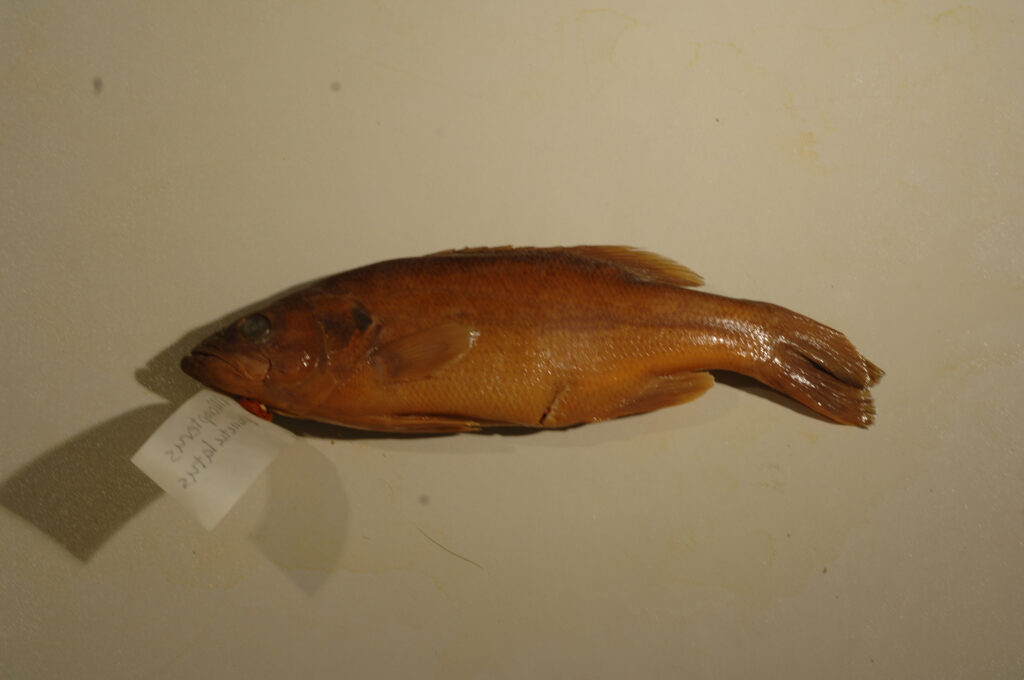
Identification
Spotted bass are built like a compromise between the other two common black basses, and they are routinely misidentified as both. Several characters, used together, settle it.
- Jaw. In adults the upper jaw extends to, or only slightly beyond, the rear margin of the eye. In largemouth bass it extends far behind the eye.
- Tongue. A rough patch of tiny teeth sits on the tongue. Largemouth bass lack it. This is the single most reliable check and can be done by feel.
- Dorsal fin. The spiny and soft dorsal fins are broadly connected rather than nearly separated by a deep notch.
- Lower sides. Dark spots are arranged in rows below the midside, forming a series of prominent horizontal streaks — the character the common name refers to.
- Midside. A broad dark horizontal stripe with wavy, irregular margins.
- Cheek scales. Very small, noticeably finer than in largemouth bass.
- Juveniles. A prominent black spot at the base of the tail fin.
These are the characters used by the Missouri Department of Conservation and echoed by the Illinois DNR. Against Guadalupe bass, which overlaps the spotted bass range in central Texas, the useful distinction is how far down the flank the green ground colour extends: in spotted bass it “does not extend as low on the body” as in Guadalupe bass (Texas Parks and Wildlife Department).
Taxonomy and the spotted bass complex
Described by Rafinesque in 1819, Micropterus punctulatus remains the valid name for the species (USFWS Ecological Risk Screening Summary). What has changed is the boundary around it.
The Alabama bass, once treated as a subspecies of spotted bass, is now recognised as a full species, Micropterus henshalli, supported by moderate genetic divergence and morphological differences from other members of the complex (Kim, Taylor and Near 2022). The two are, for practical purposes, indistinguishable in the hand: Tennessee’s wildlife agency states flatly that Alabama bass “are nearly identical in appearance to Tennessee’s native Spotted Bass” and that it “typically relies on genetic analysis to differentiate between species” (TWRA). Any historical record, distribution map or trophy claim involving a large “spotted bass” outside the Ohio–Mississippi core should be read with that in mind.
The same phylogenomic study left an unresolved puzzle inside the species itself. The spotted bass complex resolved as paraphyletic, and populations from the Sabine and Neches Rivers of east Texas clustered with Guadalupe bass rather than with other spotted bass — a pattern the authors attribute to historical introgression between the two. The taxonomy of spotted bass in the western part of its range is therefore not settled.
Range and distribution
The native range runs through the Mississippi River basin from southern Ohio and West Virginia west to southeastern Kansas and south to the Gulf, plus Gulf Slope drainages from the Chattahoochee River in Georgia to the Guadalupe River in Texas (USGS Nonindigenous Aquatic Species database). In Texas the species is native from the Guadalupe drainage north to the Red River but is absent from the Edwards Plateau, where Guadalupe bass occupy the equivalent niche; the Sabine, Neches and Cypress systems hold the best-known Texas river populations (TPWD).
Introductions have added Atlantic Slope populations in Virginia and North Carolina and scattered waters in New Mexico and California (NatureServe). Some of that expansion was deliberate stocking for sport, and some was self-propelled: in Missouri, spotted bass stocked into the Sac River spread downstream through the Osage into the Missouri River on their own.
Habitat and water temperature
The defining statement about spotted bass habitat is comparative. They occupy “permanent-flowing waters that are warmer and slightly more turbid than those where the smallmouth bass occurs” (MDC), and they hold in more current than largemouth bass prefer while tolerating water “too warm, turbid, and sluggish for smallmouth bass” (TPWD). That band — flowing but warm, gravelly but silt-tolerant — is the species’ entire ecological identity.
NatureServe describes the habitat as small clear creeks with moderate to swift current over gravel, larger rivers with gravel substrate, and reservoirs, particularly large deep oligotrophic ones. Adults typically remain within a single stream pool; juveniles school in backwater areas near cover. Spawning occurs in low-current areas at depths of 33–73 cm in streams and 1.5–6.7 m in reservoirs.
A stocking programme in northern Missouri makes the tolerances explicit. Fajen introduced more than 28,000 fingerlings between 1961 and 1968 into prairie streams that were unsuitable for smallmouth bass, on the reasoning that spotted bass are “more tolerant to turbid waters and a silt bottom” and thrive in streams with “large deep pools and well defined riffles” that run “warm and turbid in the summer” at low gradient. Self-sustaining fisheries established in the Lamine and Loutre rivers and Perche and Silver Fork creeks, whose watersheds remained protected by timber, pasture and hay. They failed in the heavily channelized Grand and Chariton rivers, where “stream beds are shifting and unstable” (Fajen 1973). Turbidity and heat the species will accept; an unstable bed it will not.
Published thermal figures, compiled by Nevada’s Division of Environmental Protection:
- Final preferendum: 32°C (89.6°F) in laboratory gradient work (Cherry et al. 1977); 28–30°C (82.4–86°F) in Gammon’s 1973 field study.
- Average preference range: 24.8–31.4°C (76.6–88.5°F) (Cherry et al. 1977); a wider 16.9–32.2°C (62.4–90°F) across acclimation states (Cherry et al. 1975).
- Upper avoidance: 33–39°C (91.4–102.2°F) (Cherry et al. 1977); 30–39°C (86–102.2°F) (Stauffer et al. 1976).
- Upper incipient lethal temperature: 30.8°C (87.4°F) at 10°C acclimation (Lutterschmidt and Hutchison 1997).
- Critical thermal maximum: 34.2°C (93.6°F), onset of spasms, same study and same acclimation.
Nevada DEP recommends a chronic threshold of 32°C (89.6°F) but explicitly declined to recommend an acute threshold, citing insufficient data at realistic summer acclimation (Nevada DEP thermal tolerance analysis). This is an important caveat. The lethal numbers above look markedly lower than the equivalent largemouth bass figures, but they were measured on fish acclimated to 10°C — cold-acclimated fish die at lower temperatures. It would be wrong to conclude from them that spotted bass are the less heat-tolerant species; the honest position is that the dataset is thin. Broader climate envelope data place the species in subtropical waters between roughly 40°N and 29°N.
Life history
Males sweep nests with the tail fin in rocky or gravelly areas of low current. Texas reports spawning at water temperatures of 57–74°F, a notably wide window; Missouri reports nesting activity most intense from mid-April to early June. Females produce between 1,150 and 47,000 eggs, and males guard the young for up to four weeks after hatching, which is a longer period of parental care than most centrarchids provide.
Most fish are sexually mature within a year, though those actually on the spawning grounds are usually three or four years old. Spotted bass grow faster than smallmouth bass through their first four years and then fall behind, and they are comparatively short-lived — about six years typically, with a maximum reported age of seven. That combination of early maturity, fast early growth and short life is why spotted bass populations rebound quickly and why they rarely produce large individuals in streams.
Diet
Young fish take zooplankton, shift to insects, and finally to fish and crayfish as adults (TPWD). Adult stream diets are dominated by crayfish, fish and immature aquatic insects (MDC). Diet overlap with juvenile and subadult bass of other species is substantial, and USGS notes this overlap as evidence for trophic competition where spotted bass have been introduced.
Behaviour and angling
The behaviour that most distinguishes spotted bass from largemouth bass in a river is their willingness to face current. They will hold in the tail of a riffle, on the seam beside a chute, and in the head of a pool where a largemouth would not stay — while still declining the fast, cold, boulder-strewn water a smallmouth would take. In a typical warmwater river the three species stack along a gradient, and spotted bass occupy the middle of it.
The second behavioural fact worth knowing is how little they move. Adults generally remain within a single pool. That sedentary habit is why spotted bass fisheries in rivers are pool-by-pool propositions: a deep pool with a defined riffle above it, stable gravel and some wood will hold fish year after year, and the pool three bends up may hold almost none. It also explains why the species colonises so effectively once introduced — a self-sustaining population needs only a short reach of suitable habitat, not a long migratory corridor.
Juvenile schooling in backwaters near cover, adult tolerance of turbidity, and a diet weighted toward crayfish and benthic insects together produce a fish that feeds close to the bottom and close to structure in water that is often too coloured for sight-feeding. Spotted bass are widely reported to fight harder than largemouth bass of the same weight, which is consistent with a body plan and habitat that require them to hold position in moving water.
Conservation and the hybridization problem
Within its native range the spotted bass is secure. NatureServe ranks it G5, though that assessment dates from September 1996 and therefore predates both the elevation of the Alabama bass and the discovery of paraphyly within the complex.
The species’ conservation significance lies almost entirely in what it does elsewhere. Spotted bass introduced into central Missouri hybridized with native smallmouth bass, and USGS states that the decline of smallmouth populations in the Moreau drainage “is at least partly attributable to hybridization with introduced Spotted Bass” (USGS NAS). The pattern repeats with its close relative: Tennessee has documented Alabama bass hybridizing with smallmouth bass in Watts Bar, Fort Loudoun and Tellico reservoirs and warns that high hybridization rates “will eventually result in a population without any genetically pure Smallmouth Bass,” alongside documented displacement of largemouth bass in Parksville Reservoir (TWRA).
Introduced predatory centrarchids including spotted bass are also implicated in the decline of native ranid frogs and of California tiger salamander populations in California. Taken together, the spotted bass is a species that is in no trouble itself and causes a great deal of trouble for others — a distinction worth keeping straight, because it is the reason unauthorised movement of these fish between drainages is treated as a serious problem by fisheries agencies across the Southeast.
Where to catch it
161 waterways on GuidedFloats list spotted bass, across 20 states. Each page carries live gauge readings, access notes, and the guides who fish it.
Alabama 18
- Alabama River below Millers Ferry
- Bayou Sara
- Black Warrior River below Bankhead Lock and Dam
- Black Warrior River below Selden Dam
- Cahaba River234 cfs
- Choccolocco Creek165 cfs
- Choctawhatchee River321 cfs
- Conecuh River2,200 cfs
- Conecuh River below Point A Dam1,240 cfs
- Coosa River3,540 cfs
- Hatchet Creek64 cfs
- Lake Tuscaloosa
- Locust Fork54 cfs
- Mobile River12,400 cfs
- Sipsey Fork8 cfs
- Tallapoosa River486 cfs
- Tensaw River8,260 cfs
- Tombigbee River below Coffeeville Lock and Dam1,680 cfs
Arkansas 13
- Bayou Bartholomew1 cfs
- Beaver Lake
- Buffalo River115 cfs
- Bull Shoals Lake
- Caddo River23 cfs
- Frog Bayou
- Illinois Bayou4 cfs
- Kings River68 cfs
- Lake Catherine
- Lake Hamilton
- Osage Creek29 cfs
- Ouachita River11 cfs
- Saline River13 cfs
California 3
- Cosumnes River61 cfs
- Nacimiento River62 cfs
- Stanislaus River849 cfs
Florida 1
- Chipola River910 cfs
Georgia 12
- Broad River193 cfs
- Carters Lake
- Chattahoochee River613 cfs
- Etowah River190 cfs
- Flint River487 cfs
- Lake Allatoona
- Lake Lanier
- Middle Oconee River102 cfs
- Ocmulgee River1,500 cfs
- Spring Creek305 cfs
- Toccoa River163 cfs
- West Point Lake
Illinois 1
- Little Wabash River76 cfs
Indiana 6
Kansas 1
- Neosho River3,040 cfs
Kentucky 10
- Big South Fork73 cfs
- Green River (Kentucky)447 cfs
- Green River Lake
- Kentucky River972 cfs
- Levisa Fork below Fishtrap Dam
- Rockcastle River72 cfs
- Rough River Lake
- South Elkhorn Creek4 cfs
- Taylorsville Lake
- Tygarts Creek35 cfs
Louisiana 26
- Abita River
- Amite River314 cfs
- Bayou Anacoco38 cfs
- Bayou Bartholomew5 cfs
- Bayou D'Arbonne
- Bayou de Loutre
- Bayou Dorcheat
- Bayou Grand Cane
- Bayou Nezpique9 cfs
- Bayou Queue de Tortue
- Bayou San Patricio
- Bayou Teche
- Bayou Toro1 cfs
- Bogue Chitto River607 cfs
- Chemin-A-Haut Bayou
- Cross Bayou
- Cypress Bayou4 cfs
- Flagon Bayou
- Kisatchie Bayou
- Little Corney Bayou
- Paw Paw Bayou
- Red Chute Bayou237 cfs
- Saline Bayou18 cfs
- Tangipahoa River355 cfs
- Tchefuncte River58 cfs
- Willow Chute Bayou
Mississippi 9
- Bayou Pierre
- Big Black River229 cfs
- Luxapallila Creek88 cfs
- Okatoma Creek78 cfs
- Pascagoula River
- Pearl River879 cfs
- Strong River43 cfs
- Tombigbee River236 cfs
- Wolf River (Mississippi)43 cfs
Missouri 9
- Big River135 cfs
- Bryant Creek140 cfs
- Elk River
- Huzzah Creek62 cfs
- James River152 cfs
- Little North Fork River
- North Fork Spring River3 cfs
- Spring River78 cfs
- Table Rock Lake
North Carolina 3
- Catawba River2,930 cfs
- Pee Dee River8,530 cfs
- Yadkin River2,230 cfs
Ohio 3
- Great Miami River1,840 cfs
- Muskingum River2,580 cfs
- Scioto River2,360 cfs
Oklahoma 15
- Big Cabin Creek3 cfs
- Blue River41 cfs
- Flint Creek4 cfs
- Glover River
- Grand Lake o' the Cherokees
- Honey Creek33 cfs
- Illinois River394 cfs
- Kiamichi River2 cfs
- Lake Eucha
- Lake Hudson
- Lake Lawtonka
- Lower Mountain Fork River158 cfs
- McGee Creek Reservoir
- Mountain Fork8 cfs
- Sager Creek8 cfs
South Carolina 6
- Catawba River4,450 cfs
- Lake Hartwell
- Lake Thurmond
- Lake William C. Bowen
- Neal Shoals Reservoir
- Pacolet River183 cfs
Tennessee 4
- Duck River376 cfs
- Harpeth River
- Hatchie River224 cfs
- South Chickamauga Creek117 cfs
Texas 18
- Attoyac Bayou
- Bayou Lanana1 cfs
- Big Cypress Bayou20 cfs
- Black Cypress Bayou
- Buffalo Bayou182 cfs
- Cow Bayou
- Frio River62 cfs
- Housen Bayou
- Hurricane Bayou
- Little Cypress Bayou
- Neches River177 cfs
- Palo Gaucho Bayou2 cfs
- Pine Island Bayou2 cfs
- Sabine River405 cfs
- San Marcos River85 cfs
- Village Creek99 cfs
- West Fork San Jacinto River
- Winters Bayou
Virginia 1
- Clinch River444 cfs
West Virginia 2
References
- Spotted Bass — Species Profile, Nonindigenous Aquatic Species database — U.S. Geological Survey
- Micropterus punctulatus — Spotted Bass — NatureServe Explorer
- Spotted Bass (Micropterus punctulatus) Ecological Risk Screening Summary — U.S. Fish and Wildlife Service
- Spotted Bass Thermal Tolerance Analysis — Juvenile and Adult, Summer — Nevada Division of Environmental Protection
- Spotted Bass — Field Guide — Missouri Department of Conservation
- Black Bass — Missouri Department of Conservation
- The Establishment of Spotted Bass Fisheries in Some Northern Missouri Streams (Fajen 1973) — Proceedings of the Annual Conference SEAFWA
- Spotted Bass species account — Texas Parks and Wildlife Department
- Spotted bass — Micropterus punctulatus species sheet — Illinois Department of Natural Resources
- Alabama Bass — Tennessee Wildlife Resources Agency
- Phylogenomics and species delimitation of the economically important Black Basses (Micropterus) — Scientific Reports (Kim, Taylor and Near 2022)
- Phylogenomics and species delimitation of the economically important Black Basses (Micropterus) — PubMed record — National Library of Medicine
- Common and Scientific Names of Fishes from the United States, Canada, and Mexico, 8th edition (Special Publication 37) — American Fisheries Society
- IGFA World Records — International Game Fish Association