Fishes St. Johns River, Suwannee River
River · Upper St. Johns Basin · Florida
St. Johns River Fishing Guides
One of the few rivers in North America that flows north, a shallow marsh-fed system through central Florida that produces trophy largemouth and legendary crappie fishing.
Gauge location. Map data © OpenStreetMap contributors.
Guides on the St. Johns River
Claimed profiles take booking requests. Unclaimed profiles are built from public records so the river is never empty; the guide can claim or remove one any time.
About the St. Johns River
The St. Johns flows north for three hundred and ten miles from the marshes south of Melbourne to Jacksonville and the Atlantic, dropping less than thirty feet the whole way. That almost nonexistent gradient is why it fishes the way it does: the upper basin is a chain of shallow lakes, marsh runs and canals rather than a defined channel, and the whole system behaves more like a slow lake network than a river.
It is a bass fishery first. The upper basin around Lake Poinsett, Lake Washington and the Puzzle Lakes grows heavy largemouth on a diet of shiners and shad, and Florida trophy-bass trips run here all winter and spring. Black crappie, which Floridians call specks, are the other headline: the winter run in the lakes and the deeper river bends draws boats from all over the state. Bluegill and redear sunfish, channel catfish, and a spring run of American shad in the middle river round it out, and striped bass show up in the cooler reaches.
The Cocoa gauge reads the upper basin, and its numbers are small by river standards because the gradient is so flat. What matters here is trend and stage rather than a headline discharge figure. After a wet season the marsh fills and fish scatter into flooded vegetation across thousands of acres; as the water falls they pull back into the runs, canals and lake edges, and the fishing concentrates. Wind matters more than flow on the open lakes.
Guides fish it from bass boats and airboats, often with wild shiners for the biggest fish and artificials the rest of the time. Cocoa, Titusville, Melbourne and Sanford are the bases for the upper and middle river; the lower river below Palatka is a different, wider, more tidal fishery.
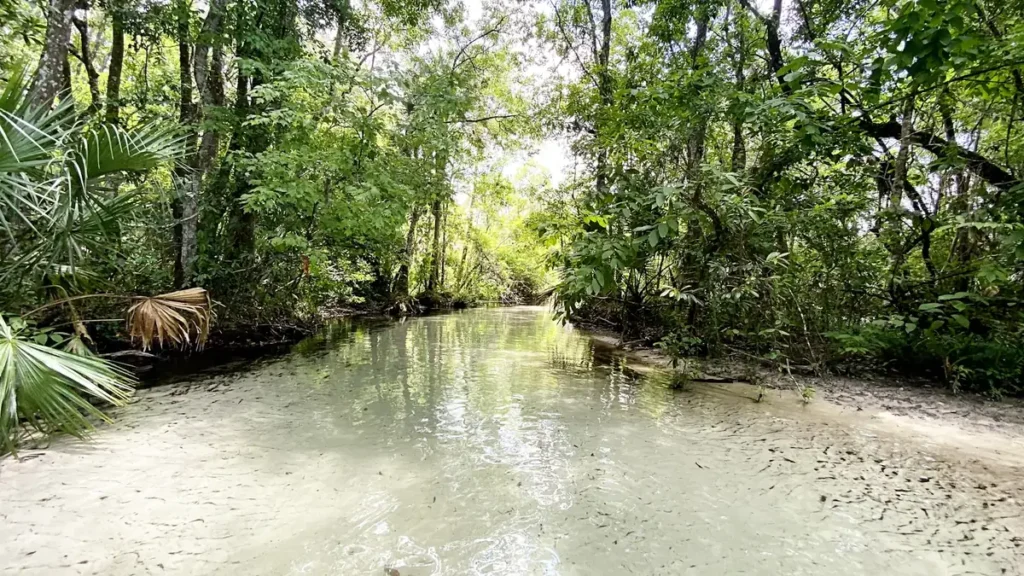
This water needs a real photo
The photo at the top of this page is not St. Johns River.
It is a regional stand-in, honestly captioned but generic — we will not put a name to a river we cannot prove. Send us a photograph you took here and it replaces the stand-in, with your credit on it.
Pioneer badgeUnclaimed
Add a photo of this water
Landscape, not fish — the water itself. Reviewed by hand before it appears. The first one published here earns the Pioneer badge.
Fished this water? Add a photo
Reviewed by hand before it appears. Pick the water, not the spot — we never publish exact locations.
Access
Lone Cabbage and State Road 520: upper basin ramps near the gauge.
Lake Poinsett and Camp Holly: classic upper-basin bass and crappie water.
Puzzle Lakes and Three Forks: marsh runs south of Lake Washington.
Mullet Lake Park and Lake Harney: middle river access in Seminole County.
Lake Monroe at Sanford: town ramps and the widest of the upper lakes.
Astor and Lake George: the big open water of the middle river.
Palatka: the head of the lower, tidal river.
Seasons
Winter: peak crappie fishing and the trophy largemouth spawn window; the busiest season.
Spring: post-spawn bass, shad in the middle river, warm days and hard afternoon wind.
Summer: hot, high water in the marsh, early mornings and topwater along the edges.
Fall: falling water pulls fish out of the marsh and concentrates them; underrated months.
From the water
No logged trips yet. Be the first to put this water on your map.
Log this water
Fished it or cleaned it? Log in or create a free account to log a trip with photos and earn the waterway badge.
Questions
What is the current flow on the St. Johns River?
As of Oct 19, 3:15 am, the USGS gauge ST. JOHNS RIVER NEAR COCOA, FL reads 3,680 cfs, the 76th percentile for this date, with water temperature 77.4 F. Conditions update every 15 minutes.
What species can you catch on the St. Johns River?
Anglers target American Shad, Black Crappie, Bluegill, Channel Catfish, Largemouth Bass, Redear Sunfish, Striped Bass on the St. Johns River in Florida.
Are there fishing guides on the St. Johns River?
GuidedFloats lists 4 guides and outfitters on the St. Johns River. Claimed profiles accept booking requests; unclaimed profiles are built from public records and link to the business.
Where can you access the St. Johns River?
Lone Cabbage and State Road 520: upper basin ramps near the gauge. Lake Poinsett and Camp Holly: classic upper-basin bass and crappie water. Puzzle Lakes and Three Forks: marsh runs south of Lake Washington. Mullet Lake Park and Lake Harney: middle river access in Seminole County. Lake Monroe at Sanford: town ramps and the widest of the upper lakes. Astor and Lake George: the big open water of the middle river. Palatka: the head of the lower, tidal river.
When is the best time to fish the St. Johns River?
Winter: peak crappie fishing and the trophy largemouth spawn window; the busiest season. Spring: post-spawn bass, shad in the middle river, warm days and hard afternoon wind. Summer: hot, high water in the marsh, early mornings and topwater along the edges. Fall: falling water pulls fish out of the marsh and concentrates them; underrated months.
Where are the fishing regulations for the St. Johns River?
Regulations change by season and section. Read the current rules on the Florida agency site: https://myfwc.com/fishing/freshwater/regulations/