Cacapon River Fishing Guides
A long free-flowing smallmouth river in West Virginia’s eastern panhandle, floated in canoes and drift boats and among the most pleasant multi-day paddles in the state.
Guides on the Cacapon River
Claimed profiles take booking requests. Unclaimed profiles are built from public records so the river is never empty; the guide can claim or remove one any time.
No guides listed yet
Guide or outfit this water? Create your profile. Listing is free, the commission is 10% or 7% with a premium profile, and premium profiles list first on this water.
About the Cacapon River
The Cacapon runs the length of West Virginia’s eastern panhandle, threading north between the ridges before joining the Potomac at the town of Great Cacapon. It is undammed for its entire length, which is increasingly unusual for a river of this size in the mid-Atlantic and is the reason it fishes and floats the way it does. The character is classic ridge-and-valley water: long quiet pools separated by ledges and cobble riffles, water that runs clear for most of the year, and a corridor that stays rural and wooded well beyond what the proximity to Washington and Baltimore would suggest.
Smallmouth bass are the reason most people are on the water. The Cacapon holds good numbers of them through its middle and lower reaches, and the fishing is the familiar mid-Atlantic pattern of working ledges, current seams and the heads and tails of pools from a canoe or a small drift boat. Rock bass and redbreast sunfish are everywhere and keep a slow day interesting, channel catfish hold in the deeper pools, and fallfish are abundant. Musky are present in the lower river and are a genuine if low-percentage target for anglers who specifically pursue them, and walleye move up out of the Potomac.
Because the river is free-flowing, it is entirely dependent on rainfall, and the USGS gauge near Great Cacapon is the number that decides whether a trip is a float, a wade or a scrape. This gauge reports water temperature along with discharge, which is a useful combination on a smallmouth river where the fish become notably more active once the water warms in late spring. Summer typically drops the river low enough that canoes drag through the shallower riffles, while a wet spring can push it up quickly. Access is through a series of public and informal launches strung along the valley, with the state park near Berkeley Springs as the regional base.
This water needs a real photo
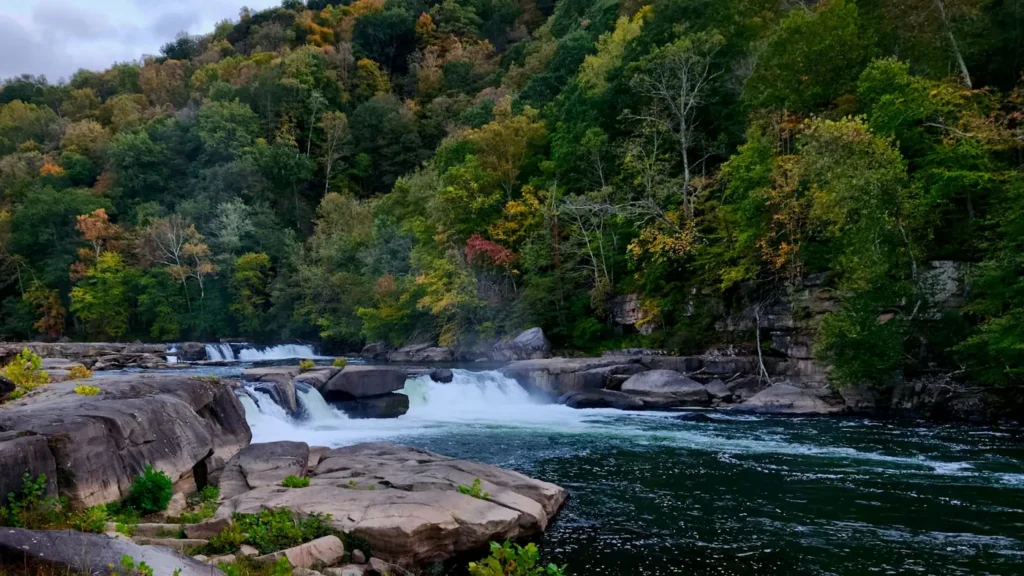
The photo at the top of this page is not Cacapon River.
It is a regional stand-in, honestly captioned but generic — we will not put a name to a river we cannot prove. Send us a photograph you took here and it replaces the stand-in, with your credit on it.
Add a photo of this water
Landscape, not fish — the water itself. Reviewed by hand before it appears. The first one published here earns the Pioneer badge.
Fished this water? Add a photo
Reviewed by hand before it appears. Pick the water, not the spot — we never publish exact locations.
Access
Great Cacapon - the town at the mouth, where the river meets the Potomac and the gauge sits.
Berkeley Springs - the nearest town with services, east of the lower river.
Cacapon Resort State Park - the regional base, with lodging on the ridge above the river.
Capon Bridge - a common access point on the middle river upstream.
Largent - a lower river access between Capon Bridge and the mouth.
Forks of Cacapon - where the North River joins, dividing the upper and middle sections.
Potomac River confluence - the downstream end of the river at Great Cacapon.
Seasons
Spring: high and pushy early, then settling into the best flows of the year as the water warms and the smallmouth turn on through May.
Summer: low and clear, with good wading and sight fishing but enough shallow riffles that floats require picking your section carefully.
Fall: flows recover with autumn rain, the smallmouth feed hard before winter, and the valley is at its best to look at.
Winter: cold and high after storms, with fishing reduced to deep pools and most of the river left to itself until spring.
From the water
No logged trips yet. Be the first to put this water on your map.
Log this water
Fished it or cleaned it? Log in or create a free account to log a trip with photos and earn the waterway badge.
Questions
What is the current flow on the Cacapon River?
As of Oct 18, 5:30 pm, the USGS gauge CACAPON RIVER NEAR GREAT CACAPON, WV reads 286 cfs, with water temperature 59.7 F. Conditions update every 15 minutes.
What species can you catch on the Cacapon River?
Anglers target Bluegill, Channel Catfish, Fallfish, Musky, Redbreast Sunfish, Rock Bass, Smallmouth Bass, Walleye on the Cacapon River in West Virginia.
Where can you access the Cacapon River?
Great Cacapon - the town at the mouth, where the river meets the Potomac and the gauge sits. Berkeley Springs - the nearest town with services, east of the lower river. Cacapon Resort State Park - the regional base, with lodging on the ridge above the river. Capon Bridge - a common access point on the middle river upstream. Largent - a lower river access between Capon Bridge and the mouth. Forks of Cacapon - where the North River joins, dividing the upper and middle sections. Potomac River confluence - the downstream end of the river at Great Cacapon.
When is the best time to fish the Cacapon River?
Spring: high and pushy early, then settling into the best flows of the year as the water warms and the smallmouth turn on through May. Summer: low and clear, with good wading and sight fishing but enough shallow riffles that floats require picking your section carefully. Fall: flows recover with autumn rain, the smallmouth feed hard before winter, and the valley is at its best to look at. Winter: cold and high after storms, with fishing reduced to deep pools and most of the river left to itself until spring.
Where are the fishing regulations for the Cacapon River?
Regulations change by season and section. Read the current rules on the West Virginia agency site: https://wvdnr.gov/fishing/fishing-regulations/