Eightmile River Fishing Guides
A Wild and Scenic river in the Lyme hills, small and heavily wooded, holding wild brook trout in its headwaters and running clean to the lower Connecticut River.
Guides on the Eightmile River
Claimed profiles take booking requests. Unclaimed profiles are built from public records so the river is never empty; the guide can claim or remove one any time.
No guides listed yet
Guide or outfit this water? Create your profile. Listing is free, the commission is 10% or 7% with a premium profile, and premium profiles list first on this water.
About the Eightmile River
The Eightmile River drains a quiet block of hills in the southeastern corner of Connecticut and reaches the lower Connecticut River near Hamburg Cove. It carries a federal Wild and Scenic designation, awarded for the condition of its watershed rather than for the size of the river, and that is the right way to understand it: this is a small, cold, forested stream whose value lies in how little has been done to it. Roughly three quarters of the basin is still wooded, the main stem runs over ledge and cobble under a closed canopy, and the water runs clear except after heavy rain.
Wild brook trout are the fish that matter here. They hold in the headwater branches and in the shaded ledge pools of the main stem, and they are small, dark and genuinely wild rather than stocked. Brown trout are present in the lower main stem, and below the trout water the river turns warmer and slower, with largemouth bass, chain pickerel and redbreast sunfish in the deeper flats toward the cove. American eel run the whole length, which is one of the reasons the watershed earned its designation. This is a river to fish with a short rod, light tippet and a willingness to walk, not a river for long casts.
The gauge at North Plain reports temperature along with discharge and stage, which is unusually useful on a stream this small and makes it one of the better instrumented wild brook trout waters in the region. Read the temperature first: brook trout here are at the southern edge of their range, and once the river climbs into the low seventies the fish stack into the coldest spring seeps and should be left alone. Spring and late autumn are the seasons to fish it hard. Summer belongs to the headwaters at first light, and the flow trace will tell you whether the upper branches are still carrying enough water to be worth the walk.
This water needs a real photo
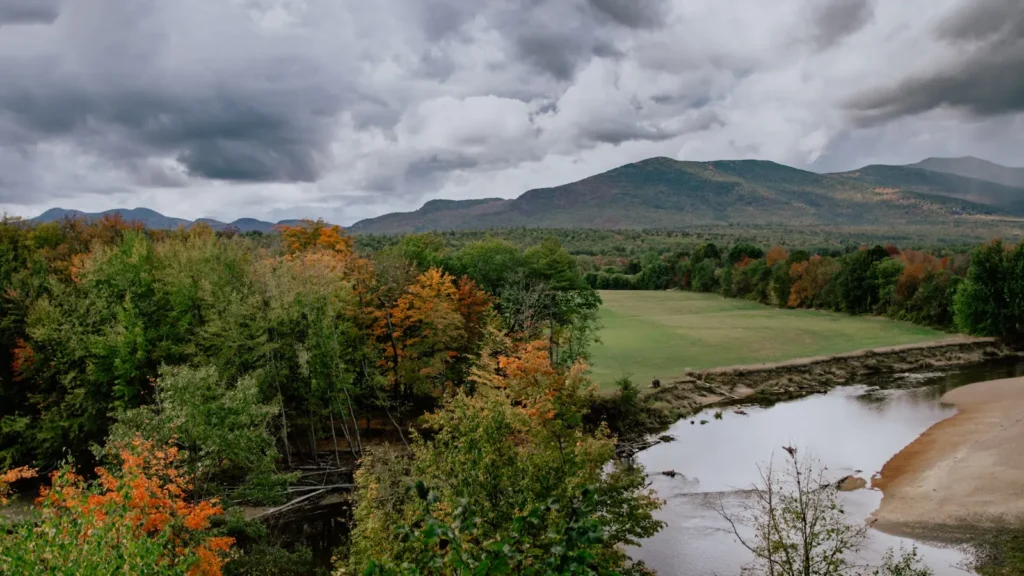
The photo at the top of this page is not Eightmile River.
It is a regional stand-in, honestly captioned but generic — we will not put a name to a river we cannot prove. Send us a photograph you took here and it replaces the stand-in, with your credit on it.
Add a photo of this water
Landscape, not fish — the water itself. Reviewed by hand before it appears. The first one published here earns the Pioneer badge.
Fished this water? Add a photo
Reviewed by hand before it appears. Pick the water, not the spot — we never publish exact locations.
Access
East Haddam - the town at the north end of the watershed, with road access to the upper branches.
Lyme - the town the main stem runs through, and the heart of the Wild and Scenic corridor.
Salem - the town on the east branch, with additional headwater access.
Hamburg Cove - the tidal cove at the mouth, where the river meets the lower Connecticut.
Devils Hopyard State Park - the state park on the main stem, with trails, falls and the easiest public access.
Old Lyme - the town at the river mouth, with services, lodging and guides on the lower Connecticut.
Nehantic State Forest - the state forest east of the river, with access to the upper watershed.
Seasons
Spring: the best of the year, with cold high water, active wild brook trout and the whole main stem fishable.
Summer: fishing retreats to the headwaters and spring seeps at first light, and warm afternoons are best left alone entirely.
Fall: cooling water brings the brook trout back onto the ledge pools in spawning color, and the fishing is excellent and short-lived.
Winter: low, cold and quiet, with the occasional mild day producing fish from the deepest pools.
From the water
No logged trips yet. Be the first to put this water on your map.
Log this water
Fished it or cleaned it? Log in or create a free account to log a trip with photos and earn the waterway badge.
Questions
What is the current flow on the Eightmile River?
As of Nov 2, 7:15 am, the USGS gauge EIGHTMILE RIVER AT NORTH PLAIN, CT reads 24 cfs. Conditions update every 15 minutes.
What species can you catch on the Eightmile River?
Anglers target American Eel, Brook Trout, Brown Trout, Chain Pickerel, Fallfish, Largemouth Bass, Redbreast Sunfish, White Sucker on the Eightmile River in Connecticut.
Where can you access the Eightmile River?
East Haddam - the town at the north end of the watershed, with road access to the upper branches. Lyme - the town the main stem runs through, and the heart of the Wild and Scenic corridor. Salem - the town on the east branch, with additional headwater access. Hamburg Cove - the tidal cove at the mouth, where the river meets the lower Connecticut. Devils Hopyard State Park - the state park on the main stem, with trails, falls and the easiest public access. Old Lyme - the town at the river mouth, with services, lodging and guides on the lower Connecticut. Nehantic State Forest - the state forest...
When is the best time to fish the Eightmile River?
Spring: the best of the year, with cold high water, active wild brook trout and the whole main stem fishable. Summer: fishing retreats to the headwaters and spring seeps at first light, and warm afternoons are best left alone entirely. Fall: cooling water brings the brook trout back onto the ledge pools in spawning color, and the fishing is excellent and short-lived. Winter: low, cold and quiet, with the occasional mild day producing fish from the deepest pools.
Where are the fishing regulations for the Eightmile River?
Regulations change by season and section. Read the current rules on the Connecticut agency site: https://portal.ct.gov/DEEP/Fishing/Fishing