Chain Pickerel
Esox niger
The warmwater pike of southeastern swamps and slow rivers — a chain-marked ambush predator that tolerates acid, low oxygen and heat that would kill a northern pike.
Identification
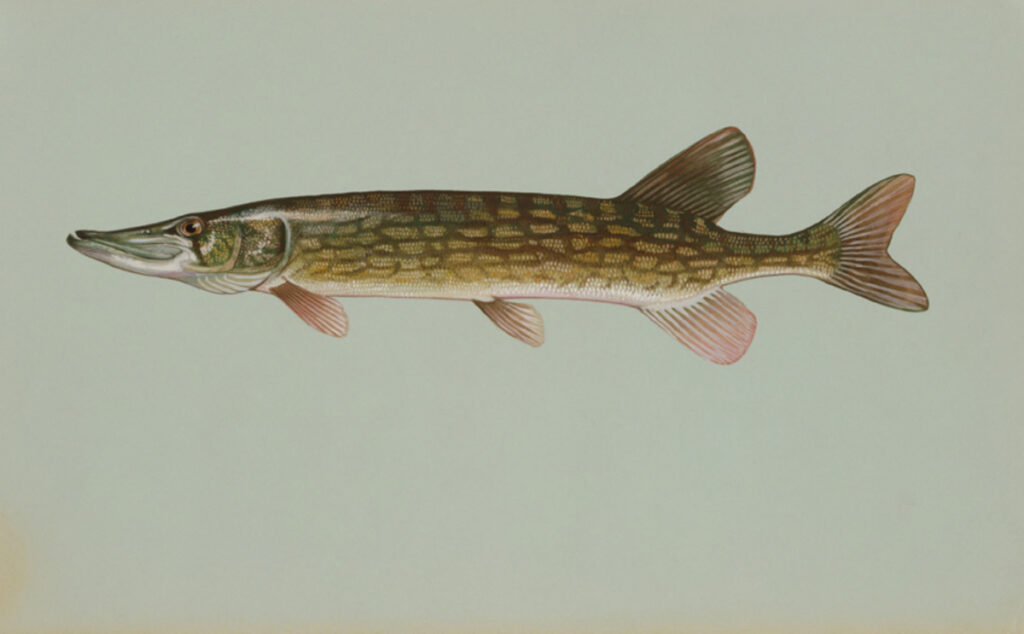
Chain pickerel are narrow, elongate esocids with the duckbill snout characteristic of the family and the dorsal and anal fins set far back near a forked tail. The ground colour is olive to yellow-green, and South Carolina describes the defining feature simply as rows of a chainlike pattern along the side. Maine puts it more descriptively — yellow-green areas broken by dark, interconnecting lines resembling the links of a chain. The pattern is unambiguous on a live fish and is the reason for the common name.
The second character is the sub-ocular bar. West Virginia describes it as a vertical black bar stretching from the bottom of the eye past the rear margin of the jaw, and Connecticut specifies that it extends vertically downward, or only slightly backward, from the eye. That orientation matters: in the closely related redfin and grass pickerels the corresponding bar slants noticeably backward. South Carolina uses the same character to separate chain from redfin pickerel, together with the chain pickerel’s longer snout, and North Carolina notes that redfin pickerel show dark vertical bars rather than a chain pattern.
Virginia adds a scaling character that separates chain pickerel from muskellunge and confirms it against northern pike: in chain pickerel the cheeks and gill covers are fully scaled. Muskellunge have both scaled only on their upper halves.
Chain pickerel among the pikes
Chain pickerel are the smallest of the three esocids commonly encountered by American anglers and the only one adapted to genuinely warm water. Northern pike and muskellunge are cool-water fish with upper limits around 85°F and 90°F respectively; chain pickerel are classed by the Royal Ontario Museum as warmwater with a preferred range of 21–30°C and tolerance to 36.7°C.
The size difference is also categorical rather than marginal. A large chain pickerel is four to six pounds where a large pike is twenty and a large muskellunge is forty. Connecticut’s characterisation is telling in this respect: within that state, the chain pickerel is the largest native freshwater predatory fish. In much of the southeastern coastal plain it occupies the apex predator role that pike and muskellunge fill further north, at a fraction of the body size.
Where ranges overlap, the species also hybridises. USGS records that chain pickerel have been documented to naturally hybridize with Esox lucius.
Range and distribution
USGS gives the native range as primarily the Atlantic slope from southwestern Maine to southern Florida, extending along the Gulf Coast west to the Sabine and Red drainages in Texas, and up the Mississippi basin to Kentucky and Missouri. Connecticut describes the same distribution from the state’s perspective — eastern coastal United States from Maine to Florida and west to Missouri and Louisiana.
Within states the distribution follows the coastal plain and piedmont. North Carolina places chain pickerel in the Piedmont and Coastal Plain; Virginia in most of the Albemarle and Chesapeake Bay watersheds across the piedmont and coastal plain; South Carolina reports them common statewide except the Broad River system; Connecticut finds them in almost all lakes and ponds and most medium to large streams. West Virginia’s native population belongs to the Ohio drainage.
Outside that native footprint the species has been widely moved. USGS records established populations in more than twenty states, with the earliest introductions in New Jersey in 1905 and Ohio in 1935 and recent records in Maine and Maryland between 2011 and 2022. Introduction was by intentional stocking in most areas, though USGS suggests the species may have reached south Florida through artificial canals. The Royal Ontario Museum records a recent northward expansion into Ontario, with the species first reported from the upper St. Lawrence in April 2008 and now present in the Bay of Quinte and Newcastle Harbour.
Habitat and water temperature
Chain pickerel are a vegetation specialist. South Carolina describes preferred habitat as heavily vegetated areas of sluggish or slow moving rivers, streams, swamps and lakes. West Virginia is more specific for riverine settings, favouring small stream pool habitats, abandoned channels, backwaters and floodplain wetlands with abundant vegetation. The Royal Ontario Museum gives clear backwaters and quiet pools of creeks and small to medium rivers, plus ponds and shallow lakes under three metres with abundant aquatic vegetation.
What separates chain pickerel from the other esocids is breadth of physiological tolerance. West Virginia records resilience to high water temperatures, high acidity and low dissolved oxygen. USGS puts numbers on two of those: tolerance of acidity to pH 3.8 and salinity to 22 parts per thousand. That combination is what allows the species to occupy blackwater swamps, tannic coastal streams, beaver ponds and tidal freshwater reaches that would exclude a northern pike outright.
Thermally, the preferred band of 70–86°F is genuinely wide and the upper tolerance near 98°F is extreme for a large freshwater predator. The practical consequence is that live water temperature is a weaker predictor for chain pickerel than for any of the other four species covered here: over most of a southeastern summer, temperature is simply not the limiting variable. Cover, vegetation density and water level matter more.
Cold behaves differently than expected too. Connecticut records that chain pickerel feed actively throughout the winter and are popular with ice anglers. A low reading on a northern river does not mean the fish have shut down.
Life history
Chain pickerel spawn earlier than most of the fish around them. South Carolina records spawning when water temperatures approach 45°F, during March and April, and notes that coastal populations may spawn in autumn. West Virginia describes spawning over aquatic vegetation in very early spring, and identifies the adaptive reason: hatching early allows the young to grow larger through the whole of their first growing season. The Royal Ontario Museum gives a spawning range of 6–11°C (43–52°F) in April and May at the northern edge of the range.
Eggs are broadcast in strings that adhere to submerged vegetation and are then abandoned; South Carolina notes they hatch unattended. Maturity comes at three to five years. Most fish caught in Maine are between ages three and five at 14 to 19 inches. Lifespan is short by esocid standards — the Royal Ontario Museum gives 8 to 10 years and Virginia about 10.
Size expectations vary regionally and modestly. South Carolina averages 14 to 15 inches and 12 to 14 ounces; Connecticut gives 10 to 18 inches as common; Maine reports 2 to 3 pound fish in productive waters with occasional 4 pounders; Virginia notes fish exceeding 20 inches. State records cluster tightly around six to eight and a half pounds — 6 lb 4 oz in South Carolina (1981), 6.19 lb in West Virginia (2001), 6 lb 13 oz in Maine (1992), 8 lb in North Carolina (1968) and 8.6 lb in Connecticut.
Diet
Chain pickerel are almost purely piscivorous as adults. South Carolina states flatly that they consume fish exclusively; other agencies record a wider list. North Carolina reports that young fish take aquatic insects and crustaceans until about four inches and then shift to fish, supplemented with small mammals, snakes and frogs. West Virginia describes them as aggressive predators on small to moderate prey — minnows, crayfish, small rodents and frogs. Virginia characterises the adult as a top-level ambush predator taking primarily fish plus amphibians, reptiles and small mammals. The disagreement is one of emphasis rather than substance: fish dominate, and everything else is opportunistic.
Angling
Chain pickerel behaviour is defined by a single mechanical strategy executed in a specific structural setting. South Carolina describes the hunting posture precisely: the fish holds motionless, resembling a drifting stick, and ambushes prey that pass. Virginia describes the same behaviour in terms of position — the fish seeks out cover adjacent to open water, holding against undercut banks, downed logs or submerged vegetation before attacking passing prey.
That combination — cover with an adjacent open lane — is the whole of chain pickerel habitat selection, and in rivers it maps onto very predictable features. Slack pools behind woody debris, the vegetated inside of bends, the mouths of abandoned channels, beaver-influenced backwaters, and the weed edge along any slow reach all provide it. Chain pickerel are conspicuously absent from open current.
Because the species tolerates warmth, acidity and low oxygen, it also occupies water that anglers targeting other predators tend to write off. Blackwater creeks, tannic swamp margins and stagnant floodplain sloughs frequently hold good pickerel populations precisely because nothing else large can live there, and the fish’s apex position in those systems is uncontested.
Seasonally, the pattern differs from the other esocids in two ways. First, the spawn is very early — March and April at around 45°F, with fall spawning in some coastal stocks — which puts pickerel in the shallowest vegetated water while other species are still weeks away. Second, there is no meaningful summer thermal retreat: with a preferred band reaching into the mid-80s Fahrenheit, chain pickerel remain in the same shallow vegetated habitat through the hottest part of the year. Winter is likewise not a dormant period; Connecticut’s note about active winter feeding under ice reflects a fish that stays engaged across a wider annual temperature swing than any other North American pike.
Conservation
Chain pickerel are not federally listed and are not a conservation concern across the great majority of their range. USGS characterises the species as established in many areas and a popular sport fish, and its documented spread is largely the result of deliberate stocking rather than incidental introduction. Where it is non-native, the same tolerances that make it successful at home — heat, acidity, low oxygen, salinity to 22 ppt — make it a durable coloniser, and its recent establishment in the upper St. Lawrence represents a genuine northward range extension rather than a stocking artefact. Its documented hybridisation with northern pike is a further reason to track that expansion where the two species now meet.
Where to catch it
110 waterways on GuidedFloats list chain pickerel, across 20 states. Each page carries live gauge readings, access notes, and the guides who fish it.
Arkansas 1
Connecticut 1
- Natchaug River121 cfs
Delaware 4
- Christina River-8,500 cfs
- Garrisons Lake
- Hearns Pond
- Marshyhope Creek13 cfs
Florida 4
- Lake Minnehaha
- Lake Seminole
- Santa Fe River965 cfs
- Withlacoochee River430 cfs
Georgia 4
- Kinchafoonee Creek137 cfs
- Ogeechee River25 cfs
- Satilla River2,420 cfs
- Spring Creek278 cfs
Illinois 1
- Cache River1 cfs
Louisiana 20
- Abita River
- Alligator Bayou
- Bayou Anacoco31 cfs
- Bayou D'Arbonne
- Bayou de Loutre
- Bayou Dorcheat
- Bayou Fountain
- Bayou Fusilier
- Bayou Mallet
- Black Bayou
- Black Lake Bayou
- Bodcau Bayou314 cfs
- Cross Bayou
- Flagon Bayou
- Henderson Bayou
- Kisatchie Bayou
- Lake Bistineau
- Lake D'Arbonne
- Saline Bayou18 cfs
- Shettleworth Bayou
Maine 15
- Allagash River566 cfs
- Aroostook River191 cfs
- Branch Brook8 cfs
- East Branch Penobscot River444 cfs
- East Branch Penobscot River below Grand Lake Matagamon190 cfs
- Fish River128 cfs
- Grand Lake Stream369 cfs
- Lewy Lake
- Meduxnekeag River39 cfs
- Narraguagus River168 cfs
- Penobscot River3,230 cfs
- Piscataquis River625 cfs
- St. Croix River373 cfs
- Stony Brook
- West Grand Lake
Maryland 3
- Licking Creek66 cfs
- Nanticoke River
- Tuckahoe Creek36 cfs
Massachusetts 8
- Charles River178 cfs
- Indian Head River34 cfs
- Jones River24 cfs
- Millers River299 cfs
- Quinebaug River80 cfs
- Saugus River7 cfs
- Upper Mystic Lake
- West River
Mississippi 1
- Wolf River (Mississippi)43 cfs
New Hampshire 11
- Ashuelot River417 cfs
- Ashuelot River below Surry Mountain Dam122 cfs
- Bearcamp River42 cfs
- Beaver Brook24 cfs
- Contoocook River89 cfs
- Contoocook River below Hopkinton Dam529 cfs
- Nubanusit Brook below MacDowell Dam
- Peabody River69 cfs
- Piscataquog River32 cfs
- Upper Ammonoosuc River285 cfs
- Winnicut River41 cfs
New Jersey 2
- Hackensack River
- Passaic River1,050 cfs
New York 4
- Conesus Lake
- Mohawk River140 cfs
- Mongaup River110 cfs
- Owasco Lake
North Carolina 3
- Currituck Sound
- Lumber River104 cfs
- Tar River3 cfs
Pennsylvania 3
- Glendale Lake
- Shohola Creek42 cfs
- Tobyhanna Creek169 cfs
Rhode Island 11
- Adamsville Brook27 cfs
- Blackstone River502 cfs
- Branch River120 cfs
- Chipuxet River29 cfs
- Nipmuc River10 cfs
- Pawcatuck River579 cfs
- Pawtuxet River243 cfs
- Peeptoad Brook1 cfs
- Usquepaug River95 cfs
- Wood River144 cfs
- Woonasquatucket River39 cfs
Texas 5
Vermont 6
- Lake Champlain
- Little Otter Creek13 cfs
- Moose River80 cfs
- Passumpsic River341 cfs
- Waterbury Reservoir
- Wrightsville Reservoir
Virginia 3
- Mattaponi River267 cfs
- North River180 cfs
- Pamunkey River216 cfs
References
- Chain Pickerel (Esox niger) — Species Profile, Nonindigenous Aquatic Species — U.S. Geological Survey
- Chain Pickerel — Freshwater Fish Species — South Carolina Department of Natural Resources
- Chain Pickerel — West Virginia Division of Natural Resources
- Chain Pickerel — Virginia Department of Wildlife Resources
- Chain Pickerel — Freshwater Fishes of Connecticut — Connecticut Department of Energy and Environmental Protection
- Chain Pickerel — Species Information — Maine Department of Inland Fisheries and Wildlife
- Chain Pickerel — North Carolina Wildlife Resources Commission
- Chain Pickerel (Esox niger) — life history — Ontario Freshwater Fishes Life History Database, Royal Ontario Museum
- Muskellunge — Field Guide (esocid scale and pore characters) — Missouri Department of Conservation
- Know Your Catch: How to ID Northern Pike and Muskies — Iowa Department of Natural Resources
- Ecological Risk Screening Summary — Northern Pike (Esox lucius) — U.S. Fish and Wildlife Service
- Northern Pike (Esox lucius) — National Park Service, Mississippi National River and Recreation Area
- IGFA Game Fish Records — International Game Fish Association