Dolly Varden
Salvelinus malma
A sea-run char of the North Pacific and Arctic, Dolly Varden fast for most of the year and overwinter in groundwater springs that stay near 42 degrees F while the rivers freeze solid.
Identification
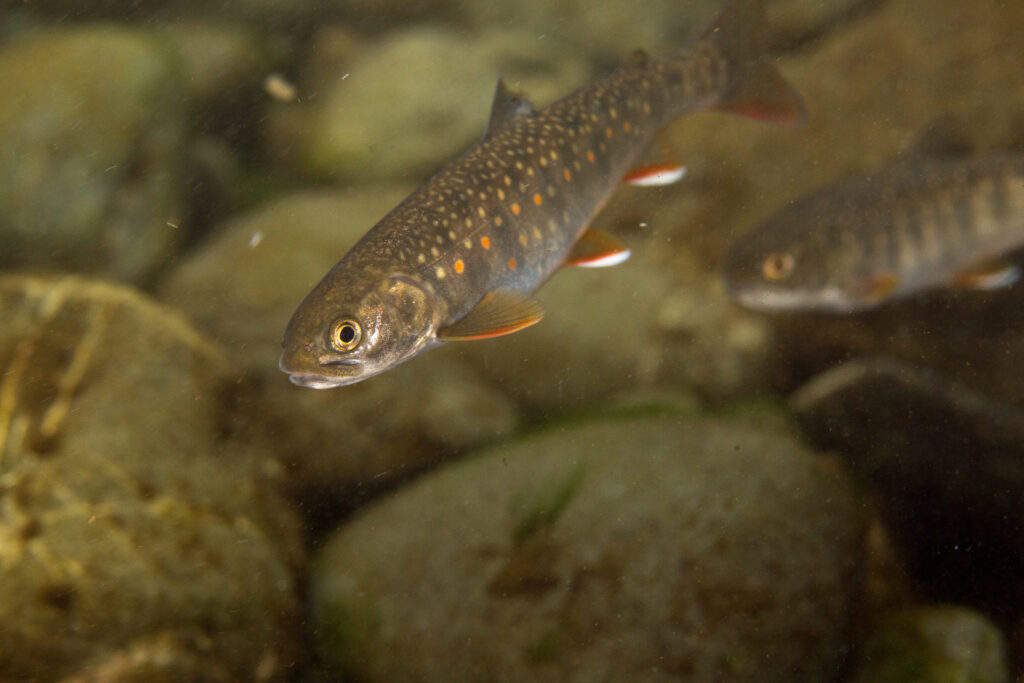
Dolly Varden are char, and the Alaska Department of Fish and Game gives the first-order rule plainly: char have light spots on a dark body, while trout and salmon have dark spots on a light body. Freshwater Dolly Varden are greenish or olive to dark blue-brown with many small pale, yellow, orange, or red spots along the flank. Sea-run adults returning from salt water are silvery with an olive-green to brown back and numerous red to orange spots. Juveniles carry eight to ten wide, oval parr marks.
The most repeatable field character is spot size relative to the eye. Alaska’s Region 2 account notes that Dolly Varden spots are typically smaller than the pupil, while Arctic char carry fewer and larger cream-to-orange spots that exceed pupil diameter. The two also differ in build: Dolly Varden have a relatively thick caudal peduncle and only a slightly forked tail, while Arctic char have a slim peduncle and a noticeably forked tail. Behaviour separates them further, since Arctic char generally complete their entire life cycle in lakes.
Separating Dolly Varden from bull trout is much harder and, in the overlap zone, not reliably possible by eye. The U.S. Fish and Wildlife Service’s 2001 similarity-of-appearance proposal cited work in which bull trout were misidentified as Dolly Varden 48 percent of the time, and stated that while genetic analysis distinguishes them, visual identification remains highly problematic. The two co-occur in the United States only within the Coastal-Puget Sound region of western Washington, west of the Cascades and on the Olympic Peninsula. That document is 66 FR 1628.
The species was not distinguished from bull trout at all until Ted Cavender’s work in 1978, which is why so much older literature, and at least one world record, was later reassigned.
Northern and southern forms
Alaska recognises two forms of Dolly Varden, and they differ in ways that are consistent enough to matter. The Department of Fish and Game separates them by vertebrae count, 62 to 65 in the southern form and 66 to 70 in the northern, and by chromosome number, 82 in the southern form and 78 in the northern.
The consequences for size and longevity are large. Northern-form fish reach up to 27 pounds and live up to 16 years. Southern-form fish top out near 10 pounds and rarely exceed 8 years, with Region 2 reporting fish rarely older than nine.
Distribution splits accordingly. The northern form occupies both sides of the Alaska Peninsula northeastward to Canada, plus the Susitna River basin. The southern form runs from the Aleutians through Southeast Alaska, including Kodiak Island.
Overwintering strategy splits with them, and this is the most functionally important difference. Southern-form fish spend winters in lakes. Northern-form fish typically overwinter in rivers or springs, and entire populations of freshwater-resident Dolly Varden may congregate at a single spring.
Range and distribution
NatureServe describes the range as extending from the Sea of Japan and the Kuril Islands, across the Aleutian chain to Alaska, north into the Chukchi and Beaufort seas, and south along the North American Pacific coast to Puget Sound drainages in Washington, with a global rank of G5, secure, reviewed in December 2017.
In Alaska the species is found in coastal areas from Southeast Alaska across the Gulf of Alaska and the Bering Sea into the Beaufort Sea to the Mackenzie River, and also in streams of Interior Alaska and the Brooks Range. Movements can be extraordinary: Alaska records a documented migration of a Dolly Varden between North America and Russia, over 1,000 miles.
In the lower 48, Dolly Varden are effectively a western Washington fish, and their conservation profile there is dominated by the fact that they cannot be told apart from federally threatened bull trout.
Habitat and water temperature
Dolly Varden are a cold-water char, and the thermal numbers that exist for them are field temperatures rather than laboratory criteria. That is a real gap: published, agency-vetted thermal tolerance analyses exist for brook trout, lake trout, and bull trout, but no equivalent verified laboratory optimum or lethal threshold for Salvelinus malma was located during research for this article. Any thermal band given for the species should be understood as inferred from close relatives.
What can be stated with confidence is the temperature of the water they actually occupy, and those numbers are remarkable. On Alaska’s North Slope, Dolly Varden survive winter in perennial springs fed by ancient groundwater from limestone country south of the Brooks Range. The U.S. Fish and Wildlife Service reports that Shublik Spring holds approximately 5.5 C (about 42 degrees F) year round, and that another spring in the system reaches 13 C. Those springs create, in the Service’s phrasing, oases of flowing water when the rivers themselves freeze completely. The account is at Dandy Dollies of Far-North Alaska.
At the other end of the annual cycle they feed in the Beaufort Sea, where the Service gives an under-ice temperature of about -1.7 C, cold enough that a salmonid without antifreeze proteins cannot overwinter there. That constraint is the whole reason Dolly Varden return to fresh water each autumn.
Winter habitat is the limiting resource across the Arctic range. USGS research on the Canning River describes Arctic rivers freezing solid, leaving pockets of overwintering habitat separated by long stretches where the river is frozen to the bottom, and states that the number of fish living in Alaska’s Arctic rivers is thought to be capped by the availability of fresh water that does not freeze. Juveniles are believed to use smaller springs and deeper pools in lower reaches, avoiding the large springs where adults concentrate and predation risk is higher. The project is described by the USGS Alaska Science Center.
For a river where live water temperature is displayed, the operative point is that Dolly Varden habitat quality is defined by groundwater. Spring-influenced reaches that stay cool in summer and unfrozen in winter are the fixed points around which entire populations organise.
Life history
Dolly Varden are anadromous over much of their range but not obligately so, and the variation is wide. Sea-run fish rear in streams for two to four years, occasionally up to six, then smolt at roughly 5 inches and migrate to sea in May and June. Freshwater-resident populations skip the ocean entirely, and landlocked dwarf forms mature at just 3 to 6 inches.
Spawning is a fall event, September through November, over gravel beds in small headwater streams. Fecundity is modest and form-dependent: Alaska gives 600 to 6,000 eggs for southern-form females and 2,500 to 10,000 for the northern form. Eggs hatch in March after four to five months, and fry emerge in April and May.
Unlike Pacific salmon, Dolly Varden are iteroparous and can spawn repeatedly. Alaska’s Region 2 account reports males spawning up to twice and females up to three times, with repeat spawners typically spawning in consecutive years, while also noting that roughly 70 percent of males and 60 percent of females die after spawning. Survival to a second spawning is the exception rather than the rule.
The North Slope feeding schedule is the most striking part of the life history. According to the Service, once these fish begin migrating to sea they do not eat again in fresh water, and their entire annual feeding occurs during about one or two months at sea in summer. Everything else, the upstream migration, spawning, and an Arctic winter under ice, runs on stored energy. Spawning adults reach more than two feet and 5 to 10 pounds on that budget.
Diet
Dolly Varden are opportunistic carnivores. At sea they feed on amphipods and small fish including juvenile salmon and sand lance. In fresh water, juveniles take aquatic insect larvae, and larger fish become generalist predators on insects, crustaceans, snails, salmon eggs, and small fish.
Their relationship with salmon is the most misunderstood part of the species, and the record is clear. Alaska describes Dolly Varden as more of a scavenger than a predator with respect to salmon, feeding largely on drifting eggs that would not have survived anyway. The Region 2 account goes further, noting that by consuming dead and fungus-infected eggs, Dolly Varden perform a hygienic function that benefits the remaining salmon eggs in a redd.
Angling
Dolly Varden behaviour is legible once the annual energy budget is understood. Where fish feed at sea for only a month or two, a returning Dolly Varden in fresh water is not primarily a feeding animal, and its response to a drifting item is opportunistic rather than nutritional. Where salmon are spawning, by contrast, the concentration of Dolly Varden behind redds is a direct expression of the egg-scavenging habit described above, and it is the most predictable aggregation the species forms.
Timing across the year is driven by migration rather than by hatch. Smolts leave for salt water in May and June. Sea-run adults return to fresh water in late summer and autumn to spawn and to overwinter, and on the North Slope those movements funnel into a small number of spring-fed reaches. Because a river’s Dolly Varden may be concentrated into a few thousand feet of unfrozen or spring-influenced water for months at a time, the species is unusually concentrated relative to its total range.
The identification problem carries a practical weight in western Washington that it does not carry in Alaska. Where Dolly Varden and federally threatened bull trout overlap, they cannot be reliably told apart by sight, which is the entire reason the Service proposed treating them alike under the similarity-of-appearance provision. Anywhere in that overlap zone, a char should be assumed to be potentially a bull trout.
Conservation
Dolly Varden are globally secure. NatureServe assigns a rank of G5, reviewed December 2017, across a very large circumpolar range. The only federal action attached to the species in the United States is the 2001 proposal to list it as threatened in Washington solely because it looks like bull trout, not because of any assessed decline in Dolly Varden themselves. NatureServe carries the corresponding code of proposed threatened due to similarity of appearance.
The species’ history in Alaska is a cautionary tale about acting on assumption. Alaska paid a bounty on Dolly Varden from 1921 to 1941, on the belief that they were destroying salmon. In 1939 an analysis of 20,000 tails submitted for payment found that more than half came from coho salmon, with further submissions from rainbow trout, and that the underlying premise about salmon predation was wrong in any case. The bounty was ended. The episode is recounted by the Alaska Department of Fish and Game, which also notes that the name traces to an Alaskan teenager, Elda McCloud, around the 1860s, referring either to a Dickens character or to a spotted fabric pattern, with the exact origin uncertain.
The live conservation issue for Arctic populations is not harvest but habitat, specifically the perennial springs. USGS states that Arctic river fish populations are thought to be capped by the availability of fresh water that does not freeze, and the Service describes those springs as the product of groundwater that has flowed underground for centuries. A small number of discrete, non-renewable, spatially fixed sites carry a disproportionate share of the population through winter, which makes them the natural focus of management attention where human activity intersects Arctic drainages.
The overlap with bull trout remains the dominant issue at the southern edge. Because the two species cannot be separated in the field, Dolly Varden conservation in Washington is in practice inseparable from bull trout recovery, and the taxonomy that was only settled in 1978 continues to shape how both fish are managed.
Where to catch it
14 waterways on GuidedFloats list dolly varden, across 2 states. Each page carries live gauge readings, access notes, and the guides who fish it.
Alaska 12
- Bradley River below Bradley Lake Dam1 cfs
- Cooper Creek29 cfs
- Copper River51,200 cfs
- Kenai River4,270 cfs
- Kvichak River28,000 cfs
- Lemon Creek
- Situk River611 cfs
- Sixmile Creek665 cfs
- Staney Creek1,290 cfs
- Stikine River81,500 cfs
- Taku River20,500 cfs
- Talkeetna River3,490 cfs
Washington 2
References
- Dolly Varden Species Profile — Alaska Department of Fish and Game
- Dolly Varden: Beautiful and Misunderstood — Alaska Department of Fish and Game, Alaska Fish and Wildlife News
- Dolly Varden, Alaska Wildlife Notebook Series — Alaska Department of Fish and Game
- Dolly Varden (Region 2 sport fish publication) — Alaska Department of Fish and Game
- Dandy Dollies of Far-North Alaska — U.S. Fish and Wildlife Service
- North Slope Dolly Varden Studies — U.S. Fish and Wildlife Service
- Winter Habitat of Juvenile Dolly Varden in the Canning River — U.S. Geological Survey, Alaska Science Center
- Migration strategies supporting salmonids in Arctic Rivers: A case study of Arctic Cisco and Dolly Varden — U.S. Geological Survey
- Proposed Rule To List the Dolly Varden as Threatened in Washington Due to Similarity of Appearance to Bull Trout, 66 FR 1628 — U.S. Fish and Wildlife Service via Federal Register
- Dolly Varden (Salvelinus malma) species profile — U.S. Fish and Wildlife Service
- Dolly Varden (Salvelinus malma) species page and state record — Washington Department of Fish and Wildlife
- Salvelinus malma, Dolly Varden, conservation status — NatureServe Explorer
- Effect of Temperature on Growth and Survival of Bull Trout (Selong et al. 2001), used for congener thermal comparison including Arctic char — American Fisheries Society, copy hosted by Montana State University
- IGFA World Records — International Game Fish Association