Common Carp
Cyprinus carpio
Imported by the U.S. Fish Commission in 1877 as a deliberate food-fish programme, now established in every state but Alaska, and one of the most technically demanding fly-rod targets in North America.
A deliberate decision, made by the federal government
The common carp did not sneak into North America. It was invited, at public expense, by the agency that became the U.S. Fish and Wildlife Service, and it was distributed nationwide as a matter of policy.
The U.S. Geological Survey records the sequence. An early private introduction came first: Henry Robinson of Orange County, New York, brought fish from France in 1831–1832. The consequential event came later and was federal. In 1877 the U.S. Fish Commission imported common carp from Germany, and for the next two decades the agency began stocking and distributing the species as food fish throughout much of the United States.
The reasoning was not unreasonable in 1877. Native fish stocks in the eastern United States were visibly collapsing under industrial pollution, dam construction, and unregulated harvest. The carp was Europe’s proven aquaculture fish: it tolerated warm, turbid, low-oxygen, degraded water that killed native species; it grew fast; it converted low-grade food efficiently; it could be raised in farm ponds by ordinary people. A cheap protein source that thrived precisely where American rivers were failing looked like a solution to a real and pressing problem.
The Commission raised carp in federal ponds and shipped them out to applicants across the country, sustaining the effort for roughly twenty years. It was one of the most effective species-introduction programmes ever mounted in North America, and it worked exactly as designed.
The reversal
The programme unravelled within a generation. Carp proved unpopular on the table relative to expectations, particularly against the shad, bass and trout Americans actually wanted. More importantly, the effects on the waters receiving them became apparent: turbid water, vanished aquatic vegetation, degraded habitat for the native fish and waterfowl that people valued.
Federal enthusiasm turned to embarrassment. Distribution was curtailed and the agency spent much of the twentieth century, in effect, working against its own nineteenth-century programme. But by then the fish was self-sustaining across the continent, and escape from farm ponds during floods and dam breaks had spread it well beyond the original stocking sites. Later releases added to it: use as bait fish and release of ornamental varieties like koi continue to move carp into new waters.
The end state is stark. USGS records the common carp from all states except Alaska, established in all five Great Lakes with self-sustaining populations. It is the most successful fish introduction in North American history, and it is worth being clear that this was not an accident of commerce or a bait bucket. It was policy.
Native range and identification
The species is Eurasian. USGS traces its origin to the Caspian Sea, from which it migrated naturally to the Black and Aral Seas, east to eastern mainland Asia and west as far as the Danube River. Its spread beyond that — through Europe under Roman and later monastic aquaculture, and eventually worldwide — is one of the oldest continuous records of humans moving a fish for food.
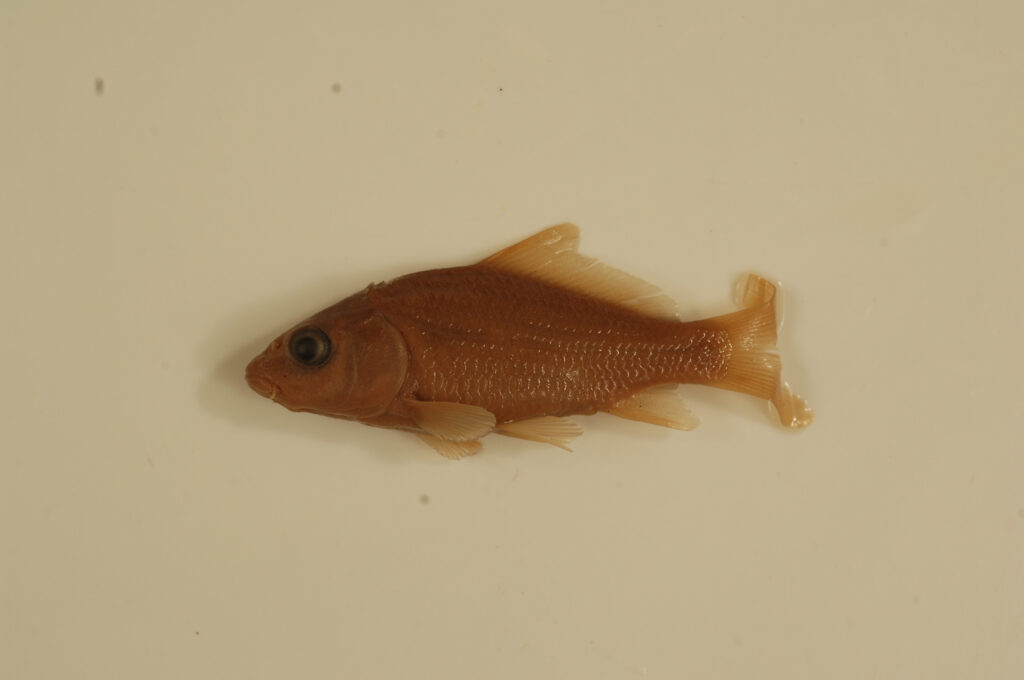
Common carp are heavy-bodied, deep, and thick through the shoulder, with a long dorsal fin carrying a serrated hardened first ray, and two pairs of barbels at the corners of a protrusible, toothless, downward-angled mouth. Wild-type fish are fully scaled in brassy gold to olive-bronze. Domesticated lineages persist in the wild as mirror carp, with scattered large irregular scales, and leather carp, essentially scaleless; koi are the ornamental form of the same species.
The barbels are the reliable field mark separating carp from native buffalo and carpsuckers, which have no barbels at all and are frequently misidentified as carp — a confusion with real consequences, since buffalo are long-lived native fish and carp are not.
What benthic foraging does to a lake
The ecological damage carp cause is mostly not predation. It is physical, and it follows directly from how they feed.
A carp feeds by working the bottom, taking in sediment, sorting invertebrates and organic matter with its pharyngeal teeth, and expelling the rest into the water column. Done by a few fish, this is unremarkable. Done by a large biomass of fish continuously across a shallow basin, it produces a cascade: suspended sediment, increased turbidity, phosphorus released from the sediment into the water where algae can use it, algal blooms, reduced light penetration, and the loss of rooted aquatic vegetation — which is uprooted mechanically at the same time.
USGS summarises the mechanism directly: carp disturb sediments and retard the growth of submerged aquatic vegetation by feeding and uprooting plants, which can disturb spawning and nursery areas of native fishes and disrupt sight-oriented predators.
The loss of vegetation is the pivot. Submerged plants stabilise sediment, shelter juvenile fish and invertebrates, compete with algae for nutrients, and support waterfowl. Remove them and a clear, plant-dominated shallow lake flips to a turbid, algae-dominated one — a change that is self-reinforcing and difficult to reverse.
This has been demonstrated experimentally rather than merely inferred. A whole-system experiment in a thermally stratified lake measured the effects of common carp on phosphorus concentrations, water clarity, and vegetation density. Separate work has distinguished the direct trophic effects of carp from habitat deterioration, and further research has documented biomass-dependent effects of age-0 common carp on aquatic ecosystems — young fish, not only adults, drive the change. The consequences reach beyond fish: a study in Hydrobiologia tracked the effects of a rapidly increasing carp population on vegetative cover and waterfowl in a recently restored Midwestern shallow lake, where the restoration was undone.
The comprehensive synthesis is a 2009 review in Reviews in Fisheries Science revisiting the question eighty years after the foundational American work on the subject: Effects of common carp on aquatic ecosystems 80 years after “Carp as a Dominant”.
Two qualifications belong here. First, the effect is strongly biomass-dependent; a threshold near 100 kilograms per hectare is widely cited as the point above which vegetation and clarity decline sharply, though the exact figure varies by system and should be treated as a working figure rather than a constant. Second, carp are not uniformly dominant everywhere: USGS notes populations declining in the Upper Mississippi River system.
Management
Because the damage scales with biomass, management aims at reduction rather than eradication, and it has become considerably more sophisticated than netting. Managers must first know how many fish are present, which has required method development in using boat electrofishing to estimate the abundance of invasive common carp in small Midwestern lakes.
Two approaches have proven effective. The first exploits winter aggregation: radio-tagged individuals lead crews to the schools they join, a method described as using the Judas technique to locate and remove wintertime aggregations of invasive common carp. The second targets reproduction rather than adults — carp in many lake chains depend on a small number of shallow, winterkill-prone marshes for recruitment, and blocking access to those nurseries starves the whole system of young fish. Case studies demonstrate that common carp can be sustainably reduced by exploiting source–sink dynamics in Midwestern lakes. The species is treated at length in the Encyclopedia of Biological Invasions.
Water temperature and spawning
Carp are warmwater fish with an exceptionally broad tolerance, which is much of why the 1877 programme succeeded. They survive winter under ice and summer in water that would kill most native game fish, and they endure low dissolved oxygen better than nearly anything else of comparable size.
Spawning is triggered by rising spring water temperature, generally beginning in the low to mid 60s Fahrenheit and continuing through the 70s, in shallow, weedy, recently flooded margins. Adhesive eggs are scattered over vegetation and abandoned; the noisy, thrashing, visible spawning activity in shallow bays in spring is characteristic. Optimal feeding and growth occur in genuinely warm water, through the high 70s and into the 80s, which is why carp fishing sharpens as summer settles in and why carp remain active in conditions that shut down trout entirely.
A technically demanding fly-rod fish
The rehabilitation of the carp as a sporting fish is one of the more interesting developments in American angling, and it rests on legitimate grounds rather than novelty.
A feeding carp in shallow water is a sight-fishing target of real difficulty. The fish is large, wary, and acutely sensitive to vibration and shadow. It feeds head-down on the bottom, often with limited forward vision, which means a fly must arrive close enough to be found but softly enough not to spook it — a narrow window. It is selective in the sense that it commits to a feeding mode and largely ignores what falls outside it. Takes are subtle: a slight change in body angle, a tilt, a flare of gills, with no perceptible tug.
Once hooked, the fish is genuinely powerful. A twenty-pound carp in moving water runs long, sustained, and repeatedly, and does so with a broad body working against current. The comparison to saltwater flats fishing is made constantly and is not marketing: the visual hunting, the presentation problem, and the running fight are structurally similar.
None of that changes what the fish is. A carp caught in an American river is the descendant of a federal food-security programme launched in 1877, living in water it has helped make turbid. It is worth pursuing precisely because it is difficult, and worth understanding because it is the clearest available example of what happens when a well-intentioned introduction succeeds beyond anyone’s intention.
Where to catch it
10 waterways on GuidedFloats list common carp, across 8 states. Each page carries live gauge readings, access notes, and the guides who fish it.
Arizona 1
Colorado 2
Connecticut 1
- Housatonic River794 cfs
Delaware 2
- Hearns Pond
- St Jones River11 cfs
Minnesota 1
Nebraska 1
- Cedar River259 cfs
South Dakota 1
Virginia 1
- Opequon Creek12 cfs
References
- Cyprinus carpio (common carp) fact sheet - Nonindigenous Aquatic Species database — U.S. Geological Survey
- Effects of Common Carp on Aquatic Ecosystems 80 Years after "Carp as a Dominant" — Reviews in Fisheries Science
- Effects of a rapidly increasing population of common carp on vegetative cover and waterfowl in a recently restored Midwestern shallow lake — Hydrobiologia
- Effects of common carp on phosphorus concentrations, water clarity, and vegetation density: a whole system experiment in a thermally stratified lake — Hydrobiologia
- Biomass-dependent effects of age-0 common carp on aquatic ecosystems — Hydrobiologia
- Impact of common carp Cyprinus carpio on aquatic communities: direct trophic effects versus habitat deterioration — Fundamental and Applied Limnology
- Using the Judas technique to locate and remove wintertime aggregations of invasive common carp — Fisheries Management and Ecology
- Case Studies Demonstrate That Common Carp Can Be Sustainably Reduced by Exploiting Source-Sink Dynamics in Midwestern Lakes — Fishes (MDPI)
- Using Boat Electrofishing to Estimate the Abundance of Invasive Common Carp in Small Midwestern Lakes — North American Journal of Fisheries Management
- Carp, Common, in Encyclopedia of Biological Invasions — University of California Press
- IGFA World Records — International Game Fish Association