Spotted Seatrout
Cynoscion nebulosus
Called speckled trout across the Gulf, this fish is a drum, not a trout — an estuarine resident that rarely leaves its home river and dies in numbers when winter water drops below 45 °F.
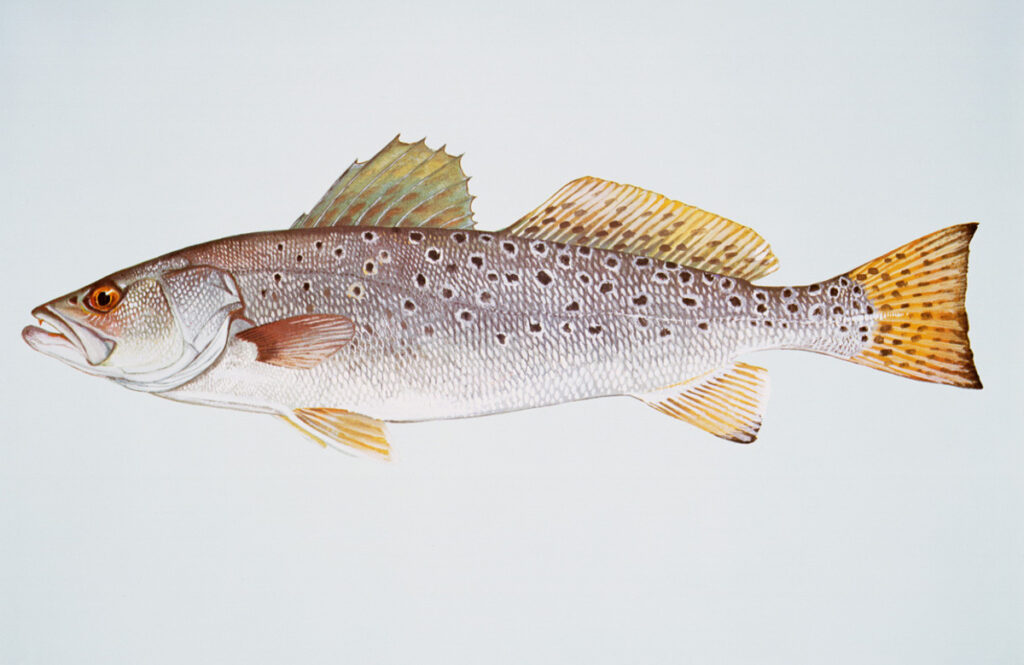
It is not a trout, and the name collides
Across the Gulf coast this fish is called speckled trout. The Mississippi Department of Marine Resources titles its own management page “Speckled Trout”, and Louisiana Sea Grant lists the common names as “Speckled Trout, Speck, Yellowmouth.” That usage is universal from Florida to Texas.
It is also a genuine source of confusion for anyone arriving from another part of the country, because “speckled trout” means something entirely different in the mountains and the north. The Maine Department of Inland Fisheries and Wildlife lists the alternate common names for brook trout, Salvelinus fontinalis, as “Squaretail, Brookie, Speckled Trout.” In North Carolina, both usages exist within one state: speckled trout in the mountains is a char in a cold headwater stream, and speckled trout on the coast is Cynoscion nebulosus in a brackish sound.
The two fish are not close relatives in any sense. Brook trout are salmonids — cold-water fish with an adipose fin, spawning in gravel in autumn, requiring water in the 50s °F or colder. Spotted seatrout are sciaenids: drums. Their nearest relatives are red drum, black drum and Atlantic croaker. They have no adipose fin, they carry a pair of prominent canine teeth in the upper jaw, they produce sound with a sonic muscle against the swim bladder, and they broadcast pelagic eggs in warm salt and brackish water in summer. Nothing about their biology is trout-like except the spots. If you are reading a fishing report for a Gulf coast river, “speckled trout” always means this drum.
Identification
Louisiana Sea Grant describes a dark silvery-gray back over white below, with “a few to many black spots,” dorsal and tail fins that are “always spotted,” “1 or 2 large sharp canine teeth” at the front of the upper jaw, and frequent yellow pigmentation around the mouth — the origin of the name yellowmouth. The spots are true spots on the body and fins, unlike the vermiculated worm-track pattern on a brook trout’s back.
Two close relatives share Gulf estuaries: sand seatrout and silver seatrout. Neither carries the distinct black spotting on body and fins, and neither reaches the size of a mature spotted seatrout.
A river-and-estuary fish
This is the point that matters most on a coastal river. Spotted seatrout are not a surf species that occasionally wanders inside. They are estuarine residents. ASMFC states they are “found primarily in estuaries,” “appear to be non-migratory,” and “spend their entire life within five to ten miles of their natal estuary.” Louisiana tagging data is even tighter: 90 percent of tagged trout were recovered “from within one mile of where the trout were tagged.”
South Carolina DNR puts rivers in the habitat description explicitly — the species inhabits “estuaries and rivers, but also shallow coastal bays and sounds,” with adults near salt marsh edges, grass beds, “the vicinity of tidal creek mouths and channels,” and oyster reefs.
How far up they run is a salinity question, and spotted seatrout have enormous latitude. The Gulf States Marine Fisheries Commission’s regional management plan describes them as “euryhaline and found in salinity ranges of 0.2‰-75‰” — from essentially fresh water to more than twice the salinity of the open ocean. Spawning itself is narrower, occurring at salinities of 17 to 35 parts per thousand.
The seasonal pattern follows from that. Louisiana Sea Grant describes summer fish holding in the high-salinity lower estuary and winter fish shifting to “lower salinity waters of the upper estuary.” On the Pascagoula — the USGS gage at Graham Ferry drains 8,204 square miles into Jackson County — river discharge determines where that gradient sits in any given week. A long dry spell moves the brackish reach upstream and the trout with it. A heavy rain event pushes fresh water down and compresses the reach toward the Sound. Larvae are the vulnerable stage in that equation: South Carolina DNR notes they are “apparently susceptible to low salinities caused by periods of significant freshwater influx.”
The drumming chorus
Male spotted seatrout produce sound the way every drum does — with specialized sonic muscles vibrating against the gas-filled swim bladder. Florida FWC describes males creating sounds by “vibrating specialized sonic muscles against the swim bladder”; South Carolina DNR describes males “contracting muscles to vibrate the swimbladder” to attract females; Louisiana Sea Grant describes a male “vibrating his air bladder, producing a croaking sound.”
The behavior is social and highly organized. Louisiana Sea Grant describes males forming “drumming aggregations which can number in the hundreds or even thousands of fish.” Florida’s acoustic work established the daily rhythm precisely: calling “begins around sunset and continues for 3 to 12 hours.” The function is straightforward — in the turbid water of a bay or river, sound carries where vision does not, and the chorus assembles the spawning group.
That sound has become a research instrument. Because the calls are species-specific, biologists can map spawning habitat with hydrophones instead of nets. In Tampa Bay, FWC found spawning “most common in the lower bay and the eastern part of the middle bay,” with “the majority of aggregation sounds” occurring at seagrass sites, though calls were also detected over channels, sand bottom and beaches. Successful spawning sites shared three traits: proximity to shoreline, shallow depth, and high dissolved oxygen.
Spawning season and temperature
The season is long and temperature-driven. GSMFC reports that Gulf-wide, spawning “begins as early as March and ends after October with peaks of activity occurring from April-July.” Florida’s Tampa Bay work found a season that “typically starts in late March and ends in late September.” ASMFC gives April to September, “around estuary inlets.” Louisiana Sea Grant gives May through September and notes that females “may spawn every 7 to 14 days during the April to September spawning period” — this is a serial batch spawner, not a once-a-year event.
The temperature numbers are specific and unusually useful. Louisiana Sea Grant reports spawning triggered at 68 °F, with “peak spawning takes place between 77ºF and 86ºF.” That aligns with the preferred adult range ASMFC gives of 60 to 80 °F. Fecundity per female ranges widely, from around 10,000 eggs to millions across a season.
Growth, sex and age
Growth is quick and then diverges sharply by sex. Louisiana Sea Grant reports 8 inches by the first birthday and over 12 inches by age two, with males reaching about 14 inches at ages three to four. Typical adults are 1 to 3 pounds, and “fish to 5 pounds are not rare.” Critically: “few males live over 5” years, meaning “virtually all spotted seatrout 5 pounds and larger are females.” Every large speckled trout is a female, and that fact drives most of the management thinking about the species.
Regional growth differs. GSMFC records Mississippi females averaging 246 mm at age one and 583 mm at age five, against Texas females at roughly 317 mm at age one and 769 mm at age nine — a reminder that a growth curve from one state does not transfer cleanly to another.
Maximum age is contested. Louisiana Sea Grant says trout “can live to over 12 years of age.” South Carolina DNR gives approximately 8 to 10 years. ASMFC allows that they “may live as long as 18 years, but individuals over five years of age are rare.” The practical reading is that the great majority of any population is under five years old, and that the oldest published ages are outliers rather than a normal ceiling.
Cold stuns and winter temperature crashes
This is the single most important environmental variable for spotted seatrout, and it is well quantified. ASMFC states that adults “prefer temperatures between 60 and 80° F” and that “water temperatures below 45° F appear to cause large-scale mortalities.” South Carolina DNR is blunter: “Excessive cold can result in mass mortalities.”
Florida FWC describes the physiological mechanism as cold-shock: “Sudden decreases in water temperature, or extended periods of cold, can cause fish adapted to warm waters to become lethargic. Biologists call this behavior ‘cold-shock’ and it is sometimes fatal.” Two separate conditions produce it — an abrupt drop, and a sustained cold period — and shallow estuarine water is exposed to both. A river flat two feet deep loses heat far faster than the adjacent Sound.
The fish respond by seeking thermal refuge. South Carolina DNR notes they “congregate to overwinter in deeper channels and rivers,” and Louisiana’s winter distribution shifts to the upper estuary. That behavior concentrates a population into a small number of deep holes, which is exactly why a hard freeze can remove a large fraction of a local stock at once.
These events are current, not historical. North Carolina reports that “in 2025 and 2026 widespread cold stun events” occurred, addressed through the cold-stun adaptive management strategy written into its management plan, with the population effects to be analyzed when data become available in 2027. Few American gamefish have winter temperature written into their management framework as an explicit trigger.
Diet
Diet shifts with size. Louisiana Sea Grant reports that fish under 12 to 14 inches eat “more shrimp and other crustaceans than anything else,” transitioning to “smaller fish such as silversides and anchovies, then later to larger prey fishes.” South Carolina DNR lists adult prey as menhaden, spot, mullet, croaker and mud minnows, with juveniles taking opossum shrimp, grass shrimp, mysids, copepods and amphipods. The canine teeth are a piscivore’s equipment, and a large female seatrout is functionally an ambush predator on baitfish along marsh edges, creek mouths and drop-offs.
Status and what remains unresolved
Because the species does not migrate, there is no single coastwide stock to assess. ASMFC lists coastwide abundance and fishing mortality as “Unknown” and notes there is “no coastwide stock assessment,” with each state assessing its own population. Commercial landings coastwide have fallen from an average of 1.33 million pounds in 1950–1976 to roughly 485,000 pounds annually in 2015–2024. The most recent regional assessment, covering North Carolina and Virginia in 2022, found the stock not overfished but experiencing overfishing in the terminal year of 2019.
Two things remain genuinely open. First, maximum age and the shape of the growth curve differ enough between states that Gulf and Atlantic numbers should not be interchanged. Second, the long-term effect of repeated cold stuns on local populations is unmeasured — North Carolina’s own analysis of the 2025 and 2026 events is not due until 2027. For a fish that spends its whole life within a few miles of the river it was born in, local weather is not background noise; it is the dominant force acting on the population.
Where to catch it
45 waterways on GuidedFloats list spotted seatrout, across 8 states. Each page carries live gauge readings, access notes, and the guides who fish it.
Alabama 4
- Bayou Sara
- Fish River55 cfs
- Mobile River989 cfs
- Tensaw River1,360 cfs
Florida 12
- Aucilla River
- Chassahowitzka River853 cfs
- Crab Creek
- Dona Bay
- Hidden River5 cfs
- Homosassa River
- Hunter Spring Run146 cfs
- Loxahatchee River
- Myakka River
- St. Lucie Estuary
- Venice Inlet
- Wakulla River591 cfs
Louisiana 9
- Bayou Dupre
- Bayou Liberty
- Bayou Perot
- Black Bay
- Caillou Bay
- Calcasieu River Estuary
- Caminada Pass
- Northeast Bay Gardene
- Vermilion Bay
Maryland 2
Mississippi 5
North Carolina 1
South Carolina 5
Texas 7
- Adams Bayou
- Bastrop Bayou
- Brazos Santiago Pass31,500 cfs
- Chocolate Bayou15 cfs
- Dickinson Bayou
- East Matagorda Bay
- West Fork Double Bayou-126 cfs
References
- Spotted Seatrout — Atlantic States Marine Fisheries Commission
- Spotted Seatrout — Biological Profile — Louisiana Sea Grant / LSU, Louisiana Fisheries
- The Spotted Seatrout Fishery of the Gulf of Mexico, United States: A Regional Management Plan (GSMFC No. 87) — Gulf States Marine Fisheries Commission
- Mapping Spawning Habitat of Spotted Seatrout in Tampa Bay — Florida Fish and Wildlife Conservation Commission (FWRI)
- Spotted Seatrout species account — South Carolina Department of Natural Resources
- Spotted Seatrout Management Information — North Carolina Division of Marine Fisheries (NC DEQ)
- Speckled Trout — Mississippi Department of Marine Resources
- Brook Trout — Species Information (alternate names: Squaretail, Brookie, Speckled Trout) — Maine Department of Inland Fisheries and Wildlife
- Common Causes of Fish Kills in Florida — Florida Fish and Wildlife Conservation Commission (FWRI)
- USGS 02479310 Pascagoula River at Graham Ferry, MS — U.S. Geological Survey
- Spotted Seatrout research overview — Florida Fish and Wildlife Conservation Commission (FWRI)
- Finfish Bureau — Mississippi Department of Marine Resources
- IGFA World Records — International Game Fish Association