Baron Fork Fishing Guides
A clear Ozark border creek running off the Arkansas line into the Illinois River, with gravel riffles, spring-fed baseflow and smallmouth bass as the main draw.
Guides on the Baron Fork
Claimed profiles take booking requests. Unclaimed profiles are built from public records so the river is never empty; the guide can claim or remove one any time.
No guides listed yet
Guide or outfit this water? Create your profile. Listing is free, the commission is 10% or 7% with a premium profile, and premium profiles list first on this water.
About the Baron Fork
Baron Fork runs west out of the Boston Mountains on the Arkansas line, through Adair and Cherokee counties, to join the Illinois River below Tahlequah. It is Ozark water rather than prairie water, and the difference is obvious on sight: clear green pools over chert gravel, bedrock ledges, gravel riffles between them, and sycamore and oak on the banks instead of cottonwood. Spring-fed baseflow keeps it running clear and cool through much of the summer, which is what separates it from almost every other creek in Oklahoma at the same latitude.
Smallmouth bass are the fish worth driving for. Baron Fork holds a good population of them in the riffle-and-pool water, along with spotted bass, the occasional largemouth in the deeper pools, and rock bass in the shaded ledge water. Longear and green sunfish are everywhere and will take a fly all day. Channel and flathead catfish hold in the larger pools and under the undercut ledges. It fishes best as a wade-and-walk creek, working upstream through the riffles and covering the heads and tails of the pools rather than the middles.
The creek has a serious flash-flood history, and the gauge at Eldon is part of why the Illinois River basin is as well studied as it is. Heavy rain on the Arkansas headwaters can put the creek up many feet in a few hours, and it drops back nearly as fast. Between those events it runs low and clear. The gauge publishes discharge and stage but no water temperature series. Access is largely from the Illinois River corridor, county crossings and private land, so permission matters here. Anglers arriving from the prairie rivers to the west should expect a completely different creek here, clear and gravel-bottomed, and bring wading boots rather than a bait rod.
This water needs a real photo
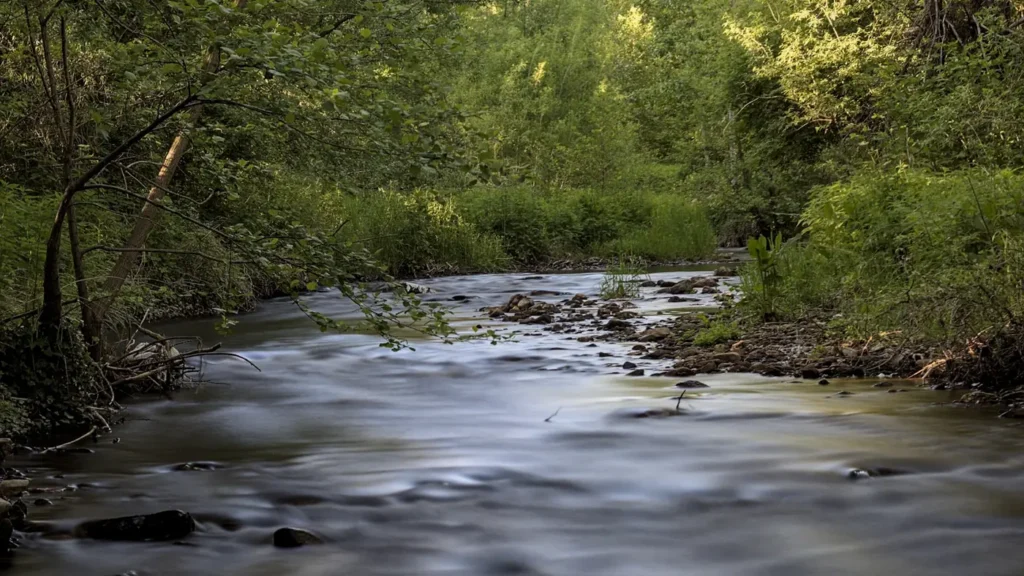
The photo at the top of this page is not Baron Fork.
It is a regional stand-in, honestly captioned but generic — we will not put a name to a river we cannot prove. Send us a photograph you took here and it replaces the stand-in, with your credit on it.
Add a photo of this water
Landscape, not fish — the water itself. Reviewed by hand before it appears. The first one published here earns the Pioneer badge.
Fished this water? Add a photo
Reviewed by hand before it appears. Pick the water, not the spot — we never publish exact locations.
Access
Eldon - the gauge reach and the most commonly used access point on the creek.
Illinois River confluence - the downstream junction, where the creek meets the state's best known float river.
Peavine - the upstream community, with county road access toward the Arkansas line.
County road crossings - the main legal public entry points along the corridor, used by most wading anglers.
Tahlequah - the nearest town, for licences, supplies, outfitters and float arrangements on the Illinois.
Illinois River State Park areas - the managed public access along the main river, the usual base for fishing the lower creek.
Arkansas state line - the upstream boundary, worth watching because storms there drive the flash flooding here.
Seasons
Spring: high and fast with Ozark storms, with the creek unfishable at the peaks but excellent for smallmouth in the windows between them.
Summer: the main season, running low, clear and cool enough to wade comfortably, with smallmouth and sunfish active through the riffles.
Fall: the best weeks, with stable low flows, cooling water, good clarity and smallmouth feeding hard before winter.
Winter: low and cold with the fish holding in the deepest pools, slow but fishable on mild days for smallmouth and rock bass.
From the water
No logged trips yet. Be the first to put this water on your map.
Log this water
Fished it or cleaned it? Log in or create a free account to log a trip with photos and earn the waterway badge.
Questions
What is the current flow on the Baron Fork?
As of Nov 2, 7:30 am, the USGS gauge Baron Fork at Eldon, OK reads 40 cfs. Conditions update every 15 minutes.
What species can you catch on the Baron Fork?
Anglers target Black Crappie, Channel Catfish, Flathead Catfish, Green Sunfish, Largemouth Bass, Longear Sunfish, Rock Bass, Smallmouth Bass, Spotted Bass, White Sucker on the Baron Fork in Oklahoma.
Where can you access the Baron Fork?
Eldon - the gauge reach and the most commonly used access point on the creek. Illinois River confluence - the downstream junction, where the creek meets the state's best known float river. Peavine - the upstream community, with county road access toward the Arkansas line. County road crossings - the main legal public entry points along the corridor, used by most wading anglers. Tahlequah - the nearest town, for licences, supplies, outfitters and float arrangements on the Illinois. Illinois River State Park areas - the managed public access along the main river, the usual base for fishing the l...
When is the best time to fish the Baron Fork?
Spring: high and fast with Ozark storms, with the creek unfishable at the peaks but excellent for smallmouth in the windows between them. Summer: the main season, running low, clear and cool enough to wade comfortably, with smallmouth and sunfish active through the riffles. Fall: the best weeks, with stable low flows, cooling water, good clarity and smallmouth feeding hard before winter. Winter: low and cold with the fish holding in the deepest pools, slow but fishable on mild days for smallmouth and rock bass.
Where are the fishing regulations for the Baron Fork?
Regulations change by season and section. Read the current rules on the Oklahoma agency site: https://www.wildlifedepartment.com/fishing/regulations