Burbot
Lota lota
The only cod that lives in fresh water, the only northern freshwater fish that spawns under the ice in midwinter, and one whose liver is both its lipid store and the first tissue to fail when the water warms.
Identification
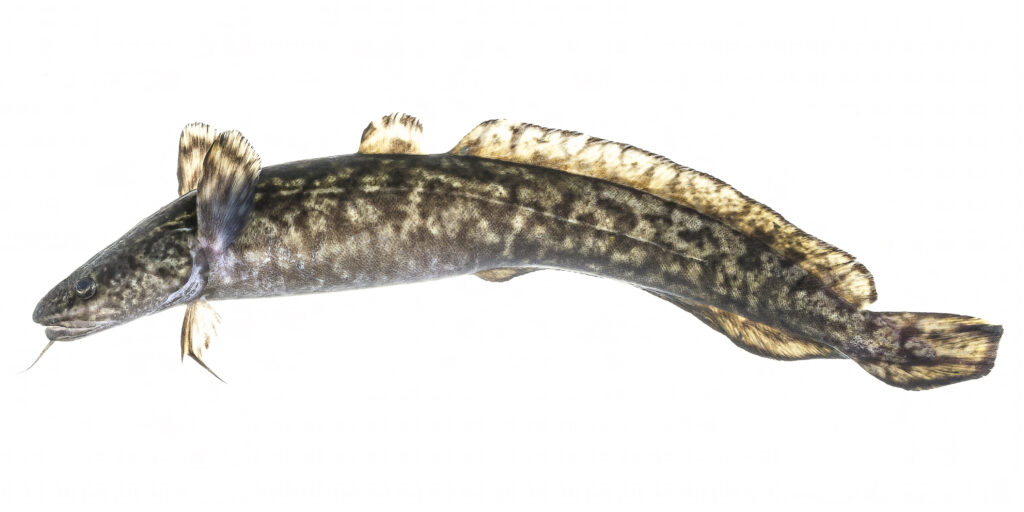
Burbot are unmistakable and consistently misidentified, usually as something a person has caught by mistake. ADF&G describes a thin, elongated body that tapers to a point near the tail, with dorsal and anal fins running from the middle of the body almost to the tail and a rounded caudal fin. The skin is mottled olive-black or brown interspersed with yellow patches, and looks scaleless — the scales are there, but they are small to the point of being almost microscopic. Beneath the lower jaw sits a single barbel, the chin whisker that is the fastest field mark.
Alaska Fish and Wildlife News put the impression well: burbot look as though they combine a wolf-eel, a catfish and a bowfin — a fierce head, a flattened skull, one chin barbel and a long uninterrupted dorsal fin (Sisinyak 2005). Minnesota’s Department of Natural Resources describes the same fish as looking “like a cross between an eel and a catfish,” with smooth skin and a habit of coiling around an angler’s arm.
What it actually is, is a cod. Burbot are the only freshwater representative of the cod lineage in North America — the one gadid that never goes to sea. ADF&G places the species in the family Gadidae with the marine cods; most current classifications place burbot and its relatives in Lotidae, a separate family within the same order. Both usages are in print and both refer to the same fish and the same relationship. The point that matters biologically is not which family name is used but that this is a cod living in rivers and lakes, with a cod’s body plan, a cod’s liver, and a cod’s cold-water physiology.
Range and distribution
Burbot are circumpolar, occurring in fresh waters throughout North America, Europe and Asia and extending south to about 40 degrees north latitude. In Alaska they occupy most large clear and glacial rivers and many lakes and are absent from Southeast Alaska. The largest Alaskan fisheries are in the Tanana River drainage and in the upper Copper and upper Susitna lake systems (ADF&G). In the Tanana drainage burbot are one of the species making up the multi-species fishery of the lower Chena River alongside Chinook salmon and northern pike (ADF&G Fishery Management Report 25-33).
Within a river they are habitat specialists in a way that surprises anglers. Burbot hold in slow-moving water and backwater eddies, and depth is not required: “two feet of water is deep enough to be home to large burbot.” In lakes they go deep. In both cases they are on or very near the bottom.
Habitat and water temperature
Burbot are the coldest-water specialists among common North American freshwater fish, and the numbers are unusually sharp. Peer-reviewed work published in 2025 describes burbot as “the only cold stenothermal member of the Gadidae family,” selecting warmer temperatures of only 10–12°C (50–54°F) outside the spawning season, while normal spawning and high larval hatch rates occur at about 2°C (36°F), often under ice (Ma et al. 2025, Antioxidants).
The same study quantifies what happens above that. Wild female burbot taken in winter and held for 96 hours at 2, 7, 12, 17 and 22°C showed a clear progression. At 7°C (45°F) there was no mortality, but fat vacuoles appeared in liver tissue and antioxidant enzymes ran at maximum activity — the fish were already working to compensate. At 12°C (54°F) oxidative stress damage, inflammatory response and cell death were first observed. At 17°C (63°F) mortality reached 15 percent, with liver structural damage, nuclear hypertrophy and hepatocyte necrosis. At 22°C (72°F) mortality reached 67 percent, antioxidant defences collapsed, and gut microbial community structure was dramatically altered.
That progression should be read for what it is: an acute exposure experiment on winter-acclimated fish, which describes how quickly burbot fail when water warms suddenly rather than what a summer-acclimated southern population tolerates. Burbot in temperate lakes do experience warmer surface water seasonally and respond by retreating to depth and becoming largely inactive. But the direction of the finding is not in doubt, and the reproductive window is narrower still — the roe incubation temperature range is described as “extremely narrow (1.8–3.0°C),” and breeding migration and spawning are completed at 1.9–3.3°C.
For Alaskan rivers, the state’s water quality criteria for fresh waters supporting fish growth and propagation cap such waters at 20°C (68°F) at any time, with 13°C (55°F) for spawning areas and egg and fry incubation (18 AAC 70). For burbot, even the general criterion sits well above the range in which the species has been shown to sustain tissue damage.
Life history
Burbot invert the northern spawning calendar. They spawn under the ice in late winter — February to March in Alaska, when ice cover is at or near its thickest. Spawning is a broadcast event, and observers describe the fish forming a large writhing, twisting ball over gravelly substrate, releasing eggs and milt into the water column rather than constructing any nest. Eggs are roughly 1 mm across, and a large female can produce over a million of them.
Timing varies between populations in ways that matter. In the lower Kootenai River, spawning “commences in late January and continues through early February and lasts for only 2 to 3 weeks,” at least a month earlier than other burbot populations within the same basin, and under natural pre-dam conditions it occurred under ice at temperatures near or below 1°C (34°F) (USFWS 2003).
Growth is slow and life is long. It takes an Alaskan burbot five to seven years to reach 18 inches, which is about the size of first spawning, and ADF&G places sexual maturity at ages six to seven. Fish over 20 years old are commonplace in Alaska. USFWS gives a maximum of about 8 kg (17.6 pounds) and a life expectancy up to 20 years, with males maturing at 3 to 4 years and females at 4 to 5 — figures that do not sit comfortably beside the Alaska state record of 24 pounds 12 ounces or ADF&G’s statement about routine 20-year-old fish. The likeliest explanation is regional variation in growth and longevity across an enormous circumpolar range, but the accounts do disagree and should be read as such.
Diet
Young burbot feed on insects and other invertebrates. By ages five and six they have become, in ADF&G’s phrase, “voracious predators, feeding mostly at night,” and by then the diet is almost exclusively fish: whitefish, sculpins, lampreys and other burbot, with the occasional small mammal. The species is a nocturnal ambush and search predator working the bottom, and its chin barbel is a sensory organ suited to finding prey in darkness and turbid water.
The cannibalism is not incidental. In systems where burbot are abundant, adult burbot are a significant predator on juvenile burbot, and this shapes the ontogenetic habitat shift — young fish occupy different water than adults partly to avoid being eaten by them.
The liver
The burbot’s liver is the organ that explains both its culinary reputation and its physiology. Like marine cods, burbot store lipid in the liver rather than in muscle, which is why the flesh is lean, white and flaky while the liver is large and oil-rich. It is also why the liver is the tissue that fails first under thermal stress: the 2025 heat-exposure study used liver histology as its principal measure of damage, and found fat vacuoles appearing in liver tissue at only 7°C above the fish’s winter baseline, progressing to hepatocyte necrosis at 17°C.
The lean flesh has given the fish its enduring nickname. As Alaska Fish and Wildlife News describes it, “when boiled and dipped in garlic butter, burbot tastes and feels like lobster” — hence the poor man’s lobster of the Tanana valley. Claims commonly repeated about burbot liver oil’s vitamin content are not something I could source to a primary agency or peer-reviewed publication, and this article does not repeat them.
Angling
Burbot fishing is a night and winter pursuit, because that is when burbot feed and move. ADF&G’s account of the Tanana valley fishery notes that burbot feed at night with best success between 10 p.m. and 6 a.m., that anglers work eddies and slack water, and that both jigging and setlining are effective. Burbot fishing in the Tanana picks up as temperatures cool.
Subsistence use is poorly documented. ADF&G states that “little is known of the burbot subsistence fisheries located throughout the state” and that most subsistence catches appear to be incidental, though “the practice of constructing wire mesh traps to capture migrating burbot during the winter is still used in some places.” Sport harvest is modest by Alaskan standards — statewide harvest averaged about 5,600 fish across 2002 to 2011.
ADF&G’s research history on the species is itself informative about how burbot are managed. Rigorous stock assessment using baited hoop traps ran from the late 1980s into the early 2000s, concentrated around the Glennallen and Paxson area, prompted by the recognition that overharvest likely took place in many lakes in the 1970s and 1980s. Research has since decreased because existing management appears to be holding harvest at sustainable levels (ADF&G). A slow-growing fish that takes six or seven years to spawn for the first time and lives past twenty is exactly the kind of stock that can be fished down faster than anyone notices.
Conservation
Burbot carry no Endangered Species Act listing, and across most of their circumpolar range they are secure. The exception is instructive.
The lower Kootenai River population in Idaho declined sharply from around 1960, was stable into the early 1970s, and then, “within only a few years, a dramatic decline in the burbot population was documented.” The fishery closed in the early 1990s. Based on data collected from autumn 1995 through spring 2000, USFWS reported that “the population is estimated to consist of roughly 540 adults.” In March 2003 the Service found that listing was not warranted — not because the population was healthy, but because “the petitioned entity is not a distinct population segment,” a determination about the boundaries of the listable unit rather than about the fish’s condition. That finding followed a 2001 90-day finding that the petition presented substantial information indicating listing may be warranted.
The Kootenai case is the clearest illustration of what threatens burbot generally. A fish that spawns under ice at temperatures near or below 1°C, whose eggs incubate within a range of barely more than one degree, and which begins sustaining measurable tissue damage a dozen degrees above that, is a fish with almost no thermal room. Any change that warms a river in winter, shifts the timing of ice cover, or alters the flow regime during a two-to-three-week midwinter spawning window acts directly on the narrowest part of its life history. Burbot are enormously hardy fish — they live in glacial rivers, feed under ice, and survive to twenty-five in water most fish cannot use. They are not hardy against warming, and the margin they have is smaller than that of almost any salmonid sharing their water.
Where to catch it
11 waterways on GuidedFloats list burbot, across 6 states. Each page carries live gauge readings, access notes, and the guides who fish it.
Alaska 2
- Chena River2,500 cfs
- Chena River below Moose Creek Dam1,880 cfs
Idaho 1
- Kootenai River4,380 cfs
Maine 3
- Allagash River566 cfs
- Aroostook River191 cfs
- Fish River128 cfs
Minnesota 2
Montana 2
- Hungry Horse Reservoir
- Jefferson River1,050 cfs
Washington 1
References
- Burbot Species Profile — Alaska Department of Fish and Game
- Burbot — Wildlife Notebook Series — Alaska Department of Fish and Game
- The Poor Man's Lobster of the Tanana Valley — Nancy Sisinyak, Alaska Fish and Wildlife News, Alaska Department of Fish and Game, April 2005
- Burbot — Research — Alaska Department of Fish and Game
- Burbot — Uses — Alaska Department of Fish and Game
- Endangered and Threatened Wildlife and Plants; 12-month Finding for a Petition To List the Lower Kootenai River Burbot (Lota lota) — U.S. Fish and Wildlife Service, 68 FR, 11 March 2003, via GovInfo
- Combined Impacts of Acute Heat Stress on the Histology, Antioxidant Activity, Immunity, and Intestinal Microbiota of Wild Female Burbot (Lota lota) in Winter — Ma et al., Antioxidants 14(8):947, 2025
- Burbot (Lota lota) — U.S. Fish and Wildlife Service
- Burbot — Minnesota Department of Natural Resources
- Fishery Management Report for Recreational Fisheries in the Tanana River Management Area (FMR 25-33) — Alaska Department of Fish and Game
- Alaska Water Quality Standards, 18 AAC 70 — Alaska Department of Environmental Conservation
- IGFA World Records — International Game Fish Association