Paddlefish
Polyodon spathula
A filter-feeding survivor that navigates by electricity, cannot be caught on bait, and in most reservoirs exists only because hatcheries keep stocking it.
Not a sturgeon, but close kin
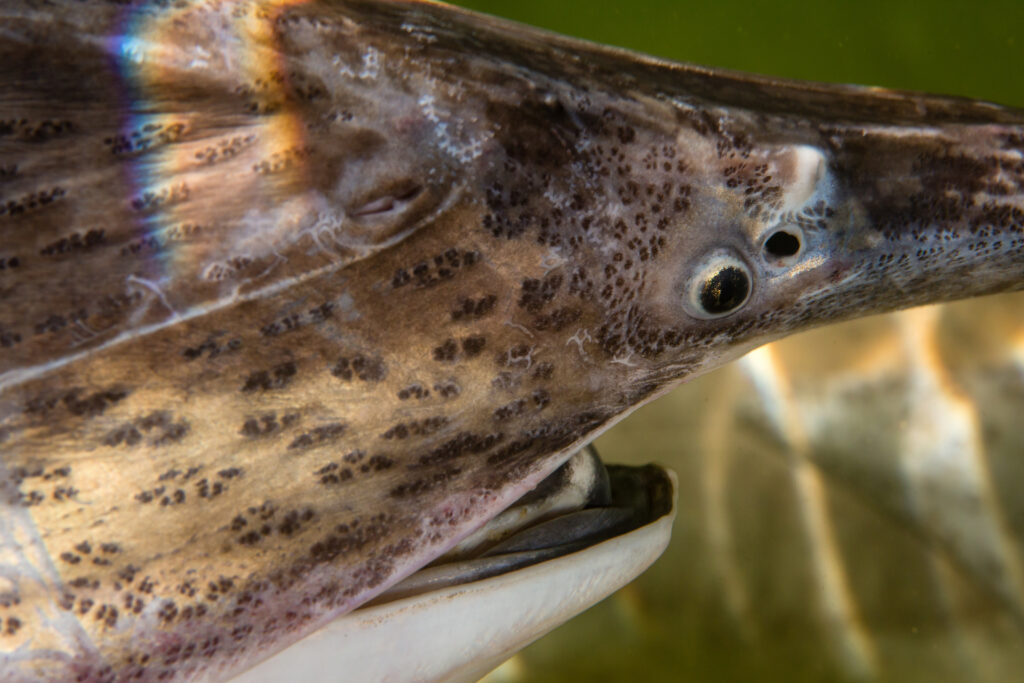
Paddlefish are the only surviving member of their family in North America, and one of just two paddlefish species that existed worldwide in modern times. They sit alongside the sturgeons in the order Acipenseriformes and share the deep structural traits of that group: a skeleton built largely of cartilage, a shark-like heterocercal tail with an extended upper lobe, and an ancient body plan that predates most of the fish fauna around them.
Where they diverge from sturgeon is instructive. Paddlefish have smooth scaleless skin and broad shark-like tails, without the five rows of heavy bony scutes that armour a sturgeon; ganoid scales are retained only on parts of the tail. And instead of a sturgeon’s short barbelled snout and protrusible sucking mouth, a paddlefish carries an enormous flattened rostrum ahead of a wide, gaping, permanently open mouth. The Fish and Wildlife Service notes the paddle can reach up to 1/3 total body length, and that it distinguishes paddlefish from every other North American freshwater fish.
What the paddle is actually for
For most of the twentieth century the rostrum was assumed to be a digging tool, a stabiliser, or a hydrodynamic plane. It is none of those. It is a sensory antenna.
The rostrum is covered in tens of thousands of ampullary electroreceptors — the same class of organ as the sturgeon’s ampullae of Lorenzini — and it functions to detect the minute electrical fields generated by zooplankton. This was demonstrated directly by Wilkens, Russell, Pei and Gurgens in Proceedings of the Royal Society B, in a paper titled, without ambiguity, “The paddlefish rostrum functions as an electrosensory antenna in plankton feeding.” Wilkens and Hofmann later reviewed the adaptation in BioScience as “a novel adaptation for plankton feeding.”
The Missouri Department of Conservation states the function plainly: the paddlefish’s paddle (rostrum) apparently functions as an electrosensory organ, allowing it to sense the presence of plankton. A paddlefish swimming through turbid water is effectively sweeping an electrical antenna ahead of itself, detecting concentrations of individually invisible prey and steering into them.
Filter feeding — and why paddlefish cannot be caught on bait
Paddlefish feed by filtration. MDC describes them swimming slowly through water with their mouths wide open, collecting tiny crustaceans and insects in their elaborate, closely set gill rakers. Oklahoma’s agency describes the same mechanism — toothbrush-like bristles in their gills and wide gaping mouths — and the Fish and Wildlife Service puts it most simply: they only eat plankton… They eat by simply swimming around with their mouth open.
This has a direct and frequently misunderstood consequence. A paddlefish does not pursue, strike, or ingest individual prey items. It has no functional interest in a baited hook, a lure, or a cut bait, and no behavioural mechanism for taking one. The fish is physically incapable of being caught by conventional hook-and-line angling in the way a catfish or a bass is.
That is why paddlefish fisheries, where they exist, are snagging fisheries — the fish is taken by hooking it externally rather than by inducing it to bite. This is a statement of biology, not of technique or law: it follows directly from the feeding anatomy. The rules governing where, when and how paddlefish may be taken vary considerably between states and waters, and this site links to those regulations rather than restating them.
Size, age and maturity
Paddlefish grow large. The Fish and Wildlife Service records that they can grow up to 7 feet long and can weigh almost 200 pounds; MDC reports lengths near 7 feet with weights exceeding 160 pounds. Growth is rapid early — MDC notes first-year fish reaching 10–14 inches, and roughly 60 inches by age 17.
Longevity estimates vary by source and by population. MDC gives 30 years and more; the Fish and Wildlife Service notes that some reports say some specimens have lived for 50 years or longer, and Oklahoma’s agency gives up to 50 years. Maturity is late: Oklahoma reports males maturing at 4–9 years and females at 6–12 years, and mature females do not spawn every year.
The result is the familiar Acipenseriform pattern in compressed form. A paddlefish population’s reproductive output is concentrated in older fish that spawn intermittently, and it cannot rebuild quickly from depletion. That is the fundamental reason these fisheries are managed as tightly as they are.
Spawning depends on a flood
Paddlefish spawning is one of the clearest cases in North American fish ecology of reproduction being tied to a river’s natural hydrograph. Oklahoma describes spawning from March through June, when spring rains raise the water levels of rivers and water temperatures reach 50–60 degrees, with males and females gathering in schools and broadcasting eggs over gravel or sandbars. MDC describes reproduction in late spring at times of high water, with eggs deposited on silt-free gravel bars.
Three conditions must coincide: a rising river, the right temperature, and clean coarse substrate that is normally dry or shallow and is only inundated during the rise. Remove any one and spawning does not happen — or happens and fails. Because the gravel must be silt-free, sedimentation alone can disable a spawning bar that is otherwise physically intact.
Dams and the collapse of natural reproduction
This is where paddlefish became a management species. MDC states the mechanism directly: dams prevent paddlefish from being able to move upstream to their spawning territories, which prevents them from reproducing on their own.
Two things happen at once. A dam blocks the migration to the gravel bars, and the reservoir behind it drowns those bars under still, depositional water while the regulated flow downstream flattens the spring rise that would have cued the run. The fish survive — reservoirs are productive plankton habitat and paddlefish grow well in them — but they stop reproducing. MDC’s conclusion is blunt: populations in impoundments are not self-sustaining and must be stocked, relying on artificial propagation to persist.
The Missouri and Osage restoration
Missouri’s Osage River system is the best-documented case of this whole sequence, and the longest-running response to it. The paddlefish fishery of the Osage River and Lake of the Ozarks was described by Purkett in Transactions of the American Fisheries Society in 1963 — a baseline account of the fishery as it existed after Bagnell Dam created Lake of the Ozarks but before further impoundment upstream.
Impoundment of the upper Osage at Harry S. Truman Dam removed access to remaining spawning habitat, and Missouri’s response was a sustained hatchery programme: paddlefish are propagated and stocked to maintain populations that no longer reproduce sufficiently on their own. That programme is why paddlefish still exist in numbers in these waters at all.
The picture is not entirely one-way, and recent work has complicated it usefully. Schwinghamer and colleagues, using ultrasonic telemetry and egg mats in Harry S. Truman Reservoir, found that although the population is supplemented by stocking, spring aggregations formed in the riverine portion of the Osage River, migratory behaviour tracked water temperature and gauge height, and embryos and larvae were collected in 2015 and 2016 near those aggregations — evidence of spawning in a system where it had never previously been documented. Factors affecting reproductive success in the lower Osage have been examined by Lallaman.
Comparable programmes operate elsewhere in the range. Oklahoma began restoration in 1992, releasing hatchery-raised juveniles into state lakes and banding thousands of paddlefish to study abundance and growth. On the Missouri River mainstem, Glassic and colleagues assessed survival and abundance of the Fort Peck paddlefish population, and juvenile behaviour in a mainstem reservoir was described by Roush and colleagues.
Caviar, CITES and market pressure
Paddlefish roe is marketed as caviar, and the species has been drawn into the same global market that emptied the Caspian. The Fish and Wildlife Service documented the supply collapse behind that pressure — international sturgeon catch declined from the record peak of 32,078 metric tons in 1978 to 2,658 metric tons in 2000, with CITES quotas further constraining supply and raising prices.
Paddlefish are consequently covered by international trade controls alongside the sturgeons. The Service states that CITES requires CITES documents for international trade of all sturgeon and paddlefish regardless of whether the species are captive-bred, and federal CITES rulemaking treats sturgeon caviar as including the processed roe of any species of sturgeon or paddlefish. A high-value product taken from a slow-maturing fish that only reproduces during floods is a durable management problem, and it is the reason paddlefish roe is tracked as closely as it is.
Status and the fish anglers meet
Paddlefish are not listed under the Endangered Species Act. Their status is nonetheless a conservation story rather than a stable one: the Fish and Wildlife Service records the species as extirpated from the Great Lakes basin, and across much of the remainder of the range the fish present are there because agencies keep putting them there.
For anyone encountering a paddlefish, the natural history worth carrying is this: it is a plankton feeder that finds its food electrically, it grew large by filtering microscopic animals out of turbid water for decades, it probably cannot reproduce in the water it was caught in, and it is likely descended from a hatchery. Males develop sandpapery breeding tubercles on the head and back during the spawning season — one of the few external signs of reproductive condition on an otherwise featureless fish. Regulations governing paddlefish differ sharply between states and waters, and this site links to them rather than restating them.
Where to catch it
5 waterways on GuidedFloats list paddlefish, across 4 states. Each page carries live gauge readings, access notes, and the guides who fish it.
Mississippi 1
- Tombigbee River232 cfs
North Dakota 1
- Missouri River (North Dakota)13,100 cfs
Oklahoma 2
South Dakota 1
References
- Paddlefish (Polyodon spathula) species profile — U.S. Fish and Wildlife Service
- Paddlefish — field guide — Missouri Department of Conservation
- Paddlefish — species profile — Oklahoma Department of Wildlife Conservation
- The paddlefish rostrum functions as an electrosensory antenna in plankton feeding — Wilkens, Russell, Pei & Gurgens, Proceedings of the Royal Society B 264:1723-1729
- The Paddlefish Rostrum as an Electrosensory Organ: A Novel Adaptation for Plankton Feeding — Wilkens & Hofmann, BioScience 57:399-407
- The Paddlefish Fishery of the Osage River and the Lake of the Ozarks, Missouri — Purkett, Transactions of the American Fisheries Society 92:239-244
- Using Ultrasonic Telemetry to Evaluate Paddlefish Spawning Behavior in Harry S. Truman Reservoir, Missouri — Schwinghamer et al., North American Journal of Fisheries Management
- Factors affecting paddlefish reproductive success in the lower Osage River — Lallaman, University of Missouri
- Fort Peck paddlefish population survival and abundance in the Missouri River — Glassic et al., Journal of Applied Ichthyology
- Distribution and Movement of Juvenile Paddlefish in a Mainstem Missouri River Reservoir — Roush et al., Journal of Freshwater Ecology
- Spawning Activity of Paddlefish (Polyodon spathula) in the Lower Black River, Wisconsin — Jennings & Zigler, Journal of Freshwater Ecology
- Importation, Exportation and Transportation of Wildlife — CITES documents required for all sturgeon and paddlefish — U.S. Fish and Wildlife Service / Federal Register
- Revision of Regulations Implementing CITES (definition of sturgeon caviar including paddlefish roe) — U.S. Fish and Wildlife Service / Federal Register
- Threatened Status for Shovelnose Sturgeon Under the Similarity of Appearance Provisions (world sturgeon catch and caviar market data) — U.S. Fish and Wildlife Service / Federal Register
- IGFA World Records — International Game Fish Association