White Sturgeon
Acipenser transmontanus
North America's largest freshwater fish, with an authenticated 1,387-pound record — and two populations now under federal protection or awaiting it.
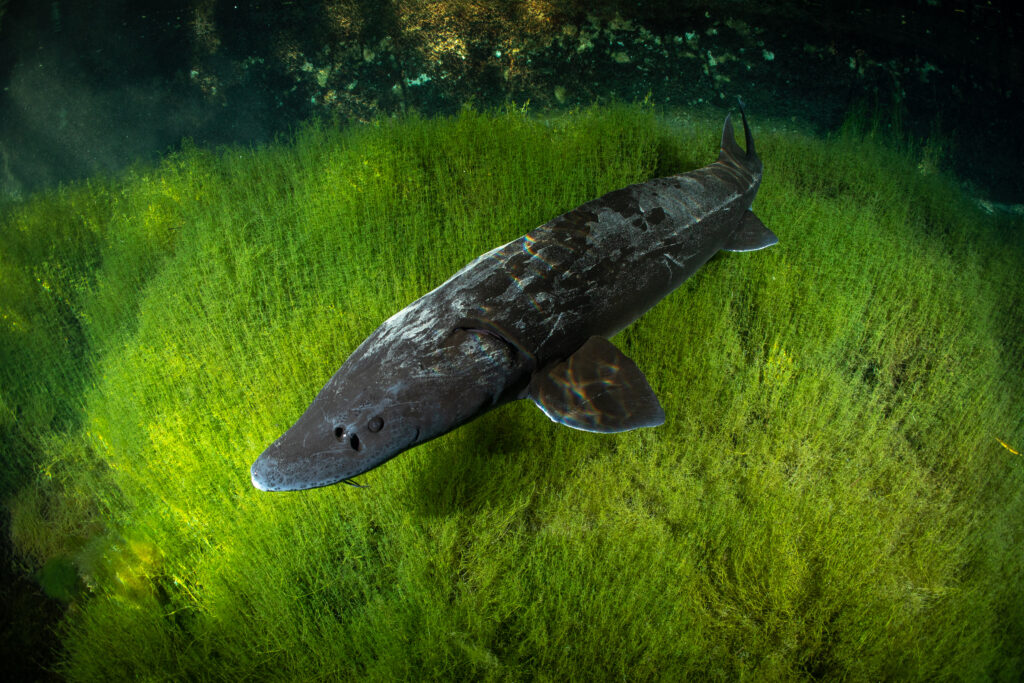
The largest freshwater fish on the continent
White sturgeon are the biggest freshwater fish in North America, and the scale is not a matter of angling folklore. The U.S. Fish and Wildlife Service, in the rule listing the Kootenai River population, records that the largest authenticated white sturgeon weighed 630 kg (1,387 lbs) and was taken from the Fraser River in 1897. The Washington Department of Fish and Wildlife describes fish that grow to more than 10 feet in length and weigh hundreds of pounds, with some individuals living to be 100 years or older.
Structurally they are built like the rest of the family: a cartilaginous skeleton, a shark-like upturned tail, five rows of bony scutes along a scaleless body, four barbels beneath a long snout, and a protrusible toothless mouth that extends downward to draw prey off the bottom. The snout carries dense fields of ampullary electroreceptors, the sturgeon version of the ampullae of Lorenzini described morphologically for the family by Jørgensen, which let the fish detect buried prey electrically in turbid water where sight is useless.
Range and movement
White sturgeon range along the Pacific slope from Alaska to central California. Washington’s agency describes the species as amphidromous, meaning they can travel between freshwater and saltwater but it’s not a requirement to complete their life cycle, and identifies three primary spawning populations that retain access to the marine environment: the Fraser, the Columbia and the Sacramento–San Joaquin.
That distinction matters enormously. Populations with an intact route to the estuary and sea have access to far more productive feeding habitat and to demographic exchange with neighbouring reaches. Populations trapped between dams do not. The Columbia and Snake systems now hold a series of impounded sturgeon populations, each confined to a reservoir, and Washington notes that loss of spawning habitat and reduced recruitment are of particular concern for impounded portions of the Columbia River.
Age, maturity and the arithmetic of slow fish
White sturgeon are extraordinarily long-lived and correspondingly slow to reproduce. The Fish and Wildlife Service’s 2026 finding for the San Francisco Estuary population records that white sturgeon can exceed 100 years of age, with an average age at first reproduction of about 14 years. Washington’s figures for the lower Columbia are later still — sexual maturity at roughly 6 feet, or around 25 years old, within a general range of 15–25 years.
Mature fish then spawn intermittently. WDFW reports that females spawn every 4–6 years, while males spawn every 2–3 years; the 1994 Kootenai listing rule cites spawning intervals for sturgeon of two to eleven years. A female white sturgeon may spawn a dozen times or fewer across a century.
The consequence is that white sturgeon populations respond to pressure on a delay measured in decades, and recover on the same timescale. A year class lost to a dry spring or a warm summer does not show up as missing adults for fifteen to twenty-five years, by which point the cause is history and the deficit is locked in.
Spawning and the thermal window
Spawning is flow-driven. The 2026 federal finding describes spawning in March in the Sacramento River within a broader February-through-June window, keyed to spring outflow — the Service notes a flow benchmark where March–July outflow exceeds 37,000 cubic feet per second — and requiring gravel or coarser substrate for egg and larval survival.
The thermal requirements are narrow at the vulnerable stages. The Service identifies suitable temperatures as below 20°C (68°F), with incubation and early rearing concentrating around 13.5–16°C, and describes waters that occasionally exceed lethal temperatures (20°C; 68°F). Peer-reviewed work has tied these variables together directly, relating river discharge and water temperature to the recruitment of age-0 white sturgeon. Reproductive condition in wild Columbia River fish has been characterised by Fitzpatrick and colleagues.
Because flow regulation moves both discharge and temperature, dams affect spawning twice over — by removing the hydrograph that cues and supports spawning, and by shifting the thermal regime that determines whether the resulting eggs and larvae survive.
The Kootenai River population: an endangered listing
The Kootenai River white sturgeon are the clearest illustration of what happens when the flow regime is rewritten. The Fish and Wildlife Service determined endangered status for this population on 6 September 1994, effective 6 October 1994. The population occupies roughly 270 river kilometres (168 miles) from Kootenai Falls, Montana, downstream through Kootenay Lake to Cora Linn Dam, split between Idaho, Montana and British Columbia.
The mechanism is set out in the rule. Since 1972, when Libby Dam began regulating flows, spring flows in the Kootenai River have been reduced an average 50 percent, and winter flows have increased by 300 percent. The spring freshet that cued and supported spawning was flattened. The Service found an almost complete lack of recruitment of juveniles into the population since 1974.
The population estimates in the listing rule trace the decline: 1,194 fish in 1982 (range 907–1,503), approximately 880 by 1990, and an estimated 785 individuals (range 569–1,080) by 1993. The Service’s current species profile gives a different and larger baseline — a decline from approximately 7,000 white sturgeon in the late 1970s to 760 fish in 2000 — which does not reconcile straightforwardly with the 1982 estimate in the listing rule. The two figures come from different assessment methods and eras and should be read as such rather than combined. What both agree on is the recruitment failure: the Service reports that during 14 years of intensive monitoring, only one hatching embryo was found and no free-swimming larvae or young-of-the-year were captured.
The San Francisco Estuary population: a 2026 candidate
The most significant recent development for this species is at the southern end of its range. On 21 July 2026 the Fish and Wildlife Service published a 12-month finding on a petition — filed 6 December 2023 by San Francisco Baykeeper, The Bay Institute, Restore the Delta and the California Sportfishing Restoration Alliance — to list the San Francisco Estuary distinct population segment as threatened.
The Service found that listing is warranted but precluded by higher priority actions. That is not a rejection. It is a determination that the population qualifies for protection but that the Service’s listing workload defers the proposed rule; the population becomes a candidate species in the meantime, and the Service assigned the 12-month finding for the SFE white sturgeon to bin 3. The status is reviewed annually until a proposed rule issues or the finding changes.
The underlying findings are stark. The Service reports that recent population growth estimates suggest population growth is below replacement level (<1), and that under current conditions the population would likely continue to decline, against a backdrop of general decline since the 1980s. Flow regulation has reduced the spring flows that cue spawning and affected coarse substrate availability during egg incubation. Climate projections point to more precipitation falling as rain rather than snow, disrupting the historical timing of those cues.
Two threats are worth singling out. First, a harmful algal bloom: the Service records that the 2022 Heterosigma akashiwo bloom caused unprecedented adult SFE sturgeon mortality, and that more than half of the adult population resided in the affected region. A single event of that kind can remove decades of accumulated reproductive capacity from a slow-maturing population. Second, poaching — the Service notes that poaching remains an ongoing, unquantified threat due to the high value of sturgeon caviar.
Caviar and the persistence of market pressure
The caviar economy that emptied North American sturgeon rivers in the nineteenth century has never fully gone away; it has relocated in response to supply. The Fish and Wildlife Service, documenting the collapse of Caspian supply, records that international sturgeon catch declined from the record peak of 32,078 metric tons in 1978 to 2,658 metric tons in 2000, with CITES quotas further constraining supply and raising prices. That price pressure is what makes illegal take of a slow-reproducing fish economically attractive, and it is why the 2026 finding treats poaching as a live threat rather than a historical one. International trade in sturgeon products is controlled: CITES documents are required for international trade of all sturgeon and paddlefish regardless of whether the species are captive-bred.
The fish as anglers encounter it
White sturgeon support some of the most closely managed fisheries in North America, and the rules differ by river, reach and population; this site links to them rather than restating them. The relevant natural history is that these are deep-holding, bottom-feeding fish that locate food electrically and by scent in turbid, often heavily modified water, and that the largest individuals in any reach are typically its oldest and most reproductively valuable.
A mature white sturgeon is a structural problem as much as a biological one when handled. It is long, heavy, and supported by cartilage rather than bone, and it evolved to be supported by water along its entire length. Contemporary handling practice in sturgeon fisheries reflects that reality, and reflects the recognition that in populations recruiting below replacement, adult survival is the variable that matters most.
Where to catch it
6 waterways on GuidedFloats list white sturgeon, across 3 states. Each page carries live gauge readings, access notes, and the guides who fish it.
California 2
Idaho 2
Oregon 2
- Columbia River74,000 cfs
- Willamette River6,730 cfs
References
- 12-Month Finding for the San Francisco Estuary Distinct Population Segment of White Sturgeon — U.S. Fish and Wildlife Service / Federal Register
- 12-Month Finding for the San Francisco Estuary DPS of White Sturgeon — full text — U.S. Government Publishing Office (govinfo)
- Determination of Endangered Status for the Kootenai River Population of the White Sturgeon — U.S. Fish and Wildlife Service / Federal Register
- Kootenai River White Sturgeon endangered listing — full rule text — U.S. Government Publishing Office (govinfo)
- White Sturgeon (Acipenser transmontanus) species profile — U.S. Fish and Wildlife Service
- White Sturgeon (Acipenser transmontanus) — Washington Department of Fish and Wildlife
- Relating river discharge and water temperature to the recruitment of age-0 White Sturgeon — Counihan et al., Journal of Applied Ichthyology
- Reproductive Physiology of Wild White Sturgeon from the Columbia River — Fitzpatrick et al., Journal of Applied Ichthyology
- Columbia River White Sturgeon (Acipenser transmontanus), 1985-1986 Progress Report — Brannon et al., U.S. Department of Energy / Bonneville Power Administration
- The Morphology of the Lorenzinian Ampullae of the Sturgeon Acipenser ruthenus — Jørgensen, Acta Zoologica
- Threatened Status for Shovelnose Sturgeon Under the Similarity of Appearance Provisions (world sturgeon catch and caviar market data) — U.S. Fish and Wildlife Service / Federal Register
- Importation, Exportation and Transportation of Wildlife — CITES documents required for all sturgeon and paddlefish — U.S. Fish and Wildlife Service / Federal Register
- IGFA World Records — International Game Fish Association