Shovelnose Sturgeon
Scaphirhynchus platorynchus
The most abundant sturgeon in North America, federally treated as threatened not because it is rare but because it cannot reliably be told apart from the endangered pallid sturgeon.
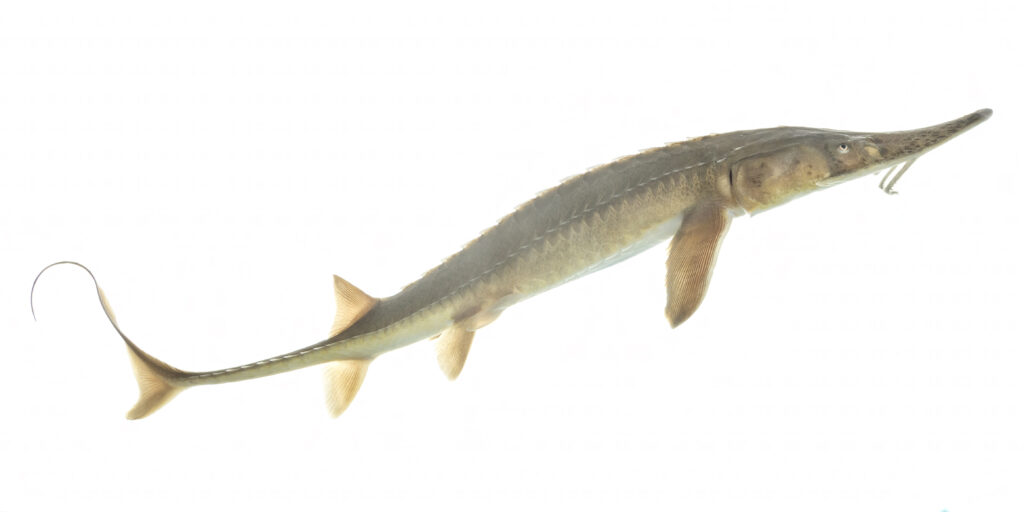
A common fish with an unusual legal status
Shovelnose sturgeon are the smallest and by a wide margin the most abundant sturgeon in North America. They are not, in the ordinary sense, an imperilled species: Keenlyne’s life-history review describes populations considered stable across the upper Mississippi, lower Missouri, Red and Atchafalaya river systems, distributed across 24 states.
Yet since 2010 the shovelnose sturgeon has been treated as a threatened species under the Endangered Species Act across a large part of its range. The reason has nothing to do with its own abundance. It is listed because of what it looks like — and specifically because it cannot reliably be distinguished, in the field, from the endangered pallid sturgeon. This is one of the few applications of a rarely used provision of the Act, and it is worth understanding properly, because it is routinely misreported as a finding that shovelnose sturgeon are in trouble.
How “similarity of appearance” works
Section 4(e) of the Endangered Species Act allows the Secretary of the Interior to treat a species as endangered or threatened even though it is not itself listed. The Fish and Wildlife Service’s 2010 rule states the authority directly: Section 4(e) of the Act and implementing regulations authorize the Secretary of the Interior to treat a species as an endangered or threatened species even though it is not itself listed where certain conditions are met.
Those conditions are essentially about enforceability. If an unlisted species closely resembles a listed one, and the resemblance makes it impracticable to distinguish them in the course of an activity, then protection of the listed species can be defeated in practice — a protected fish can be taken as a lookalike, accidentally or deliberately, and the difference cannot be established at the point of the take. The remedy is to extend the same treatment to the lookalike, so that enforcement does not depend on an identification nobody can reliably make.
The Service found exactly that situation here: the shovelnose sturgeon and the endangered pallid sturgeon are difficult to differentiate in the wild and inhabit overlapping portions of the Missouri and Mississippi River basins. The pallid sturgeon had been listed as endangered on September 6, 1990 (55 FR 36641).
The final rule was published 1 September 2010 and took effect 1 October 2010. It applies not everywhere shovelnose sturgeon occur, but in the reaches where the two species coexist: thirteen states — Arkansas, Iowa, Illinois, Kansas, Kentucky, Louisiana, Missouri, Mississippi, Montana, North Dakota, Nebraska, South Dakota and Tennessee — across the Missouri, Mississippi (below Lock and Dam 26), Platte, Kansas, Yellowstone and Atchafalaya rivers. This is a geographically bounded rule, not a rangewide listing, and it addresses commercial harvest activity rather than the species’ biological status.
Just how hard is the identification?
Hard enough that trained people get it wrong at rates that matter. The Service reported that two published diagnostic indices had an error rate of approximately 10 percent, and that reliable identification requires up to 13 morphometric body measurements, multivariate analysis, meristic counts… and genetic data. That is a laboratory procedure, not a riverbank one.
In practice, misidentification in commercial fisheries was documented at far higher rates. Along the Tennessee portion of the Mississippi River, the Service found that commercial fishers misidentified 29 percent of the encountered pallid sturgeon, and that a minimum of 1.8 percent of total sturgeon harvest was endangered pallid sturgeon — yielding an estimated minimum of 169 adult pallid sturgeon harvested annually in Tennessee alone. The underlying field study of pallid sturgeon bycatch in a commercial fishery for shovelnose sturgeon was published by Bettoli and colleagues.
The problem is compounded by hybridisation. Genetic work has established that the two species interbreed where they overlap: Tranah and colleagues reported genetic evidence for hybridisation of pallid and shovelnose sturgeon, and Schrey and colleagues examined it further. Earlier, Phelps and Allendorf established the genetic identity of the two species. Where hybrids exist, some individuals are not cleanly assignable to either species by any morphological method, because they are genuinely intermediate.
The caviar market behind the rule
The rule exists because of economics, not aesthetics. Shovelnose roe is marketed as hackleback caviar, and demand for it rose sharply as Caspian supply collapsed. The Service documented the shift: international sturgeon catch declined from the record peak of 32,078 metric tons (70,719,884 pounds) in 1978 to 2,658 metric tons (5,859,886 pounds) in 2000, and noted that recent CITES sturgeon quotas have further limited supply and exacerbated price pressures, including restrictions on beluga caviar imports effective September 2005.
The effect on domestic harvest was immediate and visible in the numbers. Across the four states where both species coexist, recorded shovelnose flesh harvest rose from 6,606 pounds in 1995 to 95,809 pounds in 2001, with roe harvest reaching 6,855 pounds in 2005. A fishery that had been incidental became a directed one, prosecuted in exactly the reaches where pallid sturgeon live, using gear that does not discriminate between the two.
That is the full causal chain: a global caviar shortfall raised the price of North American sturgeon roe, which drove commercial effort into shared habitat, where an unlisted lookalike could not be separated from an endangered species, and endangered fish were consequently killed at a documented rate. Section 4(e) was the tool that addressed it. The species’ broader management context has been reviewed by Koch and Quist.
Telling them apart
The Missouri Department of Conservation sets out the working characters. Compared with pallid sturgeon, shovelnose have a shorter, less-pointed snout; inner barbels positioned equally between the mouth and snout tip; more strongly fringed inner barbels; a dorsal fin with 30–36 rays rather than 37–43; and an anal fin with 18–23 rays rather than 24–29. Shovelnose also have a white belly covered with scale-like plates, where pallid sturgeon have a largely naked belly.
The Fish and Wildlife Service adds that pallid sturgeon have a flattened shovel-shaped snout, a long, slender and completely armored caudal peduncle, and reach around 6 feet and 80 pounds, living to at least 80 years — far larger and longer-lived than shovelnose. Size alone, however, does not resolve a young pallid from an adult shovelnose, which is precisely where the misidentifications occur. Both members of the genus lack the spiracle found above the eye in lake sturgeon.
Biology of the fish itself
Shovelnose sturgeon are main-channel specialists. MDC describes them in open, flowing channels of larger rivers with sandy or gravel bottoms, feeding as bottom feeders on aquatic invertebrates — midge, caddisfly, mayfly and stonefly larvae — and moving substantial distances, with documented migrations of up to 560 miles.
They are small by sturgeon standards: MDC gives a maximum total length near 30 inches with weight rarely exceeding 5 pounds, and Keenlyne reports typical weights under 2.5 kg through most of the range, with fish exceeding 7 kg in the upper Missouri. They are also comparatively fast to mature — most males at age 5 and most females at age 7, per Keenlyne, or five to seven years per MDC — which is early for a sturgeon but still late for a fish this size, and adults do not breed annually.
Spawning occurs in spring at 17–21°C (roughly 63–70°F) over rocky or gravelly substrates, typically downstream from dams or in tributaries. The environmental cues that initiate reproductive cycling and spawning in the lower Missouri River were characterised by Papoulias and colleagues. The ontogenetic behaviour and migration of both Scaphirhynchus species were compared by Kynard and colleagues.
Anatomically, shovelnose share the family’s cartilaginous skeleton and armoured skin. The integument — including the bony scutes and the distinctive long caudal filament that gives the fish its “switchtail” name — was described in detail by Weisel, who also published on the histology of the feeding and digestive organs. Like all sturgeon they feed with a protrusible toothless mouth and locate buried invertebrates using ampullary electroreceptors on the underside of the snout, a sense that is doing most of the work in the perpetually turbid water of the lower Missouri.
Threats beyond the lookalike problem
Independent of the 4(e) rule, shovelnose face the pressures that have reshaped every large interior river. MDC notes populations declining from overharvest, dam construction and habitat alteration. Channelisation of the Missouri and Mississippi removed the shifting sandbars, side channels and braided habitat that the species evolved in; impoundment converted flowing reaches to reservoirs; and flow regulation altered the spring rises that cue spawning. Keenlyne records that the species has been extirpated from three states, is fully protected in four, and is rare, threatened or of special concern in eight more — a mosaic that reflects how unevenly those pressures have landed.
What this means for anglers
The important thing to carry is conceptual rather than practical. A shovelnose sturgeon in the Missouri or lower Mississippi is a fish carrying federal protection borrowed from a different species — protection that exists because the fish next to it may be an endangered pallid sturgeon and nobody can tell for certain. Rules governing shovelnose sturgeon differ by state and river reach and are set by the Fish and Wildlife Service and state agencies; this site links to them rather than restating them.
What is worth internalising is that a confident field identification of shovelnose versus pallid is not achievable by eye, that the professionals who tried got it wrong roughly a tenth to a third of the time, and that hybrids exist which are not assignable to either species at all. That uncertainty is the entire reason this listing exists, and it is the most interesting thing about the fish.
Where to catch it
11 waterways on GuidedFloats list shovelnose sturgeon, across 5 states. Each page carries live gauge readings, access notes, and the guides who fish it.
Illinois 1
- Wabash River9,390 cfs
Iowa 1
- Iowa River4,550 cfs
Nebraska 5
- Bazile Creek44 cfs
- Loup River266 cfs
- Niobrara River543 cfs
- Platte River5,110 cfs
- Ponca Creek9 cfs
North Dakota 1
South Dakota 3
- Cheyenne River84 cfs
- Missouri River (South Dakota)
- White River97 cfs
References
- Threatened Status for Shovelnose Sturgeon Under the Similarity of Appearance Provisions of the Endangered Species Act (final rule) — U.S. Fish and Wildlife Service / Federal Register
- Proposed Rule To List the Shovelnose Sturgeon as Threatened Due to Similarity of Appearance — U.S. Fish and Wildlife Service / Federal Register
- Shovelnose Sturgeon — field guide — Missouri Department of Conservation
- Pallid Sturgeon (Scaphirhynchus albus) species profile — U.S. Fish and Wildlife Service
- Life history and status of the shovelnose sturgeon, Scaphirhynchus platorynchus — Keenlyne, Environmental Biology of Fishes
- Bycatch of the endangered pallid sturgeon in a commercial fishery for shovelnose sturgeon — Bettoli et al., Journal of Applied Ichthyology
- Genetic Evidence for Hybridization of Pallid and Shovelnose Sturgeon — Tranah et al., Journal of Heredity
- Hybridization between pallid sturgeon and shovelnose sturgeon — Schrey et al., Journal of Fish Biology
- Genetic Identity of Pallid and Shovelnose Sturgeon (Scaphirhynchus albus and S. platorynchus) — Phelps & Allendorf, Copeia
- Current status and trends in shovelnose sturgeon management and conservation — Koch & Quist, Journal of Applied Ichthyology
- Characterization of environmental cues for initiation of reproductive cycling and spawning in shovelnose sturgeon in the Lower Missouri River — Papoulias et al., Journal of Applied Ichthyology
- Ontogenetic Behavior, Migration, and Social Behavior of Pallid Sturgeon and Shovelnose Sturgeon — Kynard et al., Environmental Biology of Fishes
- The Integument and Caudal Filament of the Shovelnose Sturgeon — Weisel, American Midland Naturalist
- Histology of the Feeding and Digestive Organs of the Shovelnose Sturgeon — Weisel, Copeia
- IGFA World Records — International Game Fish Association