Lake Sturgeon
Acipenser fulvescens
A fish that can live 150 years and may not spawn until its third decade, delisted from federal consideration in 2024 after a six-year petition review.
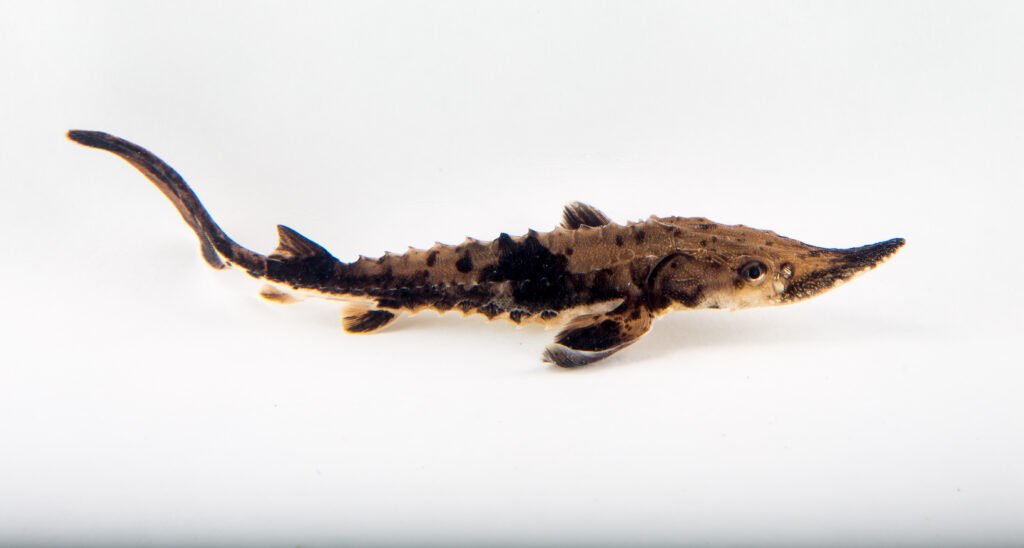
An ancient lineage in inland waters
Lake sturgeon are the freshwater survivors of a lineage that predates almost everything else swimming in North American rivers. They carry a skeleton built largely of cartilage rather than bone, a heterocercal tail with an upturned upper lobe, and five longitudinal rows of bony plates — scutes — running the length of the body instead of ordinary scales. Young fish carry sharp, keeled scutes that wear down and flatten with age, so an old sturgeon feels comparatively smooth where a juvenile feels like a rasp.
The head ends in a conical snout with four fleshy barbels slung beneath it, ahead of a protrusible, toothless mouth that extends downward to vacuum prey off the bottom. Sturgeon locate that prey partly by electroreception: the snout and head are studded with ampullary organs — the ampullae of Lorenzini, described in detail for sturgeon by Jørgensen’s morphological work on Acipenser ruthenus — which detect the weak bioelectric fields of buried invertebrates. A sturgeon working a silt flat in near-zero visibility is not searching blindly; it is reading electrical signatures.
Range and habitat
The U.S. Fish and Wildlife Service places lake sturgeon in the four major North American drainages they occupied historically — the Mississippi River basin, the Great Lakes, Hudson Bay, and the Mobile River Basin. The agency’s species profile describes a distribution spanning the St. Lawrence, Hudson Bay, Great Lakes, Mississippi and Coosa watersheds across five Canadian provinces and roughly 24 U.S. states.
Despite the name, this is fundamentally a big-river fish that also uses large lakes. Adults hold in deep runs, river mouths and lake basins over sand, gravel and clay, feeding on benthic invertebrates, and move into swift, rocky river reaches to spawn. That dual requirement — productive deepwater feeding habitat connected to hard-bottomed spawning riffles — is precisely what river development has severed across much of the range.
Size, growth and longevity
Lake sturgeon are among the longest-lived freshwater fish on the continent. The Fish and Wildlife Service reports that the largest and oldest reach about 7 feet, 200–300 pounds, and 150 years of age, with typical adults at 4–6 feet, 30–80 pounds and 50–100 years. The Michigan DNR gives a more conservative working figure — commonly around 55 years, with individuals over 100 documented — and records the state’s largest at 193 pounds from Mullett Lake, alongside historical Great Lakes fish exceeding 300 pounds.
Growth is fast early and then slows to a crawl. A fish adds length quickly through its first two decades and then spends the rest of a very long life adding girth and weight incrementally. The practical consequence is that a large lake sturgeon is not simply a big fish; it is an old one, frequently older than the dam it swims beneath.
Late maturity and intermittent spawning
This is the single fact that governs everything else about lake sturgeon management. The Fish and Wildlife Service reports males taking 12–20 years to mature and females taking 15–30 years. Michigan’s figures are comparable and in places later still: females at 14–33 years, most often 24–26, and males at 12–17.
Maturity is only half of it. Mature fish do not spawn annually. Michigan reports that females reproduce once every three to seven years while males spawn every one to four years. A female may therefore contribute to fewer than a dozen spawning events in a century of life. Fecundity is high when it happens — Michigan cites 4,000 to 7,000 eggs per pound of fish — but high fecundity does not compensate for a reproductive schedule this slow.
Populations built on that schedule cannot absorb sustained adult mortality. Remove the large old females and there is no rapid replacement cohort waiting; the deficit persists for decades. This is why sturgeon collapses were abrupt and recoveries have been measured in human generations.
Spawning
Spawning runs push into rapids and rocky riffles in spring. The Michigan DNR places spawning from mid-April through late May in water temperatures of 55–64°F; the Fish and Wildlife Service reports a broader observed band of roughly 47–72°F across the range. Adults return to natal rivers, and spawning is a conspicuous, physical business — groups of males attending a female over cobble in fast water, eggs broadcast and adhering to the substrate.
The behavior has been described in detail by Bruch and Binkowski in the Journal of Applied Ichthyology, working in the Lake Winnebago system. Later work from the same watershed documented that spawning lake sturgeon produce sound, and subsequent research has examined how anthropogenic noise overlaps those spawning signals. Spawning habitat characteristics have been described for other core populations, including the Rainy River on the Ontario–Minnesota border and the Sturgeon River flowing to Lake Superior.
The caviar century
Lake sturgeon were, for a period, treated as a nuisance — destroyed in quantity where they fouled nets — before a market for smoked flesh, isinglass and roe converted them into a target. The Fish and Wildlife Service states plainly that during the late 1800s and early 1900s, commercial harvest severely reduced the abundance of lake sturgeon. Fisheries that took decades to build were exhausted within a few years of intensive effort, because the standing stock being removed represented many decades of accumulated growth and almost no annual replacement.
The caviar economy that drove those collapses did not disappear; it moved. Demand pressure on North American sturgeon and paddlefish roe has repeatedly tracked shortfalls in Caspian supply, and international trade in sturgeon and paddlefish products is now controlled under CITES, with the Fish and Wildlife Service noting that CITES documents are required for international trade of all sturgeon and paddlefish regardless of whether the species are captive-bred.
Dams, barriers and fragmented rivers
The Service identifies habitat fragmentation as the dominant contemporary threat: dams and barriers occur across the lake sturgeon’s range and can block access to spawning and nursery habitat. A dam does not need to eliminate a population to damage it; cutting adults off from historical riffles concentrates spawning into whatever hard substrate remains below the structure, and alters the flow and temperature regime that cues the run.
Fragmentation also has a genetic dimension. Work in the Journal of Great Lakes Research has examined historical genetic connectivity of lake sturgeon in a dammed Great Lakes tributary, and related tools such as molecular sexing have made it possible to manage broodstock and monitor populations without the invasive procedures once required.
Federal status and the long petition process
Lake sturgeon spent six years inside a federal listing review. The Center for Biological Diversity petitioned to list the species on 23 May 2018. On 23 April 2024 the Fish and Wildlife Service published its 12-month finding and concluded that listing the lake sturgeon as an endangered or threatened species is not warranted at this time.
The reasoning turned on distribution and redundancy rather than on abundance being high. The Service found that lake sturgeon still occupy all four historical drainages, that highly and moderately resilient populations are still widely distributed, providing sufficient redundancy for the species rangewide, and that stocking has reversed local extirpations. It also recorded genuine uncertainty about climate response while judging the species broadly adaptable.
That finding stands. A review of Federal Register publications after April 2024 shows no subsequent action revisiting the determination; the Service’s October 2025 annual candidate notice refers back to the 2024 finding rather than superseding it. Lake sturgeon is therefore not federally listed, not a candidate species, and not currently proposed for listing — while remaining listed as endangered, threatened or of special concern under the laws of many individual states. That divergence between state and federal status is normal for this species and is the source of most confusion about it.
Stocking, passage and rehabilitation
The federal finding leaned heavily on active restoration. The Service reports that stocking programs operate in six of eight representation units in the United States and three of four designatable units in Canada, and that these efforts have brought areas back from extirpation. It also credits reconnection: restoring connectivity has improved natural recovery, as in the Red River of the North.
Michigan’s approach illustrates the method. Since the early 2000s, federal, state and tribal agencies have partnered on rehabilitation using streamside rearing facilities, which incubate and raise young fish in water drawn from the natal river so that they imprint on it before release. Wisconsin, which holds one of the strongest remaining populations in the Lake Winnebago system, maintains a long-running sturgeon management and monitoring program that has supplied much of the demographic data underpinning rangewide assessments.
The fish as anglers encounter it
Where lake sturgeon fisheries exist, they are managed intensively and vary sharply between waters and jurisdictions; this site links to the governing regulations rather than restating them. What is worth understanding is the biology behind that intensity. A large lake sturgeon may be older than the fishery managing it, may have spawned only a handful of times, and may not spawn again for several more years. The population-level cost of losing one is measured in decades, not seasons.
Practically, sturgeon are bottom-oriented and slow-moving, holding in deep holes and current seams and feeding by suction on invertebrates located electrically as much as by touch or smell. They fight with weight and sustained power rather than speed. Their armored scutes and cartilaginous skeleton make them robust to handling in some respects and vulnerable in others — a large sturgeon lifted clear of the water is unsupported along its length in a way a bony fish is not, and modern handling practice reflects that.
Identification
Lake sturgeon are separated from the other sturgeon of interior North America — the shovelnose — by snout shape and by the presence of a spiracle, a small opening above the eye that shovelnose sturgeon lack. Lake sturgeon have a shorter, blunter, conical snout, an unarmored caudal peduncle, and heavier build. Juveniles are strongly blotched and far more sharply scuted than the smooth, slate-to-olive adults, which is why small lake sturgeon are sometimes reported as a different fish entirely.
Where to catch it
11 waterways on GuidedFloats list lake sturgeon, across 3 states. Each page carries live gauge readings, access notes, and the guides who fish it.
Michigan 1
Minnesota 5
- Kettle River88 cfs
- Lake of the Woods
- Mississippi River7,520 cfs
- Rainy River6,930 cfs
- St. Croix River2,400 cfs
Wisconsin 5
- Chippewa River1,500 cfs
- Fox River (Wisconsin)1,160 cfs
- Lake Winnebago
- Wisconsin River5,300 cfs
- Wolf River1,620 cfs
References
- Endangered and Threatened Wildlife and Plants; 12-Month Finding for Lake Sturgeon (89 FR 30311) — U.S. Fish and Wildlife Service / Federal Register
- 12-Month Finding for Lake Sturgeon — full rule text — U.S. Government Publishing Office (govinfo)
- Lake Sturgeon (Acipenser fulvescens) species profile — U.S. Fish and Wildlife Service
- Lake Sturgeon — Michigan Species — Michigan Department of Natural Resources
- Sturgeon in Wisconsin — Wisconsin Department of Natural Resources
- Review of Species That Are Candidates for Listing as Endangered or Threatened; Annual Notification of Findings on Resubmitted Petitions — U.S. Fish and Wildlife Service / Federal Register
- Spawning behavior of lake sturgeon (Acipenser fulvescens) — Bruch & Binkowski, Journal of Applied Ichthyology 18:570-579
- Sound production of spawning lake sturgeon in the Lake Winnebago watershed, Wisconsin, USA — Bocast et al., Journal of Applied Ichthyology
- Ecoacoustic monitoring of lake sturgeon spawning and its relation to anthropogenic noise — Higgs et al., Journal of Applied Ichthyology
- Spawning lake sturgeon and their habitat characteristics in Rainy River, Ontario and Minnesota — Smith et al., Journal of Applied Ichthyology
- Population Characteristics and Movements of Lake Sturgeon in the Sturgeon River and Lake Superior — Auer, Journal of Great Lakes Research
- Historical genetic connectivity of lake sturgeon in a dammed Great Lakes tributary — Wilson et al., Journal of Great Lakes Research
- Molecular sexing of lake sturgeon — Scribner et al., Journal of Great Lakes Research
- The Morphology of the Lorenzinian Ampullae of the Sturgeon Acipenser ruthenus — Jørgensen, Acta Zoologica
- Importation, Exportation and Transportation of Wildlife — CITES documents required for all sturgeon and paddlefish — U.S. Fish and Wildlife Service / Federal Register
- IGFA World Records — International Game Fish Association