Longnose Gar
Lepisosteus osseus
The most widespread of North America's gars, a bimodal air-breather whose beak-like snout and armour of ganoid scales have gone essentially unchanged since the Cretaceous.
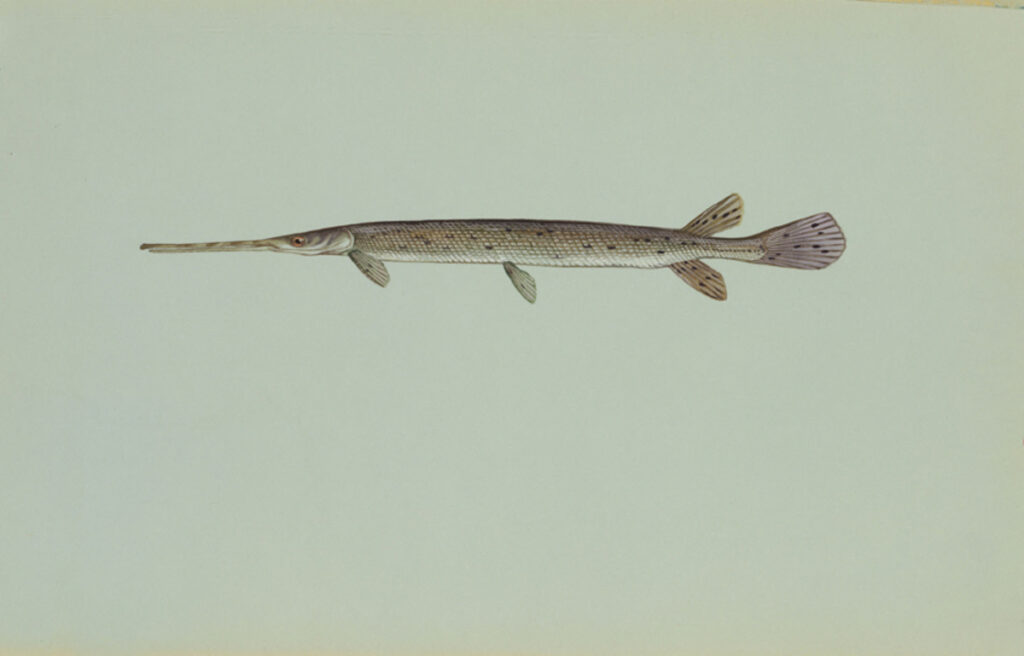
A fish built before the current design rules
Longnose gar are the most widely distributed member of an old family. Gars belong to the Lepisosteidae, a lineage the fossil record traces back well over 100 million years, and the U.S. Fish and Wildlife Service describes gars generally as fish that scientists “can trace back 100 million years in the fossil record.” The Minnesota Department of Natural Resources puts the same point plainly, calling gar “ancient fish, little changed since the days of the dinosaur.”
That antiquity is not a curiosity. It explains the fish. Nearly everything unusual about a longnose gar — the snout, the scales, the lung-like gas bladder — is a working solution to a set of problems that has not changed: how to catch fast prey in warm shallow water, how to avoid being eaten while doing it, and how to keep breathing when the water runs out of oxygen. Modern fish solved those problems differently. The gar solved them first and never needed to revise.
Distribution
Of the seven living gars, this is the one that turns up almost everywhere. Longnose gar occur through the Great Lakes and St. Lawrence system, down the length of the Mississippi basin, along the Gulf Coast and down the Atlantic slope into Florida. The Missouri Department of Conservation describes the species as “the most widely distributed gar in Missouri, probably occurring in every major stream in the state.”
The habitat description is consistent across agencies. Ohio’s Department of Natural Resources places them in “medium to large rivers” with “little or no flow with clear water,” plus the harbours, bays and backwaters of Lake Erie. Virginia’s Department of Wildlife Resources lists “lower gradient streams with deep pools and runs, reservoirs, and tidal estuaries,” with fish holding near overhanging vegetation and submerged structure. Minnesota reports them in “shallow lakes and rivers in southern and central Minnesota.”
The common thread is slow, warm, structured water — and specifically water that other large predators find marginal. Virginia notes that longnose gar tolerate brackish conditions. Minnesota notes they survive in “very warm water with little oxygen.” That tolerance is not incidental. It is the species’ competitive advantage, and it comes from the gas bladder.
Breathing air
Gars have functional gills like any other fish, but they also have a gas bladder connected to the throat and richly supplied with blood vessels. The Missouri Department of Conservation describes the organ in the gar family as one that “functions much like a lung.” Ohio DNR describes gars as possessing “a specialized air bladder that gives them the ability to breathe air,” while retaining “fully functional gills like other fish.” Minnesota describes the mechanics: gar “take in oxygen by swimming to the surface and gulping air into their swim bladders,” and can “live out of water for many hours, as long as their bodies stay moist.”
The experimental physiology is more specific than the agency summaries, and worth stating precisely because it is often garbled. Gars are bimodal breathers: they take oxygen from both water and air, and the balance shifts with conditions rather than being fixed. Work on longnose gar by Smatresk, Burleson and Azizi found that as the oxygen pressure of the water fell, air-breathing frequency increased, and identified two separate chemoreceptor systems — internal receptors setting the level of hypoxic drive, external receptors inhibiting gill ventilation — that together shift the fish from water breathing toward air breathing. The switch is actively controlled, not passive.
How much difference it makes was quantified in the closely related spotted gar. Burleson, Shipman and Smatresk exercised gar in normoxic water (oxygen partial pressure 20.7 kPa) and in severely hypoxic water (below 2.7 kPa, roughly an eighth of air saturation) and found that air breathing “allows gar to exercise to the same extent in normoxic and hypoxic water.” That is the whole story in one sentence. A largemouth bass in water at an eighth of air saturation is dying. A gar in the same water is working normally.
One correction is worth making. Virginia DWR describes longnose gar as “obligate air breathers.” The experimental literature does not support that word: gars are facultative air breathers whose reliance on the surface rises with temperature and falls with dissolved oxygen. The distinction matters for anyone trying to predict where the fish will be. Gar do not have to surface in cold, well-oxygenated water. They surface constantly in warm, stagnant water — which is precisely where and when they are easiest to find.
The snout
The proportions are extreme even by gar standards. The Missouri Department of Conservation gives the diagnostic ratio directly: “the least width of the snout goes about 15 to 20 times into its length.” No other North American gar approaches that. Ohio DNR describes it as “a very long and narrow snout containing many needle like teeth,” and treats it as the field mark separating this species from Ohio’s other gars.
The narrowness is functional. A slender jaw has low drag and low inertia, so it can be swung sideways through water fast. Longnose gar hunt by lying alongside prey and delivering a lateral slash, then working the fish around to swallow it headfirst. The teeth are for holding, not cutting. The consequence for anglers is well known and rarely stated as biology: there is almost no soft tissue in that jaw for a conventional hook to seat in.
Ganoid scales
Gars are covered in ganoid scales — “hard, diamond-shaped, non-overlapping” plates set in interlocking diagonal rows, described by MDC as characteristic of a gar lineage dating to the Late Jurassic. The U.S. Fish and Wildlife Service describes the same structures on alligator gar as “bone-like, diamond-shaped.”
Functionally this is armour rather than a scale coat. The result is a fish that is very difficult for a predator to bite through and very difficult for a person to clean; historically gar hide was used for leather and the scales as abrasive and ornament. The armour also constrains the fish’s swimming: gars cannot flex sharply along their length, which is part of why they are ambush predators that accelerate in a straight line rather than pursuers that turn.
Spawning
Spawning is a spring event tied to warming water and shallow, structured habitat. In Missouri, MDC reports that “in the Ozarks, adult longnose gar appear in their upstream spawning locations by late April, and spawning may occur from early May to mid-June.” Ohio DNR places reproduction “in the late May or early June often in shallow riffles.” Virginia reports spawning “generally between April and June.”
Females are larger than males and are attended by several males during spawning. Eggs are adhesive and are scattered over gravel, submerged vegetation and woody debris rather than deposited in a nest. There is no parental care.
The eggs are toxic — state it plainly
This is the one fact about gar that carries a genuine safety consequence, and it applies to every gar species. The Missouri Department of Conservation states it without hedging: “the eggs (roe) of gar are highly toxic to warm-blooded animals, including humans.” Ohio DNR agrees: “their eggs are poisonous,” making them unsuitable for human consumption.
Gar roe must never be eaten, and should not be fed to dogs or other animals. The toxicity is not destroyed by cooking. The flesh of gar is edible and is eaten across the South, but the eggs are not, and a gravid female cleaned carelessly is a real hazard. The toxin is thought to serve an anti-predator function, protecting eggs that are broadcast into open water with no adult guarding them.
Age, growth and what anglers now do with them
Longnose gar are long-lived and slow-growing by the standards of the fish they share water with, and females outlive and outgrow males substantially. Ohio DNR gives typical adults as 24–36 inches and 2–7 pounds, occasionally to 50 inches and 25 pounds. Missouri reports fish commonly to 3 feet and 5–6 pounds, with the largest in the state “about 60 inches and 30 pounds.” Virginia records fish that “surpass 50 inches.”
For most of the twentieth century American fisheries management treated gars as a problem to be reduced. That framing was formally challenged in the peer-reviewed literature by Dennis Scarnecchia in “A Reappraisal of Gars and Bowfins in Fishery Management” in the American Fisheries Society journal Fisheries in 1992, and the reappraisal has since worked its way into agency practice.
Angler behaviour has moved faster than management language. Longnose gar are now deliberately targeted rather than merely encountered — they are large, abundant, visible, aggressive, and they live in summer water conditions that shut down bass and walleye fishing. Virginia’s Department of Wildlife Resources lists longnose gar among the species recognised in its Master Angler programme, which is the clearest institutional signal that a fish has moved from nuisance to quarry. Because the jaw holds hooks poorly, gar angling has developed its own methods, and because the fish surface to breathe, they can be located visually in a way almost no other large freshwater predator can.
Status
Longnose gar are not federally listed and are not in trouble as a species. The U.S. Fish and Wildlife Service maintains a species profile with no listing status attached, and state agencies across the range describe the fish as widespread and common. That security is worth contrasting with the fate of its largest relative: the alligator gar was eliminated from most of its northern range within a single human lifetime, while the longnose gar — smaller, more adaptable, less conspicuous, and less worth killing — persisted through the same period essentially intact.
Where to catch it
147 waterways on GuidedFloats list longnose gar, across 20 states. Each page carries live gauge readings, access notes, and the guides who fish it.
Alabama 9
- Bayou Sara
- Black Warrior River below Selden Dam
- Choccolocco Creek158 cfs
- Choctawhatchee River305 cfs
- Conecuh River below Point A Dam564 cfs
- Fish River56 cfs
- Lake Tuscaloosa
- Mobile River-3,190 cfs
- Tensaw River-781 cfs
Arkansas 6
- Bayou Bartholomew1 cfs
- Bayou Deview
- Bayou Macon13 cfs
- Bayou Meto
- Bear Bayou
- Saline River13 cfs
Delaware 1
- Marshyhope Creek13 cfs
Florida 8
- Lake Minnehaha
- Lake Rosalie
- Lake Seminole
- Lake Trafford
- Lake Weohyakapka
- Ochlockonee River1,320 cfs
- Peace River1,170 cfs
- Santa Fe River965 cfs
Georgia 7
- Altamaha River3,740 cfs
- Broad River196 cfs
- Kinchafoonee Creek137 cfs
- Middle Oconee River105 cfs
- Ogeechee River25 cfs
- Satilla River2,420 cfs
- Spring Creek278 cfs
Illinois 9
- Cache River1 cfs
- Embarras River55 cfs
- Iroquois River122 cfs
- Kishwaukee River804 cfs
- Little Wabash River77 cfs
- Mackinaw River100 cfs
- Macoupin Creek14 cfs
- Vermilion River150 cfs
- Wabash River9,390 cfs
Kansas 3
- Cottonwood River104 cfs
- Marais des Cygnes River43 cfs
- Walnut River174 cfs
Kentucky 2
Louisiana 41
- Abita River
- Alligator Bayou
- Bayou Anacoco31 cfs
- Bayou Cocodrie62 cfs
- Bayou Conway
- Bayou D'Arbonne
- Bayou D'Arbonne
- Bayou Darby
- Bayou de Loutre
- Bayou Des Glaises11 cfs
- Bayou Dorcheat
- Bayou Fountain
- Bayou Francois
- Bayou Fusilier
- Bayou Grand Cane
- Bayou Grosse Tete
- Bayou Lafourche391 cfs
- Bayou Liberty
- Bayou Mallet
- Bayou Milhomme
- Bayou Nezpique9 cfs
- Bayou Pierre158 cfs
- Bayou Queue de Tortue
- Bayou San Patricio
- Bayou Teche
- Bayou Toro1 cfs
- Black Bayou
- Bushley Bayou
- Chauvin Bayou
- Chemin-A-Haut Bayou
- Choctaw Bayou
- Cross Bayou
- Cypress Bayou4 cfs
- Gilmer Bayou
- Henderson Bayou
- Little Corney Bayou
- Loggy Bayou
- Paw Paw Bayou
- Red Chute Bayou243 cfs
- Twelvemile Bayou
- White Bayou
Mississippi 7
- Bayou Pierre
- Big Black River229 cfs
- Old Fort Bayou
- Ross Barnett Reservoir
- Steele Bayou
- Tombigbee River230 cfs
- Wolf River (Mississippi)43 cfs
Nebraska 1
- Dismal River257 cfs
New Mexico 2
North Carolina 7
- Deep River56 cfs
- Haw River104 cfs
- Lumber River104 cfs
- Neuse River469 cfs
- Pamlico River
- Pee Dee River614 cfs
- Tar River3 cfs
Ohio 3
- Great Miami River1,790 cfs
- Hocking River516 cfs
- Scioto River2,190 cfs
Oklahoma 1
- Kiamichi River2 cfs
South Carolina 6
- Congaree River3,530 cfs
- Little Back River
- Neal Shoals Reservoir
- Ninetynine Islands Reservoir
- Parr Shoals Reservoir
- Wateree River Tailrace2,750 cfs
Tennessee 4
Texas 27
- Attoyac Bayou
- Austin Bayou
- Bastrop Bayou
- Bayou Lanana1 cfs
- Big Cypress Bayou20 cfs
- Black Cypress Bayou
- Brazos River465 cfs
- Buffalo Bayou164 cfs
- Chocolate Bayou14 cfs
- Devils River
- Greens Bayou
- Highland Bayou
- Hurricane Bayou
- Linnville Bayou
- Little Cypress Bayou
- Medina River17 cfs
- Mustang Bayou
- Nueces River75 cfs
- Palo Gaucho Bayou2 cfs
- Pecan Bayou12 cfs
- Pedernales River7 cfs
- Pine Island Bayou2 cfs
- Sabine River415 cfs
- San Saba River91 cfs
- Village Creek96 cfs
- West Fork San Jacinto River
- Whiteoak Bayou19 cfs
Vermont 1
- Little Otter Creek13 cfs
Virginia 2
- Mattaponi River267 cfs
- Pamunkey River216 cfs
References
- Longnose Gar — Field Guide — Missouri Department of Conservation
- Longnose Gar — Ohio Department of Natural Resources
- Longnose Gar — Minnesota Department of Natural Resources
- Longnose Gar — Virginia Department of Wildlife Resources
- Longnose Gar (Lepisosteus osseus) — Species Profile — U.S. Fish and Wildlife Service
- Chemoreflexive responses to hypoxia and NaCN in longnose gar: evidence for two chemoreceptor loci — Smatresk NJ, Burleson ML, Azizi SQ — American Journal of Physiology, 1986
- Ventilation and acid-base recovery following exhausting activity in an air-breathing fish — Burleson M, Shipman B, Smatresk N — Journal of Experimental Biology, 1998
- A Reappraisal of Gars and Bowfins in Fishery Management — Scarnecchia DL — Fisheries (American Fisheries Society), 1992
- Age and Growth of Spawning Longnose Gar in a North Central Texas Reservoir — Kelley SW — Western North American Naturalist, 2012
- Migratory dynamics of stream-spawning longnose gar — Johnson BL, Noltie DB — Ecology of Freshwater Fish, 1996
- Spawning within Floating Vegetation: Novel Underwater Observations of Egg Deposition in Longnose Gar — Hawthorne WH, Sulak KJ, Walsh SJ — Southeastern Naturalist, 2024
- Alligator Gar (Atractosteus spatula) — Species Profile (ganoid scale description) — U.S. Fish and Wildlife Service
- IGFA World Records — International Game Fish Association