Bayou D’Arbonne Fishing Guides
The bayou that feeds one of Louisiana's best crappie lakes, running tea-stained through pine and hardwood bottom above Lake D'Arbonne with a gauge at Dubach reading stage.
Guides on the Bayou D’Arbonne
Claimed profiles take booking requests. Unclaimed profiles are built from public records so the river is never empty; the guide can claim or remove one any time.
No guides listed yet
Guide or outfit this water? Create your profile. Listing is free, the commission is 10% or 7% with a premium profile, and premium profiles list first on this water.
About the Bayou D’Arbonne
Bayou D’Arbonne is the water that made Lake D’Arbonne, and anglers who only know the lake are missing the better half of the system. Above the impoundment the bayou runs as a genuine north Louisiana hill-country stream, tea-stained with tannin off the pine flatwoods and cutting through hardwood bottom in a channel narrow enough to shade over in summer. The bottom alternates between sand bars on the inside of bends and deep root-wadded holes on the outside, and that structure is the whole reason the fishing holds up: every laydown and every cut bank is a distinct piece of cover rather than one more yard of uniform bank.
The gauge near Dubach reports stage, and stage is what an angler should read here rather than flow. This is a bayou, not a mountain river, and the interesting number is not how fast the water is moving but whether it is up in the timber or pulled back into the channel. On a falling stage after a rise the fish stack on the first sharp bends below the flooded flats and the bite can be as good as anything in the parish. On a hard rise the bayou goes the colour of coffee with milk and spreads into the bottom, and the honest advice is to fish the lake instead for a few days.
What the bayou is genuinely famous for is crappie, both black and white, and the spring run up out of the lake into the bayou proper is a local event. Largemouth and spotted bass share the same cover, catfish work the deep outside holes, and bowfin and gar are common enough that anyone fishing cut bait should expect them. Access is workmanlike rather than developed: bridge crossings, gravel parish roads and the state park down on the lake are what there is, and a small boat or a kayak opens far more of it than wading ever will.
This water needs a real photo
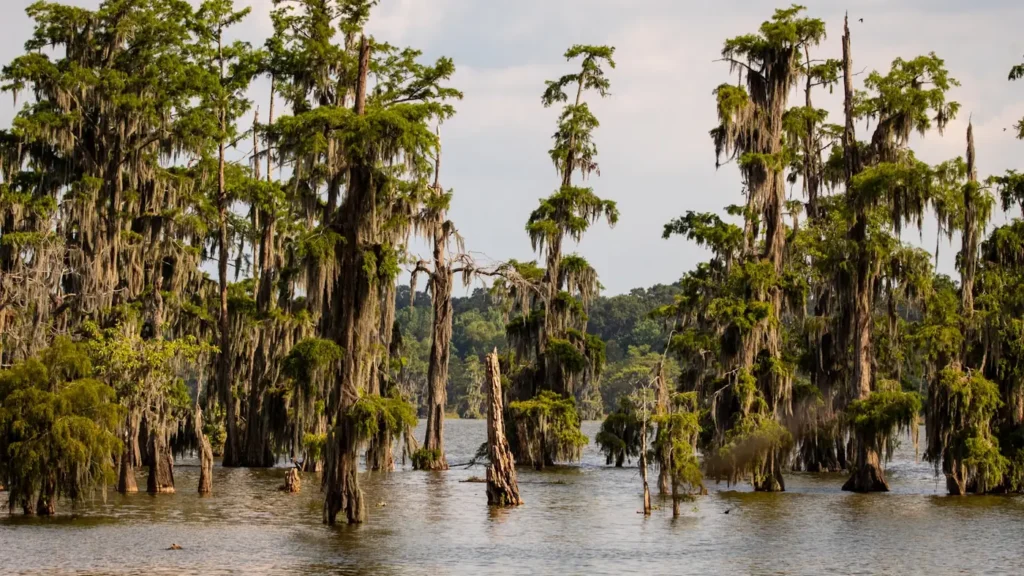
The photo at the top of this page is not Bayou D’Arbonne.
It is a regional stand-in, honestly captioned but generic — we will not put a name to a river we cannot prove. Send us a photograph you took here and it replaces the stand-in, with your credit on it.
Add a photo of this water
Landscape, not fish — the water itself. Reviewed by hand before it appears. The first one published here earns the Pioneer badge.
Fished this water? Add a photo
Reviewed by hand before it appears. Pick the water, not the spot — we never publish exact locations.
Access
Dubach - the small town nearest the gauge, with bridge access on the bayou and the most direct road approach from US 167. / Farmerville - the parish seat on Lake D'Arbonne, where most boats launch and where guides and tackle are based. / Lake D'Arbonne State Park - developed ramps, camping and the easiest hard-surface launch on the system. / Ruston - the largest town nearby and the practical base for lodging, food and supplies. / Bernice - a northern approach to the upper bayou and the surrounding hunting-club country. / Parish road bridges - several crossings between Dubach and the lake give bank and kayak access, though shoulders are narrow. / Union Parish gravel roads - the network that reaches the bottomland, passable dry but soft after rain.
Seasons
Spring: the best of the year, with the crappie run pushing out of the lake into the bayou through March and April and bass spawning in the backs of the flats. / Summer: warm and low, with the bayou pulled back into its channel; fish the deep outside bends early and late, and expect catfish to carry the day. / Fall: cooling water and falling stage concentrate fish on hard structure, and this is the most pleasant time to be on the water. / Winter: the bayou runs clear and cold between rises; crappie hold deep near the lake end and the bass bite is slow but the fish are heavy.
From the water
No logged trips yet. Be the first to put this water on your map.
Log this water
Fished it or cleaned it? Log in or create a free account to log a trip with photos and earn the waterway badge.
Questions
What species can you catch on the Bayou D’Arbonne?
Anglers target Black Crappie, Blue Catfish, Bluegill, Bowfin, Channel Catfish, Flathead Catfish, Freshwater Drum, Largemouth Bass, Longnose Gar, Redear Sunfish, Spotted Bass, Warmouth, White Crappie, Yellow Bass on the Bayou D’Arbonne in Louisiana.
Where can you access the Bayou D’Arbonne?
Dubach - the small town nearest the gauge, with bridge access on the bayou and the most direct road approach from US 167. / Farmerville - the parish seat on Lake D'Arbonne, where most boats launch and where guides and tackle are based. / Lake D'Arbonne State Park - developed ramps, camping and the easiest hard-surface launch on the system. / Ruston - the largest town nearby and the practical base for lodging, food and supplies. / Bernice - a northern approach to the upper bayou and the surrounding hunting-club country. / Parish road bridges - several crossings between Dubach and the lake give...
When is the best time to fish the Bayou D’Arbonne?
Spring: the best of the year, with the crappie run pushing out of the lake into the bayou through March and April and bass spawning in the backs of the flats. / Summer: warm and low, with the bayou pulled back into its channel; fish the deep outside bends early and late, and expect catfish to carry the day. / Fall: cooling water and falling stage concentrate fish on hard structure, and this is the most pleasant time to be on the water. / Winter: the bayou runs clear and cold between rises; crappie hold deep near the lake end and the bass bite is slow but the fish are heavy.
Where are the fishing regulations for the Bayou D’Arbonne?
Regulations change by season and section. Read the current rules on the Louisiana agency site: https://www.wlf.louisiana.gov/page/recreational-freshwater-finfish-and-crawfish