Sauger
Sander canadensis
The walleye's smaller, more riverine sibling — a turbid-water specialist that runs hundreds of miles to spawn and has lost more than half its range in some states.
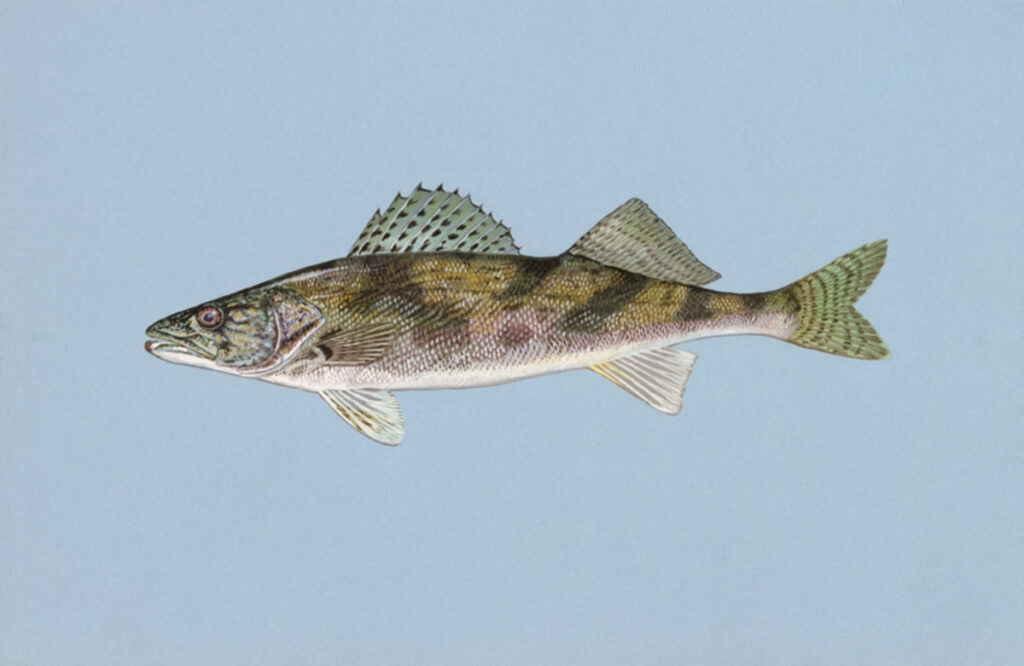
Identification
Sauger are slimmer, smaller and darker than walleye, with bronze-to-brown backs, white bellies, and — most usefully — discrete dark oblong blotches arranged along the flanks rather than the walleye’s diffuse mottling. The West Virginia Division of Natural Resources describes these as dark oblong blotches, and Missouri calls them saddle marks. Either way, the pattern is blocky and countable in a way a walleye’s is not.
The single most reliable character is the spiny dorsal fin. Sauger carry rows of distinct dark spots on the fin membranes, and they lack the large dark blotch that walleye carry at the base of the last few dorsal spines. The second is the tail: on sauger the lower caudal lobe either has no white tip at all or, per the Missouri Department of Conservation, a much-reduced one. Missouri adds a third, harder character — sauger have scales on the cheek, walleye largely do not.
None of these characters is individually infallible, and all three degrade on a dead or faded fish. Together they are decisive: spotted dorsal membranes plus no basal blotch plus no white tail tip plus blocky saddles is a sauger, and any two of the four disagreeing usually means a hybrid.
Saugeye and wild hybridisation
Sauger and walleye interbreed, producing the saugeye. Most saugeye encountered in reservoirs are hatchery products: the Ohio Division of Wildlife creates them by fertilising walleye eggs with sauger milt and stocks them annually, valuing the cross for fast growth, high survival, and tolerance of turbid water. Ohio describes them as intermediate in almost every character — dark bars between the first dorsal spines together with a dusky blotch at the rear fin base, blotching smaller than a sauger’s, and a white tail tip better defined than a sauger’s but weaker than a walleye’s. Most are functionally sterile, but Ohio notes that a small percentage reproduce and can backcross with either parent.
How much hybridisation happens in wild rivers is contested, and this matters for sauger conservation. The Montana Field Guide lists hybridisation with introduced walleye as a factor in the species’ S3 state rank. Wyoming records the first documented hybrids in the Bighorn River population in 2014. Against that, a microsatellite analysis of 925 fish across the upper Missouri drainage found only 18 hybrids — about 1.9 per cent — with 17 of them in the Yellowstone drainage despite heavier walleye stocking in the Missouri proper, and concluded that walleye introgression was not an immediate threat to native sauger there. The Michigan Natural Features Inventory notes the same lack of consensus, recording that competition with walleye remains disputed as a cause of sauger decline. The honest summary is that genetic swamping is documented but rare in the systems studied, while displacement by walleye is plausible and unproven.
Range and distribution
The native range spans the St. Lawrence–Great Lakes, Hudson Bay and Mississippi basins from Quebec to Alberta and south to northern Alabama and Louisiana. USGS records introductions in twenty states, established populations in ten, and extirpation from North Carolina.
Within that range the distribution is riverine in a way walleye distribution is not. Missouri places sauger mostly in the Mississippi and Missouri rivers and suitable tributaries, plus the Eleven Point River. West Virginia’s population is native to the Ohio River drainage. Wyoming’s native sauger occupy the North Platte, Powder, Tongue and Bighorn–Wind systems, and the department identifies the Wind River fish as among the last genetically pure sauger populations in the Missouri River drainage.
Range contraction has been severe in places. Montana reports that current sauger distribution is down 53 per cent from historical levels, with losses concentrated in tributaries. Michigan has documented sauger in thirteen counties, but the records are sparse and old — the most recent from Delta County in 1998 and Monroe County in 1996 — and the state ranks the species S1, critically imperiled, and lists it as legally endangered.
Habitat and water temperature
Sauger are a large-river fish. The Royal Ontario Museum life-history database describes habitat as sand and gravel runs, pools and backwaters of small to large rivers, plus shallow turbid lakes, and notes that sauger usually inhabit surface waters shallower than six metres. Wyoming is more specific for western rivers: deep, low-velocity pools and runs in large turbid rivers, with winter habitat in low-velocity pools deeper than six feet.
The defining habitat trait is turbidity tolerance. Missouri notes sauger are more tolerant of turbid water than walleye, and USGS states the ecological consequence directly: sauger compete with walleye where the two coexist and are generally out-competed by walleye except in highly turbid water, where the sauger’s vision gives it the advantage. That single sentence explains most of the species’ distribution: sauger dominate where the water is dirty and the current is strong, and lose ground where impoundment clears and slows it.
Thermally, the Royal Ontario Museum gives a preferred range of 20–24°C (68–75°F) and classes sauger as a coolwater species, slightly warmer in preference than its own walleye figure of 19–23°C. Spawning temperature is given as 6–12°C (43–54°F). Beyond that, published sauger thermal data are thin. No adult upper lethal temperature was located for this article, and the stress threshold has to be inferred from walleye rather than measured on sauger. That gap is worth stating plainly rather than papering over.
Life history and migration
Sauger spawn in spring. Montana records spawning from mid-April into May at water temperatures around 50°F, with eggs incubating in 12 to 18 days at that temperature and sexual maturity at three to four years. Wyoming gives May as the typical month and 52–59°F in the Bighorn River. West Virginia describes sauger as broadcast spawners that release eggs while swimming through the water column near the bottom over sand and gravel substrate. The Royal Ontario Museum gives maturity at two to three years for males and four to six for females, and a lifespan of 7 to 13 years — appreciably shorter than walleye.
What separates sauger from almost every other North American percid is the scale of their spawning migration. West Virginia notes large late-winter migrations to spawning areas. Montana documents a major spawning and feeding migration from the lower reaches of the middle Missouri River up to the reach between Fort Benton and Morony Dam, and identifies the Tongue and Powder rivers as critical spawning tributaries for Yellowstone River fish. Wyoming records spawning migrations of up to 235 miles where passage barriers are absent.
That last clause is the crux of sauger conservation. Montana states that habitat loss and migratory barriers — dams and diversions — are the primary causes of reduced sauger distribution in the state. A fish that needs two hundred miles of connected river to complete its life cycle is uniquely exposed to fragmentation, and no amount of habitat quality in an isolated reach substitutes for that connectivity.
Diet
Sauger feed on fish, crustaceans and insects. In large rivers the fish component is dominated by shad, shiners and small suckers, taken near the bottom in current. Missouri notes that spawning and much feeding occur at night, and the diel pattern is consistent with the species’ low-light visual specialisation.
Angling
Sauger behaviour is a direct product of two things: a visual system tuned for dim, sediment-laden water, and a life history built around long-distance movement in current. Both push sauger to the river bottom and into current-influenced water in a way walleye are not pushed.
Seasonally, the fish concentrate. Late winter and early spring aggregation below dams and at tailwaters is not a quirk of angler access — it is the mechanical consequence of a migratory fish meeting a barrier, and it is why tailwater reaches produce the bulk of documented large sauger, including West Virginia’s and Tennessee’s state records, both from the Ohio and Tennessee river systems respectively. After spawning the aggregation disperses downstream through deep pools and runs.
Turbidity works differently for sauger than for walleye. Where a rise in turbidity moves walleye toward day feeding, sauger already occupy that niche continuously; a clearing river tends to shift the advantage back toward walleye in shared water. Live water temperature is most useful at the front end of the year: readings climbing through the high 40s and into the low 50s Fahrenheit in a large river bracket the spawning migration, which is the period when sauger are most concentrated and most predictable.
Conservation
Globally the species is ranked G5, secure. That rank conceals the state-level picture. Michigan ranks sauger S1, critically imperiled, and lists it as endangered. Montana ranks it S3 with a 53 per cent contraction in distribution. Wyoming describes it as common within a limited range with distribution reduced from historical, and flags the Wind River population as one of the last genetically pure stocks in the Missouri drainage.
The named threats are consistent across agencies: loss of large-river habitat, migratory barriers, and altered hydrology. Whether introduced walleye add materially to that — through competition, hybridisation, or both — remains genuinely unsettled in the literature. Michigan notes that the species’ turbidity tolerance argues against habitat loss being the sole driver, while management priorities focus on restoring and protecting spawning habitat. For a river-focused reader the practical implication is straightforward: sauger populations track river connectivity more closely than almost any other popular North American sport fish.
Where to catch it
38 waterways on GuidedFloats list sauger, across 11 states. Each page carries live gauge readings, access notes, and the guides who fish it.
Illinois 5
- Big Muddy River47 cfs
- Illinois River (Illinois)13,900 cfs
- Kaskaskia River165 cfs
- Rock River4,880 cfs
- Wabash River9,390 cfs
Indiana 1
Iowa 1
- Iowa River4,550 cfs
Kansas 1
- Kansas River14,900 cfs
Kentucky 4
Minnesota 3
- Lake of the Woods
- Mississippi River7,520 cfs
- Rainy River6,930 cfs
Nebraska 7
- Bazile Creek44 cfs
- Bow Creek37 cfs
- Frenchman Creek14 cfs
- Loup River266 cfs
- Niobrara River543 cfs
- Platte River5,110 cfs
- Ponca Creek9 cfs
North Dakota 7
- Apple Creek
- Dry Lake
- Little Missouri River23 cfs
- Missouri River (North Dakota)13,100 cfs
- Pipestem Creek9 cfs
- Sheyenne River below Devils Lake Outlet5 cfs
- Tobacco Garden Creek2 cfs
Ohio 4
- Great Miami River1,790 cfs
- Muskingum River2,520 cfs
- Scioto River2,190 cfs
- Walhonding River
South Dakota 4
- Belle Fourche River11 cfs
- Cheyenne River84 cfs
- Missouri River (South Dakota)
- White River97 cfs
Wisconsin 1
- Chippewa River1,500 cfs
References
- Sauger (Sander canadensis) — conservation status and habitat — Michigan Natural Features Inventory, Michigan State University
- Sauger — species detail — Montana Field Guide, Montana Natural Heritage Program
- Sauger species account — Wyoming Game and Fish Department
- Sauger: Fish Description and Facts — West Virginia Division of Natural Resources
- Sauger — Field Guide — Missouri Department of Conservation
- Sauger (Sander canadensis) — Species Profile, Nonindigenous Aquatic Species — U.S. Geological Survey
- Sauger (Sander canadensis) — life history — Ontario Freshwater Fishes Life History Database, Royal Ontario Museum
- Near absence of hybridization between sauger and introduced walleye despite massive releases — Conservation Genetics (Bingham et al. 2012)
- Saugeye — Ohio Department of Natural Resources, Division of Wildlife
- Saugeye — West Virginia Division of Natural Resources
- Tennessee Fishing Records and Awards — Tennessee Wildlife Resources Agency
- Walleye (Sander vitreus) — life history — Ontario Freshwater Fishes Life History Database, Royal Ontario Museum
- Walleye biology and identification — Minnesota Department of Natural Resources
- IGFA Game Fish Records — International Game Fish Association