Red Drum
Sciaenops ocellatus
A long-lived estuarine drum that spawns at the passes, runs far up brackish and fresh river reaches, and whose 1980s collapse and recovery is the best-documented conservation story on the Gulf coast.
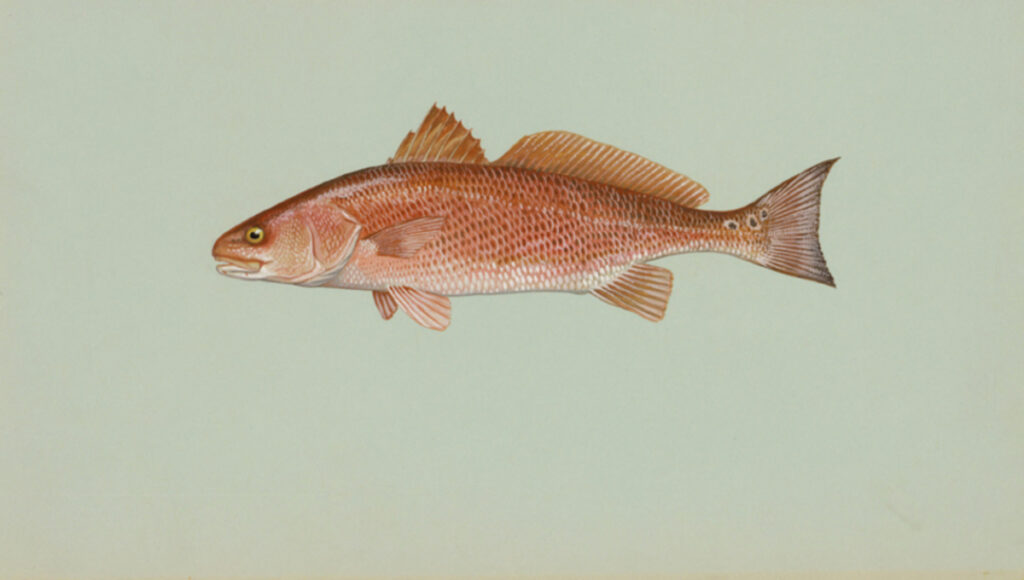
A drum, not a bass
Red drum belong to Sciaenidae, the drums and croakers — the same family as black drum, Atlantic croaker, spot and spotted seatrout. The old name “channel bass” is a misnomer that has stuck along the Atlantic seaboard; Louisiana knows the fish as poisson rouge, and most of the Gulf simply calls it a redfish. Louisiana Sea Grant lists redfish, red, spottail, channel bass and poisson rouge as the working common names for a single species, Sciaenops ocellatus.
The family membership is not trivia. It explains the sound the fish makes, the otolith-based ageing that gives us its remarkable longevity figures, and the estuarine life history it shares with its relatives. On the Pascagoula River in Mississippi, red drum and spotted seatrout appear on the same water for the same reason: both are drums that spend most of their lives inside the brackish and fresh reaches of a coastal river system.
The spot on the tail
The single most recognizable feature is the black ocellus at the base of the tail. Texas Parks and Wildlife calls it “one large black spot on the upper part of the tail base” and describes the leading hypothesis for its function: that it “helps fool predators into attacking the red drum’s tail instead of their head, allowing the red drum to escape.” That deflection hypothesis is plausible and widely repeated, but it remains a hypothesis — no agency source presents it as demonstrated.
Spot number varies more than most anglers expect. Louisiana Sea Grant notes that most fish carry a single ocellated spot just ahead of the tail fin, that more than one spot is found occasionally, and that a small number of fish carry none at all. South Carolina DNR describes “one or more ocellated spots on upper sides from below soft portion of dorsal fin to base of caudal fin.” Multi-spotted fish with a dozen or more marks are uncommon but entirely normal.
Estuary fish, river fish
Red drum are born offshore and spend their juvenile years inshore. Larvae ride tidal currents into shallow nursery habitat — South Carolina DNR describes larvae using “vertical migrations to ride high salinity tidal currents into tidal creeks and shallow salt marsh nursery habitats,” while ASMFC notes that larvae are “carried by wind and tidal action into shallow, low salinity estuarine nursery areas,” where juveniles and sub-adults remain.
How far upriver they go surprises people. Texas Parks and Wildlife states flatly that red drum “can live in fresh water and have been found many miles upriver.” On a system like the Pascagoula — the USGS gage at Graham Ferry in Jackson County drains 8,204 square miles — the position of the brackish reach moves constantly. Sustained low discharge lets salt push upstream and red drum follow it; a large rain event flushes the wedge downstream and compresses the usable reach toward the Sound. Discharge, not calendar date, is the variable that governs how far up a river these fish will be found in any given week.
Growth, longevity and the bull red
Growth is fast early. Texas Parks and Wildlife gives roughly 11 inches and one pound in the first year, 17 to 22 inches and three and a half pounds at two years, and 22 to 24 inches and six to eight pounds at three. Louisiana figures run slightly larger: 10 to 17 inches in year one, 18 to 24 inches and three to six pounds in year two, and 20 to 28 inches and four to nine pounds in year three.
Around age three or four the life history changes. Fish “show substantial movement to offshore waters where they ultimately join the schools of spawning ‘bull’ redfish,” and ASMFC notes that fish older than age four inhabit deeper water. Bull reds are simply mature adults — the same fish, a decade or more later, having left the estuary for the nearshore Gulf. They return to the passes seasonally, which is why a river mouth can hold both 16-inch juveniles and 40-inch adults within a few miles of each other in autumn.
Longevity is genuinely contested. Texas Parks and Wildlife reports “the oldest recorded red drum was 37 years old.” Florida FWC says the lifespan “can exceed 40 years.” South Carolina DNR gives approximately 38 years locally while noting “a few individuals as old as 60 have been reported in other states,” and ASMFC states the species can reach 60 years and 60 inches. The honest summary is that 35 to 40 years is well documented and 60 years is reported but rarer and less firmly established.
Spawning at the passes
Spawning is a nearshore, autumn, nighttime event tied to the mouths of passes and inlets. Texas Parks and Wildlife places it “from mid-August through mid-October in Gulf waters, near the mouths of passes and shorelines.” Louisiana Sea Grant describes an eight- or nine-week period from mid-August to mid-October. Florida FWC frames the cue directly: red drum “begin spawning in the fall when daylight hours decrease and water temperature begins to cool.” South Carolina DNR confirms that “spawning aggregations occur near estuary inlets and passes along barrier island beaches.”
Florida’s telemetry work put numbers on those aggregations. Researchers working between Tampa Bay and Charlotte Harbor observed six aggregations in 2012, seventeen in 2013 and six in 2014, estimating roughly 3,400 fish across six aggregations in 2013 and 3,781 in 2014. Using 88 underwater receivers and 100 acoustically tagged fish, they found that “60 percent of the fish detected in 2012 returned to the Tampa Bay spawning site in 2013” — strong site fidelity to particular pass-mouth locations.
Fecundity estimates diverge depending on what is being counted. ASMFC reports that “large females may produce up to two million eggs in a season,” while Louisiana Sea Grant gives 20 to 40 million eggs per season across repeated spawning events. Eggs hatch within roughly 24 to 36 hours and the larvae drift inshore.
The drumming
The family name is earned. Male red drum produce sound with a sonic muscle that vibrates against the swim bladder — Texas Parks and Wildlife describes males producing sound “by vibrating a muscle in their swim bladder” to attract females, and South Carolina DNR describes “muscular contractions to vibrate the swimbladder.” Louisiana Sea Grant is more specific about the social structure: males “form large schools at night, called drumming aggregations, because of the drumming sound that they make with their air bladders to attract females.”
The mechanism is a fast, specialized muscle contracting against a gas-filled resonator, and it is under male control during the spawning season. Because the sound is loud, low-frequency and species-specific, it also functions as a research tool: passive acoustic surveys can locate spawning aggregations in water too turbid or too deep for visual work.
Water temperature and cold
Red drum are the more cold-tolerant of the two drums that occupy the lower Pascagoula. They do not simply endure cold snaps in place, though. Texas Parks and Wildlife notes that “during cold spells large numbers of red drum can be found in tidal creeks and rivers,” and South Carolina DNR describes juveniles progressing “from marshes and tidal creeks to overwinter in deeper inshore waters” while larger adults overwinter offshore. The pattern is a retreat from thin water into thermal refuge: deep river holes, channel bends and creek mouths that hold heat and buffer the swing.
Florida FWC calls the underlying mechanism cold-shock: “Sudden decreases in water temperature, or extended periods of cold, can cause fish adapted to warm waters to become lethargic… and it is sometimes fatal.” Red drum tolerate this better than spotted seatrout, which suffer large-scale mortality below about 45 °F, but the same events still displace them. Live water temperature on a shallow estuarine river is therefore not a comfort statistic — a rapid drop of ten or fifteen degrees over a night or two reorganizes where every red drum in the system is holding.
Collapse and recovery
The conservation history is the most instructive part of this species’ record. In the early 1980s, blackened redfish became a national restaurant phenomenon, and demand for adult red drum rose sharply. NOAA’s own rulemaking record notes that “a purse seine fishery for red drum developed in the Gulf of Mexico EEZ” in that period — a fishery targeting the offshore adult spawning stock, the age classes that had already escaped a decade of inshore mortality. Federal managers then worried the same fishery would develop in the South Atlantic, and acted to prevent it.
The management response converged on escapement — the fraction of juveniles that survive the inshore fishery to join the offshore spawning stock. Louisiana Sea Grant describes a target that “30% of all redfish escape from the fishery in inshore waters,” with Louisiana’s rate subsequently estimated at “at least 69%.” On the Atlantic side, ASMFC’s review found escapement increasing by roughly 15 percent in the southern region and 18 percent in the northern region.
The federal chapter closed in 2007. Executive Order 13449, signed October 20, 2007, declared it “the policy of the United States to conserve striped bass and red drum,” directed encouragement of state gamefish designation, and directed the Secretary of Commerce to revise regulations to prohibit the sale of red drum caught within the U.S. Exclusive Economic Zone off the Atlantic and Gulf. Aquaculture-produced fish were expressly exempted.
The recovery is real but not uniform. ASMFC’s 2024 benchmark assessment found the northern stock not overfished and not experiencing overfishing, while the southern stock is overfished and experiencing overfishing; North Carolina notes that even in the northern stock “concerning trends are developing.” Forty years on, red drum are a management success that is still being actively managed.
Feeding and behavior
Red drum feed heavily on blue crabs, shrimp and bottom-oriented fish. Louisiana Sea Grant lists searobins, lizardfish, menhaden, mullet, pigfish, spot, Atlantic croaker and flounder among commonly eaten fish. The inferior mouth and downturned snout suit a fish that roots along bottom, and the tailing behavior seen on shallow flats — head down, tail out of the water — is a direct consequence of that feeding posture in one to four feet of water over grass and soft bottom.
In a river system this translates into predictable structure use: creek mouths on falling tide, oyster and shell edges, deep outside bends in cold weather, and the shallow marsh margin when water is warm and the tide is high enough to flood it. None of that is fixed by the calendar. It follows temperature, tide stage and river discharge, which is why a live gauge reading tells more about where the fish are than a seasonal rule of thumb does.
Where to catch it
56 waterways on GuidedFloats list red drum, across 10 states. Each page carries live gauge readings, access notes, and the guides who fish it.
Alabama 4
- Bayou Sara
- Fish River55 cfs
- Mobile River989 cfs
- Tensaw River1,360 cfs
Delaware 1
Florida 12
- Aucilla River
- Chassahowitzka River853 cfs
- Crab Creek
- Dona Bay
- Hidden River5 cfs
- Homosassa River
- Hunter Spring Run146 cfs
- Loxahatchee River
- Myakka River
- St. Lucie Estuary
- Venice Inlet
- Wakulla River591 cfs
Louisiana 9
- Bayou Dupre
- Bayou Liberty
- Bayou Perot
- Black Bay
- Caillou Bay
- Calcasieu River Estuary
- Caminada Pass
- Northeast Bay Gardene
- Vermilion Bay
Maryland 1
Mississippi 5
New Jersey 2
North Carolina 2
South Carolina 5
Texas 15
References
- Red Drum (Sciaenops ocellatus) — Texas Parks and Wildlife Department
- Quick Facts About Red Drum — Florida Fish and Wildlife Conservation Commission (FWRI)
- Red Drum Spawning Movements off Tampa Bay — Florida Fish and Wildlife Conservation Commission (FWRI)
- Red Drum — Biological Profile — Louisiana Sea Grant / LSU, Louisiana Fisheries
- Understanding Redfish Biology — Louisiana Sea Grant / LSU, Louisiana Fisheries
- Red Drum species account — South Carolina Department of Natural Resources
- Red Drum — Atlantic States Marine Fisheries Commission
- Executive Order 13449: Protection of Striped Bass and Red Drum Fish Populations — Office of the President / Federal Register
- Atlantic Coast Red Drum Fishery; proposed rule (background on the Gulf of Mexico EEZ purse seine fishery) — NOAA Fisheries / Federal Register
- Red Drum Management Information — North Carolina Division of Marine Fisheries (NC DEQ)
- USGS 02479310 Pascagoula River at Graham Ferry, MS — U.S. Geological Survey
- Common Causes of Fish Kills in Florida — Florida Fish and Wildlife Conservation Commission (FWRI)
- IGFA World Records — International Game Fish Association