Westslope Cutthroat Trout
Oncorhynchus clarkii lewisi
The only cutthroat native to Pacific, Atlantic and Arctic drainages, and the subspecies whose measured 19.6 C thermal ceiling defines what the whole group can tolerate.
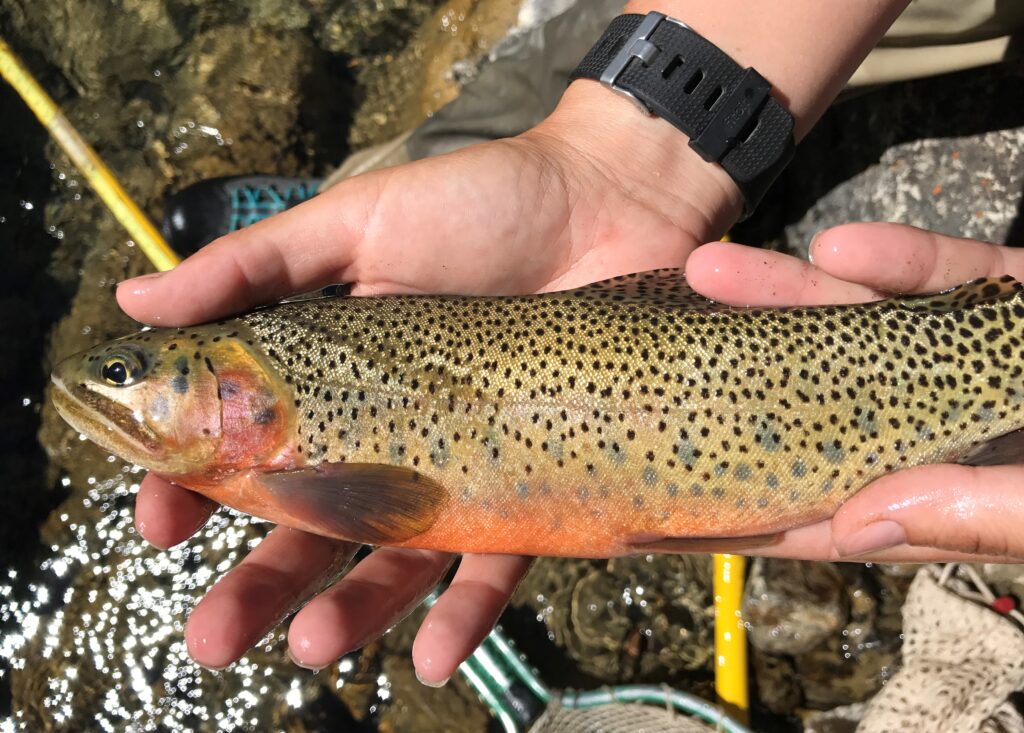
Westslope cutthroat trout are the native trout of the northern Rockies, occupying more separate ocean drainages than any other cutthroat lineage and carrying the best-measured thermal physiology in the group. They are also the subspecies where the collision with introduced rainbow trout has been documented most precisely.
Range
The U.S. Fish and Wildlife Service describes a distribution unique among cutthroat: westslope cutthroat exist “historically and today, in all three oceanic drainages — Pacific, Atlantic, and Arctic”, spanning both sides of the Continental Divide from Yellowstone National Park north into British Columbia and Alberta. In practice that means the upper Columbia system (the Clark Fork, Flathead, Kootenai, Coeur d’Alene, St. Joe and Salmon drainages) on the Pacific side, and the upper Missouri headwaters above Great Falls on the Atlantic side — a genuine oddity, since the Missouri drains to the Gulf of Mexico.
Beyond that core, the range is patchy. Washington holds westslope cutthroat both east and west of the Cascades, and WDFW lists them across Chelan, Okanogan, Pend Oreille, Spokane, Stevens and Yakima counties among others. In Oregon the subspecies is confined to the John Day Basin, where ODFW describes fish holding in cooler tributary water and dropping into mainstem rivers as fall approaches. Idaho carries them as a native, regularly occurring game fish statewide within their range.
Identification
The westslope spotting pattern is the most useful field character in the group. WDFW describes spots that are “primarily above the lateral line,” increasing in density toward the tail and fins, over olive to bronze backs and greenish-gold sides with red on the gill covers. The forward flanks below the lateral line are close to clean. That is the opposite of the Snake River fine-spotted form and unlike the evenly distributed spotting of Lahontan or Yellowstone fish. The red jaw slashes and the small basibranchial teeth on the tongue confirm the identification as cutthroat rather than rainbow, but hybrids commonly show intermediate spotting and a partial slash, and visual identification of hybrids is unreliable.
Conservation Status
Westslope cutthroat are not listed under the Endangered Species Act, but no state treats them as secure. Montana Fish, Wildlife and Parks designates them a Species of Concern with a state rank of S2 — at risk — and notes they are federally monitored but not listed. Idaho Department of Fish and Game assigns a state rank of S4 and a global rank of G5T4, meaning the parent species is secure but the westslope lineage carries elevated concern. Washington designates them a Species of Greatest Conservation Need under its State Wildlife Action Plan and a priority species under the Priority Habitats and Species program.
Hybridization
WDFW states the primary cause of decline without hedging: “The primary source of decline for westslope cutthroat has been hybridization with rainbow trout.” Rainbow trout were stocked across the northern Rockies for the better part of a century, the two interbreed readily, and the hybrids are fertile, so introgression compounds across generations rather than stopping at a first cross. A population can remain abundant while ceasing to be genetically westslope.
The most important study on how this spreads was done in this subspecies’ core range. Muhlfeld and colleagues (2014), Nature Climate Change 4:620-624, examined the Flathead River system in western Montana and found that despite long-running rainbow trout releases, hybridization stayed confined to a single source population for decades. Then, over a 30-year warming period, it spread rapidly through the watershed. The drivers were interacting: decreasing spring precipitation combined with rising summer stream temperatures promoted upstream expansion of hybridization from the source. The authors framed the endpoint as genomic extinction — a lineage lost not by the fish dying but by its genes being diluted out.
WDFW’s climate assessment describes the same mechanism prospectively, warning that warming may let rainbow trout invade the cold headwater streams where genetically pure westslope cutthroat currently persist, while also noting that in the Flathead work demographic factors proved more important than environmental ones in setting local hybridization levels. Montana’s statewide plan lists the management tools actually in use: suppression and eradication of nonnatives, barriers to prevent invasion, and selective stocking practices.
Water Temperature
The definitive comparison of cutthroat and rainbow thermal tolerance was run on this subspecies. Bear, McMahon and Zale (2007), Transactions of the American Fisheries Society 136(4):1113-1121, measured an ultimate upper incipient lethal temperature of 19.6 C (67.3 F) for westslope cutthroat trout against 24.3 C (73.7 F) for rainbow trout — a gap of 4.7 C, or 8.5 F. Above 20 C, rainbow trout demonstrated superior survival.
Growth told a different story. Between 8 and 20 C the two species grew at comparable rates with similar optima around 13-14 C; the rainbow advantage appeared only in the ability to keep growing at higher temperatures. The management recommendation the authors drew is the practical takeaway: holding maximum daily temperatures near the optimum growth temperature of 13-15 C (55-59 F) would ensure suitable thermal habitat for westslope cutthroat populations.
That is a narrow target. A river holding 55 F in August is in good condition for this fish. One touching 67 F is at the sustained-exposure lethal threshold, and one running near 70 F is a river where the competing species has a straightforward physiological edge. WDFW’s climate vulnerability assessment rates westslope cutthroat as moderately sensitive with low to moderate exposure, flagging both snowmelt timing — which governs spring spawning — and suboptimal warm temperatures during late-summer and fall base flows.
Life History and Spawning
Westslope cutthroat express three main strategies: resident fish that spend their lives in one stream, fluvial fish that rear in tributaries and mature in a larger river, and adfluvial fish that live in a lake and ascend tributaries to spawn. Unusually for an interior lineage, WDFW notes that some Washington populations display an anadromous, coastal-roaming life history, and observes that fish with that pattern may be less sensitive to altered freshwater flow and thermal regimes simply because they spend less cumulative time in fresh water.
Spawning is a spring event. USFWS describes it occurring at around 50 F, with females excavating redds in gravel and eggs incubating for weeks to months depending on water temperature. Because spawning is keyed to the rising limb of snowmelt, shifts in the timing and magnitude of snowmelt are a specific vulnerability identified in Washington’s assessment. Diet is dominated by aquatic invertebrates, with terrestrial insects taken opportunistically; westslope cutthroat remain largely insectivorous rather than becoming piscivorous at size, which is one reason they rarely reach the weights of the Lahontan or lake-dwelling forms.
Size
USFWS gives a typical length of 6 to 16 inches. WDFW narrows that for Washington to 8 to 12 inches, reaching 16 inches and better in quality populations. The Washington state record is 4.71 pounds, from Abernathy Lake in 2006. Headwater populations isolated above barriers are frequently smaller still, maturing under 8 inches — a consequence of short growing seasons and low productivity rather than poor condition.
Taxonomy
Westslope cutthroat sit at the center of the current naming dispute. The American Fisheries Society’s 8th edition names list (2023) treats the westslope lineage at full species rank as Oncorhynchus lewisi. That arrangement could not be verified against a publicly accessible copy of the list for this article and is reported here as unverified. What is verifiable is that the agencies have not followed: ITIS lists Oncorhynchus clarkii lewisi (Girard, 1856) as the valid name, an ITIS search returns no species-rank entry for Oncorhynchus lewisi, and USFWS, USGS, Montana FWP, IDFG and WDFW all use the trinomial. Readers encountering O. lewisi in recent literature and O. c. lewisi in a state management plan are looking at the same fish under two live conventions.
Where to catch it
27 waterways on GuidedFloats list westslope cutthroat trout, across 4 states. Each page carries live gauge readings, access notes, and the guides who fish it.
Idaho 11
- Clearwater River3,180 cfs
- Coeur d'Alene River273 cfs
- Kootenai River4,410 cfs
- Lake Pend Oreille
- Lochsa River359 cfs
- Priest River1,340 cfs
- Salmon River1,120 cfs
- Selway River517 cfs
- St. Joe River341 cfs
- Valley Creek91 cfs
- Warm Springs Creek29 cfs
Montana 13
- Big Spring Creek152 cfs
- Bitterroot River840 cfs
- Blackfoot River600 cfs
- Clark Fork1,470 cfs
- Flathead Lake
- Hebgen Lake
- Hungry Horse Reservoir
- Jefferson River1,070 cfs
- Lake Como
- Madison River below Hebgen Lake707 cfs
- Rock Creek270 cfs
- Ruby River53 cfs
- Warm Springs Creek58 cfs
Oregon 1
- Grande Ronde River591 cfs
Washington 2
- Methow River317 cfs
- Yakima River718 cfs
References
- Westslope Cutthroat Trout (Oncorhynchus clarkii lewisi) — U.S. Fish and Wildlife Service
- Westslope Cutthroat Trout — Washington Department of Fish and Wildlife
- Westslope Cutthroat Trout — Idaho Species Catalog — Idaho Department of Fish and Game
- Statewide Fisheries Management Plan 2023-2026, Part I — Montana Fish, Wildlife and Parks
- Comparative Thermal Requirements of Westslope Cutthroat Trout and Rainbow Trout — Transactions of the American Fisheries Society 136(4):1113-1121 (Bear, McMahon & Zale 2007)
- Invasive hybridization in a threatened species is accelerated by climate change — Nature Climate Change 4:620-624 (Muhlfeld et al. 2014)
- Oncorhynchus clarkii lewisi — Taxonomic Serial No. 553415 — Integrated Taxonomic Information System (ITIS)
- ITIS search results for Oncorhynchus lewisi — Integrated Taxonomic Information System (ITIS)
- Oncorhynchus clarkii lewisi Species Profile — U.S. Geological Survey, Nonindigenous Aquatic Species Database
- Cutthroat Trout in Oregon — Oregon Department of Fish and Wildlife (MyODFW)
- Hybridization Research — U.S. Geological Survey, Northern Rocky Mountain Science Center
- IGFA World Records — International Game Fish Association