Alligator Gar
Atractosteus spatula
North America's largest exclusively freshwater fish, subjected to deliberate eradication for much of the twentieth century and now the object of multi-state restoration stocking.
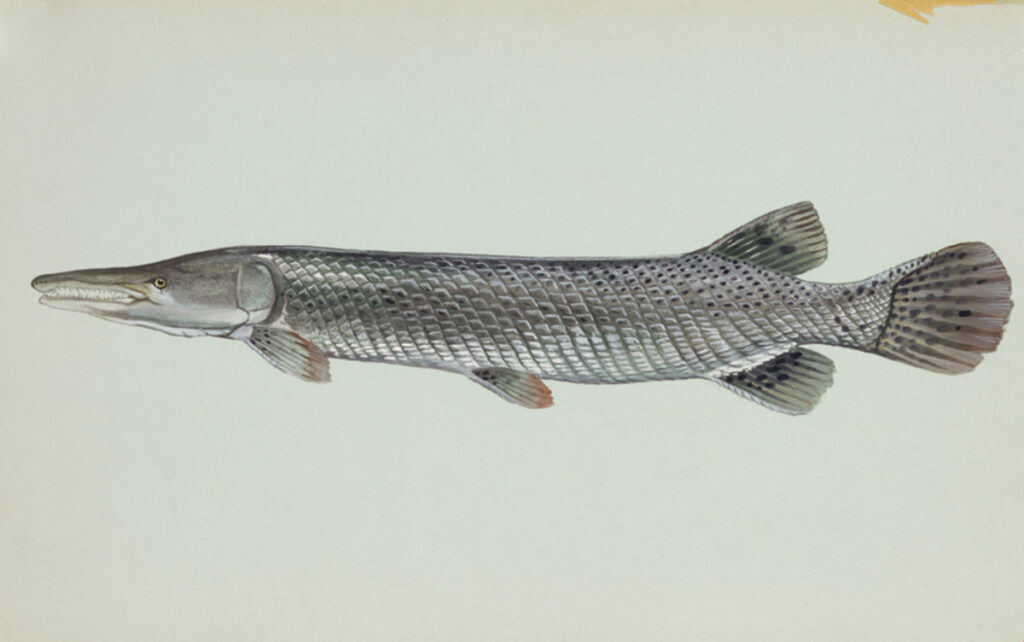
The largest freshwater fish on the continent
Alligator gar are the largest fish in North America that lives its entire life in fresh water. The Missouri Department of Conservation gives adult length as reaching 10 feet and 300 pounds, calling it “one of the largest freshwater fishes in North America.” Kentucky’s Department of Fish and Wildlife Resources describes it as “the largest of the living gars and one of the largest freshwater fishes in North America,” with fish commonly exceeding 9 feet and over 300 pounds, and the largest Kentucky specimen recorded at 9 feet 8 inches and roughly 302 pounds. The U.S. Fish and Wildlife Service gives a typical length of 79 inches, a maximum of 10 feet, and weights up to 350 pounds.
Sturgeon and paddlefish get larger, but both are anadromous or partly so across parts of their ranges. The alligator gar does all of it — hatching, growth, spawning, sixty-plus years of life — in rivers, oxbows and floodplain lakes. Tennessee’s Wildlife Resources Agency notes that individuals often exceed 60 years of age.
The range it used to have
The historical distribution is well documented. The U.S. Geological Survey’s Nonindigenous Aquatic Species database records the native range as the “Mississippi River basin from southwestern Ohio and southern Illinois south to Gulf of Mexico; Gulf Coastal Plain from Econfina River, Florida, to Veracruz, Mexico.” Missouri records the species from the Mississippi “at least as far upstream as the mouth of the Illinois River and in major tributaries.” Kentucky’s historical populations occupied “the Ohio, Mississippi, and lower Cumberland and Tennessee River systems.” Tennessee lists former occupancy of the Mississippi and its West Tennessee tributaries — the Hatchie, Loosahatchie, Obion, Forked Deer and Wolf Rivers — plus Reelfoot Lake.
The range it has now is considerably smaller. MDC states that alligator gar have been eliminated from “central Kansas, Nebraska, Ohio, Iowa, and Illinois.” Kentucky documents just five confirmed historical sightings between 1925 and 1976, with the last verified specimen found dead in Kentucky Lake in 1977 and no further sightings despite ongoing surveys. Tennessee’s assessment is blunt: “the current status of Alligator Gar across West Tennessee is unknown.”
How the fish was removed: the eradication era
This is the part of the story that is usually skipped, and it should not be. Alligator gar did not simply decline. Across much of the twentieth century, state and federal fisheries management classified gars as detrimental “rough” or “trash” fish and set out to reduce them, on the reasoning that they competed with or preyed on the sport and food fish the agencies were paid to produce.
Missouri’s Department of Conservation names the causes of extirpation directly. Alongside habitat destruction and unrestricted harvest, MDC lists “indiscriminate culling” — that is, deliberate killing of the fish as a management objective — as a driver of its elimination from five states. The scientific reappraisal of that entire management posture came in 1992, when Dennis Scarnecchia published “A Reappraisal of Gars and Bowfins in Fishery Management” in Fisheries, the American Fisheries Society’s professional journal — an explicit argument that the profession had got these species wrong.
The diet data agencies now publish makes the original premise look thin. TWRA states that alligator gar feed primarily on buffalo, carp and shad, and “rarely consume sportfish.” The fish was removed in large part to protect species it was not eating.
Killing was not the only mechanism, and probably not the decisive one. MDC identifies the structural problem: “levees and dams prevent gar from moving between the river and critical floodplain spawning habitat.” A species that spawns only on inundated floodplain cannot reproduce in a leveed river, whatever the harvest pressure. Direct removal and floodplain disconnection worked on the same population from two directions, and a fish that takes years to mature and lives for decades can be losing an entire generation without anyone noticing for a long time.
Restoration: the same agencies, reversed
Within a single human lifetime the management posture inverted completely. The alligator gar is now the object of coordinated multi-state restoration.
Kentucky is the clearest documented case. Beginning in 2009 the Kentucky Department of Fish and Wildlife Resources partnered with the U.S. Fish and Wildlife Service on a long-term restoration programme. The state receives alligator gar fry annually from the Private John Allen National Fish Hatchery, rears them at Kentucky facilities, and releases them into historic range across eight counties — McCracken, Ballard, Livingston, Crittenden, Union, Carlisle, Fulton and Hickman. The same fish is listed as endangered by the Kentucky State Nature Preserves Commission.
The federal hatchery at the centre of that effort states its own mission as “Alligator Gar Restoration in Lower Mississippi Valley,” noting that although the species is not federally listed, “in some areas their populations have substantially decreased over the past 50 years,” prompting states within the historic range to implement protections.
Missouri runs its own programme: MDC states it “has been restocking this dwindling species in areas near the Mississippi River for several years,” and the fish is a Missouri species of conservation concern, ranked critically imperiled and protected from harvest. In Illinois — one of the states MDC lists as having lost the species entirely — the Department of Natural Resources runs an Alligator Gar Reintroduction programme listed among its fisheries programmes alongside sturgeon recovery. Tennessee takes a different approach appropriate to a state that does not know what it has: TWRA protects the species and asks anglers to report incidental catches with location, date and length, in order to establish a baseline.
Taken together, that is four states in the northern range — Illinois, Missouri, Tennessee and Kentucky — running restoration or status-assessment programmes for a fish their predecessor agencies helped remove.
Spawning is a flood event, not a date
Alligator gar reproduction depends on a coincidence of conditions that engineered rivers rarely deliver. Published habitat modelling by Meitzen and colleagues, drawing on the work of Buckmeier and others, sets out the requirements: spawning occurs during floods and high flow pulses in “the warmer months of April–July” at water temperatures of 20–31°C (68–88°F), over hydrologically connected floodplain inundated to depths of 0.2–2 metres in grassy, herbaceous or shrubby vegetation in low-velocity areas, and — critically — the flood must last more than five days, “to allow for egg hatching, larval development, and swimming access.”
The timing inside that envelope is tight. Eggs incubate over two to three days, and within about five days the young have consumed their yolk sac and are free-swimming. USFWS gives hatching at 48 to 72 hours. If the floodwater drops before that clock runs out, the entire year class strands and dies. Missouri observes spawning in its region “during the first half of May.”
This is why levees matter more than any harvest question. Water temperature is necessary but nowhere near sufficient: a warm river with no accessible floodplain produces no alligator gar at all, indefinitely.
Breathing air
Alligator gar carry the same equipment as their smaller relatives. MDC describes the swim bladder as “connected to the throat and richly supplied with blood vessels — thus, the swim bladder functions much like a lung.” Ohio DNR describes gars generally as having “a specialized air bladder that gives them the ability to breathe air” while keeping fully functional gills.
The controlled experiments were done on smaller gars, and the findings transfer. In longnose gar, air-breathing frequency rises as water oxygen falls, governed by two distinct chemoreceptor systems — internal receptors setting hypoxic drive and external receptors inhibiting gill ventilation. In spotted gar, air breathing allowed fish to exercise identically in normoxic water and in water below 2.7 kPa oxygen partial pressure — roughly an eighth of air saturation, a level lethal to most fish.
The practical consequence for a river in August is that alligator gar occupy water no other large predator can use: warm, stagnant, oxygen-poor backwaters and oxbows. They are not tolerating those conditions. They are exploiting them.
Ganoid scales
The armour is heavier than on any other North American gar. USFWS describes the scales as “ganoid scales (bone-like, diamond-shaped)”; MDC characterises the family’s scales as hard, diamond-shaped and non-overlapping, a feature of a lineage dating to the Late Jurassic. On a mature alligator gar the plates form a rigid interlocking mail that historically served as arrowheads, plough points and leather. It is also why an adult of this size has effectively no natural predators, and why the fish’s decline can be attributed almost entirely to human decisions.
The eggs are toxic — state it plainly
The Missouri Department of Conservation states it without qualification for the alligator gar specifically: “the eggs (roe) of gar are highly toxic to warm-blooded animals, including humans.” Ohio DNR confirms the same for gars generally, noting the eggs are “poisonous” and unsuitable for human consumption.
Alligator gar roe must never be eaten, and must not be fed to dogs or other animals. Cooking does not make it safe. This deserves emphasis for one specific reason: bowfin roe is now sold commercially as caviar, and the two fish share range, habitat, size class and a general reputation as “primitive” fishes. Confusing them at the cleaning table has consequences that confusing most fish does not.
A case study in reversal
The alligator gar is unusual among conservation stories because the reversal was so complete and so fast. The same institutional apparatus that classified this fish as vermin now operates federal hatcheries to produce it, rears its fry in state facilities, releases it into eight Kentucky counties, protects it from harvest in Missouri and Tennessee, and asks anglers to report every one they see. Nothing about the fish changed. What changed was the understanding of what a river predator does, and what a floodplain is for.
Where to catch it
44 waterways on GuidedFloats list alligator gar, across 5 states. Each page carries live gauge readings, access notes, and the guides who fish it.
Alabama 3
- Bayou Sara
- Mobile River12,400 cfs
- Tensaw River8,260 cfs
Arkansas 1
Louisiana 15
- Alligator Bayou
- Bayou Bartholomew5 cfs
- Bayou Bonne Idee
- Bayou Darby
- Bayou Fusilier
- Bayou Grosse Tete
- Bayou Lacassine
- Bayou Milhomme
- Bayou Perot
- Bayou Queue de Tortue
- Big Colewa Bayou
- Cross Bayou
- Shettleworth Bayou
- Vermilion Bay
- Youngs Bayou
Mississippi 2
- Pearl River885 cfs
- Tombigbee River236 cfs
Texas 23
- Austin Bayou
- Bairds Bayou
- Bastrop Bayou
- Big Cypress Bayou20 cfs
- Brazos River469 cfs
- Buffalo Bayou182 cfs
- Cedar Bayou2 cfs
- Chocolate Bayou14 cfs
- Dickinson Bayou
- Greens Bayou
- Highland Bayou
- Lake Charlotte
- Linnville Bayou
- Luce Bayou3 cfs
- Mustang Bayou
- Neches River172 cfs
- Pine Island Bayou2 cfs
- Sabine River405 cfs
- Trinity River1,460 cfs
- Turtle Bayou
- West Fork Double Bayou184 cfs
- West Fork San Jacinto River
- Whiteoak Bayou16 cfs
References
- Alligator Gar — Field Guide — Missouri Department of Conservation
- Alligator Gar — Kentucky Department of Fish and Wildlife Resources
- Alligator Gar — Tennessee Wildlife Resources Agency
- Alligator Gar (Atractosteus spatula) — Species Profile — U.S. Fish and Wildlife Service
- Private John Allen National Fish Hatchery — Alligator Gar Restoration in the Lower Mississippi Valley — U.S. Fish and Wildlife Service
- Atractosteus spatula — Nonindigenous Aquatic Species fact sheet (native range) — U.S. Geological Survey
- Applying Floodplain Inundation Modeling to Estimate Suitable Spawning Habitat and Recruitment Success for Alligator Gar — Meitzen KM, Robertson CR, Jensen JL, Daugherty DJ, Hardy TB, Mayes KB — Hydrology, 2023
- Critical thermal minima of alligator gar (Atractosteus spatula) during early life stages — Bartnicki J, Snow RA, Taylor AT, Butler CJ — Journal of Applied Ichthyology, 2021
- A Reappraisal of Gars and Bowfins in Fishery Management — Scarnecchia DL — Fisheries (American Fisheries Society), 1992
- Chemoreflexive responses to hypoxia and NaCN in longnose gar: evidence for two chemoreceptor loci — Smatresk NJ, Burleson ML, Azizi SQ — American Journal of Physiology, 1986
- Ventilation and acid-base recovery following exhausting activity in an air-breathing fish — Burleson M, Shipman B, Smatresk N — Journal of Experimental Biology, 1998
- Longnose Gar (gar air bladder and egg toxicity) — Ohio Department of Natural Resources
- iFish Illinois — fisheries programmes including Alligator Gar Reintroduction — Illinois Department of Natural Resources
- IGFA World Records — International Game Fish Association