Atlantic Salmon
Salmo salar
The wild sea-run Atlantic salmon of Maine is federally endangered: fewer than 1,200 adults have returned to all Gulf of Maine rivers in an average year since 2015, most of them hatchery-reared.
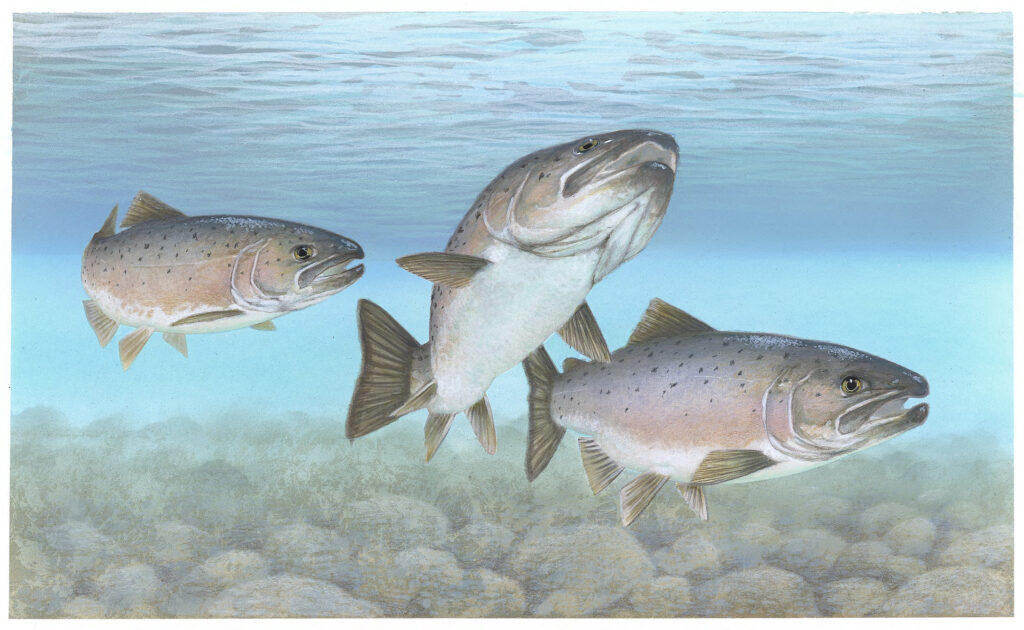
The last wild Atlantic salmon in the United States
Atlantic salmon once ran into nearly every large river on the northeastern seaboard. The U.S. Fish and Wildlife Service describes a historical range reaching from northern Quebec and Newfoundland south to Long Island, New York, with salmon present in almost every river north from the Hudson. The Maine Department of Marine Resources puts the scale of the Penobscot run before the Civil War at roughly 100,000 returning adults in a single year, and records that by 1865 there were no Atlantic salmon left in southern New England at all.
What is left can be counted by hand. NOAA Fisheries reports that since 2015, annual returns to all Gulf of Maine rivers combined have averaged fewer than 1,200 fish — against a modern high of nearly 5,000 reached in 1985, after which marine survival deteriorated sharply. The 2009 federal listing rule recorded 1,014 adult returns in 2007, of which 925 (91 percent) came back to the Penobscot, and of those Penobscot fish 802 were hatchery-origin and only 123 naturally reared. The naturally spawned, wild-origin component of the U.S. population is in the low hundreds.
Endangered status and who manages the fish
The Gulf of Maine Distinct Population Segment (DPS) of Atlantic salmon was listed as endangered under the Endangered Species Act in 2000. In 2009 NOAA Fisheries and the U.S. Fish and Wildlife Service jointly expanded the listed range to take in the Penobscot, Kennebec and Androscoggin rivers, and NOAA designated critical habitat the same day. Atlantic salmon is one of the few species with genuinely split federal jurisdiction: NOAA Fisheries has authority in the marine and estuarine environment, the Fish and Wildlife Service in fresh water, and the two agencies share the listing. Maine DMR’s Bureau of Sea-Run Fisheries and Habitat and the Penobscot Nation are co-managers on the ground.
The 2009 critical habitat rule is worth reading for its sheer geography. It designated about 19,571 km of perennial river, stream and estuary habitat and 799 square km of lake habitat across 45 occupied areas, organised into three Salmon Habitat Recovery Units: Penobscot, Merrymeeting Bay, and Downeast Coastal. The delisting criteria attached to those units are modest in absolute terms and still far out of reach — each SHRU needs at least 500 adult spawners, with habitat capacity to support 2,000, and a decade of positive population growth.
Federal and state agencies manage this DPS as an endangered species rather than as a sport fish. GuidedFloats does not restate agency rules; NOAA Fisheries, the U.S. Fish and Wildlife Service and Maine DMR are the authorities on what protected status means in practice on any given water.
Where wild salmon still spawn
NOAA lists the rivers holding remaining populations as the Sheepscot, Penobscot, Ducktrap, Narraguagus, Pleasant, Machias, East Machias and Dennys. Maine DMR’s own list adds the Sandy River in the Kennebec drainage and the Union. These are small coastal and inland Maine rivers, most of them Downeast — the Machias, East Machias, Narraguagus, Pleasant and Dennys are modest systems by any national standard, and the Penobscot is doing most of the demographic work for the entire DPS.
Genetically, this matters more than the raw numbers suggest. Maine’s salmon are not interchangeable with Canadian or European stock, and the loss of individual river populations is a loss of distinct lineages. The 2009 listing rule identified loss of genetic diversity in very small populations as a threat in its own right, separate from the habitat and marine-survival problems.
Life cycle: two years in gravel, two years at sea
Atlantic salmon are anadromous, and the U.S. life cycle runs long on the freshwater end. Eggs are buried in gravel nests called redds through the winter. Alevins hatch and live on a yolk sac before emerging; fry take up feeding stations in the current; parr — recognisable by dark oval “parr marks” along the flank — hold in the river for two to four years.
Smoltification then converts a stream fish into a sea fish: the parr marks are replaced by silver, the body slims, and gill physiology reorganises to handle salt water. Smolts run downstream in Maine from mid-April through early June. From the estuary they move fast to feeding grounds off Labrador and Greenland, where they spend one to three years.
Most U.S. fish return as two-sea-winter (2SW) adults — roughly four years old, two in the river and two in the ocean. NOAA describes adult returns to Maine as occurring mostly in spring and summer, with a few fall migrants. Unlike Pacific salmon, Salmo salar is iteroparous: a post-spawn adult, called a kelt, can drop back to sea and return to spawn again. Maine DMR notes plainly that repeat spawners are now very rare in Maine — a demographic signal of how thin the margin has become.
Size
NOAA Fisheries gives returning U.S. adults as 8 to 12 pounds and up to 30 inches, with individuals reaching 30 pounds, and a lifespan of four to six years. Two-sea-winter fish, the commonest returning class, run about 28 to 30 inches. One-sea-winter fish — grilse — come back substantially smaller, because they have spent a single winter feeding at sea rather than two.
The very large Atlantic salmon of angling literature — 40-pound-plus fish from Norway, Russia and eastern Canada — reflect river systems with long-lived multi-sea-winter components that the Maine populations no longer produce in any number.
Telling one apart
Salmo salar is a true salmon of the Atlantic basin and sits in the same genus as brown trout, not with the Pacific Oncorhynchus species. A sea-fresh adult is deep-bodied and bright silver with a small, distinctly forked tail, a slim caudal peduncle that a hand can nearly encircle, and sparse black spots that are mostly confined to above the lateral line, often shaped like X’s or crosses. There are no spots on the tail, which separates the species at a glance from a brown trout of similar size and from Pacific salmon.
Colour changes with time in fresh water. Fish that have held in a river for weeks lose the chrome and take on bronze and olive tones, and males develop a hooked lower jaw called a kype. Kelts — fish that have already spawned — are dark, thin and slack-bellied, and are sometimes called black salmon. Parr, the stage most likely to be seen in a Maine river, carry a row of dark oval marks along the flank, often with small red spots between them, and are easily confused with young brown trout.
Spawning
Spawning is a late-autumn event keyed to falling water temperature. Maine DMR describes females cutting redds as water drops below about 50°F (10°C), which in Maine rivers puts the main spawning period in late October and November. The female excavates a depression in clean gravel with her tail, deposits eggs that the male fertilises, then covers them with displaced gravel. Eggs incubate in the substrate through the winter, which makes redd sites acutely sensitive to sedimentation, scouring flows and midwinter ice dynamics.
Water temperature
Atlantic salmon are a cold-water fish, and summer heat is one of the clearest constraints on where juveniles can survive in Maine’s rivers. A USGS study of summer temperature variation in the Connecticut River found that accumulating days at or above 23°C (73°F) was significantly associated with reduced age-0 parr density — the authors were careful to note that single thresholds oversimplify, because cycling temperatures, multiple stressors and access to thermal refuges all modify the outcome.
Radio-telemetry work by USGS on Maine’s Rapid River recorded summer water above 25°C (77°F), described as near the reported lethal limits for these cold-water species, with salmon and brook trout both relocating to presumed thermal refugia from early July into mid-September. Warmwater smallmouth bass in the same reach did not move.
That refuge behaviour is now an active research target. USGS and the National Park Service are using airborne thermal infrared imaging on the East Branch of the Penobscot, Wassataquoik Stream and the Seboeis River to map groundwater-fed cold patches, which they describe as thermally stable, oxygen-rich habitat critical to reducing summer thermal stress. On a river page, a live gauge reading in the low 70s °F is not a curiosity — it is the temperature at which juvenile salmon habitat starts contracting toward a handful of seeps and tributary mouths.
Why the population collapsed, and what is being done
NOAA’s recovery framing identifies four intertwined problems. Dams and stream crossings come first: more than 90 percent of Maine’s rivers and streams are affected by dams, and of the 400-plus dams in salmon habitat only about 75 have fishways. A dam does not need to be large to remove a watershed from production; it needs only to be impassable.
Marine survival is the second, and the hardest to influence from Maine. Returns collapsed after the late 1980s as conditions on the Labrador and Greenland feeding grounds changed, and the fraction of smolts surviving to adulthood fell far below what the freshwater habitat could otherwise support. Foreign fisheries, particularly at Greenland, intercept U.S.-origin fish. Climate change compounds everything else by warming rivers and shrinking the cold-water refuges juveniles depend on.
The federal response is set out in the 2019 recovery plan, which replaced a 2005 plan and states its goal as delisting — conditions under which self-sustaining populations persist with minimal ongoing intervention. Its priorities are habitat connectivity, increased smolt production, and better understanding of marine survival. NOAA has also carried Atlantic salmon in its Species in the Spotlight initiative, reserved for species considered most at risk of extinction in the near term.
Maine DMR runs a conservation hatchery programme, supported by the federal Craig Brook and Green Lake National Fish Hatcheries, and works on dam and culvert passage. The Penobscot River Restoration Project — removal of the Great Works and Veazie dams and construction of a bypass at Howland — is the largest single connectivity gain to date, and the Penobscot’s dominance in the return numbers reflects both that investment and the hatchery output feeding it.
The hatchery dependence is itself contested ground. Conservation hatcheries have almost certainly prevented extirpation in several rivers, and the 2009 listing rule explicitly folded the Green Lake and Craig Brook hatchery populations into the listed DPS. But a run in which four out of five returning adults began life in a tank is not a self-sustaining population, and the recovery criteria are written around naturally spawning fish for that reason. The honest summary is that the hatchery programme is buying time for habitat work and marine conditions to catch up, and that nobody involved treats it as an end state.
The marine phase remains the largest unknown. Smolts leaving the Penobscot in May are in the Labrador Sea within months, feeding alongside salmon from Canadian, Icelandic, Irish, Scottish and Norwegian rivers, and mortality there is not something Maine can manage directly. International agreements limiting the Greenland fishery have reduced one source of loss, but the underlying decline in survival at sea since the late 1980s tracks broad changes in North Atlantic productivity that no dam removal in Maine can offset. This is why NOAA’s recovery plan pairs habitat and smolt-production goals with an explicit research objective on marine survival — the freshwater work raises the number of smolts leaving, but the fraction of those smolts that come back is set somewhere off Greenland.
Records
IGFA recognises an all-tackle world record for Atlantic salmon, long held by a European fish. GuidedFloats could not independently verify the current standing record against IGFA’s own database at the time of writing; IGFA’s records are searchable at igfa.org/world-records, and that page should be treated as the authority rather than any secondary listing. No record claim from the Gulf of Maine DPS would be meaningful in any case: these are protected fish, and the relevant numbers for U.S. Atlantic salmon are annual return counts, not weights.
How to read a Maine salmon river
For anyone floating Maine’s Downeast rivers, sea-run Atlantic salmon are a fact of the watershed rather than a target. The habitat features that define them — clean gravel riffles for redds, well-oxygenated runs for parr, spring-fed cold pockets for summer — are the same features that support wild brook trout and sea-run brook trout in the same systems, and Maine DMR manages both under the same bureau alongside rainbow smelt, alewife, shad and river herring.
That co-occurrence is the useful frame. Restoring diadromous fish passage on the Penobscot did not only move salmon; it moved alewives and shad in numbers that reshaped the estuary’s forage base. Watching a Maine river warm past the low 70s °F in August, or run clear and cold below a spring seep in the same reach, tells you most of what matters about whether this species has a future in that watershed.
Where to catch it
19 waterways on GuidedFloats list atlantic salmon, across 6 states. Each page carries live gauge readings, access notes, and the guides who fish it.
Connecticut 4
- Farmington River558 cfs
- Naugatuck River243 cfs
- Salmon River (Connecticut)82 cfs
- West Branch Farmington River151 cfs
Maine 7
- Androscoggin River2,160 cfs
- Aroostook River188 cfs
- East Branch Penobscot River444 cfs
- Fish River128 cfs
- Kennebec River1,680 cfs
- Narraguagus River170 cfs
- St. Croix River373 cfs
Massachusetts 2
- Deerfield River257 cfs
- Swift River126 cfs
New Hampshire 2
- Androscoggin River (New Hampshire)1,410 cfs
- Pemigewasset River519 cfs
New York 3
- Ausable River600 cfs
- Salmon River236 cfs
- Saranac River1,300 cfs
Vermont 1
- White River (Vermont)513 cfs
References
- Atlantic Salmon (Protected) — NOAA Fisheries
- Atlantic Salmon (Protected): Overview — NOAA Fisheries
- Species in the Spotlight: Atlantic Salmon — NOAA Fisheries
- Recovery Plan for the Gulf of Maine Distinct Population Segment of Atlantic Salmon (2019) — NOAA Fisheries
- Atlantic Salmon Critical Habitat, Gulf of Maine DPS — NOAA Fisheries
- Atlantic Salmon (Salmo salar) — U.S. Fish and Wildlife Service
- Atlantic Salmon — Maine Department of Marine Resources, Bureau of Sea-Run Fisheries and Habitat
- Rainbow Smelt — Maine Department of Marine Resources
- Endangered and Threatened Species; Determination of Endangered Status for the Gulf of Maine Distinct Population Segment of Atlantic Salmon (final rule, June 19, 2009) — Federal Register — NMFS and U.S. Fish and Wildlife Service
- Designation of Critical Habitat for Atlantic Salmon, Gulf of Maine DPS, 74 FR 29300 — Federal Register — National Marine Fisheries Service
- Summer temperature variation and implications for juvenile Atlantic salmon — U.S. Geological Survey
- Summer movements of sub-adult brook trout, landlocked Atlantic salmon, and smallmouth bass in the Rapid River, Maine — U.S. Geological Survey
- Thermal Imaging to Detect Cold-Water Habitat for Atlantic Salmon and Brook Trout at Katahdin Woods and Waters National Monument — U.S. Geological Survey, New England Water Science Center
- IGFA World Records — International Game Fish Association