American Shad
Alosa sapidissima
An anadromous herring that once ran Atlantic rivers in tens of millions, collapsed under dams and pollution, and now runs strongest in the Pacific rivers it was never native to.
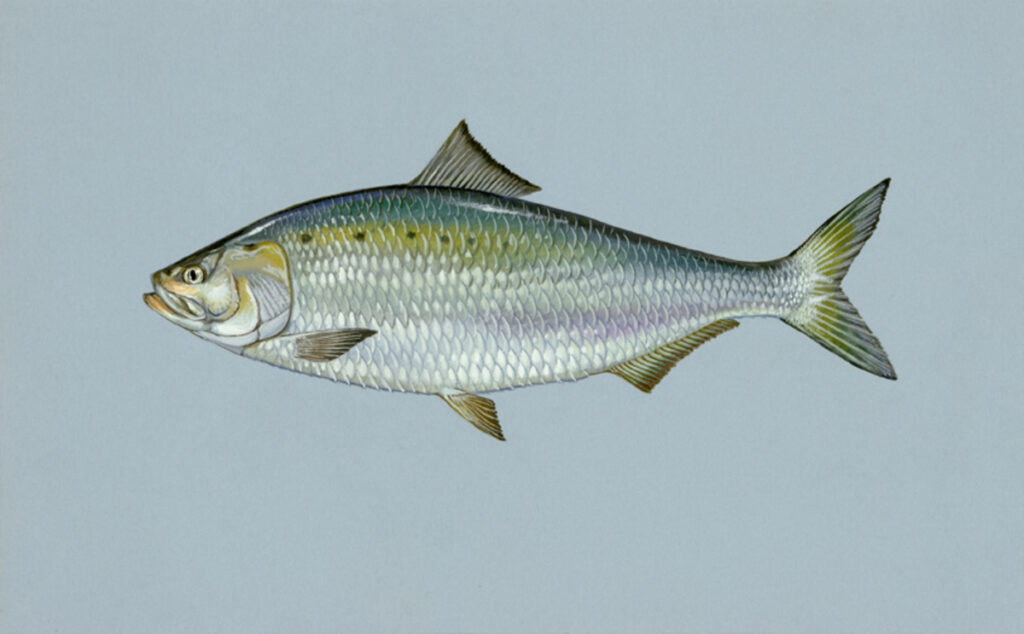
The American shad is the largest of the true herrings and the most consequential anadromous fish in the history of the eastern United States. It is a filter-feeding, ocean-dwelling clupeid that returns to fresh water in spring to spawn, and for two and a half centuries its runs fed colonial towns, drove river fisheries, and shaped where and how Americans settled along tidewater. John McPhee’s The Founding Fish made the case for its place in that history at book length; the biology behind the story is, if anything, stranger than the history.
What it is
A shad is a herring built large. The body is deep, laterally compressed and brilliantly silver, blue-green to metallic along the back, with a row of dark spots behind the gill cover and, running along the belly midline, a saw-like serrated edge of modified scales called scutes — the character that separates the herrings from everything else in a river. Virginia reports fish commonly 13 to 22 inches long and living up to 10 years. Oregon describes them as the largest herring, generally 3 to 5 pounds.
Its sensory equipment is unusual. The U.S. Fish and Wildlife Service notes that American shad have exceptional hearing, with fine sensory hairs in the otoliths, water-filled cranial channels, and a swim bladder extension reaching the braincase, making them acutely sensitive to underwater sound and movement. Shad are among the few fishes known to detect ultrasound, an adaptation generally read as a defence against echolocating predators.
The run, and the temperature that sets it
Shad run on water temperature more tightly than almost any other North American migratory fish, which is why a live river-temperature reading is genuinely predictive for this species and only loosely so for most others. The Fish and Wildlife Service species profile for the mid-Atlantic states that the shad “returns to its natal river to spawn in the spring when temperatures reach 12 °C” — about 54°F — after wintering offshore in water of 37 to 59°F.
Spawning follows a few degrees behind entry. The Fish and Wildlife Service puts peak spawning at 65.3°F, typically from sundown until midnight. A later federal evaluation of shad habitat models found the spawning-suitability range of 57–68°F supported at its lower limit but extending upward to about 76°F, with eggs and larvae most abundant at 59–77°F and larvae not appearing at all until water reached about 55°F. Timing shifts with latitude: adults arrive in Florida rivers as early as November and in northern rivers in May and June.
Thermal limits at the top end are now measured. Juvenile shad acclimated to 77°F have a median critical thermal maximum of 95°F, with a heat-shock protein response beginning around 86°F — a temperature juveniles routinely meet in nursery reaches during late summer, which is one of several reasons warming rivers are treated as a recovery constraint.
Spawning and life history
Shad are broadcast spawners. Virginia describes spawning over sandbars or rocky riffles in about five feet of water, with neutrally buoyant eggs that remain suspended in open water until they hatch. Males arrive first; multiple males and females release eggs and milt together near the surface after dark.
Reproductive strategy splits sharply by latitude, and this is one of the more striking facts about the species. Southern populations are semelparous: the Atlantic States Marine Fisheries Commission records southern females producing up to 700,000 eggs and dying after spawning in rivers south of North Carolina, while northern populations produce fewer eggs — 300,000 or fewer — and survive to return over a decade-long life, spawning repeatedly. Juveniles spend their first year in the natal river, drop to sea, school and feed for several years, and return at about age four.
The feeding question, and why it matters
Shad are filter feeders. At sea they strain small crustaceans from the water column — the mid-Atlantic species profile records copepods and mysids making up 90 percent of the diet, with prey below a certain size passing straight through the gill rakers. Oregon simply calls them plankton eaters.
The standard claim is that adults stop feeding once they enter fresh water, which is the usual explanation for why shad strike small, bright, fast-moving lures — a reflexive or territorial response rather than a feeding one. The primary literature is more equivocal than the claim, and it is worth saying so plainly. The same federal profile reports that “food was scarce in the stomachs of shad migrating upstream to spawn” (Leim 1924) but also that prespawning shad held in a freshwater pond fed readily on artificial feed (Atkinson 1951). More recently, a U.S. Geological Survey study of Columbia River shad found that pre-spawn and partially spawned adults fed primarily on the amphipod Corophium, and post-spawn adults on gastropods above McNary Dam. The accurate statement is that adult shad feed little and inconsistently on the spawning run, not that they do not feed at all.
The collapse
The historical scale of the Atlantic runs is hard to overstate, and the numbers are documented. The Atlantic States Marine Fisheries Commission records peak Atlantic coast catches of 50 million pounds in 1896, falling to about 10 million pounds by the 1950s. By 2022, coastwide commercial landings were 110,027 pounds — roughly two-tenths of one percent of the 1896 figure — following the closure of directed ocean fisheries in 2005.
The causes are not mysterious. Dams cut the fish off from the gravel and riffle reaches they spawn on; the Commission estimates that about 40 percent of historic spawning habitat in the United States and Canada is currently blocked by dams and other barriers. Nineteenth- and twentieth-century industrial and municipal pollution rendered lower rivers uninhabitable during the run. Overfishing, water withdrawals, non-native predators and climate change compound the problem. The 2020 benchmark assessment found the coastwide stock depleted, with river-by-river variation: the Potomac and Hudson determined depleted, Albemarle Sound not.
Restoration and fish passage
Recovery work has concentrated on the barriers. Fish passage — ladders, lifts, trap-and-truck operations, and increasingly outright dam removal — is the central tool, because a shad that cannot reach spawning gravel produces nothing regardless of how well the rest of the river is managed. The Commission’s habitat plans identify dam-related passage as the primary restoration priority. Virginia, for example, operates a dedicated fish passage program with coordinators and biologists working to identify, complete and monitor passage projects that reopen historical habitat.
Progress is real but uneven. Some rivers have responded quickly to barrier removal; others have reopened habitat without producing the expected run, which has pushed research toward passage efficiency, delay at successive dams, and juvenile downstream survival through turbines. The honest summary is that fish passage is necessary and demonstrably insufficient on its own.
The West Coast introduction
The other half of the shad story is that the species is now more abundant on a coast where it does not belong. American shad were transplanted to California’s Sacramento River in 1871; Washington’s Department of Fish and Wildlife records that some of that original population strayed north and homed on the Columbia, where catches were documented by 1880, before formal plantings began in 1885. Oregon dates the western introduction to the same year, 1871, when fish were released in major rivers up and down the Pacific coast.
The result is one of the most successful fish introductions in North American history. Oregon reports shad returning to the Sacramento, Umpqua, Siuslaw, Columbia and Willamette, with millions making the run annually and best fishing from May through mid-July. The Columbia below Bonneville Dam supports the largest of these runs. That abundance is not universally welcomed: Washington notes concern about potential impacts including predation, competition and interference with fish ladder access for native salmon and steelhead, and the state removed more than 1,500 shad from Lake Washington in 2024 to limit further spread.
The angling picture
Shad angling is built on the fish’s reflexive strike and its position in the river. Migrating shad hold in defined travel lanes — the seam between fast water and slack, the deeper slot along an inside bend, the tailout below an obstruction — and they move upstream in pulses tied to flow and temperature. The shad dart, a small weighted jig, works because it can be swung on a tight line across the current at the depth the fish are running, presenting a small, fast, high-contrast target directly in front of a fish that is not looking for food. Oregon describes the effective pattern as small bright-coloured jigs, with or without bucktail or plastic tails, taken by fish facing upstream into the current.
The behaviour follows from the biology. A fish that filter-feeds on copepods at sea has no reason to chase a two-inch lure; what it has is acute hearing, sharp vision, a strong current-holding instinct and, on the spawning run, a very low threshold for striking at something small and bright that intrudes into its lane. That is why colour changes matter more than size, why depth control matters more than retrieve speed, and why the same water can be dead one day and full of fish the next as a temperature-driven pulse moves through.
Where to catch it
46 waterways on GuidedFloats list american shad, across 15 states. Each page carries live gauge readings, access notes, and the guides who fish it.
California 7
- American River1,500 cfs
- Carquinez Strait
- Russian River156 cfs
- South Fork Eel River14 cfs
- Stanislaus River846 cfs
- Suisun Bay
- Yuba River551 cfs
Connecticut 5
- Connecticut River
- Connecticut River Estuary
- Quinnipiac River
- Salmon River (Connecticut)86 cfs
- Thames River
Delaware 3
- Brandywine Creek276 cfs
- St Jones River46 cfs
- White Clay Creek54 cfs
Florida 1
- St. Johns River3,590 cfs
Georgia 2
- Altamaha River3,760 cfs
- Ocmulgee River1,500 cfs
Maine 2
- Penobscot River3,490 cfs
- Saco River
Massachusetts 3
- Connecticut River7,210 cfs
- Merrimack River2,870 cfs
- Westfield River574 cfs
New Hampshire 1
- Winnicut River41 cfs
New Jersey 4
- Delaware River5,490 cfs
- Maurice River
- Musconetcong River154 cfs
- Raritan River359 cfs
North Carolina 2
- Pee Dee River8,530 cfs
- Roanoke River1,510 cfs
Oregon 3
- Columbia River74,000 cfs
- Siuslaw River Estuary
- Umpqua River1,000 cfs
Pennsylvania 3
- Lackawaxen River199 cfs
- Lehigh River1,250 cfs
- Lehigh River below Francis E. Walter Dam700 cfs
Rhode Island 1
- Pawcatuck River602 cfs
South Carolina 6
- Ashley River
- Broad River1,890 cfs
- Little Back River
- South Santee River
- Wando River
- Wateree River Tailrace5,250 cfs
Virginia 3
- Mattaponi River232 cfs
- Pamunkey River229 cfs
- Rappahannock River790 cfs
References
- American Shad — species page — Atlantic States Marine Fisheries Commission
- American Shad (Alosa sapidissima) — U.S. Fish and Wildlife Service
- Species Profiles: Life Histories and Environmental Requirements of Coastal Fishes and Invertebrates (Mid-Atlantic) — American Shad, Biological Report 82(11.37) — U.S. Fish and Wildlife Service / U.S. Army Corps of Engineers (1985)
- Evaluation of Habitat Suitability Index Models for Riverine Life Stages of American Shad, Biological Report 14 — U.S. Fish and Wildlife Service / U.S. Department of the Interior (1993)
- Upper Thermal Tolerance and Heat Shock Protein Response of Juvenile American Shad (Alosa sapidissima) — Bayse, Shaughnessy, Regish & McCormick — Estuaries and Coasts (2020)
- Diet of juvenile and adult American Shad in the Columbia River — U.S. Geological Survey (2011)
- American shad — Alosa sapidissima — Washington Department of Fish and Wildlife
- American shad — Oregon Department of Fish and Wildlife
- American Shad — Virginia Department of Wildlife Resources
- Gizzard Shad — Field Guide (for comparison with the non-anadromous shads) — Missouri Department of Conservation
- IGFA World Records — International Game Fish Association